
 Worksheets
Exam Review Homework
Total questions: 38
Worksheet time: 19mins
What role does PH play during the Maillard reaction?
It has no effect on browning
The higher the PH, the faster browning occurs
The lower the PH the faster the browning
The higher PH prevents burning
What is the role of salt in food preservation, especially when it comes to pickled vegetables?
It makes the vegetables soggy
It prevents mold
It preserves the crunchiness of vegetables
It preserves the color of the vegetables
What is the role of moisture in the Maillard reaction?
It changes the color
It does nothing
It slows the process down
It adds flavor to the food
Which of the following is NOT an example of food preservation?
Drying
Pickling
Formaldehyde
Freezing
What is the acid in vinegar which helps to prevent growth of bad bacteria called?
Hydrochloric acid
Acetic acid
Malic Acid
Citric acid
What are the good bacteria called as a result of fermentation?
Streptococcus Pneumoniae
Vibrio cholera
Thermus aquaticus
Probiotics
At which temperate does caramelization start?
190ºC
Zero Kelvin
160ºC
160ºF
What happens during the caramelization process when the temperature exceeds 190ºC?
It becomes fairy dust
The caramel turns black and becomes bitter
The sugar evaporates
It becomes more nutritious
Which two nutrients are involved in the Maillard reaction?
Fat and protein
Sugar and fat
Amino acids and sugar
Vitamins and minerals
Which of the following is NOT an example of the Maillard reaction?
Seared steak
Toast
Caramelized onions
Croissant
Jerky is an example of the following preservation method:
Freezing
Irradiation
Fermentation
Drying
What prevents growth of pathogens during FREEZING as a food preservation method?
Salt
Acidity
Subzero temperatures
Antibiotics
Which process was responsible for the browning of the rolls?
Fermentation
Evaporation
Caramelization
Freezing
The moisture content is the highest in:
Row 1
Row 2
Row 3
Row 4
If vinegar was added to the dough, which row would have the most vinegar?
Row 1
Row 2
Row 3
Row 4
Which row has the most baking soda added to it?
Row 1
Row 2
Row 3
Row 4
The reaction responsible for the rich brown color is:
Photosynthesis
Fermentation
Maillard reaction
Hydrolysis
If it was marinated in a sauce containing vinegar, the outcome (look) would be:
the same
different
burnt
uncooked
If the outcome in 2. wouldn’t be the same, why not?
Because the conditions have changed.
Because the process is different.
Because the variables are not controlled.
Because the initial setup is altered.
Which two nutrients were part of this reaction?
Carbohydrates and proteins
Fats and vitamins
Proteins and minerals
Water and fiber
Which of the following are key safety rules for pickling food?
Use sterilized jars, follow tested recipes, and ensure proper sealing.
Use any type of container, add extra spices, and store at room temperature.
Skip boiling water bath, use untested recipes, and reuse old lids.
Store pickles in sunlight, use unwashed produce, and avoid measuring ingredients.
Which of the following are examples of food that get their browning from the Maillard reaction?
Bread crust, roasted coffee, seared steak, toasted marshmallows
Boiled potatoes, raw apples, steamed rice, fresh lettuce
Frozen peas, raw carrots, boiled eggs, fresh tomatoes
Pickled cucumbers, raw onions, fresh grapes, steamed broccoli
It is advisable to pat a steak dry with a paper towel before searing it because:
It helps the steak cook faster.
It prevents the steak from sticking to the pan.
It allows for better browning and crust formation.
It makes the steak more tender.
What is a safe and effective way to clean wooden chopping boards without using harsh chemicals?
Using hot soapy water and scrubbing with a brush
Wiping with bleach solution
Cleaning with strong detergents
Soaking in ammonia
The role of lactic acid in the natural fermentation process when we make pickled cucumbers is:
To provide a sour taste and preserve the cucumbers
To add sweetness to the cucumbers
To make the cucumbers crunchy
To remove all moisture from the cucumbers
Which of the following are examples of food that have undergone the caramelization process?
Bread, onions, crème brûlée, caramel sauce
Rice, lettuce, raw apples, milk
Boiled eggs, steamed broccoli, raw carrots, yogurt
Pasta, cheese, raw fish, orange juice
Which of the following are two major differences between the Maillard reaction and caramelization?
Maillard reaction involves amino acids and reducing sugars, while caramelization involves only sugars; Maillard reaction occurs at lower temperatures than caramelization.
Maillard reaction involves only sugars, while caramelization involves amino acids and sugars; Maillard reaction occurs at higher temperatures than caramelization.
Maillard reaction involves amino acids and reducing sugars, while caramelization involves only sugars; Maillard reaction occurs at lower temperatures than caramelization.
Maillard reaction involves only sugars, while caramelization involves only amino acids; Maillard reaction occurs at lower temperatures than caramelization.
Below are the chemical formulas of three complex organic molecules which are formed during the caramelization process. Please write the name of each molecule next to the formula. C24H36O18 - ____________
Isomaltose
Maltotriose
Leucrose
Palatinose
Below are the chemical formulas of three complex organic molecules which are formed during the caramelization process. Please write the name of each molecule next to the formula. C36H50O25 - ____________
Maltotriose
Isomaltose
Leucrose
Trehalulose
Below are the chemical formulas of three complex organic molecules which are formed during the caramelization process. Please write the name of each molecule next to the formula. C125H188O80 - ____________
Dextrin
Cellulose
Lactose
Maltose
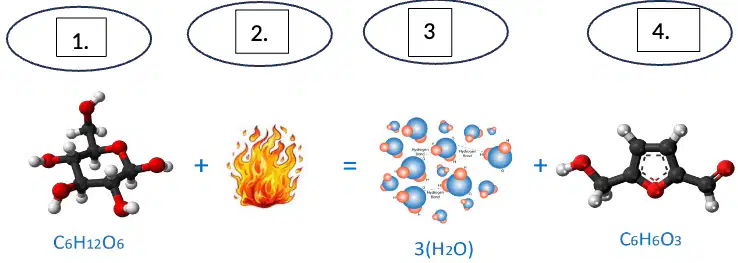
Name the four reactants in 1., 2., 3., and 4. above? (Refer to the diagram showing C6H12O6 + heat = 3(H2O) + C6H6O3)
1. Glucose (C6H12O6) 2. Heat 3. Water (H2O) 4. Hydroxymethylfurfural (C6H6O3)
1. Sucrose (C12H22O11) 2. Light 3. Oxygen (O2) 4. Ethanol (C2H5OH)
1. Fructose (C6H12O6) 2. Cold 3. Carbon dioxide (CO2) 4. Acetic acid (C2H4O2)
1. Maltose (C12H22O11) 2. Electricity 3. Nitrogen (N2) 4. Methanol (CH3OH)
This reaction is called:
Addition reaction
Substitution reaction
Elimination reaction
Redox reaction
The reaction starts at which temperature?
100°C
200°C
300°C
400°C
The temperature that is approximately the UPPER LIMIT for it NOT to result in a bitter, burnt taste and black color is:
80°C
90°C
100°C
120°C
An increase in PH would:
Accelerate the process
Slow the process down
Added moisture would:
Accelerate the process
Slow the process down
Have no effect
Stop the process completely
Name two sweet dishes (desserts) in which this cooking process and resultant chemical reaction plays a role.
Crème brûlée and caramel custard
Pizza and pasta
Grilled chicken and steak
Sushi and sashimi
Name one savory dish in which this cooking process and resultant chemical reaction plays a role.
Grilled steak
Fruit salad
Vanilla ice cream
Boiled rice

