
 Worksheets
The Renaissance
Total questions: 36
Worksheet time: 21mins
Base your answer to question _ on the statement below and on your knowledge of social studies. ... I conclude, then, returning to being feared and loved, that since men love at their convenience and fear at the convenience of the prince, a wise prince should found himself on what is his, not on what is someone else's; he should only contrive to avoid hatred, as was said. This statement is taken from the written work of
John Locke
Niccolò Machiavelli
Adam Smith
Ignatius Loyola
Base your answer to question _ on the statement below and on your knowledge of social studies. ... I conclude, then, returning to being feared and loved, that since men love at their convenience and fear at the convenience of the prince, a wise prince should found himself on what is his, not on what is someone else's; he should only contrive to avoid hatred, as was said. Who is the intended audience of the written work from which this statement comes?
Rulers
Monks
Merchants
Scientists
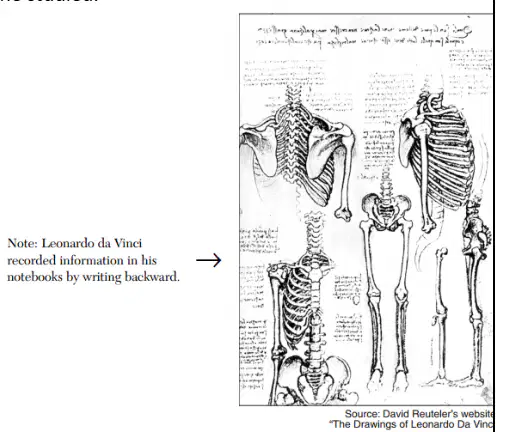
According to this document, state one of Leonardo da Vinci’s contributions to science.
He studied and drew the anatomy of the human body.
He invented the steam engine.
He discovered penicillin.
He developed the theory of relativity.
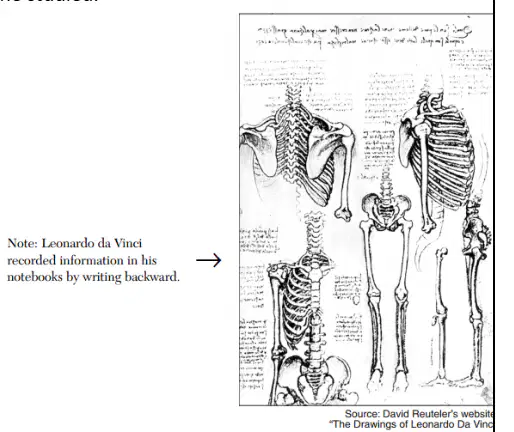
Base your answer to the question on the passage and image below and on your knowledge of social studies. The passage and image above are evidence of Leonardo da Vinci’s involvement in which historical developments?
Protestant Reformation and Catholic Counter Reformation
Golden Age of Athens and Peloponnesian War
Renaissance and Scientific Revolution
The First and Second Crusades
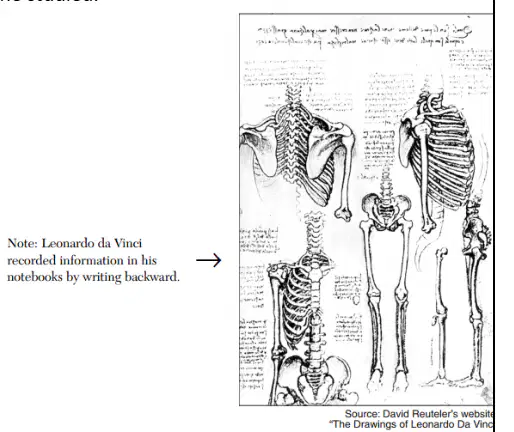
Leonardo da Vinci’s learned about the human body through
Observation
Examining the anatomy of other animals
The teachings of Martin Luther
Studying biblical sources
What most directly contributed to the creation of the Gutenberg press?
The Ottoman takeover of Constantinople
The Protestant Reformation
Classical Greek and Roman writing
Trade between Asia and Europe
Identify one effect of the creation of Gutenberg’s press.
Literacy rates increased
Scientific discoveries were less likely to be widely known
Interest in the Americas declined
The Middle Ages
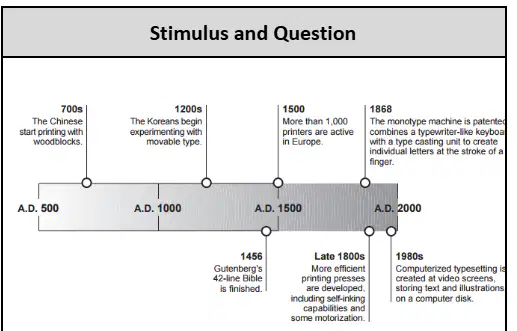
What invention in the 1400s most directly contributed to the increase in the number of active printers in Europe in 1500?
Paper
Printing Press
Ink
Computer

Which generalization is supported by the diagram above?
Modern day technology is based on innovations from the past
Western Europeans were the first to develop printing technology
Most innovation in the past took place in the Middle East
Innovation in communication technology ended in the 1980s

Which individual supported the theory represented in this illustration?
Socrates
Ptolemy
Dante
Galileo
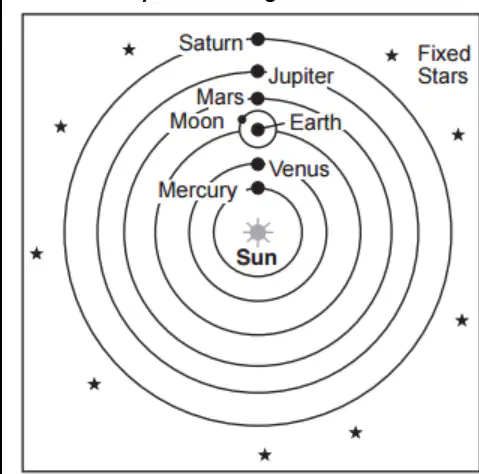
The discovery depicted in the diagram is most closely associated with which historical event?
Protestant Reformation
Founding of Hinduism
Fall of the Roman Empire
Scientific Revolution
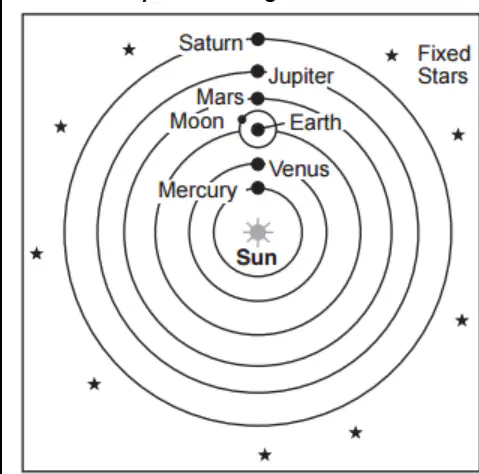
At the time it was first published, which group was most opposed to the discovery depicted in the diagram above?
Islamic Caliphs
Merchants
Catholic Church
Artists
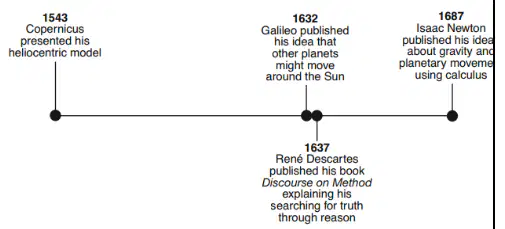
Which historical period is most closely associated with these achievements?
Pax Romana
Age of Alexander the Great
European Middle Ages
Scientific Revolution
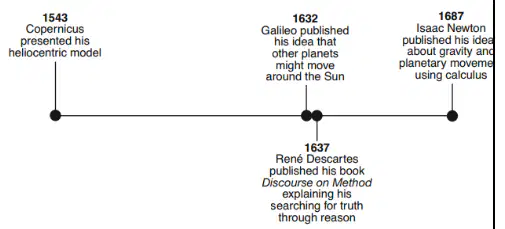
What historical event most directly contributed to the developments in this timeline?
Mansa Musa’s Hajj
Fall of the Roman Empire
Renaissance
Building of the Great Wall of China
A DEO REX, A REGE LEX — “the king is from God, and law is from the king.” This quotation best reflects the concept of
constitutional monarchy
separation of powers
equal representation
divine right rule
The actions described in the passage above demonstrate that Peter the Great was
Democratically elected
An absolute monarch
A traditionalist
A supporter of Martin Luther’s
The actions described in the passage above demonstrate Peter the Great’s attempts to
Convert Russia to Islam
Improve Russia’s military
Westernize Russia
Model Russian culture after the Ottoman Empire
Base your answer to the question on the passage below and on your knowledge of social studies. ... More and more Louis tried to impose uniformity in religious affairs. In the 1680s he intensified persecution of Protestants; his actions made the edict [of Nantes] nothing but a scrap of paper. Finally in 1685 he declared that the majority of French Protestants had been converted to Catholicism and that therefore there was no need for the edict. It was revoked. Now Louis launched a reign of terror. He refused to allow French Protestants to leave the country. He promised that those who remained could worship privately, free of persecution, but never kept the promise. Their churches were torn down, their gatherings forbidden, their children made to attend mass. The Waldensians in Savoy were massacred, and six hundred Protestants “caught making assemblies” were executed. Perhaps two hundred and fifty thousand fled abroad to escape persecution.... The actions described in the passage above demonstrate that Louis XIV was
Democratically elected
An absolute monarch
A traditionalist
A supporter of Martin Luther’s
The Movement in Response to the criticisms of Martin Luther and other Protestants that sought to regain followers and power while reforming corruption within the church and reaffirming Catholic beliefs
The Catholic Counter Reformation
The Protestant Reformation
Vasco da Gama
The Scientific Revolution
The Prince by Machiavelli:
Encouraged honesty and fair play by political rulers
Provided a set of rules for rulers to take and hold power
Was the story of an English prince fro the Middle Ages
Firmly established democracy as the government in Italy
What philosophy was depicted in Renaissance art?
Daoism
Nationalism
Shintoism
Humanism

What was the significance of the printing press?
the production of written work was slower, therefore written works were not available to everyone.
there is no significance
the production of written work was faster, however not everyone was able to read.
the production of written work was faster, therefore written works were available to everyone.

The _________ expanded ideas and increased cultural diffusion.
Perspective
Greece and Rome
Printing Press

What was the impact of the invention of the printing press?
It did not have an impact
It helped spread Renaissance ideas
It made books more expensive
Why would an absolute monarch circumvent getting approval on their initiatives according to the text?
A) To avoid delays and opposition
B) To increase transparency
C) To strengthen democratic processes
D) To encourage public participation
What was the primary reason absolute monarchs focused on controlling the nobility?
A) To gain more wealth
B) To consolidate power
C) To promote equality
D) To improve agriculture
One way in which Louis XIV controlled the French nobility was by
Maintaining standing armies in the countryside to crush noble uprisings
Requiring the presence of the major noble families at Versailles for at least part of the year
Periodically visiting the nobility in order to check on their activities
Forcing them to participate in a parliamentary assembly
Which of the following phrases best sums up the spirit of Louis XIV’s government?
Traditional liberties
I am the state
Paris is worth a Mass
I am the sufferer
Which of the following statements best applies to Peter the Great of Russia?
Even though he desired to teach Russians western customs, he could only enforce his ideas among the old-fashioned nobles.
His program of modernization was predominantly technical and aimed at modernizing the military while securing a sea port to make Russia a real military power.
His respect for eastern governments led to increased powers for the Duma/Russian parliament.
His traditional, conservative attitude stripped away all previous social gains for women.

Which statement is true about Humanists during the Renaissance?
Humanists believed that citizens needed a good, well-rounded education
Humanists believed that the church should make all political decisions
Humanists believed that the church should control every part of civic (city/government) matters
Humanists believed that citizens should only look to the Church & their teachings for knowledge
How did the philosophy of Humanism influence Renaissance art?
By focusing on religious themes exclusively
By emphasizing the importance of human potential and achievements
By rejecting classical antiquity
By promoting abstract art forms
Which literary work is considered a hallmark of Renaissance literature for its exploration of human nature?
"The Divine Comedy" by Dante Alighieri
"The Canterbury Tales" by Geoffrey Chaucer
"Don Quixote" by Miguel de Cervantes
"Hamlet" by William Shakespeare
What was the primary focus of Renaissance humanism?
The study of medieval scholasticism
The glorification of religious dogma
The study of classical texts and human potential
The rejection of all ancient knowledge
When did the Renaissance occur?
1300s–1600s
1300s–1500s
1200s–1600s
none of these

