
 Worksheets
Electricity Practice Test
Total questions: 28
Worksheet time: 15mins
The force or push that causes electric charges to move is called ___________.
resistance
voltage difference
current
static electricity
Electric charges always flow from ___________ areas to ___________ areas.
positive, negative
negative, positive
positive, neutral
neutral, negative
A material through which electrons do NOT flow easily is a(n) ___________.
insulator
fuse
conductor
circuit breaker
Which of the following statements about electric charge is true?
Objects must be touching one another to exert electrical force.
Electrical forces act at a distance.
Air cannot conduct electricity; it is conducted only by solid materials.
Opposite electric charges always repel one another.
Mr. Peterson and his class are conducting an experiment. The class needs to choose a good insulator. Which of the following could be used as an insulator?
plastic plate
silver spoon
copper wire
gold necklace
Which of the following will increase the resistance of a wire?
using a thicker/wider wire
using a shorter wire
increasing the temperature of the wire
using silver instead of copper
What is the current produced by a 9-volt battery flowing through a resistance of 0.2 ohms?
1.8 amps
45 amps
0.022 amps
8.8 amps
Silver has a resistance of 0.0198 ohms. What voltage would produce a current of 100 amps?
1.98 V
0.000198 V
5,050 V
100.0198 V
This contains a piece of metal that melts if it gets too hot in order to open a circuit.
conductor
insulator
fuse
circuit breaker
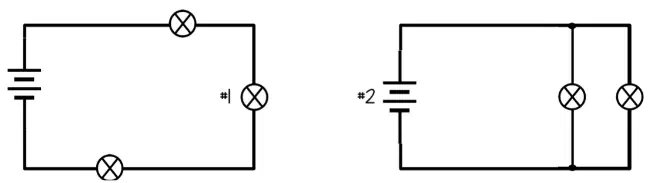
What does the symbol labeled #1 represent?
light
battery
resistor
switch
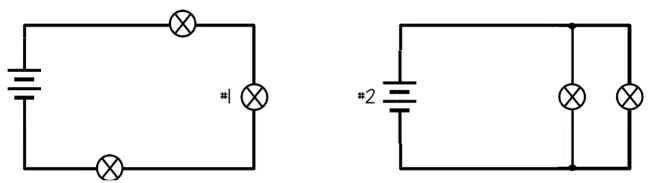
What does the symbol labeled #2 represent?
light
battery
resistor
switch
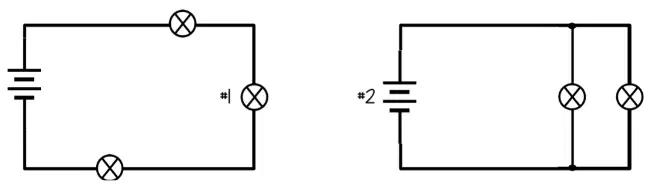
Circuit __ is wired in parallel, and circuit ______ is wired in series.
1; 2
2; 1
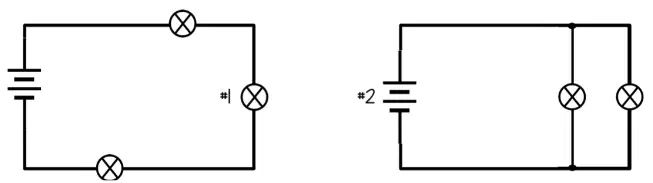
Circuit __ represents the way homes are usually wired.
1
2
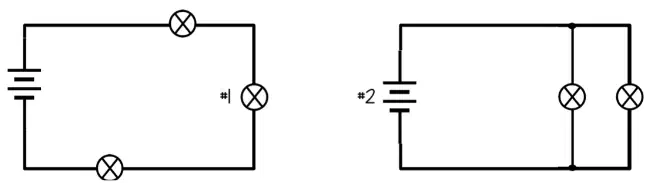
Circuit __ is the type of circuit that causes an entire string of lights to go out when one of the bulbs burns out.
1
2
This exerts a force that causes other electric charges to move.
A. electrical poles
B. electrical fields
C. insulators
D. conductors
Which circuit below contains the greatest voltage?
A circuit with a current of 20 amps and a resistance of 16 ohms
A circuit with a current of 10 amps and a resistance of 10 ohms
A circuit with a current of 25 amps and a resistance of 16 ohms
A circuit with a current of 20 amps and a resistance of 10 ohms
What process is the method by which a neutral object obtains an electrical charge from a distance?
convection
conduction
radiation
induction
Which of the following objects would NOT be a good insulator of electric charge?
skin
wood
plastic
rubber
The Law of Conservation of Charge states that ________.
charge can be created and destroyed but NOT transferred.
charge cannot be created and destroyed but it can be transferred.
charge cannot be created and destroyed and it cannot be transferred.
none of the above
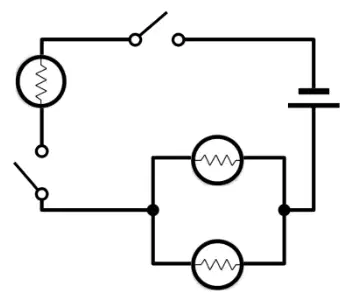
Which of the following statements is true about the circuit to the right?
There are 2 batteries, 2 switches, and 2 resistors.
There are 2 batteries, 2 switches, and 3 resistors.
There is 1 battery, 2 switches, and 3 resistors.
There are 3 batteries and 3 resistors.
Opposite charges _________________. Like charges _______________.
Opposite charges attract. Like charges repel.
Opposite charges repel. Like charges attract.
Opposite charges attract. Like charges attract.
Opposite charges repel. Like charges repel.
Electric charge flows from ________________ voltage to __________ voltage.
Electric charge flows from high voltage to low voltage.
Electric charge flows from low voltage to high voltage.
Electric charge flows from negative voltage to positive voltage.
Electric charge flows from positive voltage to negative voltage.
To increase the current, you should ________________ voltage and ______________ resistance.
increase voltage and decrease resistance.
decrease voltage and increase resistance.
increase voltage and increase resistance.
decrease voltage and decrease resistance.
Charges can act at a distance by exerting a(n) ______________________ which is an example of charging by _______________.
electric field, induction
magnetic field, conduction
gravitational force, friction
current, polarization
A battery works by converting which type of energy into electrical energy?
Chemical energy
Thermal energy
Mechanical energy
Light energy
An outlet has a current of 10 amperes and a resistance of 14 ohms. Find the voltage difference.
24 V
140 V
1400 V
1.4 V
Find the current in a circuit with a total resistance of 9 ohms and a battery with 180 V of potential difference.
10 A
20 A
15 A
25 A
Match the term to the definition.
Circuit that has more than one pathway for current to travel through
Parallel circuit
Positively charged particles in an atom
Protons
Negatively charged particles in an atom
Electrons
Particles in the atom that have no charge
Neutrons
Circuit that has one pathway for current to travel through
Series circuit

