
 Worksheets
Spring 2025 IPS Review
Total questions: 48
Worksheet time: 24mins
Name
Class
Date
1.
Two objects, A and B, have the same momentum. If Object B has a greater velocity than Object A, then
a)
Object A is moving faster than Object B
b)
both objects have the same mass
c)
Object A has a smaller mass than Object B
d)
Object B has a smaller mass than Object A
2.
Which of the following have shorter wavelengths and can ionize atoms, causing damage to living cells?
a)
infrared, visible light, x-rays
b)
ultraviolet light, gamma rays, x-rays
c)
radio, microwave, infrared
d)
visible light, ultraviolet light, infrared
3.
The photoelectric effect is a phenomenon in which light, when it strikes a metal, produces photoelectrons. The photoelectric effect provides evidence to support which of the following claims?
a)
Metals produce electrons when exposed to light.
b)
Electrons can be converted into photons.
c)
Electromagnetic radiation such as light behaves like a particle
d)
Light has more energy than an electric circuit.
4.
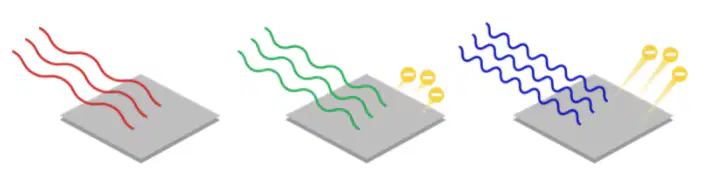
The image below shows different energy light sources hitting metal. Based on the photoelectric effect, what can you conclude based on the picture?
a)
when any frequency or intensity of light hits strikes a piece of metal, electrons are emitted
b)
the shorter the wavelength and higher the frequency of light, the greater the energy of the electrons emited.
c)
light is a particle because it can strike metal and emit particles at all colors of light
5.
True or false: Light is both a wave and a particle
a)
True
b)
False
6.

A penny is placed on top of a flashlight and produces an image as seen. Is light traveling through the penny? Select the best explanation
a)
Yes light is travelling through the penny because light is a wave
b)
Light is hitting the penny and bending around it because of defraction
c)
Light is reflecting off the penny causing the image to appear as though light is travelling through the penny.
7.
The part of the electromagnetic spectrum you can see is called visible light.
a)
true
b)
false
8.
Which of the following is NOT a form of electromagnetic radiation?
a)
radio waves
b)
gamma rays
c)
gravity
d)
visible light
9.
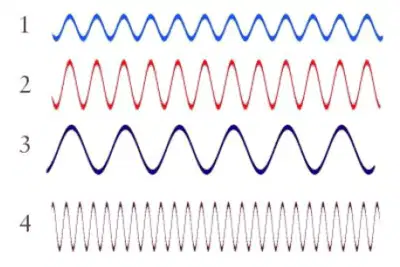
Which wave has the highest frequency?
a)
1
b)
2
c)
3
d)
4
10.
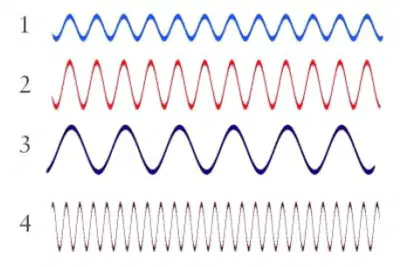
Which wave has the greatest wavelength?
a)
1
b)
2
c)
3
d)
4
11.
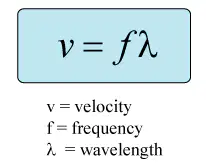
What is the velocity of a wave that has a frequency of 200Hz and a wavelength of 4m
a)
50
b)
800
c)
204
d)
1000
12.
Which type of radiation can be dangerous?
a)
ionizing
b)
non-ionizing
13.
Light cannot be refracted (bent).
a)
True
b)
False
14.
Gamma rays have high frequencies, high energies, and very small wavelengths. Which would be appropriate use of uses of gamma rays?
Select all that apply. (2)
a)
treating cancer
b)
lighting your home
c)
imaging and seeing the contents of shipping containers for security
d)
communications networks
15.
Light can travel through a medium (matter) or vacuum (lack of matter).
a)
True
b)
False
16.
A wave has a wavelength of 15m and a frequency of 10Hz. What is the wave speed?
a)
1.5
b)
150
c)
0.15
17.
True or False: constructive interference of a way results in a wave with a larger amplitude
a)
True
b)
False
18.
On a rollercoaster, the potential energy is _____________ at the top of a hill.
a)
Greatest
b)
Least
19.

If you were to add up kinetic and potential energy at each red circle on the track, what statement would be true?
a)
Kinetic and potential energy adds up to 100% at each location.
b)
Kinetic energy is greater.
c)
Potential energy is greater.
d)
Potential energy is equal to kinetic energy at each location.
20.

Using the following picture; where is potential energy greatest?
a)
at the top
b)
at the bottom
21.

What type of energy is shown in the picture?
a)
Thermal
b)
Nuclear
c)
Electric
d)
Mechanical
22.
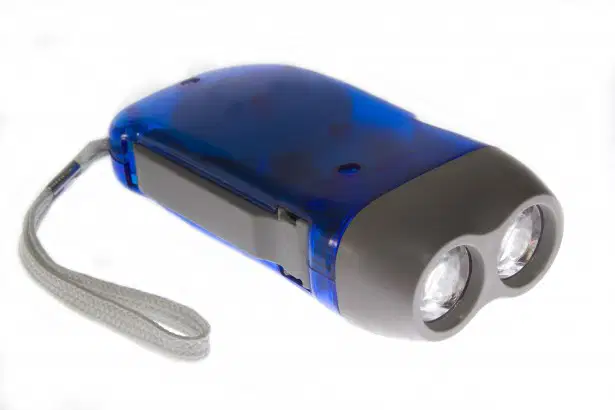
Which best explains the energy transfers of this cranking flashlight?
a)
Mechanical Energy to Electrical Energy to Light Energy
b)
Mechanical Energy to Chemical Energy, to Electrical Energy
c)
Light Energy to Electrical Energy to Chemical Energy
d)
Potential Energy to Kinetic Energy to Light Energy
23.

Which free body diagram represents moving a book across a desk with acceleration while being opposed by friction
a)
A
b)
B
c)
C
d)
D
e)
E
24.
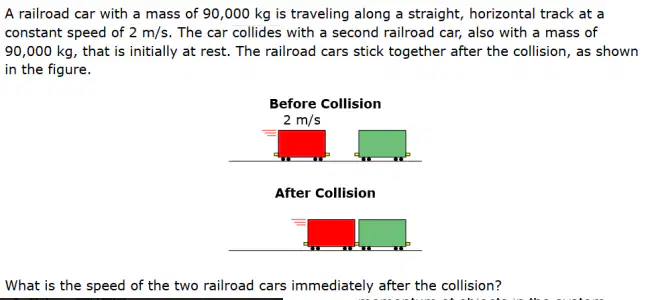
a)
0.5 m/s
b)
1 m/s
c)
2 m/s
d)
4 m/s
25.
What is the momentum of a 2000kg bus moving at 2m/s?
a)
4000 kg m/s
b)
2000 kg m/s
c)
8000 kg m/s
26.
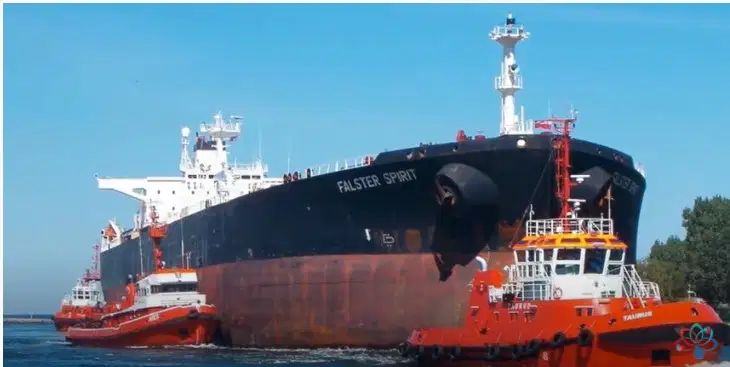
What gives this tanker most of it's momentum?
a)
The velocity
b)
The acceleration
c)
The speed
d)
The mass
27.
A 2000 kg elephant is traveling north at 6 m/s. A 2 kg falcon is traveling south at 107 m/s. Which animal has the greatest momentum
a)
falcon
b)
elephant
28.
____________________is the rate at which the velocity changes.
a)
accleration
b)
force
c)
mass
d)
speed
29.

A 50kg crate is pushed to an acceleration of 2m/s2. What is the force on the crate?
a)
100 N
b)
25 N
c)
0.04 N
d)
50 N
30.
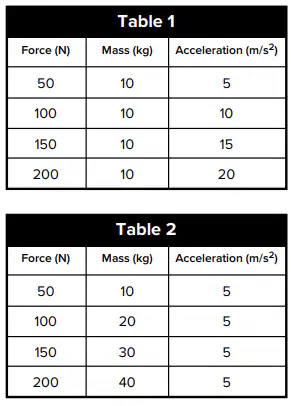
Newton’s second law of motion describes the mathematical relationship among the net force on an object, the mass of that object, and its acceleration.
What does analysis of the data in Tables 1 and 2 tell us about that relationship?
Select all that apply. (Select two)
a)
When mass is constant, acceleration increases as net force increases.
b)
When acceleration is constant, net force increases as mass increases.
c)
When mass is constant, acceleration decreases as net force increases.
d)
When acceleration is constant, net force decreases as mass increases
31.
If the mass of an object doubles, then the acceleration is ________ when the force is kept the same.
a)
halved
b)
doubled
c)
stays the same
32.
A vehicle with _______________ mass will have a greater acceleration when compared to larger vehicles.
a)
less
b)
greater
c)
zero
d)
incresasing
33.
The initial momentum of a golf ball rolling down a track is 10 kg m/s. It collides with a 20kg block at rest. What is the final momentum?
a)
10 kg m/s
b)
20 kg m/s
c)
30 kg m/s
34.
When the speed of an object is doubled, its momentum
a)
remains unchanged in accord with the conservation of momentum.
b)
doubles
c)
quadruples
d)
decreases
35.
Car crashes result in injury due to the ______________ that occurs upon impact. Seatbelts and airbags can reduce the severity of car crash injuries due to the fact that they increase the __________________ that the force is being applied to the passenger during the crash.
a)
constant momentum, time
b)
change in momentum, acceleration
c)
change in momentum, time
d)
force, distance
36.
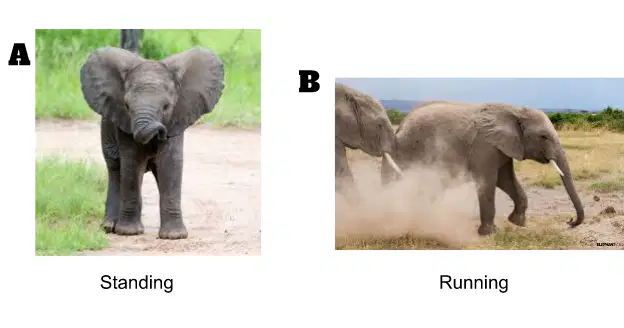
The same elephant is in two different pictures, when does it have more momentum?
a)
Picture A
b)
Picture B
c)
Both A and B, its the same
37.

Using the image below, which graph would represent the objects motion?
a)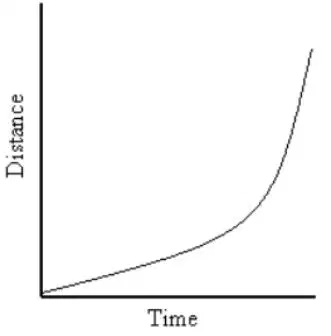
Graph 1
b)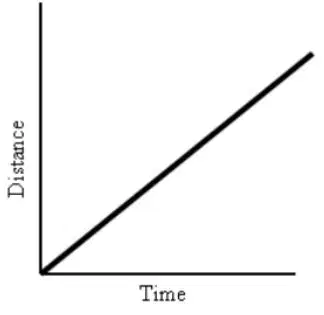
Graph 2
c)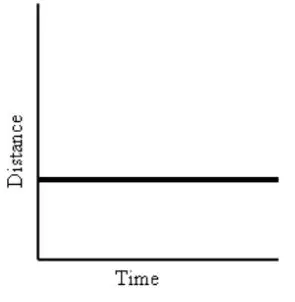
Graph 3
d)
Graph 4
38.
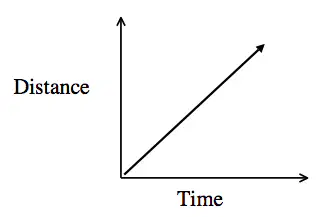
On this time vs. distance graph, what does the line represent?
a)
Constant Speed
b)
Acceleration
c)
Stationary (not moving)
d)
Deceleration
39.
What is a force? ( Select 3 that apply)
a)
A push
b)
A pull
c)
Something that can cause motion if unbalanced
d)
The power Jedi Knights use
e)
Energy
40.
Which of the following accurately describes speed
a)
speed is the rate direction changes.
b)
speed is the change in position
c)
speed is the rate at which an object moves.
41.
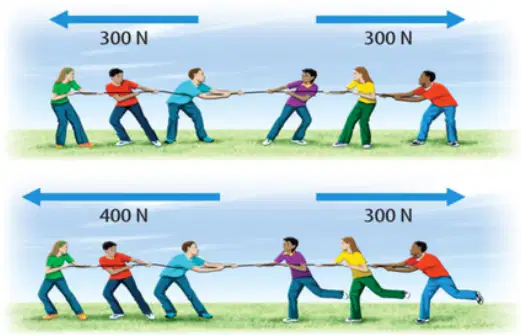
Which image shows balanced forces
a)
top
b)
bottom
42.
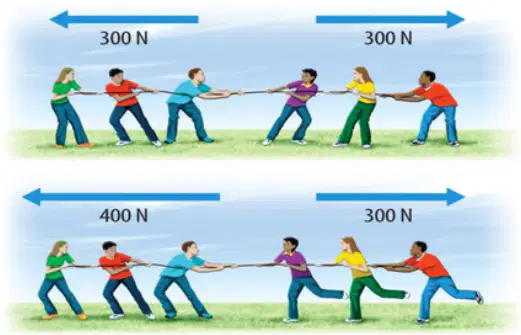
Which team won the tug of war and by how much
a)
left by 100 N
b)
right by 100 N
c)
left by 700 N
d)
right by 700 N
43.
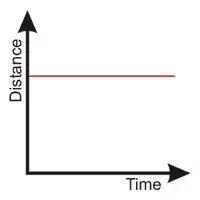
This time-distance graph is showing what representation?
a)
Stationary (not moving)
b)
Constant Speed
c)
Acceleration
d)
Deceleration
44.
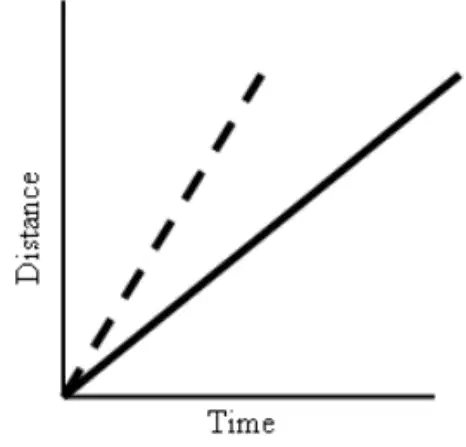
Based on the graph, which line indicates an object moving at a greater speed
a)
The solid line indicates an object moving faster
b)
The dashed line indicates an object moving faster
45.
What physical quantity is represented by the slope of the line on a distance vs time graph
a)
acceleration
b)
motion
c)
speed / velocity
d)
force
46.
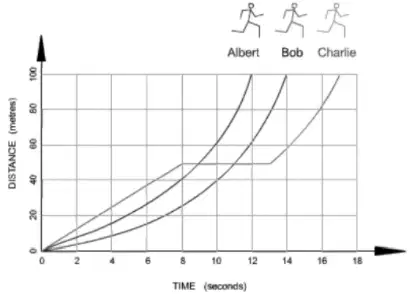
Who won the race?
a)
Albert
b)
Bob
c)
Charlie
47.
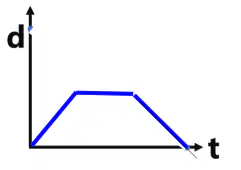
Match the statement with the graph below
a)
object leaves home, increase speed, and continues away
b)
object leaves home, stops and then continues back home
c)
object leaves home, and increases speed
48.
Which diagram shows a book accelerating across a surface (assume no friction)
a)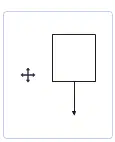
Option 1
b)
Option 2
c)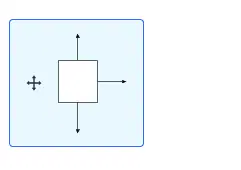
Option 3
100 %

