
 Worksheets
Science Review
Total questions: 51
Worksheet time: 26mins
Name
Class
Date
1.
2- A land-based community of organisms and the interactions of biotic and abiotic components in a given area.
a)
Opción a
b)
Opción b
c)
Opción 3
d)
Opción 4
2.
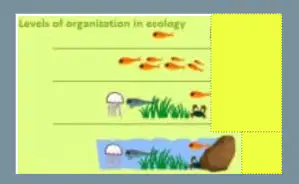
3. What are the levels of organization of living things in order from the least complex to the most complex?
a)
species – population – community – ecosystem
b)
ecosystem – community – population – species
c)
population – species – community – ecosystem
d)
species – community – population – ecosystem
3.
4. Select the option that represents a competition.
a)
A lion eating a deer.
b)
Two cheetas fighting for a bunny.
c)
A deer running from a lion.
4.
5. When an iguana eats an insect, what role does each organism have?
a)
The iguana is the prey, and the insect is the predator.
b)
The iguana is the predator, and the insect is the prey.
c)
They mutually benefit.
d)
They are competitors.
5.
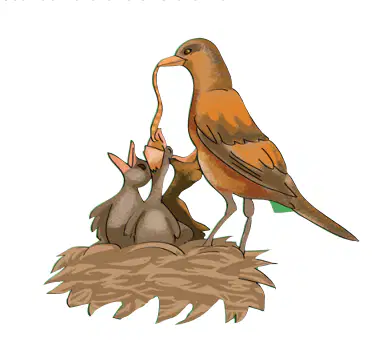
6. The interaction between the worm and the birds is:
a)
Mutualism
b)
Competition
c)
Predation
6.
8. Which structures form the skeletal system?
a)
Muscles and tendons
b)
Tendons and cartilage
c)
Ligaments and muscles
d)
Bones and joints
7.
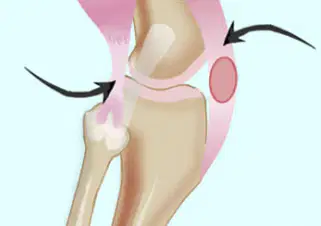
9. Are rigid structures that give support and strength to the body and protection to the organs.
a)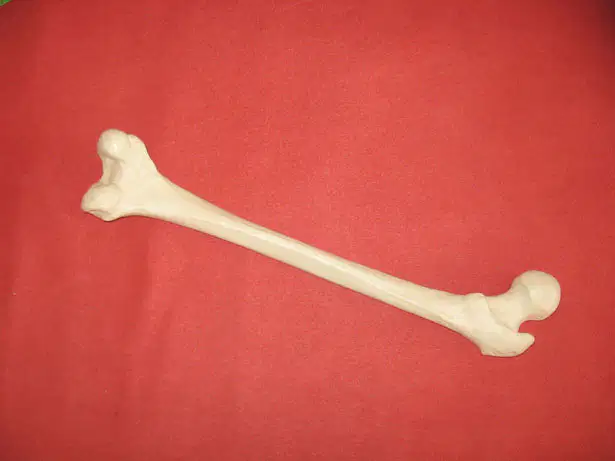
bones
b)
joins and ligaments
8.
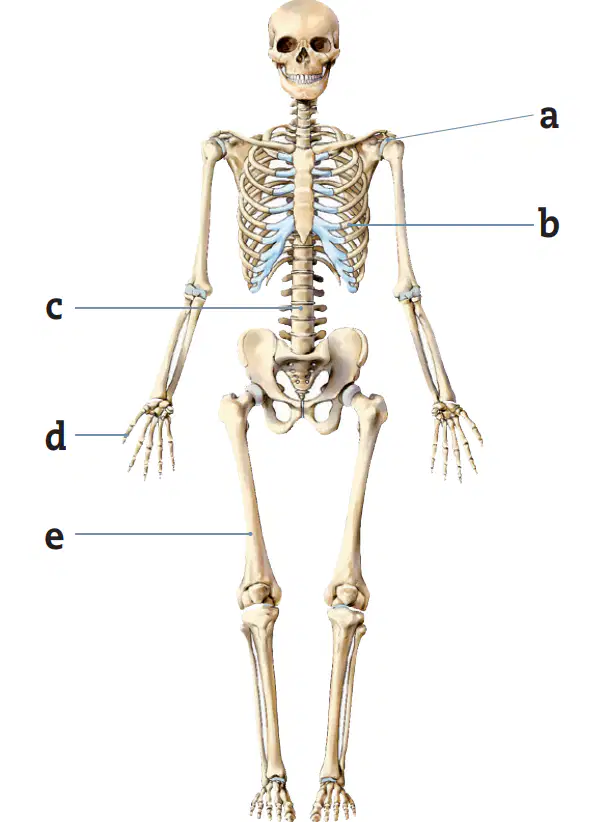
10. Which are the bones b and c?
a)
Femur and pelvis
b)
Ribs and spinal column
c)
Phalanges and femur
d)
Vertebrae and femur
9.
11. This bone protects some organs like the brain, heart or lungs.
a)
femur
b)
spinal cord
c)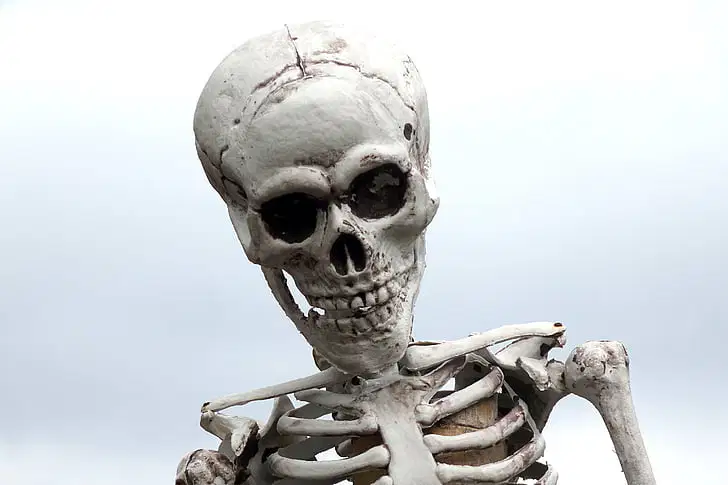
cranium
10.

12. These are important functions of the skeletal system
a)
To move, to contract and to be flexible.
b)
To protect, support and allow us to move.
c)
To support, walk and control movements,
11.
13. Which structures contract and expand to generate movements?
a)
Bones
b)
Joints
c)
Tendons
d)
Muscles
12.
15. This system is responsible for taking in information from the world around us and interpreting it.
a)
Skeletal System
b)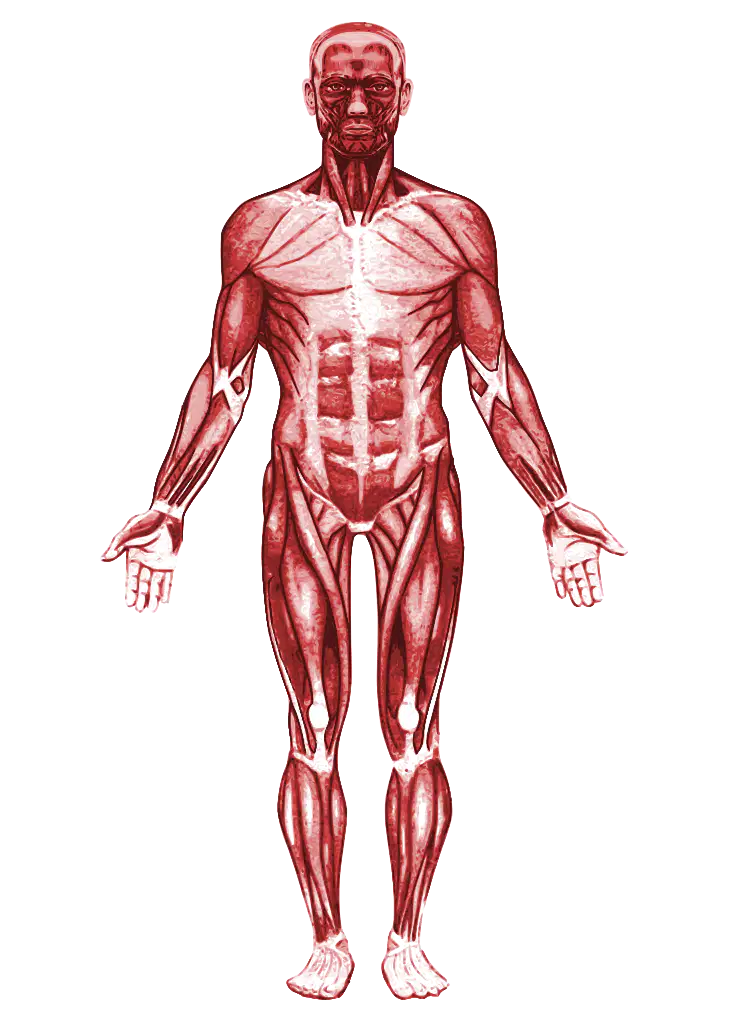
Muscular System
c)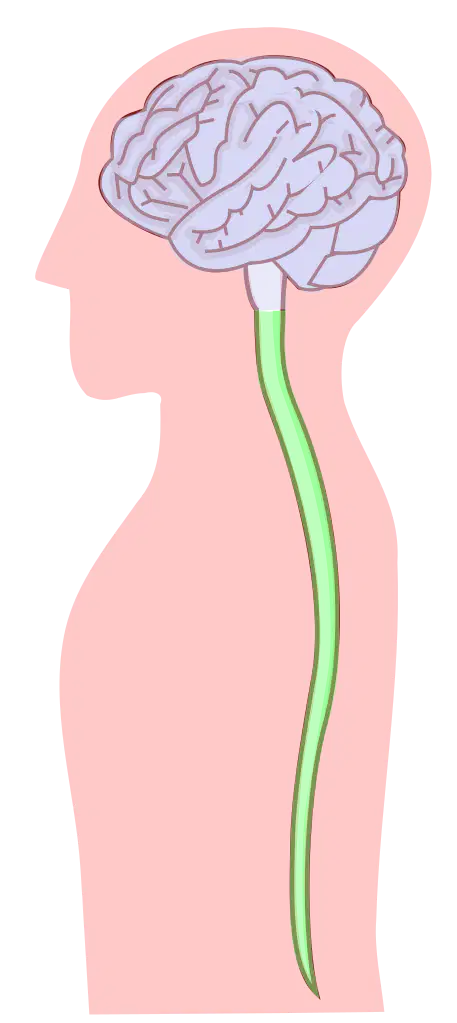
Nervous System
13.
16. The heart beating is an example of:
a)
Nothing
b)
Voluntary movement from a muscle
c)
Involuntary movement from a muscle
14.
17. Which are the 3 states of matter
a)
Volume, Size and Mass.
b)
Liquid, Gas and Size
c)
Ice, Solid and Juice
d)
Solid, Liquid and Gas
15.
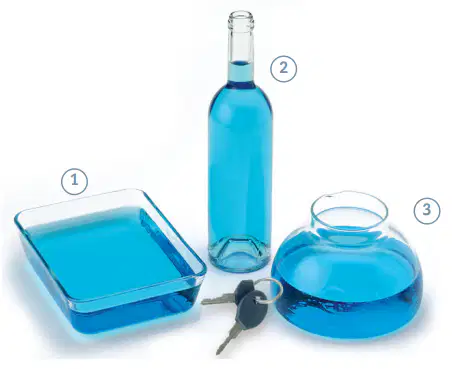
19. Look at the image. If we put the keys in each container, what shape will the KEYS have in each one?
a)
They will take the shape of container 1.
b)
They will take the shape of container 2.
c)
They will change their shapes in container 3 only
d)
Their shape will not change
16.
20. _______ is everywhere. It is a form of gas.
a)
Water
b)
Rain
c)
Solid
d)
Air
17.
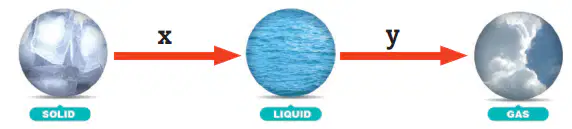
21. Select the option that best describes X and Y process.
a)
X is fusion and Y is vaporization
b)
X is solidification and Y is vaporization
c)
X is vaporization and Y is fusion
d)
X is condensation and Y is sublimation
18.
22. Joaquin wants to drink some water, but the water in his water bottle is frozen. What could he do to make it become liquid quickly?
a)
Put the bottle in water.
b)
Put the bottle in the freezer.
c)
Put the bottle in sunlight.
d)
Leave the bottle on a table.
19.
23. Which situation describes a body in motion?
a)
A girl sitting on a bench.
b)
A car parked on the street.
c)
A dog running through a park.
d)
A boy standing on a street corner.
20.
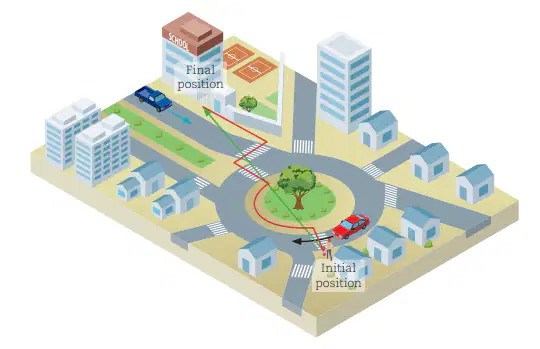
24. Which line represents the displacement of a girl going to school with her mother?
a)
The green line.
b)
The red line.
c)
The black line.
d)
The blue line.
21.
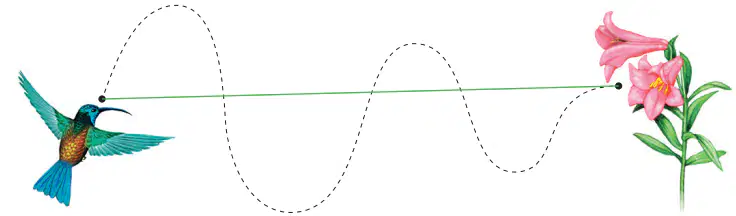
25. What does the dotted line represent?
a)
Displacement
b)
Time
c)
Trajectory
d)
Velocity
22.
26. Which is a unit of measurement of speed?
a)
km
b)
km/h
c)
h/m
d)
N
23.
27. Which option provides enough information to calculate the speed of the car?
a)
The car moves on the right side of a highway.
b)
The car goes 20 km on a highway.
c)
The car takes an hour to go 80 kilometers.
d)
It takes two hours for the car to reach its destination.
24.
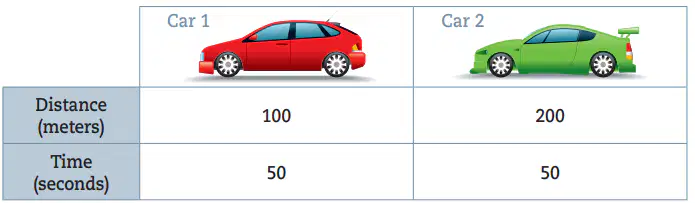
28. What is the speed of Car 1?
a)
2 m/s.
b)
50 m/s.
c)
100 m/s.
d)
5,000 m/s.
25.
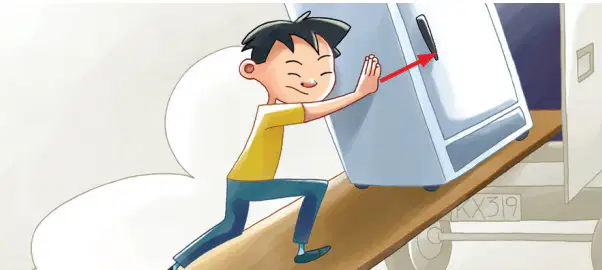
29. What type of force is shown in the image?
a)
A noncontact force that deforms an object.
b)
A contact force that deforms an object.
c)
A noncontact force that results in a change of position.
d)
A contact force that results in a change of position.
26.
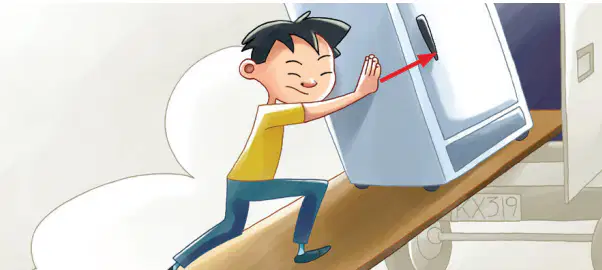
30. Who or what exerts frictional force on the refrigerator?
a)
The boy.
b)
The ramp.
c)
The ground.
d)
The truck.
27.
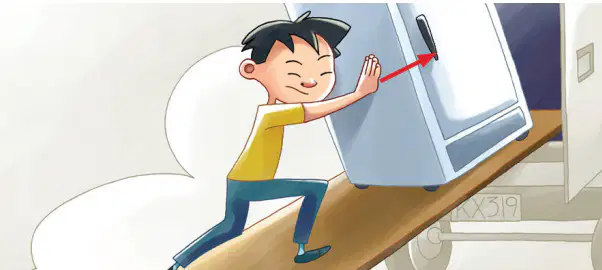
31. What does the arrow in the image represent?
a)
The direction of the force that the boy exerts.
b)
The speed of the force that the boy exerts.
c)
The boy’s weight.
d)
The refrigerator’s weight.
28.
32. Which describes a noncontact force?
a)
A girl pushing a box.
b)
A car pulling a cart.
c)
A balloon charged with static electricity attracting some paper.
d)
A boy flying a kite.
29.
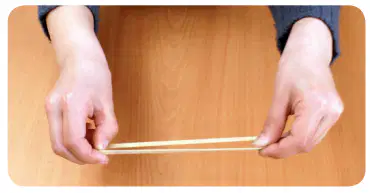
33. What happens to the rubber band when it is stretched?
a)
Its shape changes.
b)
Its speed increases.
c)
It changes its direction.
d)
Its matter varies.
30.
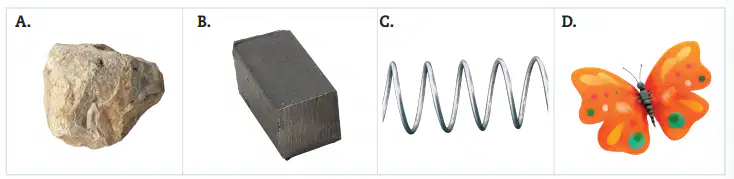
34. Which is an elastic body?
a)
A
b)
B
c)
C
d)
D
31.
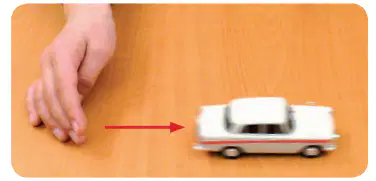
35. What will happen to the car after this force is applied to it?
a)
It will change shape.
b)
Its speed will increase.
c)
Its speed will decrease.
d)
The direction of its movement will change.
32.

36. What is the force by which the earth attracts objects?
a)
Frictional force.
b)
Magnetic force.
c)
Electric force.
d)
Gravitational force.
33.
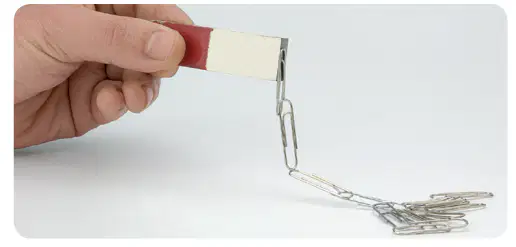
37. What type of force is this?
a)
Frictional force.
b)
B. Magnetic force.
c)
C. Electric force.
d)
D. Gravitational force.
34.
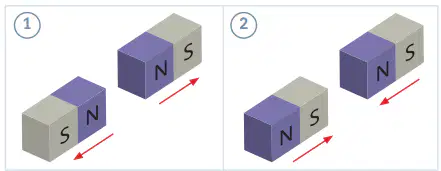
38. Which shows a magnetic force of attraction?
a)
1.
b)
2.
c)
Both.
d)
Neither.
35.
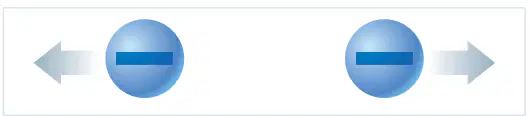
39. What type of interaction is shown in the image?
a)
Repulsion between electric charges.
b)
Attraction between poles.
c)
Repulsion between poles.
d)
Attraction between electric charges.
36.
40. What is an epicenter?
a)
The center of the Earth.
b)
The point on the surface exactly above the hypocenter, where the tremor or earthquake is felt with the greatest intensity.
c)
Lava, tectonic plates and volcanic cone.
37.
41. What is an Earthquake?
a)
The oceans and the waves.
b)
The movement of the tectonic plates of the lithosphere.
c)
The movement of the air.
38.
42. What are the parts of a volcano?
a)
Magma and tectonic plates.
b)
Lava, crater and epicenter.
c)
Crater, volcanic cone, magma chamber, lava.
39.
43. The inner components of Earth are?
a)
The ocean and the land.
b)
The tectonic plates and the air.
c)
Crust, mantle and core.
40.
44. What are the outer components of the Earth?
a)
Atmosphere, geosphere and hydrosphere.
b)
Atmosphere, volcanoes and tsunamis.
c)
The volcanoes and the tectonic plates.
41.
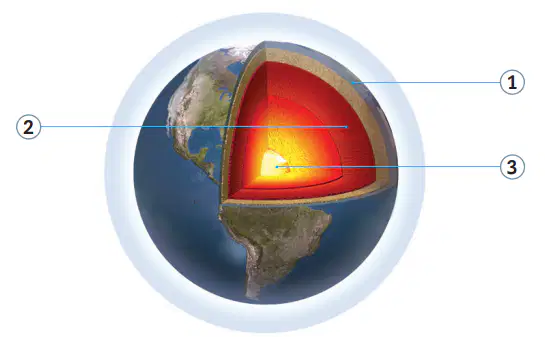
45. What is the name of structure 1?
a)
Mantle.
b)
Crust.
c)
Geosphere.
d)
Core.
42.
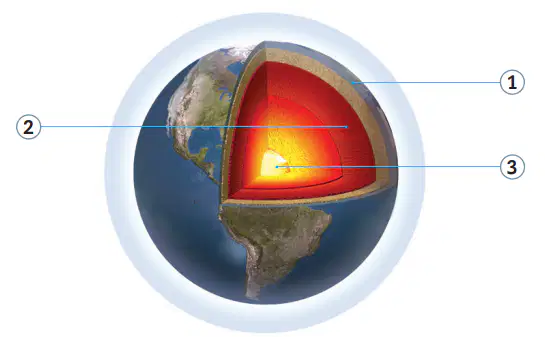
46. From the exterior to the interior, which is the correct order of the layers of the geosphere?
a)
Mantle, core and crust.
b)
Crust, mantle and core.
c)
Crust, core and mantle.
d)
Mantle, crust and core.
43.
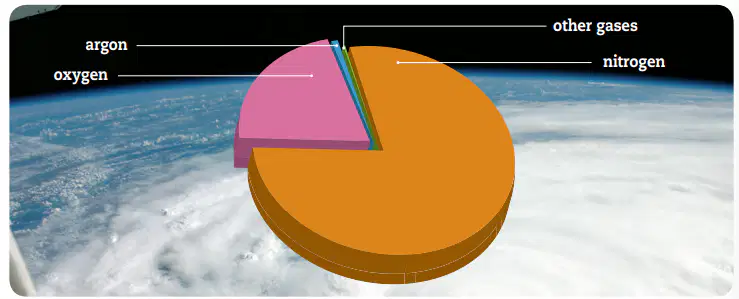
47. What are the main gases in the atmosphere?
a)
Argon and carbon dioxide.
b)
B. Nitrogen and carbon dioxide.
c)
C. Oxygen, nitrogen and argon.
d)
D. Oxygen and argon.
44.
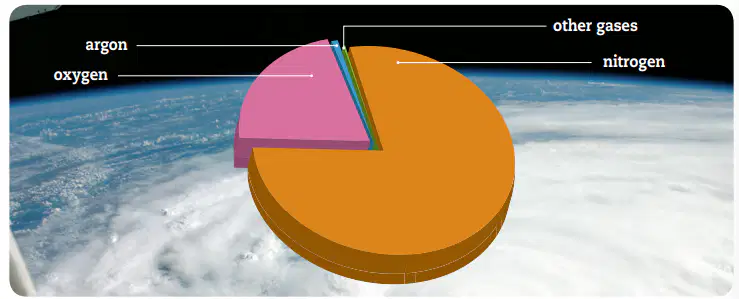
48. How does carbon dioxide get into the atmosphere?
a)
From the respiration of living things.
b)
From plant photosynthesis.
c)
From the evaporation of water.
d)
From water vapor condensation.
45.
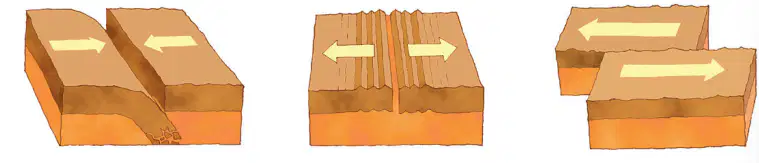
49. What do the following diagrams show?
a)
The movement of tectonic plates.
b)
B. The movement of the lower mantle.
c)
C. The movement of the upper mantle.
d)
D. The movement of the geosphere.
46.
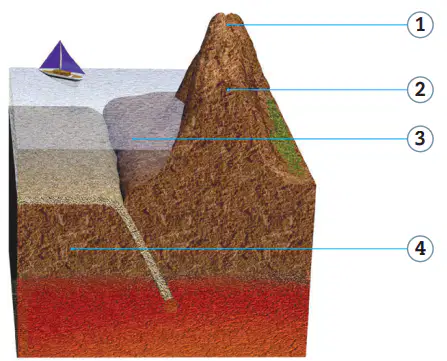
50. Which number indicates a hypocenter that would cause a tsunami?
a)
1
b)
2
c)
3
d)
4
47.
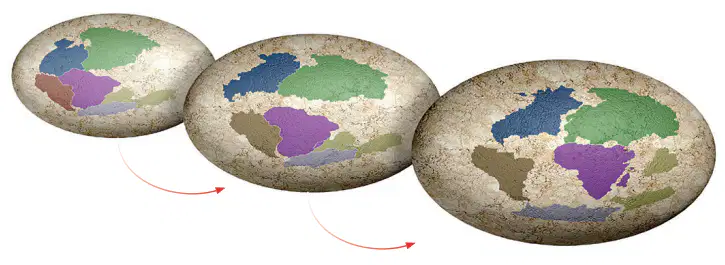
51. What does this diagram show?
a)
The core is formed by plates.
b)
The lithosphere is formed by plates.
c)
The upper mantle is formed by plates.
d)
The lower mantle is formed by plates.
48.
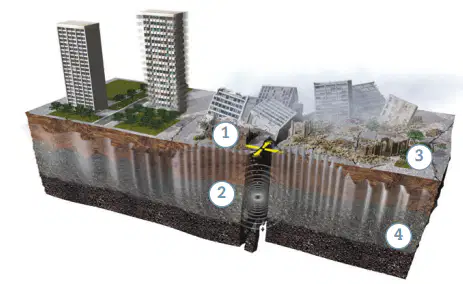
52. Which is the hypocenter of the earthquake?
a)
1
b)
2
c)
3
d)
4
49.
53. What is magma?
a)
Molten rock found in the interior of a volcano.
b)
Molten rock that leaves a volcano.
c)
Solid rock found in the interior of a volcano.
d)
Solid rock expelled by a volcano.
50.
54. How is a volcanic cone formed?
a)
Lava cools and hardens, making a volcanic cone.
b)
Magma cools and hardens, making a volcanic cone.
c)
Gases condense and form a volcanic cone.
d)
Ashes cool and form a volcanic cone.
51.

55. Which symbol represents a flood?
a)
A
b)
B
c)
C
d)
D
100 %

