
 Worksheets
Cosmological Review
Total questions: 89
Worksheet time: 45mins
What does the principle of sufficient reason state?
A) Everything has a cause
B) Nothing has a cause
C) Only some things have a cause
D) Causes are not important
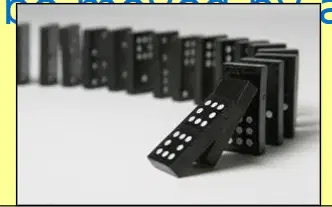
In a sequence of toppling dominoes, what is the cause and what is the effect? Fill in the blanks: The first event is the ______ and the resulting event is the ______.
cause, effect
effect, cause
effect, effect
cause, cause
Thinking through ideas based on observation and experience is called (a) reasoning.
a priori
a posteriori
deductive
hypothetical
Inductive argument involves drawing conclusions via (a) reasoning.
a priori
a posteriori
hypothetical
deductive
True or False: Inductive arguments can express logical certainty.
True
False
Example: “Every swan I have ever seen is white, so the next swan I see will be white.” What does this example illustrate about inductive arguments?
They are always logically certain
They express likelihood or probability
They are never correct
They are based on a priori reasoning
What is Premise 1 of the cosmological argument?
Observation and experience tell us that everything that exists has a cause.
Everything that exists is eternal and uncaused.
The universe has always existed without a cause.
Only living things require a cause for their existence.
What is Premise 2 of the cosmological argument?
The universe exists.
Everything that begins to exist has a cause.
God exists necessarily.
The universe is eternal.
What is the conclusion of the cosmological argument?
Therefore the universe has a cause (i.e. God).
The universe is eternal and uncaused.
Science can explain everything without a cause.
The universe is an illusion.
Match each philosophical question with the type of question it represents.
What is the purpose of life?
Teleological question
What caused the universe to exist?
Cosmological question
What is the nature of God?
Theological question
What is the meaning of morality?
Ethical question
Fill in the blank: Premise 1 of the cosmological argument states that observation and experience tell us that everything that exists has a _____
cause
purpose
beginning
creator
Which of the following best describes the type of reasoning used in the cosmological argument?
Deductive reasoning
A priori reasoning
A posteriori reasoning
Circular reasoning
The conclusion of the cosmological argument is that therefore the universe has a (a) (i.e. God).
The cosmological argument is an example of which type of argument?
Deductive argument
Inductive argument
Abductive argument
Analogical argument
What is a never-ending backward chain of causes called?
An infinite regress.
A causal loop.
A paradoxical cycle.
A finite sequence.
A logical endpoint.
True or False: The backward chain of causes cannot be never-ending.
True
False
According to the cosmological argument, what is the cause that has no cause of its own called?
A beginningless beginning-thing (God).
A contingent entity.
A temporal effect.
A random occurrence.
Does the cosmological argument prove that there is a being with all the properties Christians believe God to have (such as omnibenevolence, immanence, transcendence, etc.)?
Yes
No
Is it true that the backward chain of causes cannot be never-ending?
Yes, it is true
No, it is not true
Who explored the cosmological argument more than 2000 years ago?
St. Thomas Aquinas
Aristotle
Plato
Socrates
Who made the cosmological argument popular in the 13th Century?
Aristotle
St. Thomas Aquinas
Socrates
Plato
God is the ________ (he sets everything in motion but didn’t require anything to set him in motion).
unmoved mover
eternal observer
first creator
infinite designer
God is an ________ (he causes things to happen but has no cause himself).
uncaused cause
eternal effect
dependent being
created entity
All things are ________, except for God who is ________.
contingent, necessary
eternal, finite
temporary, infinite
created, uncreated
According to Aquinas' First Way, what is meant by 'God is the first mover'?
God is the first to move from one place to another
God set everything in motion and is the start of the chain of movers
God is the last in the chain of movers
God is not involved in movement
What does 'movement' mean in the context of Aquinas' First Way?
Only moving from place to place
Any kind of change, such as location, size, shape, or form
Only physical movement
Only spiritual movement
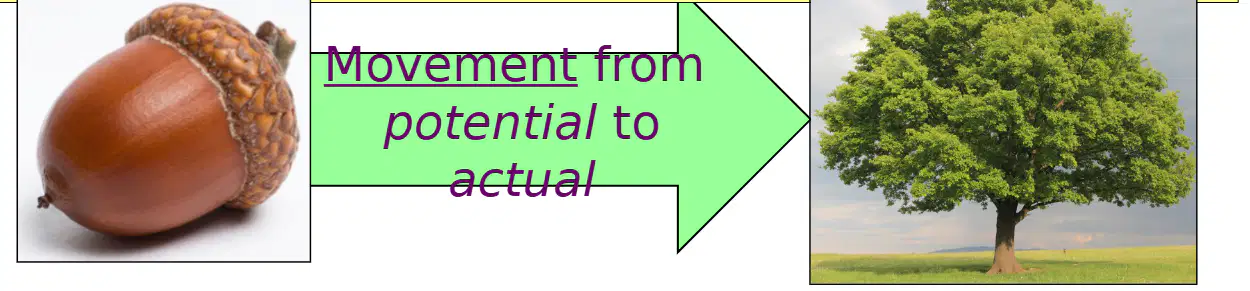
Match the following philosophical concepts with their correct descriptions according to Aquinas.
potential; actual
Movement is from _______ to _______ (Aquinas)
actual; potential
Movement is from actual to potential
motion; rest
Movement is from motion to rest
cause; effect
Movement is from cause to effect
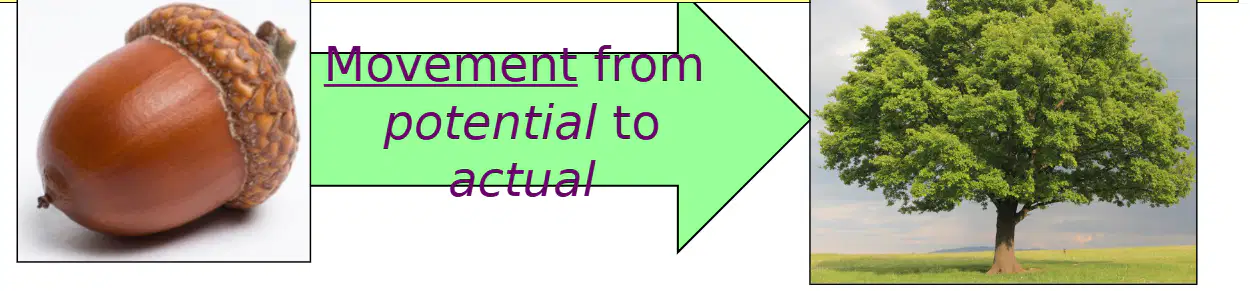
Which of the following best describes the analogy of 'the acorn becoming a tree' in Aquinas' First Way?
A) The acorn is already a tree
B) The acorn moves from potential to actual as it becomes a tree
C) The tree becomes an acorn
D) The acorn never changes
According to Aquinas, God is fully actualised and there is nothing left for him to become.
True
False
What does the term 'unmoved mover' not address according to the slide?
It does not address omnibenevolence, immanence, transcendence, etc.
It does not address the concept of motion.
It does not address the existence of the universe.
It does not address the laws of physics.

What is the 'schoolboy objection' in the context of Aquinas' Second Way?
The belief that everything has a cause
The question 'what caused God?'
The idea that God is infinite
The universe exists
Fill in the blank: According to Aquinas' Second Way, ______ is the uncaused cause.
God
The universe
Matter
Chance
According to Aquinas' Second Way, God needs a cause.
True
False
According to the Kalam cosmological argument, what does everything that comes into existence have?
A) A purpose
B) A cause
C) A beginning
D) An end
Fill in the blank: The universe came into _________
existence
pieces
colors
silence
What is the conclusion of the Kalam cosmological argument?
The universe is eternal
The universe has a cause
The universe is an illusion
The universe is infinite
According to the Kalam cosmological argument, whatever ________ to exist has a cause.
begins
ceases
continues
fails
The Kalam cosmological argument overcomes which objection regarding God?
The objection that God cannot exist outside of time
The objection that God is not all-powerful
The objection that God is not benevolent
The objection that God is not necessary
Which of the following is an implication of the Kalam cosmological argument?
The universe can be infinitely old
The universe can be consistent with modern scientific evidence
The universe has no cause
The universe is an illusion
What does the term 'contingency' refer to in the context of Aquinas' Third Way?
A property relating to truth where something could be otherwise; it is not necessarily true.
A necessary being that must exist by its own nature.
A cause that brings about motion in the universe.
A principle that everything has a purpose or end.
According to the passage, what is an example of a contingent statement?
Tails won the toss
The sun rises in the east
2+2=4
Water is wet
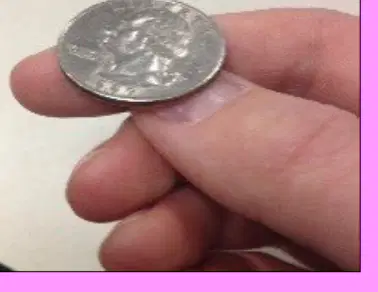
Match the following philosophical concepts with the analogies or ideas they are commonly associated with.
Contingency
Coin-toss analogy
Determinism
Everything is predetermined
Dualism
Mind-body distinction
Essentialism
Fixed inherent nature
The statement 'tails won the toss' is necessarily (a) .
What does 'a posteriori' knowledge mean as described in the passage?
Knowledge that is gained from experience or observation.
Knowledge that is innate and independent of experience.
Knowledge that is based solely on logical reasoning.
Knowledge that is universally accepted without proof.
According to Aquinas' Third Way: The argument from contingency, what does it mean for the universe to be contingent?
It exists necessarily and independently
Its existence and the way in which it exists depend on other factors
It cannot fail to exist
It is eternal
Aquinas' Third Way: The argument from contingency states that the universe we inhabit could have failed to exist altogether.
True
False
Fill in the blank: According to Aquinas' Third Way: The argument from contingency, a non-contingent thing, a necessary thing upon which the existence of the universe depends, must exist _______ of the universe.
outside
inside
within
because
According to Aquinas' Third Way: The argument from contingency, what is the non-contingent thing-outside-the-universe called?
God
The Big Bang
Matter
The Prime Mover
According to Aquinas' Third Way: The argument from contingency, anything that is non-contingent exists necessarily.
True
False
Do you agree or disagree with this statement?
Agree
Disagree
It is a fair assumption to think the question is about that God. Why or why not?
Yes, because the context implies it.
No, because the question does not specify which God.
Yes, because there is only one God.
No, because all gods are the same.

According to the passage, what does the system of pipes and taps represent in relation to the universe?
The laws of physics
The contingency of everything in the universe
The planets and stars
The flow of time
Fill in the blank: We know _______ that the universe right now could be different from the way it is [think about coin-tosses].
intuitively
mathematically
historically
accidentally
We 'kind of' know intuitively that the universe could have totally failed to exist. It could have failed to begin in the (a) place.
There is nothing to stop us assuming that the universe had no beginning.
True
False
Fill in the blank: The (current) _______ of the universe is intuitively contingent.
nature
color
temperature
size
Fill in the blank: The very _______ of the universe might not be contingent.
existence
color
temperature
shape
A universe with no beginning would, by definition, have no creator.
True
False
Fill in the blank: If, by that definition, the universe has no _______, then no proof is necessary.
creator
beginning
purpose
end
What is the name of the scientific theory that holds the view that the universe had no beginning?
the steady state theory
the big bang theory
the inflationary theory
the oscillating universe theory

Which analogy is used to represent Aquinas' first and second ways?
Dominoes falling in a line
A network diagram
An acorn growing into a tree
A circle
What does Hume say about the necessary connection between two events?
The necessary connection between the two events simply cannot be known.
The necessary connection is always evident through observation.
The necessary connection is established by logical deduction alone.
The necessary connection is a product of divine intervention.
According to Hume, why can't we apply the idea of cause and effect to the beginning of the universe?
Nobody was around to witness the beginning of the universe, so we can’t even begin to apply the idea of cause and effect.
The laws of physics were different at the beginning of the universe, so cause and effect did not exist.
Hume believed the universe had no beginning, so the question is meaningless.
Cause and effect only apply to living beings, not to the universe.
The response to Hume's first objection about cause and effect is that (a) .

What analogy is used to illustrate Hume's first objection?
The analogy of the white ball causing other balls to move (as in a game of billiards or snooker).
The analogy of a tree falling in a forest with no one around to hear it.
The analogy of a ship sailing across the ocean.
The analogy of a candle melting in the sun.
Fill in the blank: Even if one effect seems to have a cause, this doesn't mean that there has to be a ______ going back to a first cause.
chain
circle
pattern
reason
Fill in the blank: Maybe the universe is ______ – why do we have to assume it had a beginning?
eternal
finite
temporary
artificial
Match each type of effect with its possible cause.
finite
A finite effect can only ever have a ______ cause.
infinite
An infinite effect can only ever have a ______ cause.
random
An unpredictable effect can only ever have a ______ cause.
unknown
An effect with no known origin can only ever have a ______ cause.
Fill in the blank: Aquinas' Third Way states that God is necessarily true. For Hume there is no such thing as a ______ being.
necessary
contingent
finite
eternal
Fill in the blank: Anything that can be claimed to exist can also be claimed ______ to exist.
not
always
rarely
often
Aquinas’ 1st, 2nd and 3rd ‘ways’ are:
The arguments from motion, causation, and contingency
The arguments from design, morality, and beauty
The arguments from experience, reason, and faith
The arguments from knowledge, belief, and truth
Aquinas’ 1st, 2nd and 3rd ways are based upon which intuitive principles?
Causality, contingency, and motion
Empiricism, rationalism, and skepticism
Faith, hope, and charity
Justice, prudence, and temperance
Which of the following is an example of using analogies to show understanding of principles?
Comparing the flow of electricity to water in pipes
Listing the names of scientists
Reciting a definition from memory
Drawing a picture of a tree
Match each description of the universe with the assumption Aquinas makes in his 1st, 2nd, and 3rd ways as proofs of God’s existence.
Eternal and uncaused
The universe is not caused by anything and has always existed.
Finite and contingent
The universe has limits and depends on something else for its existence.
Infinite and necessary
The universe exists by necessity and has no beginning or end.
Self-sustaining and independent
The universe exists on its own without any external cause or support.
Aquinas’ 1st, 2nd and 3rd ways are limited as proofs of God’s existence. What is his cosmological argument able to prove?
That there must be a first cause or necessary being
That God is all-loving
That miracles exist
That the universe is eternal
As proofs of God’s existence, Aquinas’ 1st, 2nd and 3rd ways are limited. What is his cosmological argument not able to prove?
That God exists as a necessary being
That God is omnipotent and omniscient
That the universe had a beginning
That there is a first cause
What assumption does Aquinas make about the nature of the universe? Fill in the blank: He assumes it to be ________ old (i.e. he assumes it had a beginning). He assumes its existence to be ________ (i.e. it could have failed to exist).
finitely; contingent
infinitely; necessary
eternally; dependent
timelessly; absolute
What is Aquinas's cosmological argument able to 'prove'? Fill in the blanks: That so long as the changing universe is ________ old, there must be a ________ mover. That so long as there is not an ________ chain of cause and effect, there must be a ________ cause. That so long as the existence of the universe is ________, there must be a necessary thing-outside-the-universe.
finitely; first; infinite; first; contingent
infinitely; last; finite; last; necessary
eternally; unmoved; endless; unmoved; permanent
temporarily; prime; circular; prime; dependent
What is Aquinas's cosmological argument not able to prove? Fill in the blank: That this first mover/first cause/necessary thing is necessarily the ________-Christian God.
Judeo
Greek
Roman
Hindu
What is abiogenesis?
The creation of life from a non-living source
The destruction of life by living organisms
The process of photosynthesis
The theory that life always comes from pre-existing life
According to the Miller-Urey experiments from the 1950s, molecules containing the 'building blocks of life' can arise ________ out of simple chemicals when these are placed in simulated conditions similar to those of the very early Earth.
spontaneously
artificially
gradually
mechanically
The Miller-Urey experiments provide evidence that molecules containing the 'building blocks of life' can arise spontaneously out of simple chemicals when these are placed in simulated conditions similar to those of the very early Earth.
True
False
(a) from the 1950s provided evidence for the spontaneous formation of life's building blocks from simple chemicals.
What is the Latin term for 'out of nothing'?
ex nihilo
ad infinitum
per se
de facto
Who said: "Spontaneous creation is the reason there is something rather than nothing, why the universe exists, why we exist."?
Stephen Hawking
Albert Einstein
Carl Sagan
Richard Feynman
13-14 billion years ago, the universe existed in a ________.
single point
giant galaxy
cluster of stars
cloud of gas
The rapid expansion of the universe from a single point is called:
The Big Crunch
The Big Bang
The Steady State
The Great Expansion
Energy was turned into _______ ('stuff' came into existence) during the Big Bang.
mass
light
sound
gravity
According to the Big Bang Theory, at some instant the universe expanded at incredible speed and incredible ________.
temperature
distance
pressure
volume

