
 Worksheets
Honors FINAL EXAM review PART 3 for 24-25 (mostly Unit 7)
Total questions: 25
Worksheet time: 24mins
Which of the following is NOT a sign of a chemical change?
change in color
increase in temperature
evaporation
bubbling

Given the heating curve of a solid being heated at a constant rate, what is the boiling point of this substance?
20°C
50°C
110°C
170°C
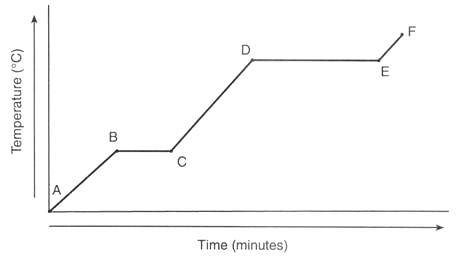

Which segment of the graph represents both melting and freezing?
AB
BC
DE
EF
C10H8 + 12O2 → 10CO2 + 4H2O
Synthesis
Double Replacement
Decomposition
Combustion
3Ca + 2AlCl3 → 3CaCl2 + 2Al
Synthesis
Single Replacement
Double Replacement
Decomposition
What state of matter should be written next to the CaCl2 in the reaction: 3Ca + 2AlCl3 → 3CaCl2 + 2Al ?
(s)
(aq)
(l)
(g)
What state of matter should be written next to the Al in the reaction: 3Ca + 2AlCl3 → 3CaCl2 + 2Al ?
(s)
(aq)
(l)
(g)
CaCO3 → CaO + CO2
Combustion
Double Replacement
Single Replacement
Decomposition
Balance the equation: __Al + __HCl → __H2 + __AlCl3
2, 6, 3, 2
4, 12, 3, 4
balanced
6, 3, 2, 3
Balance the equation: __P4 + __O2 → __P2O3
balanced
1, 2, 3
2, 1, 3
1, 3, 2
Based on the activity series, which metal could X represent in the reaction below?
X + Ca (NO3)2 --> Ca + X (NO3)2
Li
Mg
cannot determine
What will be the precipitate formed in this reaction: AgF + KCl --->
AgCl
KF
cannot determine
Which of the following processes REMOVES carbon dioxide from the atmosphere?
Animal respiration (Breathing)
Volcanic eruption
Photosynthesis
Burning fossil fuels
Why does cutting down trees increase global warming?
trees soak up carbon dioxide and removing them causes more carbon to stay in the atmosphere
trees provide shade which counteracts global warming
trees absorbs the sun's energy without radiating back into the atmosphere
trees drain greenhouse gases like methane from soil

What do greenhouse gases do in our atmosphere?
They absorb heat given off by the Earth
They block heat from reaching Earth
They help create clouds
They help keep gases "in" the Earth's atmosphere

With more greenhouse gases in the atmosphere, what do we expect to happen to Earth's average temperature?
Earth's temperature will increase
Earth's temperature will decrease
Earth's temperature will not change
Which of the following natural processes is a source of greenhouse gases, contributing to global warming?
Industrial production of CFCs
Volcanic eruptions
Fossil fuel combustion
Deforestation
Besides burning fossil fuels, what is one HUMAN activity that is contributing to climate change?
Recycling (converting waste into reusable material)
Forest restoration (replanting trees)
Conservation of energy use (use less energy)
Deforestation (cutting down trees)

The reactants in the image are:
CH4 and O2
H2O and CO2
All of these are reactants
All of these are products

A precipitate is a ___________ that forms when 2 liquids react together.
solid
liquid
gas
plasma
The product(s) of complete combustion of any hydrocarbon is/are _________________.
water
water and carbon dioxide
carbon dioxide
carbon monoxide
True or False: In incomplete combustion, one of the products might be CO
True
False
What reaction has the following general formula:
AB + CD --> CB + AD
Combination
Decomposition
Single Replacement
Double Replacement
Combustion
Which equation is balanced?
PbO2 + 2H2--> H2SO4
SO2 + H20 --> H2SO4
2Na + 2H2O --> 2NaOH + H2
2Na + 2H2O --> 2NaOH + H

