wayground logo

Free Printable Worksheets

NEW

Font size

S
M
L
XL
Worksheets

Cycle 3 revision

Total questions: 20

Worksheet time: 10mins

Name
Class
Date
1.

What type of plate boundary is this?

a)

Constructive plate boundary

b)

Conservative plate boundary

c)

Divergent plate boundary

d)

Distructive plate boundary

2.

What is a constructive plate boundary?

a)
A constructive plate boundary is where tectonic plates collide, causing earthquakes.
b)
A constructive plate boundary is where tectonic plates slide past each other without creating new crust.
c)
A constructive plate boundary is where tectonic plates move apart, allowing new crust to form from rising magma.
d)
A constructive plate boundary is where tectonic plates move downward, leading to volcanic eruptions.
3.

Which is the correct description of a shield volcano?

a)
A shield volcano has broad, gentle slopes formed by low-viscosity lava flows.
b)
A shield volcano is characterized by explosive eruptions and ash clouds.
c)
A shield volcano has steep, conical slopes formed by thick lava flows.
d)
A shield volcano is primarily made up of solid rock and lacks lava flows.
4.

Which is the correct description of a composite volcano?

a)
A composite volcano is a steep, layered volcano formed from explosive eruptions of viscous lava, ash, and tephra.
b)
A composite volcano is a volcano that forms exclusively from the accumulation of sedimentary rocks.
c)
A composite volcano is a flat, shield-shaped volcano formed from gentle lava flows.
d)
A composite volcano is a small, cone-shaped volcano that erupts only gas and steam.
5.

What is the correct definition of weather?

a)
Weather is the study of geological formations and their impact on the environment.
b)
Weather is the short-term state of the atmosphere at a specific time and place.
c)
Weather refers to the climate of a region over many years.
d)
Weather is the long-term average of atmospheric conditions.
6.

What is the correct definition of climate?

a)
Climate is the daily temperature in a region.
b)
Climate refers to the current weather conditions.
c)
Climate is the seasonal variation of weather patterns.
d)
Climate is the long-term average of weather in a specific region.
7.

If the weather across the UK is sunny and settled what kind of pressure is over the UK?

a)
Low pressure
b)
Tropical pressure
c)
Variable pressure
d)
High pressure
8.

Which greenhouse gas contributes most to climate change?

a)
Methane (CH4)
b)
Nitrous oxide (N2O)
c)
Ozone (O3)
d)
Carbon dioxide (CO2)
9.

What are the three variables on a climate graph?

a)

Temperature, precipitation, and month

b)
Air pressure, cloud cover, and season
c)
Soil type, vegetation, and sunlight
d)
Humidity, wind speed, and altitude
10.

Which of these statements about Antarctica or not true?

a)
Antarctica is the coldest continent on Earth.
b)
Antarctica has a tropical climate.
c)
Antarctica is home to a variety of wildlife including penguins.
d)
Antarctica is a desert with very little precipitation.
11.

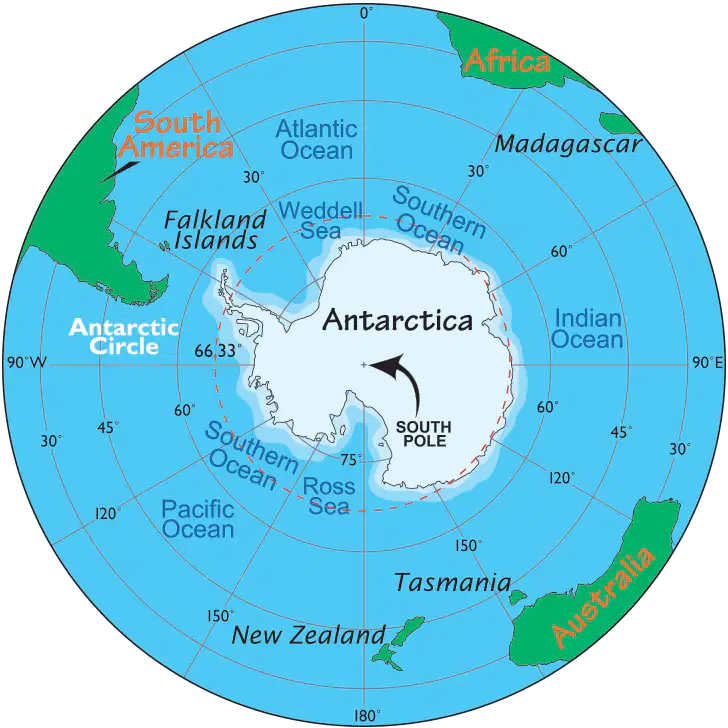
Which ocean surrounds Antarctica?

a)
Atlantic Ocean
b)
Indian Ocean
c)
Arctic Ocean
d)
Southern Ocean
12.

Which continent is closets to Antarctica?

a)
Australia
b)
Asia
c)
South America
d)
Africa
13.

Which biome covers nearly all of Antarctica?

a)
Savanna
b)
Tropical rainforest
c)
Temperate forest
d)
Polar desert
14.

What term is given to an organism within an ecosystem that if it was taken away the ecosytem would collapse?

a)
Primary producer
b)
Keystone species
c)
Invasive species
d)
Trophic level
15.

Which of the following best describes a destructive plate boundary?

a)

Where two plates collide and one is forced beneath the other, often causing earthquakes and volcanoes

b)

Where two plates slide past each other without creating or destroying crust

c)

Where plates remain stationary and do not interact

d)

Where two plates move apart and new crust forms

16.

What is the main reason for the extremely cold temperatures in Antarctica?

a)

Its high elevation and position at the Earth's southern pole

b)

Its frequent volcanic eruptions

c)

Its proximity to the equator

d)

Its dense forests and vegetation

17.

Which of the following is NOT considered a greenhouse gas?

a)

Carbon dioxide (CO2)

b)

Water vapor (H2O)

c)

Oxygen (O2)

d)

Methane (CH4)

18.

Which of the following best explains why Antarctica receives very little precipitation?

a)

Because it is surrounded by mountains that block all moisture

b)

Because cold air holds less moisture, resulting in low precipitation

c)

Because it is located near the equator

d)

Because it is covered by dense forests

19.

What is the primary cause of earthquakes at destructive plate boundaries?

a)

The plates moving apart and forming new crust

b)

The plates sliding past each other smoothly

c)

The plates remaining stationary for long periods

d)

One plate being forced beneath another, causing stress and sudden movement

20.

Which of the following is a characteristic of a polar desert biome?

a)

Dense vegetation and diverse animal life

b)

High temperatures and abundant rainfall

c)

Low precipitation and extremely cold temperatures

d)

Frequent volcanic eruptions