
NEW
Font size
 Worksheets
The Spread of Protestantism
Total questions: 47
Worksheet time: 24mins
Reform can influence society and beliefs by:
Maintaining the status quo
Encouraging change and new perspectives
Preventing any social progress
Eliminating all traditions
Martin Luther’s complaints about the Church included:
The sale of indulgences and Church corruption
The translation of the Bible into local languages
The construction of new cathedrals
The support for scientific discoveries
Define the vocabulary term: Annul.
Annul means to declare invalid, especially in reference to a marriage or legal agreement.
Annul means to support or uphold a decision.
Annul means to celebrate an event with great enthusiasm.
Annul means to delay or postpone an action.
Define the vocabulary term: Justification.
Justification is the action of declaring or making righteous in the sight of God.
Justification is the process of learning a new language.
Justification is the act of creating a legal document.
Justification is the method of organizing a scientific experiment.
Define the vocabulary term: Predestination.
Predestination is the doctrine that God has already chosen who will be saved and who will not.
Predestination is the belief that everyone can choose their own fate without any divine influence.
Predestination is the idea that only good deeds determine salvation, not divine choice.
Predestination is the concept that salvation is based solely on personal wealth and status.
Who was John Calvin?
John Calvin was a Swiss theologian and pastor who was a leading figure in the Protestant Reformation.
John Calvin was an Italian artist known for painting the Sistine Chapel.
John Calvin was a Spanish explorer who discovered the Pacific Ocean.
John Calvin was an English king during the Tudor dynasty.
Who was King Henry VIII (England)?
King Henry VIII was the King of England who separated the Church of England from the Roman Catholic Church.
King Henry VIII was the founder of the Spanish Inquisition.
King Henry VIII was the first emperor of the Holy Roman Empire.
King Henry VIII was a famous French philosopher.
Who was Pope Paul III?
Pope Paul III was the Pope who initiated the Counter-Reformation and called the Council of Trent.
Pope Paul III was the first Pope to travel to the Americas.
Pope Paul III was the Pope who excommunicated Martin Luther.
Pope Paul III was the Pope who built St. Peter's Basilica.
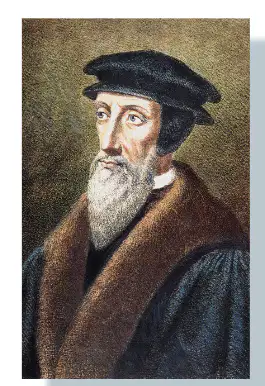
Who took leadership of Protestantism in Switzerland?
Martin Luther
John Calvin
Henry VIII
Ulrich Zwingli
John Calvin's work and ideas spread quickly because of what invention?
Printing press
Steam engine
Telegraph
Compass
What is a theocracy? Fill in the blank: A theocracy is a system of government in which ______ rule in the name of God or a god.
priests
citizens
soldiers
scientists
Why did Henry VIII want to divorce Catherine of Aragon?
A) She was not of royal blood
B) She did not produce a male heir
C) She was from another country
D) She was too old
What does the term 'Annul' mean as used in the context of Henry VIII's marriage?
To celebrate
To declare invalid
To approve
To delay
Who declared Henry VIII's marriage to Catherine of Aragon invalid in 1533?
The Pope
Archbishop of Canterbury
King Edward VI
Anne Boleyn
After Henry VIII's marriage to Catherine was annulled, who was made queen?
Catherine
Anne
Mary
Elizabeth
Who replaced Henry VIII after his death in 1547?
His daughter Mary
His son King Edward VI
The Pope
Archbishop of Canterbury
The Church of England was also known as the ________ Church after Henry VIII's death.
Anglican
Catholic
Orthodox
Lutheran
How old was King Edward VI when he became king?
9 years old
12 years old
15 years old
7 years old
Edward VI died of ________ when he was 15.
tuberculosis
influenza
measles
malaria
Who was Henry's daughter who came into power after his death in 1553?
Elizabeth I
Mary I
Anne Boleyn
Jane Seymour
What did Mary I want to restore in England?
Protestantism
Roman Catholicism
Monarchy
Democracy
How many Protestants did Mary I order to be burned as heretics?
100
200
300
400
Mary I was nicknamed '________ Mary'.
Bloody
Merry
Gentle
Kind
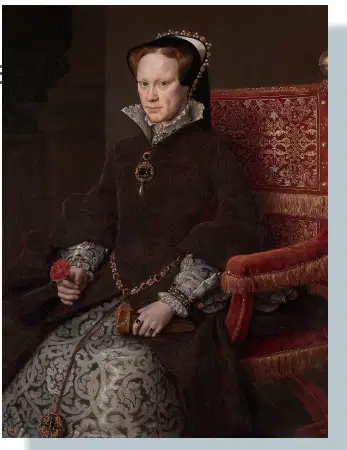
Who is depicted in the image labeled 'Queen Mary I'?
Queen Mary I
Queen Elizabeth I
Queen Victoria
Queen Anne
Who were the Anabaptists?
Members of the Catholic Church
Members of a fringe, or radical, movement of the Protestant Reformation and spiritual ancestor of modern Mennonites and Quakers
Leaders of the Roman Empire
Founders of the American government
Anabaptists believed that the church, the community of those who made a public commitment of faith, should be separated from the ________, which they believed existed only for the punishment of sinners.
state
family
school
market
Anabaptists believed in the separation of church and state.
True
False
Roots of American ideas on separation of church and state can be traced to the Anabaptists, who settled in which state?
California
Texas
New York
Virginia
What methods did Protestant teachers use in education during the societal changes of the Reformation?
Humanist methods
Scholastic methods
Traditional monastic methods
Oral folklore methods
Protestant teachers aimed their education at a wider audience than which type of schools?
Humanist schools
Grammar schools
Cathedral schools
Monastic schools
Who believed that all children should be educated and that the state should provide education during the Reformation? (Fill in the blank)
Martin Luther
John Calvin
Henry VIII
Ulrich Zwingli
According to Martin Luther, who should provide education?
The state
The church
Private individuals
Families
During the societal changes of the Reformation, who was allowed to marry that previously could not?
Clergy
Nobles
Merchants
Peasants
Traditional roles in marriage were still in place during the societal changes of the Reformation.
True
False
The Catholic Reformation: What was another name for the revitalization of the Church in the 16th century?
The Great Schism
The Counter-Reformation
The Protestant Reformation
The Renaissance

Who established the Society of Jesus (Jesuits) in 1540?
Ignatius of Loyola
Martin Luther
John Calvin
Francis Xavier
The Catholic Reformation: The Jesuits took a vow of absolute obedience to the _____?
pope
king
bishop
emperor
The Catholic Reformation: The Jesuits used _____ to spread their message.
War
Education
Trade
Art
The Catholic Reformation: Jesuit missionaries restored Catholicism to parts of Germany and Eastern Europe.
True
False
Reform of the papacy: Corruption had occurred throughout the blank: Corruption had occurred throughout the ________.
Renaissance
Industrial Revolution
Middle Ages
Enlightenment
Reform of the papacy: Who saw the need for reform during the Catholic Reformation?
Pope Paul III
Martin Luther
Henry VIII
John Calvin
Reform of the papacy: The Reform Commission blamed the church’s problems on the pope’s corrupt policies.
True
False
Who called the Council of Trent in 1545?
Pope Leo X
Pope Paul III
Pope Gregory VII
Pope Urban II
The Council of Trent was made up of which of the following groups?
Cardinals, archbishops, bishops, abbots, and theologians
Kings and queens
Merchants and traders
Artists and writers
The Council of Trent met occasionally for 18 years in ________ (modern day Italy).
Trent
Florence
Venice
Milan
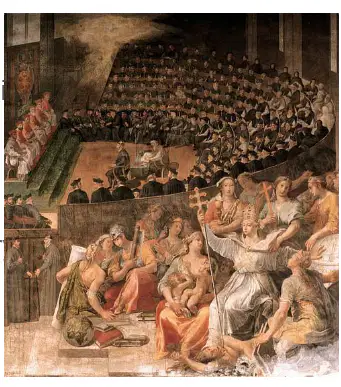
The selling of indulgences was forbidden after the Council of Trent.
True
False
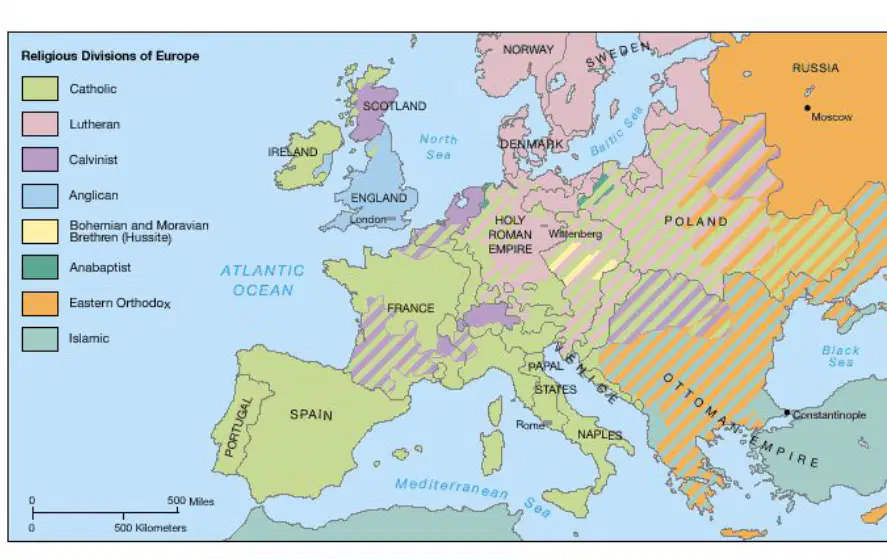
Refer to the map titled 'Religious Divisions of Europe, ca. 1555.' Which religion was practiced by the majority of European countries in 1555?
Catholic
Lutheran
Calvinist
Eastern Orthodox

