
 Worksheets
USHB Pre Test
Total questions: 42
Worksheet time: 21mins
Name
Class
Date
1.
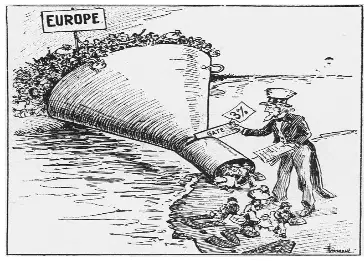
What is the message of this 1920’s political cartoon about immigration?
a)
Immigration is being significantly limited by the United States
b)
Immigration is changing the United States
c)
Immigration is happening in large numbers throughout the United States
d)
Immigrants are living in large cities once they arrive to the United States
2.
Why did banks fail during the Great Depression?
a)
They invested heavily in the stock market.
b)
They ran out of cash when depositors withdrew their money.
c)
They were unable to collect loan repayments.
d)
all of the above
e)
I don't know
3.
The aims of _____ could best be summarized as relief, recovery, and reform.
a)
the Reconstruction Finance Corporation
b)
the New Deal
c)
the government
d)
"safety nets"
e)
I don't know
4.
Which of the following is NOT considered a cause of the Great Depression?
a)
Overproduction
b)
stock speculation
c)
under consumption
d)
foreign competition
e)
I don't know
5.
What happened during the First Hundred Days of Franklin D. Roosevelt's presidency in regard to the Great Depression?
a)
Congress passed a record number of bills to promote economic recovery.
b)
Franklin Roosevelt toured the nation in a whirlwind presidential campaign.
c)
The Bonus Army gathered in the nation's capital to demand their bonus payments.
d)
The Reconstruction Finance Corporation issued a record number of business loans.
e)
I don't know
6.
The New Deal program that still exists today and that provides income for many retired Americans is the..
a)
Agricultural Adjustment Act
b)
Social Security Act
c)
Tennessee Valley Authority
d)
Works Project Administration
e)
I don't know
7.
At the beginning of World War II, which of these events caused Great Britain and France to declare war against Germany?
a)
Germany's seizure of the Sudetenland
b)
Germany's political union with Austria
c)
Germany's occupation of the Rhineland
d)
Germany's invasion of neighboring Poland
e)
I don't know
8.
What event pushed the United States into World War II?
a)
Germany’s invasion of Poland
b)
Italy’s invasion of Ethiopia
c)
Japan’s attack on Pearl Harbor
d)
I don't know
9.
Why had there been tensions between Japan and the United States in the period before the United States entered World War II?
a)
Japan sought to prevent the United States from entering the war against Germany.
b)
A U.S. trade embargo limited Japan's supply of goods needed by the military.
c)
The United States refused to provide Japan aid under the Lend-Lease Act.
d)
Japan wanted to expand into the eastern Pacific, near the United States.
e)
I don't know
10.
The Allied D-Day invasion of Europe was
a)
a final battle in the war for Europe.
b)
a turning point in the war in Russia.
c)
an air and sea attack on occupied France.
d)
I don't know
11.
Which of these allowed the United States to send "all aid short of war" to Britain despite its status as a neutral nation early in World War II?
a)
Atlantic Charter
b)
Double V campaign
c)
Lend-Lease Act
d)
Selective Training and Service Act
e)
I don't know
12.
What did Hitler take advantage of in order to spread his ideas?
a)
A strong alliance with the United States
b)
Germany’s need for oil in the Dutch East Indies
c)
The aggressive actions of Great Britain in the Rhineland region
d)
Germany’s economic depression following World War I
e)
I don't know
13.
Why did the Battle of Midway mark a turning point in the war?
a)
It was the last battle in the island-hopping campaign before the U.S. invaded Japan.
b)
The United States’ win was the first success in the island-hopping campaign.
c)
Japan’s losses rendered it incapable of being a direct threat to the United States.
d)
It made the Japanese realize that American air superiority would be their downfall.
e)
I don't know
14.
What was the goal of the government’s Manhattan Project?
a)
to create an Axis spy network
b)
to develop the atomic bomb
c)
to improve nuclear power plants
d)
to reduce urban unemployment
e)
I don't know
15.
At the beginning of the outbreak of World War II, why did the United States population passionately support isolationism and the neutrality acts?
a)
After World War I, they completely disbanded their military.
b)
They had a strong relationship with the Soviet Union and believed they could defeat Germany.
c)
They recalled the horrors of World War I and wanted to avoid getting drawn into a new conflict.
d)
I don't know
16.

Based on the document below, what conclusion can you make about how US war officials thought about using the atomic bomb on Japan during World War II?
a)
US war officials decided very early on that the atomic bomb would be used on Japan
b)
US war officials had differing opinions about how and whether or not to use the atomic bomb on Japan
c)
All US officials believed that a warning should be given to the Japanese before the bomb was used
d)
President Truman was kept out of the loop about the atomic bomb and knew very little about it
e)
I don't know
17.
Japanese Americans on the West Coast spent the years during World War II
a)
unjustly imprisoned in internment camps.
b)
supporting the war effort by working in factories.
c)
fearful of being attacked on the streets as enemy spies.
d)
working to undermine the Allied Powers.
e)
I don't know
18.
What role did African Americans serve in the military by the end of the World War II?
a)
They were not allowed in the military.
b)
They served in segregated combat units.
c)
They only served in non-combat positions.
d)
They served in fully integrated combat units.
e)
I don't know
19.
The spread of McDonald's fast-food franchises and Holiday Inns during the 1950s contributed most directly to which of these postwar trends?
a)
a population shift from small families to large families
b)
a population shift from northern states to southern states
c)
an economic shift from blue-collar jobs to white-collar jobs
d)
a rise of the Service Industry
e)
I don't know
20.
Which of the following MOST ACCURATELY describes planned postwar communities like Levittown?
a)
simple, low-cost housing for the working poor in cities
b)
large country homes designed to attract wealthy buyers
c)
small suburban homes that middle-class families could afford
d)
custom-designed homes built to meet the needs of individual buyers
e)
I don't know
21.
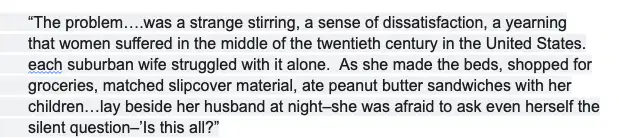
This document was written in 1963 about women's role in US society after World War II. Which statement is best supported by this document
a)
Women were involved in many activities outside of the home during the 1950s
b)
Women were very satisfied with their role in society after World War II
c)
Many women were not completely satisfied with their role as a mother and wife in the 1950s
d)
Women were beginning to protest publicly wanting to have more rights in US society during the 1950s
e)
I don't know
22.
What was the meaning of the famous phrase “iron curtain”?
a)
a symbolic barrier between the democratic western and communist eastern Europe
b)
a secret program for developing nuclear weapons
c)
a physical blockade built between western and eastern Berlin
d)
a political divide between radicals and traditionalists in America
e)
I don't know
23.
What was the economic goal of the Marshall Plan?
a)
hurting the finances of communist nations
b)
helping Europe recover from World War II
c)
rebuilding the United States’ infrastructure
d)
imposing sanctions on the German government
e)
I don't know
24.
What American politician launched a controversial campaign to uncover communists in the 1950s?
a)
Dwight Eisenhower
b)
Harry Truman
c)
John F Kennedy
d)
Joseph McCarthy
e)
I don't know
25.
The policy of containment led the U.S. into wars in
a)
Cuba and China.
b)
East and West Germany.
c)
Hungary and Poland.
d)
Vietnam and Korea.
e)
I don't know
26.
The Cold War ended with
a)
the American withdrawal from Vietnam.
b)
the peaceful resolution of the Korean War.
c)
a peace agreement between the superpowers.
d)
the collapse of communism in the Soviet Union.
e)
I don't know
27.
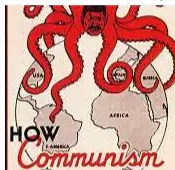
Which Cold War figure is pictured on the octopus?
a)
Winston Churchill
b)
Joseph Stalin
c)
Harry Truman
d)
Joseph McCarthy
e)
I don't know
28.
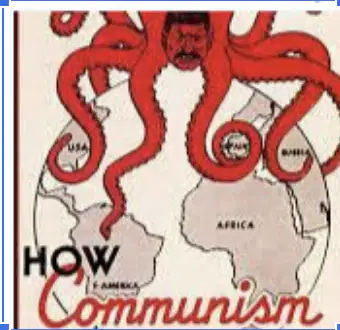
What does the octopus represent, and what is it trying to do?
a)
Communism trying to help people around the world
b)
Democracy trying to take over the world
c)
Communism trying to take over the world
d)
Vietnam trying to take over the world
e)
I don't know
29.
What effect did television have on attitudes toward the Vietnam War?
a)
Viewing the violence of war persuaded people that the war was not worth fighting.
b)
Seeing protests convinced many that the war was unjust.
c)
Watching the Fulbright hearings convinced people the war was worth fighting.
d)
Seeing positive stories about American soldiers sustained public support for the war.
e)
I don't know
30.
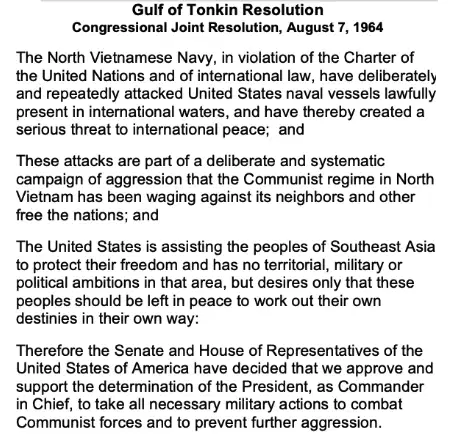
According to this document, the North Vietnamese Navy
a)
Was defending themselves against other nations
b)
Was receiving help from the United States
c)
Was taking all necessary steps to defend its nation against Communism
d)
Was attacking US ships that were lawfully present in international waters
e)
I don't know
31.
What were the primary goals of the civil rights movement of the 1950s and 1960s?
a)
electing more African Americans to office and fighting corruption
b)
ending poverty and improving opportunities for the poor
c)
ending racial segregation and securing equal rights for all Americans
d)
protecting immigrants and ending restrictions on immigration
e)
I don't know
32.
The Brown vs. Board of Education Supreme Court court decision of 1954 declared that
a)
school segregation was a matter for local governments.
b)
school segregation was illegal.
c)
segregated buses were unconstitutional.
d)
separate but equal facilities were constitutional.
e)
I don't know
33.
Martin Luther King Jr. supported nonviolent resistance because he believed it would
a)
allow activists to achieve their goals without anyone noticing.
b)
convince the public of the righteousness of the movement's goals.
c)
prevent protestors from being arrested and put in jail.
d)
show that separate facilities were inherently unequal.
e)
I don't know
34.
President Eisenhower sent federal troops to Little Rock, Arkansas, in 1957 to
a)
arrest governor Orval Faubus for defying a court desegregation order.
b)
prevent African Americans from entering Central High School.
c)
protect Central High School from Ku Klux Klan attacks.
d)
protect the first black students to attend Central High School.
e)
I don't know
35.
The black power movement was different from the movement led by Martin Luther King Jr. because it
a)
promoted racial integration.
b)
embraced the use of violence.
c)
tried to bring about more gradual change.
d)
was led by white activists.
e)
I don't know
36.
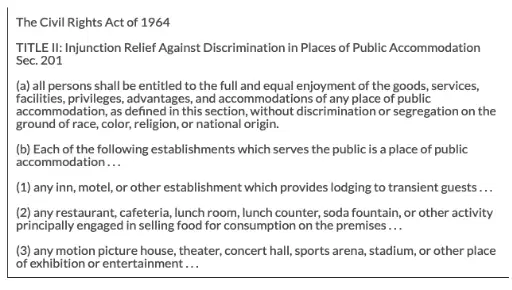
The purpose of Section 201 of the Civil Rights Act of 1964 is to
a)
promote racial peace and understanding.
b)
discourage job discrimination.
c)
ban discrimination in public accommodations.
d)
end segregation in schools.
e)
I don't know
37.
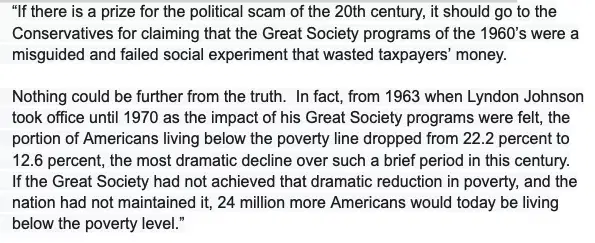
According to the document below, the Great Society Program of the 1960s
a)
Was one of the greatest political scams of the 20th century
b)
Greatly reduced poverty in the US during the 1960s
c)
Increased poverty to from 22% in 1963 to 24% in 1970
d)
Wasted taxpayer money
e)
I don't know
38.
What country ruled Vietnam before the war?
a)
a) China
b)
b) France
c)
c) Japan
d)
d) United States
e)
I don't know
39.
What was the main goal of the United States in the Vietnam War?
a)
a) To expand communism
b)
b) To help North Vietnam
c)
c) To stop communism from spreading
d)
d) To take over Vietnam
e)
I don't know
40.
What was the fighting style used by the Viet Cong?
a)
a) Traditional battle formations
b)
b) Guerrilla warfare
c)
c) Naval attacks
d)
d) Airstrikes
e)
I don't know
41.
What was the Tet Offensive?
a)
a) A U.S. military strategy
b)
b) A surprise attack by the Viet Cong
c)
c) A peace treaty
d)
d) A battle between the U.S. and China
e)
I don't know
42.
How did the Vietnam War affect America?
a)
a) It helped people trust the government
b)
b) It divided the nation
c)
c) It made communism stronger in the U.S.
d)
I don't know
100 %

