
 Worksheets
F5-CÂU HỎI
Total questions: 83
Worksheet time: 42mins
A company produces a range of products and uses an absorption costing system. Which of the following are unlikely to be a consequence of the company switching to an activity based costing (ABC) system?
Indirect overheads will be shared between products on fairer bases
Product pricing decisions will be improved
Cost control on indirect overheads will be harder to achieve
Total production cost of each product will change

$29.76
$8.93
$71.43
$80.00
Which of the following statements about activity based costing is true?
The cost driver for quality inspection is likely to be batch size
The cost driver for materials handling and despatch costs ís likely to be the number of orders handled
In the short run, all the overhead costs for an activity vary with the amount of the cost driver for the activity
A cost is an activity based cost
Which of the following statements about activity based costing is true?
ABC recognises the complexity of modern manufacturing by use of multiple cost drivers
ABC reapportions support activity costs
ABC is an apportion costing system when overheads vary with time spent on production
Implementation of ABC is unlikely to be cost effective when variable production cost are a low proportion of total production costs are a low proportion of total production costs
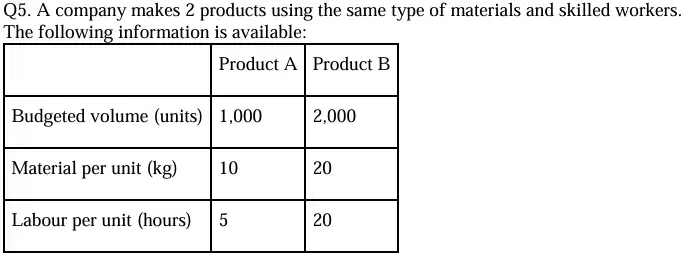
Fixed costs relating to material handling amount to $100,000. The cost driver for these costs is the volume of material purchased. General fixed costs, absorbed on the basis of labor hours, amount to $180,000.
Using activity-based costing, what is the total fixed overhead amount to be absorbed into each unit of product A ( to be nearest whole 5)?
$113
$120
$40
$105
In target costing, which of the following would be an appropriate strategy to reduce a cost gap for a product that existed in a competitive industry with demanding shareholders?
Increase the selling price
Reduce the expectation gap by reducing the selling price
Reducing the desired margin on the product
Mechanizing production in order to reduce average production cost
Which of the following strategies would be an immediately acceptable method to reduce an identified cost gap?
Reduce the desired margin without discussion with business owners
Reduce the predicted selling price
Source similar quality material from another supplier at reduced cost
Increase the predicted selling price
Which of the following techniques is NOT relevant to target costing?
Value analysis
Variance analysis
Functional analysis
Activity analysis
The selling price of product Z is set to be $250 for each unit and sales for the coming year are expected to be 500 units. The company requires a return of 15% in the coming year on its investment of $350,000 in product Z.
What is the target cost for each unit of Z for the coming year? Select from the list as appropriate.
$105
$145
$212.5
$250
Dimo Co wants to calculate a target cost for a new product X. The price of X will be set at $20,950. The company requires a 12% profit margin on sales. What is the target cost?
$18,436
$18,705
$20,950
$23,464
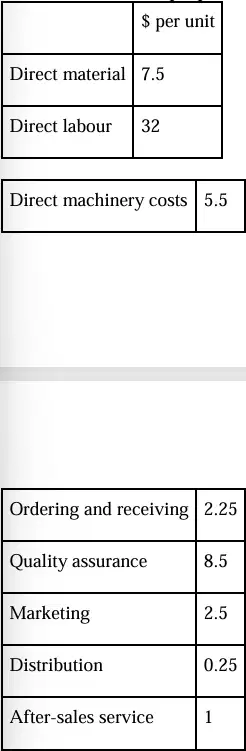
Dimo Co. Is in the process of introducing a new product Z. The target selling price has been set at $78 per unit in order to achieve the required sales volume. Cost estimates have been prepared based on the proposed product specification.
The target profit margin for the product in 30% of the target selling price What is the target cost gap?
$1.15
$3.65
$3.9
$4.9
Which of the following is the correct formula to calculate target cost gap?
Target cost gap = Target selling price - Target profit
Target cost gap = Target selling price - Target cost
Target cost gap = Estimated cost - Target cost
Target cost gap = Target selling price - Estimated cost
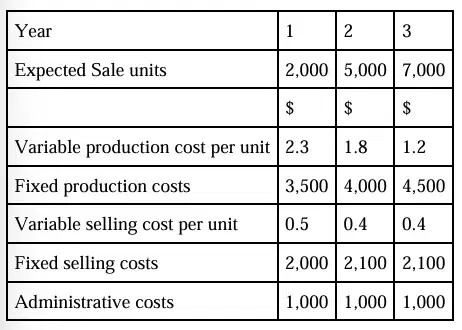
A company has produced the following information for a product it is about to launch. The product is expected to have a life of three years.
What is the life-cycle cost per unit?
$2.64
$2.84
$3.29
$3.5

The company’s total fixed production overheads are budgeted to be $72 million each year and total machine hours are budgeted to be 96 million hours. The company absorbs overheads on a machine hour basis.
What is the budgeted life-cycle cost per unit for product X?
$25.08
$25.15
$27.33
$27.4
Which of the following are said to be benefits of life-cycle costing?
(i) It provides the true financial cost of a product
(ii) The length of the life-cycle can be shortened
(iii) Lower costs can be achieved earlier by designing our costs
(iv) Better selling prices can be set
(i), (ii) and (iii) only
(i), (iii) and (iv) only
(ii), (iii) and (iv) only
All of the above
Which of the following is NOT the benefit of life-cycle costing?
Decline stages of the life-cycle can be avoided
Lower costs can be achieved earlier by designing out costs
Expensive error can be avoided in that potentially failing products can be avoided
It provides the true financial cost of a product
In which of the following ways might financial returns be improved over the life cycle of a product?
(i) Minimizing the breakeven time
(ii) Minimizing the time to the market
(iii) Maximizing the length of the life-cycle
(i) only
(i) and (ii) only
(ii) and (iii) only
All of the above
BL Co. is about to start developing a new product for launch in its existing market. They have forecast sales of 30,000 units and the marketing department suggests a selling price of $45/unit. The company seeks to make a mark-up of 40% product cost. It is estimated that the lifetime costs of the product will be as follows: Design and development costs $45,000 Manufacturing costs $15/unit Plant decommissioning costs $30,000 The company estimates that if it were to spend an additional $15,000 on design manufacturing costs/unit could be reduced
What is the life-cycle cost per unit of the new product?
$17.5
$18
$23.5
$24
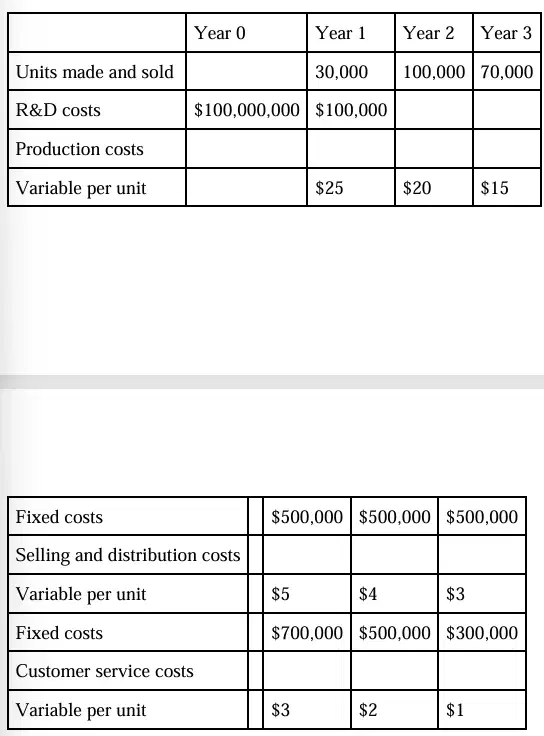
The following information relates to the expected cost of a new product over its expected three-year life.What is the expected average life-cycle cost per unit?
$45.10
$35.10
$45.35
$27.23
The following costs have arisen in relation to the production of a product:
(i) Planning and design costs
(ii) Testing costs
(iii) Production costs
(iv) Customer service costs
In calculating the life-cycle cost of a product, which of the above items would be included?
(iii) only
(i) and (iii) only
(i), (ii) and (iii) only
All of the above
Which of the following statements about life-cycle costing is TRUE?
A product is usually most profitable during the growth of its life-cycle
Life-cycle costing is useful for deciding the selling price for a product
An important use of life-cycle costing is to decide whether to go ahead with the development of a new product
Life-cycle costing is most useful for products with an even weighting of cost over their life
Different management accounting techniques can be used to account for environmental costs. One of these techniques involves analyzing costs under three distinct categories: material, system and delivery and disposal? What is this technique known as?
Activity based costing
Life-cycle costing
Input-output analysis
Flow cost accounting
Which of the following statements is/are true regarding the issue faced by business in the management of their environmental costs? (i) The costs involved are difficult to define
(ii) Environmental costs can be categorized as quality related cost (iii) Cost control can be an issue, in particular if costs have been identified incorrectly in the first place.
(i) only
(ii) and (iii) only
None of them
All of them
Flow cost accounting is a technique which can be used to account for environmental costs. Inputs and outputs are measured through each individual process of production
Which of the following is NOT a category within flow cost accounting?
Material flows
Waste flows
System flows
Delivery and disposal flows
Accountants usually find it difficult to deal with environmental costs. Which of the following is NOT a reason for this?
Costs are often hidden
Costs are mostly minor
Cost are often very long term
Accounting systems rarely split off these costs automatically
The contribution ratio of product A is 40%. The manufacturer of product A wishes to make a contribution of $100,000 towards fixed costs. If the selling price is $ per unit, the number of units of A that must be sold is:
50,000 units
40,000 units
20,000 units
8,000 units
A company makes a single product and incurs fixed costs of $100,000 per month. Variable cost per unit is $10 and each unit sells for $20. It’s budgeted to sell 10,000 units monthly.
How much is a contribution earned from each $1 of sales revenue?
$2
$1
$0.5
$0.25
Taylor. Co makes a single product, which it sells for $25 per unit. Fixed costs are $87,500 per month and the product has a contribution ratio of 25%. In a month when actual sales were $425,000, Taylor’s margin of safety, in units, was:
17,000 units
14,000 units
3,500 units
3,000 units
The following information is available for a manufacturing company which procedures multiple products:
(i) The production mix ratio
(ii) Contribution to sales ratio for each product
(iii) General fixed cost
(iv) Method of apportioning general fixed costs
Which of the above are required in order to calculate breakeven sales revenue for the company?
(i), (ii) and (iii) only
(i), (ii) and (iv) only
(ii) and (iii) only
All of the above
A company makes a single product and incurs fixed costs of $90,000 per month. Variable cost per unit is $10 and each unit sells for $25.
The breakeven point in terms of monthly sales units is:
9,000 units
6,000 units
3,600 units
None of the answers are correct
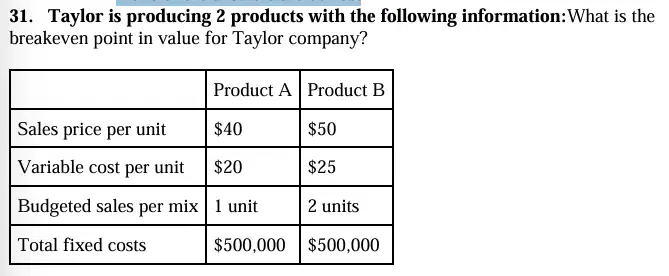
Impossible to calculate without more information
$1,000,000
$1,125,000
$1,500,000

Impossible to calculate without more information
$1,500,000
$1,700,000
$2,000,000
Which of the following statements regarding cost-volume-profit analysis are correct?
(i) It assumes that selling prices remain constant
(ii) It ignores non-production costs
(iii) It ignore economies of scale that impact on the cost per unit
(iv) It assumes that fixed costs remain constant throughout the range of production and sales volumes
(i) and (ii) only
(i), (ii) and (iii) only
(ii), (iii) and (iv) only
(i), (iii) and (iv) only
A company has fixed costs of $1.3 million. Variable costs are 55% of sales up to a sales level of $1.5 million, but at higher volumes of production and sales, the variable cost for incremental production units falls to 52% of sales.
What is the breakeven point in sales revenue, to the nearest $1,000?
$1,977,000
$2.027,000
$2,708,000
2,802,000
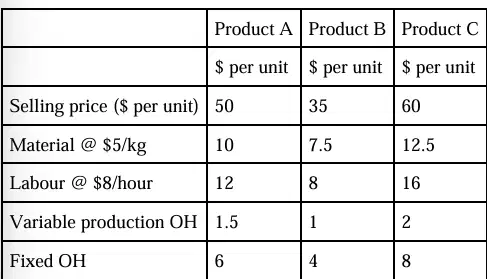
A company makes three products to which the following budget information relates:
Maximum annual demand in for 2.000 units of product A, 1500 unit of product B and 1200 unit of product C, and the factory has budgeted to produce that number of units. It has just been discover that next year material will be limited to 9000kg and labor to 7000 hours If the company wishes to maximize profit, the priority in which the products should be made and sold is:
A then B then C
A then C then B
B then A then B
B then C then C

Only 5,000 hours of machine time will be available during the period, and subcontractor has quoted the following unit prices of supplying components : X$14, Y$12, Z$18. What should production mix be to maximize profit?
1000 units of X, 1000 units of Y, 800 units of Z
750 units of X, 1000 units of Y, 1000 units of Z
1000 units of X, 500 units of Y, 1000 units of Z
None of the answer are correct

$ 26,200
$ 14,200
$24,997
$32,000
The following statements have been made about the use of the graphical method of solving linear programmes:
(i) It can only be used to solve programmes with two variables (c.g. two products)
(ii) It can only be used to solve problems with two constraints
(iii)It assumes that the objective function (e.g. contribution) is a linear function
(iv) There will always be one unique solution (e.g. production plan)
Which of the above statements is/are correct?
(i) and (iii)
(iii) only
(i) and (iv)
(ii) only
Which of the following costs are not identified as relevant
Opportunity cost
Incremental cost
Futured cost
Committed cost
A machine owned by a company has been idle for some months but could now be used on a one year contract which is under consideration. The net book value of the machine is $1,000. If not used on this contract, the machine could be sold now for a net amount of $1,200. After use on the contract, the machine would have no saleable value and the cost of disposing of it in one year's time would be $800. What is the total relevant costs of the machine to the contract?
$400
$800
$1,200
$2,000
"The value of a benefit sacrificed in favor of an alternative course of action"
Which term is best described by the definition above?
Avoidable cost
Relevant cost
Variable cost
A contract is under consideration which requires 600 labor hours to complete. There are 350 hours of spare labor capacity. The remaining hours for the contract can be found either by weekend overtime working paid at double the normal rate of pay or diverting labor from the production of product A. If the contract is undertaken and labor is diverted, then sales of product A will be lost. Product A takes three labor hours per unit to produce and makes a contribution of $12 per unit. The normal rate of pay for labor is $9 per hour. $1,000
What is the total relevant cost of labor for the contract?
$1,000
$2,250
$3,250
$4,500
Your company is launching a brand new product that would require two types of labor: 10 hours of skilled labor along with 5 hours of semi-skilled. If a skilled worker is free and can work on the product, the payment would be $8 per hour. On the other hand, if the skilled worker must be taken from another job, replacement would cost $6 per hour for the work they are supposed to do in the presettleed job. For semi-skilled workers, the rate is $3 per hour and workers appointed for this work are additional.
Determine the relevant cost of labor needed for one unit of the new product?
$95
$155
$15
$75
Annual rent of the store is $500,000. The annual rent cost is not a relevant cost.
Why is this cost NOT a relevant cost?
It is an uncontrollable cost
It is not an opportunity cost
It occurs in every plans
It is a notional cost
The price of a good is $5 per unit and annual demand is 1,000,000 units. Market research indicates that an increase in price of 25 cents per unit will result in a fall in annual demand of 100,000 units.
What is the price elasticity of demand? (Ignore the negative sign)
2
1
0.5
1.25
The following statements have been made about price elasticity of demand.
(i) When sales demand is inelastic, a company can increase profits by rising the selling price of its product.
(ii) Price elasticity of demand is a measure of the extent of change in market demand for a good in response to a change in its price.
Which of the above statements is/are true?
(i) only
(iI) only
Neither (i) or (ii)
Both (i) and (ii)
In a traditional pricing environment, which of the following “C” words is NOT traditionally considered when setting a price?
Cost
Cash flow
Competition
Customers
If the demand for a product is 5,000 units when the price is $400 and 6,000 units when price is $380, what is the optimal price to be charged in order to maximize profit if the variable cost of the product is $200?
$150
$350
$200
$700
The following price and demand combinations have been given: P1 = 400, Q1 = 5,000 P2 = 380, Q2 = 5,500 The variable cost is a constant $80 per unit and fixed costs are $600,000 per annum.
What is the optimal price and maximum profit?
Price = 340. Maximum profit = $1,090,000
Price = 240. Maximum profit = $1,090,000
Price = 340. Maximum profit = $1,000,000
Price = 240. Maximum profit = $1,080,000
Blake produces one single product A. Variable costs per unit are $15. Total fixed overheads are $120,000 per annum. Budgeted sales per month are 400 units to allow the product to break even.
Calculate the budgeted price for product A.
$315
$300
$40
$10
The following statements have been made about cost plus pricing. (i) A price in excess of full cost per unit will always ensure that a company will cover all its costs and make a profit. (ii) Cost plus pricing is an appropriate pricing strategy when jobs are carried out to customer specifications.
Which of the above statements is/are true?
(i) only
(ii) only
Neither (i) nor (ii)
Both (i) and (ii)
Which of the following terms would NOT normally be used to describe a relevant cost for a decision?
Incremental
Future
Cash flow
Fixed cost
Which of the following pricing policies is the most appropriate for a new product for which the price elasticity of demand is expected to be inelastic?
Marginal cost plus
Market skimming
Penetration pricing
Price discrimination
A company currently sells a products for $100 and at this price, demand is 2,000 units per month. It has been estimated that for every $4 increase or reduction in the price, monthly demand will fall or increase by 100 units. What is the formula for the demand curve for this product?
A. P = 180 - 0.04*Q
A. P = 100 - 0.04*Q
A. P = 180 - 0.05*Q
A. P = 150 - 0.04*Q
Which one of the following is not the objective of a budgetary system?
Planning
Control
Ensuring success
Motivation
Which one of the following is the best description of “top-down budgeting approach”?
Senior manage set budget targets and prepare budgets that meet the targets
Senior managers set budget targets; Lower managers prepare budgets that meet the targets
Lower managers set budget targets and prepare budgets that meet the targets
All of the above are wrong.
Which one of the following is the best description of “bottom-up budgeting approach”?
Lower managers draft the budgets: Senior managers combine lower budgets
Lower managers draft the budgets and combine those budgets.
Senior managers draft the budgets and combine lower budgets
All above are wrong.
‘Next year’s budget is prepared by using the current year’s actual results as a starting point, and making adjustments for expected inflation, sales growth or decline and other known changes’ is the principle of which following budgeting approaches?
Incremental budgeting
Zero-based budgeting
Activity-based budgeting
Rolling budgets
Which of the following is the advantage of ‘incremental budgeting approach’?
Builds in previous problems and inefficiencies
Managers may spend for the sake of spending in order to use up their budget for year and thus ensure that they get the same (or a larger) budget next year
Uneconomical activities may be continued
Suitable for organizations that operate in a stable environment
The budget for each cost center should be made from 'scratch' or zero' is the principle of which following budgeting approaches?
Incremental budgeting
Zero-based budgeting
Activity-based budgeting
Rolling budgets
Defining the key activities that account for overhead spending, and considering the costs of the activity' is the principle of which following budgeting approaches?
Incremental budgeting
Zero-based budgeting
Activity-based budgeting
Rolling budgets
Which of the following budgets may be used when the pace of change in the business environment is fast and continual?
Incremental budgeting
Zero-based budgeting
Activity-based budgeting
Rolling budgets
The first unit of output of a new product requires 80 hours. An 85% learning curve applies. Output is being doubled each time. What's the average time per unit if there are 4 units produced?
68 hours
57.8 hours.
54.8 hours.
51.6 hours.
The first unit of output of a new product requires 80 hours. An 85% learning curve applies. Output is being doubled each time. What's total time for production if there are 4 units produced?
272 hours.
231.2 hours
241.2 hours
239 hours
A company operates in export and import markets, and its operational cash flows are affected by movements in exchange rates, which are highly volatile. As a result, the company has great difficulty in establishing a budgeting system that is reliable for more than three months ahead. Which of the following approaches would be most appropriate for this company's situation?
Flexible budget
Incremental budget
Rolling budget
Zero based budget
'Ideal standard':
Can be attained under perfect operating conditionsCan be attained under perfect operating conditions
Can be attained if production is carried efficiently, machines are properly operated and/or materials are properly used
Based on current working conditions
Remains unchanged over the years and is used to show trends
'Attainable standard':
Can be attained under perfect operating conditions
Can be attained if production is carried out efficiently, machines are properly operated and/or materials are properly used
Based on current working conditions
Remains unchanged over the years and is used to show trends
The following statements have been made about standard mix and yield variances.
(1) Mix variances should be calculated whenever a standard product contains two or more direct materials.
(2) When a favorable mix variance is achieved, there may be a counterbalancing adverse yield variance.
Which of the above statements is/are true?
1 only
2 only
Both 1 and 2
Neither 1 nor 2
The following statements have been made about standard mix and yield variances.
(1) Mix and yield variances enable management to resolve problems with the quality of production output.
(2) Persistent adverse mix variances may have an adverse effect on sales volume variances and direct labour efficiency variances.
Which of the above statements is/are true?
1 only
2 only
Both 1 and 2
Neither 1 nor 2

What was the materials mix variance?
880 (F)
880 (A)
1,090 (F)
1,090 (A)

What was the materials mix variance?
270 (F)
270 (A)
271 (F)
271 (A)

What was the materials mix variance?
25 (F)
26 (F)
27 (F)
28 (F)
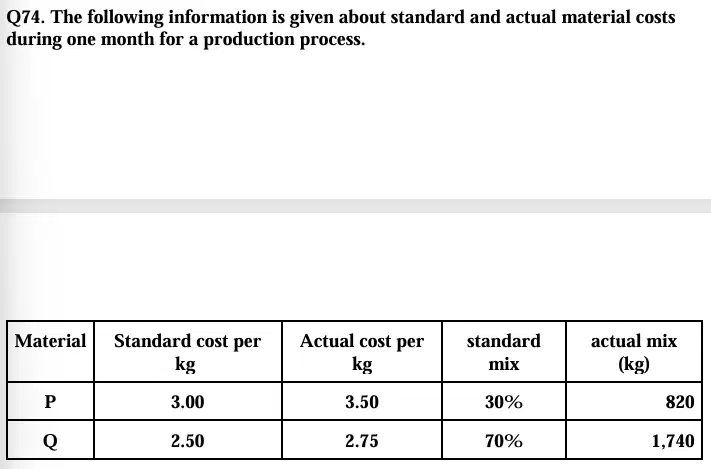
What was the materials mix variance?
26 (A)
27 (A)
28 (A)
29 (A)

What was the materials mix variance?
100 (F)
101 (F)
102 (F)
103 (F)
For which one of the following variances should a production manager usually be held responsible?
Material price planning variance
Material price operational variance
Material usage planning variance
Material usage operational variance
A standard product uses 3 kilograms of direct material costing $4 per kg. During the most recent month, 120 units of the product were manufactured. These required 410 kilograms of material costing $4.50 per kg. It is decided in retrospect that the standard usage quantity of the material should have been 3.5 kg, not 3 kg.
What is the materials operational usage variance, if it is chosen to use planning and operational variances for reporting performance?
40 (F)
40 (A)
50 (F)
50 (A)
A standard product uses 3 kilograms of direct material costing $4 per kg. During the most recent month, 120 units of the product were manufactured. These required 410 kilograms of material costing $4.50 per kg. It is decided in retrospect that the standard usage quantity of the material should have been 2.5 kg, not 3 kg. What is the materials operational usage variance, if it is chosen to use planning and operational variances for reporting performance?
440 (F)
440 (A)
450 (F)
450 (A)
A standard product uses 3 kilograms of direct material costing $4 per kg. During the most recent month, 120 units of the product were manufactured. These required 410 kilograms of material costing $4.50 per kg. It is decided in retrospect that the standard usage quantity of the material should have been 3.5 kg, not 3 kg. What is the materials planning usage variance, if it is chosen to use planning and operational variances for reporting performance?
240 (F)
240 (A)
250 (F)
250 (A)
A standard product uses 3 kilograms of direct material costing $4 per kg. During the most recent month, 120 units of the product were manufactured. These required 410 kilograms of material costing $4.50 per kg. It is decided in retrospect that the standard usage quantity of the material should have been 2.5 kg, not 3 kg. What is the materials planning usage variance, if it is chosen to use planning and operational variances for performance?
240 (F)
240 (A)
250 (F)
250 (A)
Which one of the following is not a financial performance indicator?
Revenues
Cost
Profit
Innovation
Which one of the following is NOT a financial performance indicator?
Service quality
Reliability
Assets value
Flexibility
Which one of the following is NOT the perspective of a balanced scorecard
Financial
Customer
Digital transformation
Innovation
In which one of the following centers, a manager is responsible for cost, revenue and asset?
Investment center
Profit center
Revenue center
Cost center

