
 Worksheets
Economics - Final Exam (2023)
Total questions: 129
Worksheet time: 1hrs 5mins
Name
Class
Date
1.
Paradox of value refers to the
a)
high value of an essential item and the low value of a nonessential item.
b)
high value of a nonessential item and the low value of an essential item.
c)
contradiction of what consumers want and what they need.
d)
contradiction between gross domestic product and market value.
2.
What was the name of Adam Smith's philosophy that focused on self-interested individuals operating through a system of mutual interdependence?
a)
Invisible Hand
b)
Laissez-faire
c)
trickle down economics
d)
Five Year Plan
3.
A nation’s wealth is determined by its
a)
accumulation of all tangible and intangible resources.
b)
natural resources.
c)
accumulation of all tangible products.
d)
product possibilities frontier.
4.
The most comprehensive measure of a nation’s wealth is provided by its
a)
gross domestic product.
b)
product possibilities curve.
c)
TINSTAAFL rating.
d)
capital goods.
5.
Which of the following statements best describes the purpose of the production possibilities curve?
a)
It predicts the future production of a nation.
b)
It identifies trends in production.
c)
It shows which products are most profitable.
d)
It identifies all possible combinations of goods and services an economy can produce.
6.
Which of the following descriptions best explains the meaning of opportunity cost?
a)
the initial cost of starting a new business
b)
the cost of business failure
c)
the cost of choosing one alternative over another
d)
the risk associated with producing a new item
7.
Consumers waiting in long lines for a new product is an example of
a)
consumerism.
b)
consumer rights.
c)
consumer responsibilities.
d)
scarcity.
8.
When a nation’s total output increases over time, the nation is experiencing
a)
a decrease in gross domestic product.
b)
economic growth.
c)
economic interdependence
d)
an expansion of the possibilities curve.
9.
The efficient use of scarce resources leads to an increase in
a)
productivity.
b)
investment.
c)
scarcity.
d)
capital.
10.
When a business needs to decide whether a certain action is worth the cost, the most helpful analysis would be a(n)
a)
production possibility comparison
b)
cost-benefit analysis.
c)
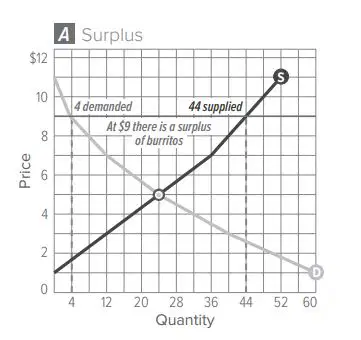
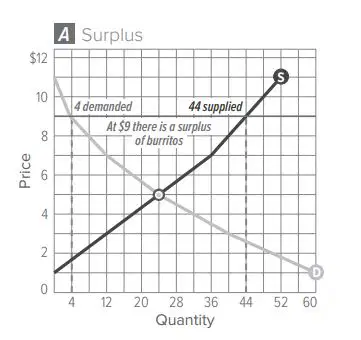
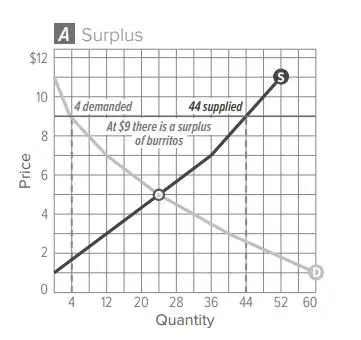
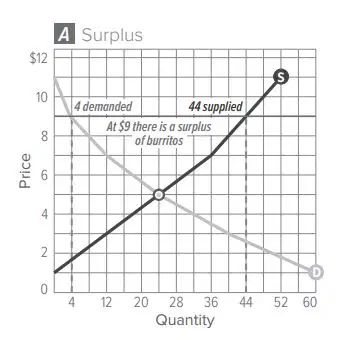
economic model.
d)
needs assessment.
11.
The study of economics involves
a)
explaining how people deal with scarcity.
b)
studying how things are made, bought, sold, and used.
c)
explaining how incomes are earned and how jobs are created.
d)
all of the above
12.
Societies are faced with which three basic questions about production of goods?
a)
what, how, and why
b)
what, where, and when
c)
what, how, and for whom
d)
when, where, and for whom
13.
A car is an example of a
a)
durable good.
b)
nondurable good.
c)
capital good.
d)
service.
14.
Which of the following helps determine something's value?
a)
utility
b)
beauty
c)
scarcity
d)
both A and C
15.
A nation's wealth is made up of
a)
all intangible items.
b)
all goods and services.
c)
all tangible items.
d)
all tangible and intangible items.
16.
Which of the following would result in a change in the production possibilities frontier in the mythical country Alpha?
a)
an influx of immigrants from other countries
b)
the discovery of an abundant natural resource
c)
a long drought
d)
all of the above
17.
Division of labor is practiced because
a)
companies do not want workers to talk to one another.
b)
it increases efficiency by ensuring that all workers become good at every task.
c)
it increases efficiency by ensuring that workers become good at specific tasks.
d)
it prevents specialization.
18.
Dave gets a job at a grocery store, which pays him an hourly wage in exchange for his labor. Dave is participating in
a)
entrepreneurship.
b)
human capital.
c)
the product market.
d)
the factor market.
19.
Which of these would an item’s producer be most likely to do if total revenue on that item began to drop?
a)
produce less of that item
b)
produce more of that item
c)
raise the price of that item
d)
lower the price of that item
20.
Which of these best describes the influence of high prices on the behavior of producers?
a)
High prices are an incentive for producers to produce less.
b)
High prices are an incentive for producers to produce more.
c)
High prices have no significant influence on the behavior of producers.
d)
High prices influence producers to use fewer raw materials and less labor.
21.
Which of these industries has the least elastic supply curve?
a)
the toy industry
b)
the nuclear industry
c)
the automobile industry
d)
the entertainment industry
22.
Which of these do producers of an item hope to achieve when adopting new technologies?
a)
inelasticity of supply of that item
b)
a repeal of subsidies for production of that item
c)
a shift of the supply curve for that item to the left
d)
a shift of the supply curve for that item to the right
23.
At which stage of production does the concept of “diminishing returns” first become significant?
a)
Stage I
b)
Stage II
c)
Stage III
d)
It is significant throughout the production process.
24.
At which point in the stages of production does the maximum profitable number of workers become most apparent?
a)
the end of Stage I
b)
the end of Stage III
c)
the beginning of Stage I
d)
the beginning of Stage III
25.
Which term denotes the change in total income when one additional unit of output is added?
a)
total product
b)
supply schedule
c)
change in supply
d)
marginal revenue
26.
Which two terms are the most similar in meaning?
a)
fixed costs and overhead
b)
variable costs and overhead
c)
marginal costs and fixed costs
d)
marginal costs and variable costs
27.
Which term is generally associated with machines and other capital goods?
a)
total cost
b)
fixed cost
c)
variable cost
d)
marginal cost
28.
Which of these best enables a firm to establish its profit-maximizing quantity of output?
a)
a periodic marginal analysis
b)
a periodic analysis of total revenue
c)
a periodic determination of its overhead
d)
a periodic determination of its break-even point
29.
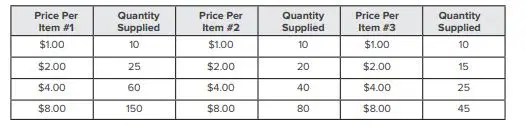
Which of the following items has the greatest inelastic supply?
a)
Item #1
b)
Item #2
c)
Item #3
d)
All of the above.
30.
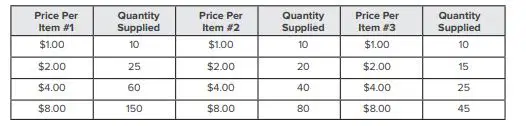
Which of the following items has the greatest elastic supply?
a)
Item #1
b)
Item #2
c)
Item #3
d)
All of the above.
31.
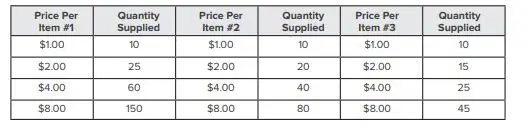
Which of the following items possesses a supply that is unit elastic?
a)
Item #1
b)
Item #2
c)
Item #3
d)
None of the above.
32.
According to the Law of Supply, which of these would happen to an item as its price rose?
a)
Producers would make less of it.
b)
Producers would make more of it.
c)
Producers would increase the price even more.
d)
Producers would lower the price on similar items
33.
Which of these describes an effect of increased government regulation on producers?
a)
It shifts their market supply curve to the right.
b)
It shifts their market supply curve to the left.
c)
It prompts them to increase output at all possible prices.
d)
It encourages production by requiring the use of new technology.
34.
Which of these describes an item for which a change in its supply is proportional to a change in its price?
a)
elastic
b)
inelastic
c)
unit elastic
d)
demand elastic
35.
Why might a producer’s introduction of a new technology result in a brief shift of a product’s supply curve to the left?
a)
That technology may reduce production costs.
b)
There may be a period of adjustment to that technology.
c)
There may be an increase in output despite the same amount of input.
d)
That technology may increase production more rapidly than expected
36.
Which stage of production is distinguished by negative marginal returns?
a)
Stage I
b)
Stage II
c)
Stage III
d)
Negative marginal returns are a dynamic of the entire production process.
37.
Which of these statements describes a disadvantage of a traditional economy?
a)
Everyone knows his or her role.
b)
New ways of doing things are encouraged.
c)
New ways of doing things are discouraged.
d)
Difficult economic decisions are made by the state.
38.
Which of these economic systems have the least in common?
a)
market economy and capitalism
b)
command economy and socialism
c)
command economy and capitalism
d)
free-enterprise economy and market economy
39.
In which of these systems is the government most likely to provide people with goods and services they could not otherwise afford?
a)
a market economy
b)
a socialist economy
c)
a traditional economy
d)
a free-enterprise economy
40.
Which of these helps explain why mixed economies develop?
a)
People become unhappy with aspects of their current economy.
b)
People are seldom exposed to the ideas and technologies of other cultures.
c)
Government control of an economy tends to make a nation more prosperous.
d)
Government control of an economy leads to a diversity of economic approaches
41.
Which of these countries has an economy most similar to that of the former Soviet Union?
a)
Sweden
b)
Norway
c)
South Korea
d)
North Korea
42.
Which of the following is a feature of a command economy that distinguishes it from a socialist economy?
a)
All production is managed by the government.
b)
All economic decisions are made by the free market.
c)
All economic decisions are based on custom and habit.
d)
Some degree of private ownership and activity is allowed.
43.
In a transitioning economy, why would privatization tend to raise a nation’s overall standard of living?
a)
People are less likely to assume the risks of entrepreneurship.
b)
It places the means of production in the hands of the government.
c)
People are more likely to be productive when it benefits them personally.
d)
It places a nation’s ruling class in a position to administer the economy efficiently.
44.
Which of the following is a cause of struggle in the process of privatization?
a)
People must adjust to government control of their economy.
b)
People must decide how best to get along without a free market.
c)
People must adjust to the costs and risks that are part of capitalism.
d)
People must become used to no longer owning their own homes and businesses
45.
Which of these is the most striking example of the costs and risks of pure capitalism?
a)
the Gosplan
b)
the Five-Year-Plan
c)
the Great Depression
d)
the Great Leap Forward
46.
How are economic transactions shaped in a traditional economy?
a)
Each community decides as a group for whom the group will produce.
b)
Elders and ancestors make certain that things are done in specific ways.
c)
The three basic questions of production do not arise in this type of economy.
d)
Individuals form networks within which they buy, sell, and trade as they choose
47.
Which of the following lists economic systems in order from least to most flexible?
a)
command, socialism, free market
b)
free market, socialism, command
c)
socialism, command, free market
d)
free market, command, socialism
48.
Which of the following could raise the cost of production in a command economy?
a)
a newly discovered source of raw materials
b)
a free media
c)
a large and inefficient bureaucracy
d)
a strict quota system
49.
Which of these is a major advantage of a market economy?
a)
It can change direction rapidly as needed when markets change.
b)
There is a high degree of individual freedom.
c)
There is efficient government control of production and distribution.
d)
People are likely to be offered goods and services they cannot afford
50.
Which type of economy is most prevalent in the world today?
a)
mixed
b)
market
c)
command
d)
traditional
51.
Which of the following explains why products made under a command economy are more likely to be low quality?
a)
The workers who make them have little incentive to make them well.
b)
The workers who make them are not given quality-control guidelines.
c)
The workers who make them are left to manage production facilities on their own.
d)
The workers who make them are forced by tradition to use old-fashioned methods.
52.
Which statement describes a disadvantage of a command economy?
a)
Items tend to be produced solely for the sake of profit.
b)
It cannot “change direction” easily if the need arises to do so.
c)
It does little to help the less advantaged obtain the goods and services they need.
d)
Nothing stops the government from producing things that people don’t need or want
53.
What are the characteristics of demand?
a)
the desire and ability to buy a product
b)
the willingness to buy a product
c)
the willingness and desire to buy a product
d)
the desire, ability, and willingness to buy a product
54.
Changes in quantity demanded and changes in price have a(n) _________ relationship
a)
indirect
b)
positive
c)
inverse
d)
neutral
55.
A hungry man is willing to pay a high price for food. After he is no longer hungry, he is not willing to pay the same high price. Which of the following best defines this example?
a)
a complement
b)
diminishing marginal utility
c)
unit elasticity
d)
the substitution effect
56.
On a demand curve, movement along the curve, as opposed to a shift in the entire curve, is a result of ___________________
a)
a change in price.
b)
an increase in demand
c)
a decrease in demand
d)
a change in demand.
57.
What is the income effect?
a)
a change in quantity demanded caused by a change in consumer income
b)
a change in demand caused by substitution
c)
a proportional change in quantity demanded based on income
d)
an increase in purchase of complements based on an increase in income
58.
Which would an economist consider a likely substitute for coffee?
a)
car
b)
tea
c)
chicken
d)
basketball
59.
Which would an economist consider a likely complement for coffee?
a)
Coca-Cola
b)
car
c)
chicken
d)
donut
60.
Which product most likely has a demand that is inelastic?
a)
a meal at a restaurant
b)
green beans
c)
a vital medicine
d)
a vacation
61.
What test do economists use to measure elasticity?
a)
utility
b)
quantity demanded
c)
total expenditures/revenue
d)
demand
62.
To estimate elasticity, compare the _________ of a price change to the _________ of the change in total revenue.
a)
amount, amount
b)
amount, direction
c)
direction, amount
d)
direction, direction
63.
A demand schedule is best described as _______
a)
a calendar.
b)
an incentive.
c)
data.
d)
a time line.
64.
When the price of something increases, the quantity demanded _______
a)
increases
b)
decreases.
c)
remains unchanged
d)
reverses.
65.
Consider the term marginal utility. Which word is the best synonym for marginal?
a)
useful
b)
satisfactory
c)
borderline
d)
additional
66.
Why is a demand curve downward sloping?
a)
because quantity demanded increases as price decreases
b)
because of the natural elasticity of the market
c)
because it shows how increasing incentives changes demand
d)
because it reflects the desire, ability, and willingness of consumers
67.
Why is the Law of Demand called a “law”?
a)
because it is legally required
b)
because there are no exceptions to it
c)
because it has been demonstrated repeatedly
d)
because it is an economic term
68.
A change in quantity demanded is represented by ______
a)
movement along the demand curve.
b)
a shift of the demand curve
c)
substitution.
d)
complements.
69.
What is the main cause of a change in quantity demanded?
a)
substitution
b)
changes in revenue
c)
change in price
d)
the income effect
70.
What is the relationship between income and demand?
a)
A decrease in income increases demand.
b)
A decrease in price decreases income.
c)
An increase in price increases income.
d)
An increase in income increases demand.
71.
Which of the following replaces a costly item with a less costly one?
a)
the substitution effect
b)
the income effect
c)
change in demand
d)
consumer taste
72.
What do low prices signal buyers to do?
a)
nothing
b)
buy more
c)
buy less
d)
substitute
73.
In a competitive market economy, prices are considered _______ .
a)
dictated
b)
uncompromising
c)
favorable
d)
neutral
74.
Without prices, the three basic questions of WHAT, HOW, and FOR WHOM to produce are answered by _______ .
a)
consumers
b)
producers
c)
government
d)
markets
75.
What do most economists believe is the most efficient way to allocate resources?
a)
competitive markets
b)
rationing
c)
government action
d)
distorted incentives
76.
Equilibrium is reached when what occurs?
a)
quantity supplied equals quantity demanded
b)
there is no change in the quantity supplied
c)
price increases
d)
prices are inelastic
77.
Which is the opposite of a surplus?
a)
inelastic
b)
shortage
c)
equilibrium
d)
floor
78.
What effect would a high yield of crop most likely have on the price of that crop?
a)
increase
b)
decrease
c)
equilibrium
d)
no effect
79.
What do price ceilings and price floors prevent?
a)
shortages
b)
surpluses
c)
prices reaching equilibrium
d)
benefits to consumers
80.
Which term best describes a cap on the costs of prescription drugs and lab tests?
a)
price ceiling
b)
subsidy
c)
equilibrium price
d)
nonrecourse
81.
Why have agricultural products been the object of many price stabilization efforts?
a)
their prices would not otherwise reach equilibrium
b)
their prices are exempt from supply and demand
c)
their prices are easily controllable
d)
their prices tend to fluctuate widely
82.
Which rationing method was instituted for gasoline in the mid-1970s?
a)
distribution of ration vouchers
b)
administration of gas sales through post offices
c)
manufacturing of more fuel-efficient automobiles
d)
purchasing days determined by license plate numbers
83.
Which of these best describes prices in a market economy?
a)
a signal for consumers to purchase less
b)
a signal for producers to manufacture less
c)
a set of compromises between buyers and sellers
d)
a set of compromises between the government and citizens
84.
Why does an increase in gas prices lead to less consumer spending on other items?
a)
The price of gas is largely elastic.
b)
The price of gas is largely inelastic.
c)
The demand for gas is largely elastic.
d)
The demand for gas is largely inelastic.
85.
Which of these events sparked the most extensive rationing in United States history?
a)
World War II
b)
Hurricane Sandy
c)
the 1970s energy crisis
d)
the 1999 Baltimore Orioles exhibition game
86.
Which of these is a major problem in the execution of a rationing system?
a)
market spikes
b)
price neutrality
c)
price flexibility
d)
administrative expense
87.
Which of these best describes an economic process similar to “haggling”?
a)
choice
b)
fluctuation
c)
perceived value
d)
compromise
88.
Which of these tends to force the price of an item downward?
a)
a surplus of that item
b)
a shortage of that item
c)
attainment of an equilibrium price for that item
d)
attainment of an equilibrium quantity of that item
89.
Which of these tends to force the price of an item upward?
a)
a surplus of that item
b)
a shortage of that item
c)
attainment of an equilibrium price for that item
d)
attainment of an equilibrium quantity of that item
90.
Which of these describes the process of an item finding its economic equilibrium?
a)
variation
b)
direction
c)
fluctuation
d)
expectation
91.
A basic economics problem in which the gap between limited resources and theoretically limitless wants.
a)
Scarcity
b)
Capital Goods
c)
Paradox of Value
d)
Opportunity Cost
e)
Division of Labor
92.
Physical assets that a company uses in the production process to manufacture products and services that consumers will use later.
a)
Capital Goods
b)
Scarcity
c)
Paradox of Value
d)
Opportunity Cost
e)
Division of Labor
93.
An apparent contradiction between the high value of a nonessential item and the low value of an essential item.
a)
Paradox of Value
b)
Scarcity
c)
Capital Goods
d)
Opportunity Cost
e)
Division of Labor
94.
Cost of the next best alternative use of money, time, or resources, when one choice is made rather than another.
a)
Opportunity Cost
b)
Scarcity
c)
Capital Goods
d)
Paradox of Value
e)
Division of Labor
95.
Separation of work into a number of tasks to be performed by different workers.
a)
Division of Labor
b)
Scarcity
c)
Capital Goods
d)
Paradox of Value
e)
Opportunity Cost
96.
Economic system in which private citizens own and use factors of production in order to generate profits.
a)
Capitalism
b)
Scarcity
c)
Capital Goods
d)
Paradox of Value
e)
Opportunity Cost
97.
Economic system characterized by a central authority that makes most of the major economic decisions.
a)
Command Economy
b)
Scarcity
c)
Capital Goods
d)
Paradox of Value
e)
Opportunity Cost
98.
Economic system that has some combination of traditional, command, and market economies.
a)
Mixed Economy
b)
Scarcity
c)
Capital Goods
d)
Paradox of Value
e)
Opportunity Cost
99.
Shift of an economy, or part of an economy, from private ownership to government ownership.
a)
Nationalization
b)
Scarcity
c)
Capital Goods
d)
Paradox of Value
e)
Opportunity Cost
100.
Meeting place or arrangement through which buyers and sellers interact to determine price and quantity of an economic product.
a)
Market
b)
Scarcity
c)
Capital Goods
d)
Paradox of Value
e)
Opportunity Cost
101.
What is point E considered to be in terms of economic productivity?
a)
inefficient
b)
efficient
c)
over production
d)
impossible
102.
According to this production possibilities curve, if the country Alpha chose to produce 40 units of cars, how many units of clothing could it produce?
a)
450
b)
300
c)
200
d)
400
103.
What conditions would have to change if Alpha wanted to produce more than 80 units of cars or 500 units of clothing?
a)
Nothing would need to change.
b)
Alpha would need to find new ways to increase production efforts such as implementing new technologies.
c)
Alpha would need to decrease its production efforts.
d)
Alpha would need hire more workers.
104.
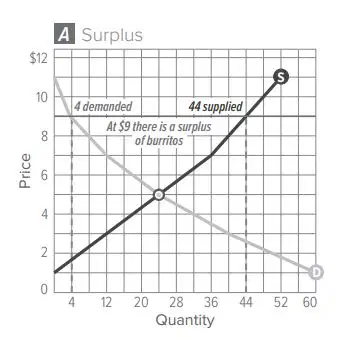
What is the equilibrium price of burritos?
a)
$6
b)
$4
c)
$3
d)
$5
105.
At $8, what kind of disequilibrium is present?
a)
market-clearing price
b)
surplus
c)
shortage
d)
scarcity
106.
At $4, what kind of disequilibrium is present?
a)
market-clearing price
b)
surplus
c)
shortage
d)
scarcity
107.
At $3, how much of shortage or surplus is present?
a)
17
b)
13
c)
28
d)
35
108.
If demand for burritos increases and supply for burritos stays the same, what will happen to equilibrium price and equilibrium quantity?
a)
an increase in EQ price, a decrease in EQ quantity
b)
a decrease in EQ price, a decrease in EQ quantity
c)
an increase in EQ price, an increase in EQ quantity
d)
a decrease in EQ price, an increase in EQ quantity
109.
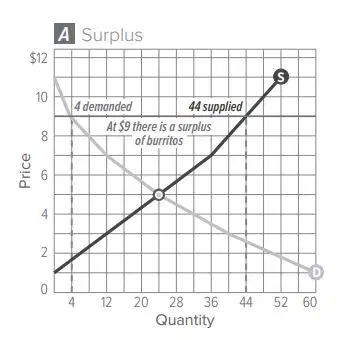
If supply for burritos increases and demand for burritos stays the same, what will happen to equilibrium price and equilibrium quantity?
a)
an increase in EQ price, a decrease in EQ quantity
b)
a decrease in EQ price, a decrease in EQ quantity
c)
an increase in EQ price, an increase in EQ quantity
d)
a decrease in EQ price, an increase in EQ quantity
110.
The government document that grants permission to establish a corporation is called a
a)
charter.
b)
stock certificate.
c)
partnership agreement.
d)
limited liability agreement.
111.
A business run by a single person is a
a)
partnership.
b)
corporation.
c)
sole proprietorship
d)
limited liability corporation.
112.
In a retail business, the stock held in reserve is called
a)
raw materials.
b)
inventory.
c)
capital.
d)
profits.
113.
Which of the following phrases best defines the term limited partnership?
a)
an organization that limits liability to the corporation rather than the individual owners
b)
a partnership in which at least one partner has less responsibility in the business operations and less liability for business losses
c)
a business that is limited to three or fewer investors
d)
a business model that combines aspects of corporations and partnerships
114.
A document certifying ownership of part of a corporation is a
a)
an approval offer.
b)
stock certificate.
c)
dividend check.
d)
bond.
115.
To get a picture of a business’s overall expenses and profits, you should look at its ______ .
a)
inventories
b)
depreciation
c)
dividends
d)
income statement
116.
Which of the following is a noncash charge?
a)
wages
b)
depreciation
c)
dividends
d)
horizontal merger
117.
Most mergers take place to improve a company’s performance in the eyes of ______ .
a)
the shareholders
b)
the employees
c)
government regulators
d)
tax collectors
118.
A company with four or more businesses that make unrelated products is called a ______ .
a)
horizontal merger
b)
vertical merger
c)
conglomerate
d)
multinational
119.
Which of the following is an advantage of a multinational?
a)
They produce tax revenue for the countries where they do business.
b)
They use cheap labor.
c)
They export scarce natural resources.
d)
They help preserve traditional ways of life.
120.
A change in the independent variable (usually price) results in a large change in the dependent variable (usually quantity demanded or supplied).
a)
Elasticity
b)
Law of Demand
c)
Law of Supply
d)
Subsidy
e)
Break-even point
121.
A rule stating that more will be demanded at lower prices and less at higher prices.
a)
Law of Demand
b)
Elasticity
c)
Law of Supply
d)
Subsidy
e)
Break-even point
122.
A rule stating that less will be supplied at lower prices, and more at higher prices.
a)
Law of Supply
b)
Elasticity
c)
Law of Demand
d)
Subsidy
e)
Break-even point
123.
Government payment to encourage or protect certain economic activity.
a)
Subsidy
b)
Elasticity
c)
Law of Demand
d)
Law of Supply
e)
Break-even point
124.
A production level where total cost equals total revenue; production needed if the firm is to recover its costs.
a)
Break-even point
b)
Elasticity
c)
Law of Demand
d)
Law of Supply
e)
Subsidy
125.
Price when quantity supplied equals quantity demanded; price that clears the market.
a)
Equilibrium Price
b)
Elasticity
c)
Law of Demand
d)
Law of Supply
e)
Subsidy
126.
Highest legal price that can be charged for a product or service.
a)
Price Ceiling
b)
Elasticity
c)
Law of Demand
d)
Law of Supply
e)
Subsidy
127.
A situation where quantity supplied is less than quantity demanded at a given price.
a)
Shortage
b)
Elasticity
c)
Law of Demand
d)
Law of Supply
e)
Subsidy
128.
A broad category of fixed costs that includes interest, rent, taxes, and executive salaries.
a)
Overhead
b)
Elasticity
c)
Law of Demand
d)
Law of Supply
e)
Subsidy
129.
The deliberate nature of distributing resources.
a)
Allocation
b)
Elasticity
c)
Law of Demand
d)
Law of Supply
e)
Subsidy
100 %

