
 Worksheets
Exploring Earth and Matter Concepts
Total questions: 89
Worksheet time: 1hrs 8mins
Which material would be best to use for building a tower that needs to be strong and stable?
Paper
Wood
Cotton
Sponge
If you mix sand and clay together, what property of the mixture changes compared to just sand alone?
The color becomes lighter
The mixture becomes stronger
The mixture becomes colder
The mixture becomes softer
Which of the following would be the best material to use for making a waterproof raincoat?
Cotton
Plastic
Paper
Wool
What happens to an ice cube when it is left out in a warm room?
It turns into water
It turns into gas
It becomes colder
It grows larger
When you see water droplets on the outside of a cold glass, what is happening?
Water is leaking from the glass
Water vapor in the air is cooling and turning into liquid
The glass is melting
The glass is sweating
What change of state happens when you boil water on the stove?
Solid to liquid
Liquid to gas
Gas to solid
Liquid to solid
Which of the following best describes the movement of the Earth around the Sun?
The Earth spins in place
The Earth orbits around the Sun
The Sun orbits around the Earth
The Moon orbits around the Sun
What does the Moon do as it moves in space?
It stays still
It orbits around the Earth
It orbits around the Sun
It moves away from the Earth
Which of the following is a correct model of the Sun, Earth, and Moon system?
The Sun orbits the Earth, and the Earth orbits the Moon
The Earth orbits the Sun, and the Moon orbits the Earth
The Moon orbits the Sun, and the Earth orbits the Moon
The Earth and Moon both orbit the Sun separately
Which of the following is a rapid change that can happen to Earth's surface?
A tree growing
A volcanic eruption
A river forming over thousands of years
Soil forming from rocks
What is an example of a rapid change caused by an earthquake?
A mountain slowly forming
The ground shaking and cracking
A river changing its path over centuries
Soil forming from dead plants
Which event can quickly move large amounts of soil and rocks down a hill?
Landslide
Plant growth
Weathering
Erosion by wind
How is sand formed from rocks?
By melting
By weathering and breaking down of rocks
By freezing
By burning
What is one way that clay soil is formed?
By mixing sand and water
By weathering of certain types of rocks
By freezing water
By planting trees
What role do plant and animal remains play in soil formation?
They make the soil harder
They decompose and add nutrients to the soil
They turn into rocks
They make the soil dry
You need to build a bridge that can hold a lot of weight. Which materials would you choose and why?
Paper and cotton, because they are light
Wood and metal, because they are strong and sturdy
Plastic and rubber, because they are flexible
Glass and sand, because they are shiny
A student wants to make a brick that is stronger than one made of just sand. What should they add, and why?
Add water, because it makes the sand wet
Add clay, because it helps the sand stick together and become stronger
Add sugar, because it is sticky
Add leaves, because they are soft
Explain why you would choose metal instead of plastic to make a frying pan.
Metal is heavier than plastic
Metal can withstand high heat without melting, while plastic cannot
Metal is shiny
Plastic is colorful
A student observes that a puddle of water disappears on a hot day. What process is happening, and what causes it?
Freezing, caused by cold air
Condensation, caused by warm air
Evaporation, caused by heat from the sun
Melting, caused by sunlight
If you put a metal spoon in a freezer, what change of state might you observe on the spoon after taking it out into a warm room, and why?
The spoon will melt
Water droplets will form on the spoon due to condensation
The spoon will catch fire
The spoon will freeze
Describe what happens to the particles in water when it is heated from a liquid to a gas.
The particles slow down and stick together
The particles move faster and spread apart
The particles freeze in place
The particles disappear
A student builds a model of the Sun, Earth, and Moon using balls. How should the student show the movement of these objects to accurately represent their orbits?
The Earth and Moon both orbit the Sun at the same distance
The Earth orbits the Sun, and the Moon orbits the Earth
The Sun orbits the Earth, and the Moon orbits the Sun
The Moon orbits the Sun, and the Earth orbits the Moon
Explain why the Moon appears to move across the sky each night.
The Moon is moving around the Earth
The Sun is moving around the Moon
The Earth is spinning on its axis and the Moon is orbiting the Earth
The Moon is standing still
A student wants to model the orbits of the Sun, Earth, and Moon. What is the best way to show their movements?
Draw three circles that do not touch
Show the Earth moving around the Sun and the Moon moving around the Earth
Show the Sun moving around the Earth and the Moon moving around the Sun
Show all three moving in a straight line
After a volcanic eruption, what rapid change might you observe on the Earth's surface?
New land is formed from cooled lava
Trees grow taller
Rivers dry up
Soil forms slowly
Explain how an earthquake can change the shape of the land quickly.
By slowly wearing down rocks
By shaking the ground and causing cracks or shifts in the land
By growing plants
By forming soil
A landslide happens after heavy rain. What effect does this have on the land?
It slowly builds up soil
It quickly moves rocks and soil down a slope, changing the landscape
It melts rocks
It freezes the ground
Describe how weathering and decomposition work together to form soil.
Weathering breaks rocks into smaller pieces, and decomposition adds plant and animal remains to make soil
Weathering melts rocks, and decomposition freezes them
Weathering grows plants, and decomposition removes soil
Weathering and decomposition both make rocks harder
A student finds dark, rich soil in a forest. What does this tell you about how the soil was formed?
It was formed only by weathering of rocks
It was formed by both weathering of rocks and decomposition of many plant and animal remains
It was formed by freezing water
It was formed by volcanic eruptions
Explain why sandy soil is often found near rivers and beaches.
Because sand is made by weathering of rocks and is carried by water to these places
Because sand grows from plants
Because animals make sand
Because sand is made by melting ice
Two main processes of making fabric from yarn are -
Weaving and Spinning
Weaving and Ginning
Knitting and Ginning
Weaving and Knitting
What is a man-made material?
A material that comes from nature.
A material that is created by man.
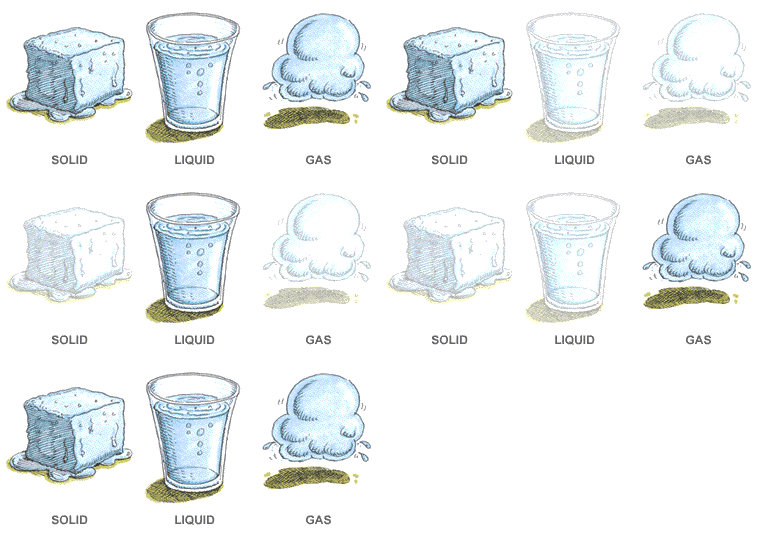
In which of these do particles move slowest?
matter
gas
liquid
solid

Orange juice is an example of a ....
solid
liquid
gas

A teacher gives a student 4 clear sealed containers. Each container holds a different substance. The students record their observations about each substance. Based on these observations, which container most likely holds only gas?
Container 1
Container 2
Container 3
Container 4

Read the text and choose the correct answer.
Observation 1 and 3 only
Observation 2 only
Observation 2 and 4 only
Observation 1, 3, and 4 only

¿Qué modelo de materia es más probable que sea un líquido?
A
B
C

Which state of matter is found in our Sun and other stars?
solid
liquid
gas
plasma
Which model of matter is most likely a liquid?
A
B
C
How does the tilt of the Earth's axis affect the seasons?
It changes the Earth's distance from the sun.
It causes the Earth to move faster in its orbit.
It results in varying amounts of sunlight hitting different parts of the Earth.
It has no effect on the seasons.
What is the main source of energy for the Earth's systems?
The Moon
The Sun
Wind
Geothermal heat
What evidence supports the theory of plate tectonics?
The shape of continents
The distribution of fossils
The location of earthquakes and volcanoes
All of the above
Which layer of the Earth is made mostly of solid rock and includes both the crust and the upper part of the mantle?
Core
Mantle
Lithosphere
Asthenosphere
What evidence supports the theory of plate tectonics?
The shape of the continents
The distribution of fossils
The location of earthquakes and volcanoes
All of the above


The diagram shows land and sea. What is most likely occurring in Location X?
Weathering of rock by water
Cementation to form sedimentary rock
Deposition to form a river delta
Layering of deposited sediment
A beach is said to be (a) if the sand input is less than the output.
Match the following to there definition
A process or force that builds land up
constructive process
A process or force that breaks land down
destructive process
A structure that prevents flooding
levee
A break in Earth’s crust
fault
The quick collapse of an underground cave
sink hole
Propose a study to explore the relationship between the solar system's structure and the possibility of life on other planets.
Analyze the atmospheres of different planets and moons in the solar system to assess their potential to support life.
Observe the moon through a telescope to look for signs of life.
Send a satellite to photograph the surface of Mars without analyzing atmospheric composition.
Study the sun's impact on Earth's climate without considering other planets.
Which planet is closest to the Sun?
Venus
Earth
Mercury
Mars
Which planet is closest to the sun?
Earth
Venus
Mercury
Mars
How many planets are in our solar system?
7
8
9
10
What is the largest planet in our solar system?
Earth
Mars
Jupiter
Saturn
Which planet is known as the "Red Planet"?
Venus
Mars
Jupiter
Mercury
Which planet is known for its rings?
Jupiter
Saturn
Uranus
Neptune
What is the name of our galaxy?
Andromeda Galaxy
Whirlpool Galaxy
Milky Way Galaxy
Triangulum Galaxy
What is the smallest planet in our solar system?
Mars
Mercury
Venus
Earth
What is the name of the fifth planet from the sun?
Mars
Jupiter
Saturn
Uranus
What celestial body orbits the Earth?
The Sun
Mars
The Moon
Venus
Which of the following is not a terrestrial planet?
Mercury
Venus
Jupiter
Mars
What is the center of our Solar System?
Earth
Mars
The Sun
The Moon
Which planet in our solar system is known for its rings?
Mars
Jupiter
Saturn
Neptune

Reviewing Condensation
To get water vapor to (a) , you created a (b) surface for the gas to condense on to. The water vapor particles transferred energy to the cooler surface. The (c) of energy caused the water vapor particles to (d) and condense as (e) on the cooler surface.
In matter, as energy is increased particle distance and motion (a) , which can result in a change of physical state.
Match the following

Dissolving

Cutting

Burning

Melting

Breaking
Match the following
a process in which the nucleus of an atom is changed by being split apart or joined with the nucleus of another atom.
Nuclear change
A change when new matter is formed(same atoms in come out) and involves the electrons
chemical change
A change when no new matter is formed
physical change
A (a) is when the molecules that make up a substance experience a change to their freedom of movement. This involves a (b) -scale change in appearance.
Match the following
Physical change (2)
Melting (2)
Chemical Change (2)
Precipitate (2)
Chemical Change (3)
Burning (3)
Physical Change (1)
Solubility (1)
Chemical Change (1)
Color Change (1)
Which term describes when a substance is changed from a liquid to a gas? (a)
(a) is the change of substance from a liquid to a gas.
Most matter (a) , or gets bigger, when heated.
(a) is change of state from a liquid to a solid.
Maggie is baking cookies. When she takes the cookies out of the oven Maggie notices that the chocolate chips have melted and the cookie is darker after it has been cooked. The melting of the chocolate chips is a (a) change, while the cookie color being darker is a (b)
Match the following

Physical Change

Chemical Change

Homogenous Mixture

Heterogeneous Mixture
What process takes place when a gas becomes a liquid? (Think clouds) (a)
The greater (a) of the washers caused a (b) (c) in (d)
What is the main reason we experience day and night on Earth?
The Earth's orbit around the Sun
The Earth's rotation on its axis
The Moon's orbit around the Earth
The tilt of the Earth's axis

The Earth (a) around the sun in one (b) or (c) .
Match the following
the movement of one object around another.
Revolution is...
the spinning motion of a planet on its axis
Rotation is...

Which shows rotation?

Which shows revolution?
Match the following words with their definition.
Rotation
The Earth's spin on its axis.
Revolution
The Earth's orbit around the Sun
Orbit
A path the Earth follows around the Sun
Axis
The invisible line in the Earth's tilt.

(a) is (b) orbit around the (c) .
(a) is (b) orbit around the (c) .
Revolution
Earth’s
sun
Rotation
Mars's
moon
In which of these do particles move slowest?
matter
gas
liquid
solid
Which state of matter is found in our Sun and other stars?
solid
liquid
gas
plasma
Read the text and choose the correct answer.
Observation 1 and 3 only
Observation 2 only
Observation 2 and 4 only
Observation 1, 3, and 4 only
A teacher gives a student 4 clear sealed containers. Each container holds a different substance. The students record their observations about each substance. Based on these observations, which container most likely holds only gas?
Container 1
Container 2
Container 3
Container 4
Orange juice is an example of a ....
solid
liquid
gas

