
 Worksheets
Density Reading Passage
Total questions: 10
Worksheet time: 5mins
Density is:
the amount of mass per unit volume
the amount of volume per unit mass
the amount of energy per unit mass
the amount of force per unit area
Density can be calculated by:
Dividing mass by volume
Multiplying mass and volume
Adding mass and volume
Subtracting volume from mass
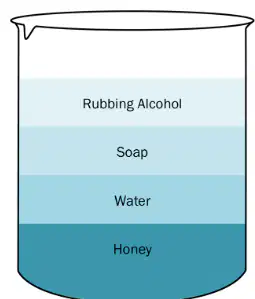
In general, how would substances of different densities layer themselves in a heterogeneous mixture?
The densest substances settle at the bottom, and the least dense float to the top.
The least dense substances settle at the bottom, and the densest float to the top.
All substances mix evenly regardless of density.
Substances of different densities form a single uniform layer.
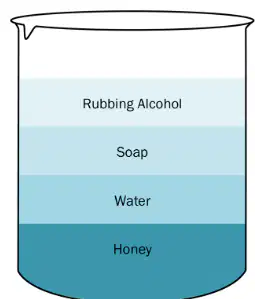
Ice has a density of 0.93 g/mL. Where would you find ice in the beaker?
At the bottom of the beaker
Floating on the surface of the liquid
Evenly mixed throughout the liquid
Stuck to the sides of the beaker
What is the density of saltwater?
The density of saltwater is 1.03 g/mL.
The density of saltwater is 0.80 g/mL.
The density of saltwater is 2.50 g/mL.
The density of saltwater is 0.50 g/mL.
Density is:
The amount of mass per unit volume
The amount of energy in an object
The speed of an object
The temperature of an object
Density can be calculated by:
Dividing mass by volume
Multiplying mass and volume
Adding mass and volume
Subtracting volume from mass
In general, how would substances of different densities layer themselves in a heterogeneous mixture?
The substance with the highest density settles at the bottom, and the substance with the lowest density stays at the top.
The substance with the lowest density settles at the bottom, and the substance with the highest density stays at the top.
All substances mix evenly regardless of density.
Substances of different densities cannot form a heterogeneous mixture.
Ice has a density of 0.93 g/mL. Where would you find ice in the beaker?
At the bottom of the beaker
Floating on the surface of the liquid
Evenly mixed throughout the liquid
Stuck to the sides of the beaker
The density of saltwater is:
1.0 g/cm³
1.03 g/cm³
0.98 g/cm³
1.5 g/cm³

