
 Worksheets
Science - 6th Grade Finals Review
Total questions: 100
Worksheet time: 50mins
The science of classification is called ________.
taxonomy
anatomy
ecology
genetics
All living things are called ________.
organisms
minerals
machines
objects
All organisms have a scientific name that is made up of their ________ and ________ classification.
Genus, species
Family, order
Class, phylum
Kingdom, domain
Which is the largest, most general, level of classification?
Species
Genus
Kingdom
Order
Which is the smallest, most specific, level of classification?
Kingdom
Species
Order
Family
Order the classification levels from broadest to most specific:
Kingdom, phylum, class, order, family, genus, species
Species, genus, family, order, class, phylum, kingdom
Phylum, kingdom, class, order, family, genus, species
Order, class, phylum, kingdom, family, genus, species
Name the five kingdoms.
Plant, Animal, Fungus, Bacteria, Protist
Plant, Animal, Mineral, Bacteria, Protist
Plant, Animal, Fungus, Virus, Protist
Plant, Animal, Fungus, Bacteria, Algae
Cells are the basic unit of ________.
life
energy
water
matter
All organisms are composed of at least one ________.
cell
atom
molecule
tissue
An organism that only has one cell is called a ________ organism.
unicellular
multicellular
bacterial
complex
Organisms composed of 2 or more cells are called ________ organisms.
multicellular
unicellular
prokaryotic
autotrophic
Cells that do not have a nucleus or membrane-bound organelles are called ________ (bacteria).
prokaryotic
eukaryotic
multicellular
photosynthetic
Cells that do have a nucleus and membrane-bound organelles are called ________ cells.
eukaryotic
prokaryotic
bacterial
archaeal
Small structures in the cell that perform specific functions are called ________.
organelles
chromosomes
enzymes
tissues
Do animal cells have these structures?
No, animal cells do not have a cell wall, large vacuole, or chloroplasts.
Yes, animal cells have a cell wall, large vacuole, and chloroplasts.
Yes, animal cells have a cell wall and chloroplasts, but not a large vacuole.
Yes, animal cells have a large vacuole, but not a cell wall or chloroplasts.
A force is a ________ or a ________.
push, pull
mass, weight
speed, velocity
energy, power
heat, light
Unbalanced forces cause movement in an object. There is a ________ as a result.
net force
balanced force
friction
static force
Energy is the ability to do work; which means ________ a force over a distance.
exerting
removing
ignoring
measuring
Potential energy is the idea of ________ energy.
stored
moving
thermal
sound
Kinetic energy is the energy responsible for the movement of ________/objects.
molecules
colors
sounds
shapes
The more potential energy present, the greater ________ energy possible.
kinetic
thermal
sound
light
What is inertia?
The tendency of an object to resist change in its motion.
The force that pulls objects toward the center of the Earth.
The process of forming chemical bonds.
The number of protons in an atom.
Which of Newton's laws states: 'An object at rest will remain at rest and an object in motion will remain in motion unless acted upon by an outside force'?
First law of motion
Second law of motion
Third law of motion
Law of universal gravitation
According to Newton's second law, what is the formula for force?
F = ma
F = mv
F = m/a
F = m+v
Newton's third law states: For every action, there is an equal and opposite _______.
reaction
force
energy
motion
Gravity pulls everything toward the center of _______.
Earth
the Moon
the Sun
a tree
Atoms are the building blocks of _______.
matter
energy
cells
light
Atoms are composed of which smaller subatomic particles?
Protons, neutrons, and electrons
Molecules, ions, and atoms
Neutrons, molecules, and compounds
Protons, electrons, and molecules
The atomic number indicates the number of _______ and the number of _______ in an atom.
protons; electrons
neutrons; protons
electrons; neutrons
protons; neutrons
The atomic mass number is equal to the number of protons plus the number of _______.
neutrons
electrons
atoms
molecules
To determine the number of neutrons, you should _______ the atomic mass and atomic number.
subtract
add
multiply
divide
How many electrons can energy level 1 hold in a Bohr model?
2
8
18
6
How many electrons can energy level 2 hold in a Bohr model?
2
8
18
6
How many electrons can energy level 3 hold in a Bohr model?
2
8
18
6
Chemical bonds hold two or more atoms together to form _______.
compounds
elements
ions
mixtures
Name the two types of chemical bonds studied.
Ionic and covalent bonds
Hydrogen and metallic bonds
Peptide and ester bonds
Van der Waals and coordinate bonds
Ionic bonds are formed when electrons are transferred from a _______ to a _______.
metal; nonmetal
nonmetal; metal
metal; metalloid
nonmetal; noble gas
Covalent bonds are formed when electrons are shared between two _______.
nonmetals
metals
noble gases
ions
Chemical reactions can be identified by the presence of bubbles, change in temperature, release of energy, etc.
True
False
What is the chemical symbol for oxygen?
O
Ox
Og
Oy
What is the chemical symbol for gold?
Au
Ag
Fe
Cu
What is the chemical symbol for sodium?
Na
So
Sd
Sm
What is the goal of all the systems in the human body?
The goal of all the systems in the human body is to maintain homeostasis.
To increase the body temperature constantly.
To make the body grow indefinitely.
To ensure the body never changes.
What is homeostasis?
Homeostasis is the maintenance of stable internal conditions.
Homeostasis is the process of cell division.
Homeostasis is the breakdown of food for energy.
Homeostasis is the movement of water across a membrane.
Identify the following body systems:
Nervous system, digestive system, circulatory system, respiratory system, musculoskeletal system.
Nervous system, reproductive system, endocrine system, immune system, integumentary system.
Digestive system, urinary system, lymphatic system, reproductive system, endocrine system.
Respiratory system, excretory system, integumentary system, immune system, reproductive system.
Which of the following best explains the roles, important parts, and functions of each system in the body?
They help the body move, protect organs, and transport nutrients and oxygen.
They only help the body move.
They only protect organs.
They only transport nutrients.
What does the nervous system control and what is it composed of?
The nervous system controls the actions of the body and is composed of the brain, spinal cord, and neurons.
The nervous system controls only the digestive system and is composed of muscles and bones.
The nervous system controls blood flow and is composed of the heart and veins.
The nervous system controls breathing and is composed of the lungs and trachea.
What is the main function of the digestive system?
The digestive system is responsible for the breakdown of food into smaller particles to make it easier to absorb nutrients.
The digestive system is responsible for pumping blood throughout the body.
The digestive system is responsible for sending signals between different parts of the body.
The digestive system is responsible for filtering waste from the blood.
What is the difference between chemical and mechanical digestion?
Chemical digestion involves breaking down food with enzymes and acids, while mechanical digestion involves physically breaking down food by chewing and churning.
Chemical digestion happens only in the mouth, while mechanical digestion happens only in the stomach.
Chemical digestion uses only water, while mechanical digestion uses only air.
Chemical digestion and mechanical digestion are the same process.
What is the role of the large intestine in the digestive system?
The large intestine absorbs water and forms waste (feces).
The large intestine produces digestive enzymes to break down proteins.
The large intestine is responsible for absorbing most nutrients from food.
The large intestine pumps blood to the digestive organs.
Where does digestion occur in the digestive system?
Digestion occurs in the mouth, stomach, and small intestine.
Digestion occurs only in the large intestine.
Digestion occurs only in the esophagus.
Digestion occurs only in the rectum.
What is the main function of the circulatory system? Name its major parts.
The circulatory system is responsible for moving blood around the body. Major parts include the heart and blood vessels.
The circulatory system is responsible for digesting food. Major parts include the stomach and intestines.
The circulatory system is responsible for sending signals throughout the body. Major parts include the brain and nerves.
The circulatory system is responsible for filtering waste. Major parts include the kidneys and bladder.
What is the main function of the respiratory system and where does gas exchange occur?
The respiratory system is responsible for gas exchange. Gas exchange occurs at the alveoli.
The respiratory system is responsible for digestion. Gas exchange occurs at the stomach.
The respiratory system is responsible for circulation. Gas exchange occurs at the heart.
The respiratory system is responsible for movement. Gas exchange occurs at the muscles.
Explain diffusion in the context of the human body.
Diffusion is the movement of molecules from an area of higher concentration to an area of lower concentration, such as oxygen moving from the alveoli into the blood.
Diffusion is the process by which blood cells multiply rapidly in the bone marrow.
Diffusion is the active transport of nutrients from the stomach to the intestines using energy.
Diffusion is the movement of muscles to pump blood throughout the body.
The importance of the interdependence between the different human body systems is that:
It allows the body to function efficiently as a whole.
Each system works independently without affecting others.
It causes the body systems to compete with each other.
It makes the body systems less effective.
What is a hypothesis?
A) A variable that is being tested
B) A prediction based on available evidence
C) A type of graph
D) A data table
Fill in the blank: If __Independent Variable (IV)____ then __Dependent Variable (DV)____.
If Independent Variable (IV) then Dependent Variable (DV)
If Dependent Variable (DV) then Independent Variable (IV)
If Control Variable (CV) then Dependent Variable (DV)
If Dependent Variable (DV) then Control Variable (CV)
What is the independent variable?
Variable that is measured at the end of an experiment
Variable that is being tested
The result of an experiment
The title of a graph
The independent variable is always plotted on the _______.
Y-axis
X-axis
Z-axis
Data table
What is the dependent variable?
Variable that is being tested
Variable that is measured at the end of an experiment
The title of a graph
The first column in a data table
The dependent variable is always plotted on the _______.
Y-axis
X-axis
Z-axis
Data table
What are data tables used for?
To organize data which will be plotted in a graph
To measure variables
To label axes
To draw bar graphs
In a data table, the first column is for the ________ variable and the second column is for the ________ variable.
first column: independent variable; second column: dependent variable
first column: dependent variable; second column: independent variable
first column: controlled variable; second column: independent variable
first column: dependent variable; second column: controlled variable
Both the x and y axis of the graph must be labeled or titled. The independent variable is always plotted on the _______ and the dependent variable is always plotted on the _______.
independent variable: x-axis; dependent variable: y-axis
independent variable: y-axis; dependent variable: x-axis
independent variable: y-axis; dependent variable: y-axis
independent variable: x-axis; dependent variable: x-axis
What is an appropriate scale for a graph?
The x and y axis must be numbered
The numbers must increase by a uniform increment
The numbers must line up with the grid lines of the graph
All of the above
What is a line graph used for?
To compare amounts
To show a change
To organize data
To label axes
What is a bar graph used for?
To show a change
To compare amounts
To organize data
To label axes
What is ecology?
Ecology is the study of how organisms interact with the living and nonliving things.
Ecology is the study of chemical reactions in the laboratory.
Ecology is the study of planets and stars.
Ecology is the study of ancient human civilizations.
All food chains begin with a ________.
Producer (Autotroph or Plant)
Consumer (Heterotroph)
Decomposer
Carnivore
All food chains end with a ________.
Decomposer
Producer
Herbivore
Carnivore
In a food chain, arrows show the direction of ________ flow.
energy
water
carbon dioxide
heat
Which of the following is the correct order in the example food chain?
Grass → Grasshopper → Frog → Snake → Hawk → Decomposer
Grass → Frog → Grasshopper → Snake → Hawk → Decomposer
Grasshopper → Grass → Frog → Snake → Hawk → Decomposer
Hawk → Snake → Frog → Grasshopper → Grass → Decomposer
A food web is a diagram composed of many interlocking ________ chains.
food
energy
water
carbon
Autotrophs make their own food by ________.
photosynthesis
digestion
chemosynthesis
respiration
Heterotrophs eat other ________.
organisms (consumers)
minerals
sunlight
rocks
Herbivores are ________ eaters.
plant
meat
insect
fish
Carnivores are ________ eaters.
meat
plant
fruit
seed
Omnivores eat ________ and ________.
plants and animals
only plants
only animals
fruits and seeds
Decomposers break down ________ / decaying organisms and recycle nutrients back into the earth.
dead
living
plastic
rocks
Scavengers prey upon already ________ animals (did not hunt & kill themselves).
dead
alive
injured
sleeping
Predators kill and eat other organisms called ________.
Prey
Producers
Decomposers
Scavengers
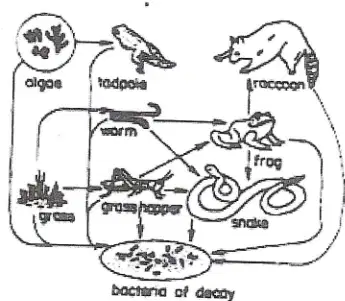
The organism eaten by the frog is:
Grasshopper
Snake
Eagle
Grass
What is an organism?
A group of the same organisms
An individual living thing
All of the different organisms in an area
All of Earth's ecosystems
Fill in the blank: A group of the same organisms (species) is called a ________.
Population
Community
Ecosystem
Habitat
What is a community in an ecosystem?
All of the biotic species plus abiotic factors
All of the different organisms/living things in an area
Similar ecosystems
All of Earth's ecosystems
Fill in the blank: An ecosystem consists of all the ________ species plus the ________ factors.
biotic, abiotic
abiotic, biotic
living, nonliving
plant, animal
What is a biome?
All of Earth's ecosystems
Similar ecosystems
A group of the same organisms
A constant source of energy
One requirement for a self-sustaining ecosystem is:
constant input of energy
removal of all organisms
absence of producers
lack of decomposers
Fill in the blank: The original source of life's energy on Earth is the ________.
Sun
Moon
Earth's core
Wind
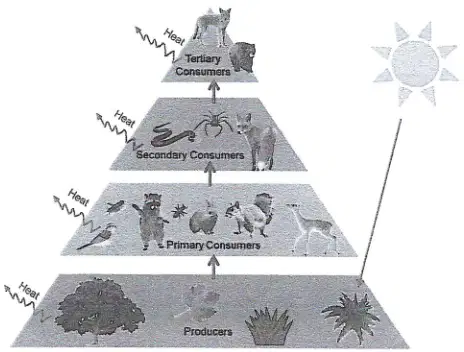
According to the energy pyramid diagram, which trophic level has the greatest amount of energy?
Tertiary consumers
Secondary consumers
Primary consumers
Producers
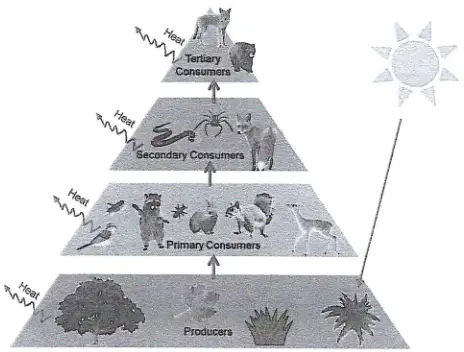
Where does the energy go as you move up the energy pyramid?
It is lost as heat
It is stored in the top predators
It increases at higher levels
It is recycled back to plants
What are biotic factors in an ecosystem?
Nonliving parts of the ecosystem
Living parts of the ecosystem
The maximum size of a population
The place where a plant or animal lives
What are abiotic factors in an ecosystem?
Living parts of the ecosystem
Nonliving parts of the ecosystem
The maximum size of a population
Fighting for the same resource
The maximum size of a population is called the _________.
carrying capacity
population density
biotic potential
growth rate
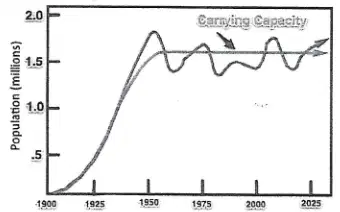
Refer to the diagram showing population growth. The carrying capacity in the graph represents:
The maximum population size the environment can support
The initial population size
The average birth rate
The rate of population decline
What is a niche in an ecosystem?
The place where a plant or animal lives
A species' role in its environment (its job and what it eats)
Fighting for the same resource
The gradual process where a community of organisms changes over time
What is competition in an ecosystem?
The place where a plant or animal lives
Fighting for the same resource
The gradual process where a community of organisms changes over time
The maximum size of a population
What is ecological succession?
The maximum size of a population
The gradual process where a community of organisms in an area changes over time, increasing the number of species
A species' role in its environment
Fighting for the same resource

Refer to the diagram showing ecological succession. What is the correct order of succession from bare land to a climax community?
Bare Land → Grasses → Shrubs → Aspens and Birches → Maples
Maples → Aspens and Birches → Shrubs → Grasses → Bare Land
Grasses → Bare Land → Shrubs → Maples → Aspens and Birches
Shrubs → Grasses → Bare Land → Maples → Aspens and Birches
What is biodiversity?
The gradual process where a community of organisms changes over time
The variety of life on earth
The maximum size of a population
Fighting for the same resource

