
 Worksheets
Chapter 24 Health Assessment
Total questions: 36
Worksheet time: 19mins
People infected with STDs often do not realize they have an infection because many STDs can be _______.
asymptomatic
painful
visible
fatal
Health experts say that the United States currently faces an STD _______.
epidemic
solution
decline
myth
STDs can be passed from person to person through
casual contact such as shaking hands.
the air by coughing or sneezing.
sexual contact.
all of the above.
Females infected with trichomoniasis
never experience symptoms.
cannot be cured.
are at higher risk of infection from HIV.
are not endangering their health.
If left untreated, all STDs
can lead to serious health problems.
will eventually cure itself.
will become asymptomatic.
lead to infection by HIV/AIDS.
STDs often go undiagnosed and untreated because:
They always show clear symptoms
People are too young to get them
They often have no noticeable symptoms
They are easy to cure
STDs affect males and females differently. Which of the following best describes one of these differences?
Females are more likely to have visible symptoms than males.
Males are more likely to experience long-term complications than females.
Females are more likely to have serious health complications from untreated STDs than males.
STDs affect both genders in exactly the same way.
Correct the sentence below by replacing the italicized term with the correct vocabulary term.
Many STDs can be treated and some cured with medications called HPV vaccines.
antibiotics
painkillers
antivirals
vaccines
Correct the sentence below by replacing the italicized term with the correct vocabulary term.
A refusal skill is the deliberate decision to avoid sexual activity.
abstinence
peer pressure
negotiation
communication
Which is not a high-risk behavior?
Engaging in sexual activity with multiple partners
Engaging in unprotected sexual activity
Using alcohol and other drugs
Abstaining from sexual activity
Getting a diagnosis and treatment is
acting responsibly.
crucial for those infected with STDs.
a healthful behavior.
all of the above.
Treatment of an STD
does not prevent reinfection.
isn’t always necessary.
can be postponed.
always cures the infection.
Viral and bacterial STDs differ in their causes and treatments. Which of the following best describes a key difference between them?
Viral STDs can be cured with antibiotics, while bacterial STDs cannot.
Bacterial STDs can be cured with antibiotics, while viral STDs usually cannot be cured.
Both viral and bacterial STDs can be cured with antibiotics.
Neither viral nor bacterial STDs can be treated.
Which STD can be treated with the HPV vaccine?
HIV
Syphilis
Human Papilloma Virus
Gonorrhea
Preventing STD transmission is more effective than treating STDs because:
It avoids the spread and complications of infections.
It is less expensive than treatment.
It is easier to do than treatment.
It requires no medical intervention.
Antibiotics are _________. They are used to treat STDs by _________.
drugs that kill or inhibit bacteria; killing or inhibiting the growth of bacteria causing the disease
viruses that attack bacteria; boosting the immune system
proteins that neutralize toxins; preventing viral replication
hormones that regulate metabolism; balancing body functions
Choose the correct term in the sentences below. (a) is the final stage of HIV infection.
HIV
Choose the correct term in the sentences below. Health care officials consider AIDS to be a(n) (a) .
antibody
pandemic
During the course of HIV/AIDS, the infected person
gets stronger.
should not hug anyone or shake hands.
needs less and less medication.
becomes vulnerable to opportunistic illnesses.
Which of the following is not a way that HIV attacks cells?
The virus attaches itself to the cell’s surface.
The virus makes a copy of its genetic material.
The virus shrinks cells.
The new virus assembles at cell surface.
It is difficult for antibodies to fight AIDS because
HIV weakens antibodies.
HIV destroys white blood cells.
HIV is protected once it enters cells.
HIV mutates rapidly.
HIV infection progresses in the body by:
Attacking and destroying the immune system, specifically CD4 cells
Directly killing red blood cells
Increasing the production of insulin
Strengthening the immune system
HIV is transmitted in which of the following ways?
Through sharing needles, unprotected sex, and from mother to child during birth
By shaking hands, hugging, and sharing food
Through mosquito bites, coughing, and sneezing
By touching surfaces, using public toilets, and sharing clothes
Some people stay away from those infected with HIV due to which misinformation?
HIV can be transmitted through casual contact like hugging or sharing utensils
HIV is only spread through blood transfusions
HIV can be cured by antibiotics
HIV only affects certain age groups
The ________ test is the first test that technicians use to screen for HIV.
The EIA test is the first test that technicians use to screen for HIV.
The Western Blot test is the first test that technicians use to screen for HIV.
The PCR test is the first test that technicians use to screen for HIV.
The Rapid Antigen test is the first test that technicians use to screen for HIV.
If the initial test produces positive results twice, a(n) ________ test is run.
Western blot test
PCR test
ELISA test
Rapid antigen test
The ________ allows samples to be tested on site rather than sending them to labs.
The rapid test
The microscope
The incubator
The centrifuge
A person who thinks he or she is infected with HIV/AIDS should
use a home testing kit.
hide the condition from others.
get a medical diagnosis right away.
hope that symptoms do not appear.
About one-fourth of the people infected with HIV/AIDS
are males.
are females.
don't know they are infected.
will never develop symptoms.
People who are infected with HIV/AIDS, but don't know it,
won't become as ill as those who know they have the virus.
don't need to change their high-risk behaviors.
don't need to practice abstinence.
can unknowingly spread the virus to others.
The number of HIV/AIDS infections is much higher in developing nations than in developed countries. Why might this number be higher in some countries?
Due to limited access to healthcare and education about prevention.
Because developed countries have more cases.
Because HIV/AIDS is not present in developed countries.
Due to better healthcare in developing nations.
33. Early diagnosis of HIV/AIDS can lead to:
Delayed treatment and worse outcomes
Early treatment and better health outcomes
No change in disease progression
Increased risk of transmission
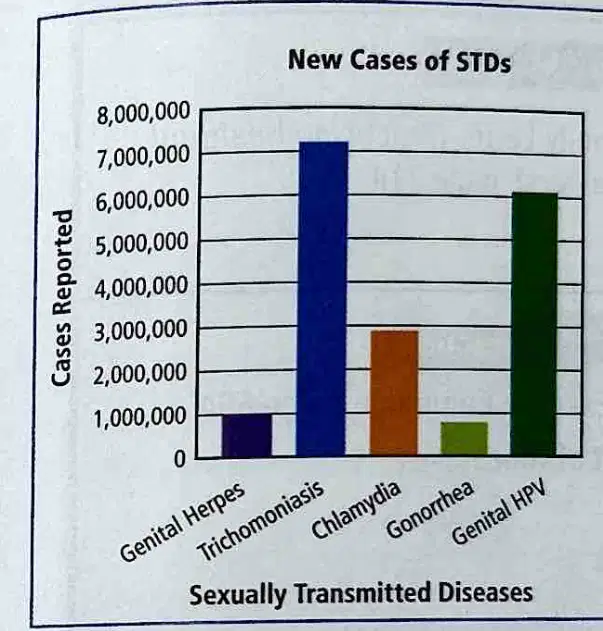
If the population of the United States is about 296 million, what is the ratio of infection for trichomoniasis this year?
1 in 4
1 in 40
1 in 400
1 in 4,000
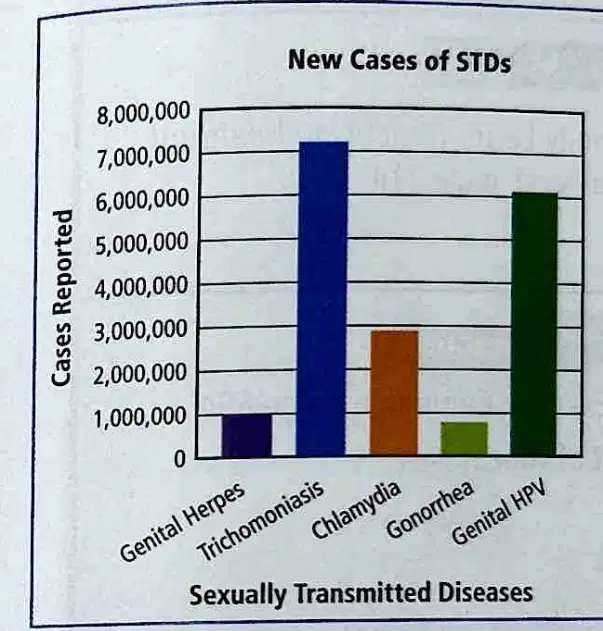
How much more common is genital HPV infection than genital herpes?
Twice as common
Three times more common
Four times more common
Six times more common
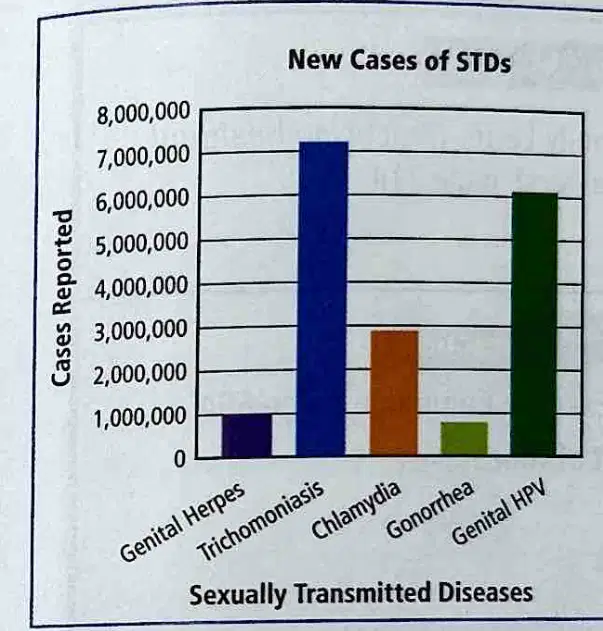
Using the bar graph, what method would you use to predict the rates of STD infection for people in your state?
Compare your state's data to the national average
Ignore the bar graph and guess
Use data from a different country
Only look at the highest bar
(a) is transmitted through the bloodstream.

