
 Worksheets
CH 20 Electrochemistry
Total questions: 85
Worksheet time: 43mins
What is the definition of "basic research"?
Research aimed at increasing fundamental knowledge without immediate practical application
Research focused on developing new products for the market
Research conducted only in industrial laboratories
Research that involves only simple experiments
What is the primary goal of a chapter on electrochemistry?
To understand the chemical processes involving electricity
To memorize the periodic table
To learn about organic reactions
To study only physical changes in matter
What is the primary driving force for lightning and batteries?
The movement of electrons
The flow of water
The increase in temperature
The presence of sunlight
Which of the following best describes how lightning is generally formed?
By the rapid movement of electrons between clouds and the ground
By the condensation of water vapor in the atmosphere
By the rotation of the Earth
By the absorption of sunlight by clouds
How does a battery generally operate?
By converting chemical energy into electrical energy through redox reactions
By storing heat energy for later use
By absorbing light and converting it to electricity
By using magnets to generate electricity
What is the definition of oxidation?
The gain of electrons by a substance
The loss of electrons by a substance
The combination of a substance with hydrogen
The splitting of a molecule into two parts
Which of the following is an example of reduction?
Iron rusting in air
Hydrogen gas gaining electrons to form H2
Magnesium losing electrons to form Mg2+
Sodium reacting with chlorine to form NaCl
Why can balancing redox reactions be more challenging than balancing other types of reactions?
Because redox reactions do not involve electron transfer
Because redox reactions require balancing both mass and charge
Because redox reactions only occur in basic solutions
Because redox reactions are always endothermic
What method is commonly used to balance redox reactions and why?
The trial and error method, because it is the fastest
The half-reaction method, because it allows separate balancing of oxidation and reduction
The combustion method, because it is used for all reactions
The precipitation method, because it balances ions
Which of the following is the first step in the general procedure for balancing aqueous redox reactions in acidic solution?
Balance the oxygen atoms
Write the unbalanced equation
Balance the hydrogen atoms
Add electrons to balance charges
What is the definition of electric current?
The flow of electric charge through a conductor
The storage of energy in a battery
The resistance to the flow of electrons
The amount of energy produced by a chemical reaction
How can the components in redox reactions be utilized to do electrical work?
By allowing electrons to flow through an external circuit, generating electricity
By increasing the temperature of the solution
By mixing the reactants together in a closed container
By preventing any electron transfer between substances
Which of the following best describes a spontaneous redox reaction?
A reaction that occurs naturally and releases energy, such as the reaction in a galvanic cell
A reaction that requires continuous input of energy to proceed
A reaction that only occurs at high temperatures
A reaction that does not involve electron transfer
What is the definition of an electrochemical cell?
A device that converts chemical energy into electrical energy through redox reactions
A container used to store electricity
A type of battery that only uses non-metallic elements
A device that measures the pH of a solution
What is a voltaic (galvanic) cell?
A device that converts chemical energy into electrical energy
A device that converts electrical energy into chemical energy
A device that stores mechanical energy
A device that measures temperature
What is an electrolytic cell?
A device that converts electrical energy into chemical energy
A device that converts chemical energy into electrical energy
A device that stores solar energy
A device that measures voltage
What is a half-cell in the context of electrochemistry?
A part of an electrochemical cell where either oxidation or reduction occurs
A device that measures current
A type of battery used in mobile phones
A cell that only produces heat
What is an electrode?
A conductor through which electricity enters or leaves an object, substance, or region
A type of chemical reaction
A device that stores energy as heat
A measuring instrument for pressure
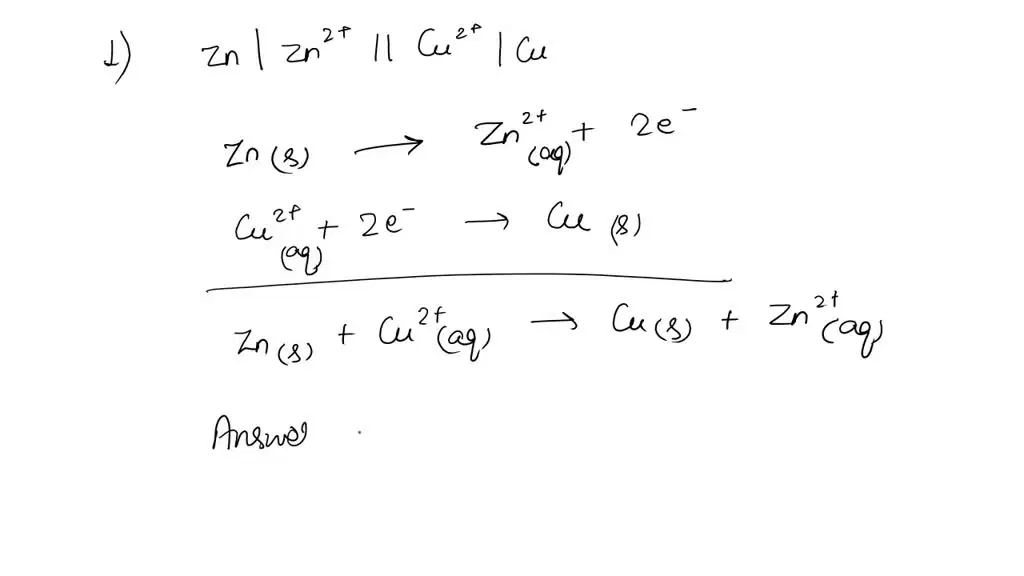
In a Zn/Zn²⁺ ||Cu2+/Cu system, how does the movement of electrons occur and from where?
Electrons move from the zinc electrode to the copper electrode through an external circuit
Electrons move from the copper electrode to the zinc electrode through an external circuit
Electrons move from the solution to the electrodes directly
Electrons do not move in this system
Describe the central idea in Voltaic Cells.
Voltaic cells convert chemical energy into electrical energy through spontaneous redox reactions
Voltaic cells store electrical energy for later use
Voltaic cells are used to measure temperature changes
Voltaic cells are only used in laboratory experiments
Define electric current and give its unit and relative equivalencies.
Electric current is the flow of electric charge, measured in amperes (A), where 1 A = 1 C/s
Electric current is the flow of heat, measured in joules (J)
Electric current is the flow of mass, measured in kilograms (kg)
Electric current is the flow of light, measured in lumens (lm)
What is the unit of potential difference?
Volt
Ampere
Ohm
Watt
Which of the following best defines electromotive force (emf)?
The energy supplied by a source per coulomb of charge
The resistance in a circuit
The current flowing through a conductor
The power consumed by a device
What does the term "cell potential" refer to in electrochemistry?
The voltage difference between two electrodes in a cell
The resistance of a cell
The current produced by a cell
The temperature of a cell
What is meant by "standard cell potential"?
The cell potential measured under standard conditions (1 M, 1 atm, 25°C)
The maximum current a cell can produce
The resistance of a cell at room temperature
The energy lost as heat in a cell
Describe the difference between Zn(s) and Ni(s) in a cell. Which of the following is a correct comparison?
Zn(s) is more easily oxidized than Ni(s)
Ni(s) is more easily oxidized than Zn(s)
Zn(s) and Ni(s) have the same tendency to be oxidized
Both Zn(s) and Ni(s) act as cathodes
Comparing two cell potentials allows you to analyze which of the following?
The direction of electron flow and the spontaneity of the reaction
The color of the electrodes and the temperature of the cell
The size of the electrodes and the amount of electrolyte
The pressure and the volume of the cell
What is the definition of an anode in an electrochemical cell?
The electrode where oxidation occurs
The electrode where reduction occurs
The electrode with the highest voltage
The electrode that is always positive
What is the definition of a cathode in an electrochemical cell?
The electrode where oxidation occurs
The electrode where reduction occurs
The electrode that loses electrons
The electrode that is always negative
In a voltaic cell, how is the charge of the anode and cathode designated?
Anode is positive, cathode is negative
Anode is negative, cathode is positive
Both are positive
Both are negative
What happens when electrons flow out of the anode in a voltaic cell?
The anode gains electrons
The anode is oxidized
The anode is reduced
The anode becomes neutral
What is the function of a salt bridge in an electrochemical cell?
To generate electricity
To allow the flow of electrons between electrodes
To maintain electrical neutrality by allowing ion flow
To separate the anode and cathode physically
Which of the following best describes the line notation for a Zn/Cu electrochemical cell?
Zn(s) | Zn2+(aq) || Cu2+(aq) | Cu(s)
Cu(s) | Cu2+(aq) || Zn2+(aq) | Zn(s)
Zn2+(aq) | Zn(s) || Cu(s) | Cu2+(aq)
Cu2+(aq) | Cu(s) || Zn(s) | Zn2+(aq)
What is the definition of standard electrode potential?
The potential of a cell when all reactants and products are at unit activity
The potential of an electrode measured relative to the standard hydrogen electrode under standard conditions
The voltage produced by a battery under non-standard conditions
The energy required to remove an electron from an atom
Which of the following is the correct half-reaction for the standard hydrogen electrode (SHE)?
H₂(g) + 2e⁻ → 2H⁺(aq)
2H⁺(aq) + 2e⁻ → H₂(g)
H₂O(l) + 2e⁻ → H₂(g) + 2OH⁻(aq)
2H₂(g) → 4H⁺(aq) + 4e⁻
What conditions are required to use the standard hydrogen electrode (SHE) to measure electrode potentials?
1 M H⁺ concentration, 1 atm H₂ gas, 25°C
0.1 M H⁺ concentration, 2 atm H₂ gas, 0°C
1 M H⁺ concentration, 1 atm O₂ gas, 25°C
2 M H⁺ concentration, 1 atm H₂ gas, 50°C
What does a negative potential indicate in a SHE experiment?
The electrode is more easily reduced than hydrogen
The electrode is more easily oxidized than hydrogen
The electrode is at equilibrium with hydrogen
The electrode is not reactive
What does a positive potential indicate in a SHE experiment?
The electrode is more easily oxidized than hydrogen
The electrode is less reactive than hydrogen
The electrode is more easily reduced than hydrogen
The electrode is not involved in redox reactions
How are standard potentials for electrochemical cells calculated from standard electrode potentials of the half reactions?
By multiplying the standard electrode potentials of the half reactions
By adding the standard electrode potentials of the half reactions
By subtracting the anode potential from the cathode potential
By dividing the cathode potential by the anode potential
Which of the following is a method to predict whether a metal will dissolve in acid?
By checking the metal's position in the activity series
By measuring the metal's density
By observing the metal's color
By testing the metal's melting point
What is an exception to the general rule for predicting whether a metal will dissolve in acid?
Copper does not dissolve in hydrochloric acid
Sodium dissolves in water but not in acid
Gold dissolves in all acids
Iron dissolves in all acids
Which of the following is a generalization that can be made for spontaneous redox reactions?
The cell potential (E°cell) is positive
The cell potential (E°cell) is negative
The reaction absorbs energy
The reaction does not involve electron transfer
Which of the following is true for nonspontaneous redox reactions?
The cell potential (E°cell) is negative
The reaction occurs without external energy
The reaction produces energy
The reaction always forms a precipitate
What is the correct formula relating standard free energy change (ΔG°) and standard cell potential (E°cell)?
ΔG° = -nFE°cell
ΔG° = nFE°cell
ΔG° = -RTlnK
ΔG° = E°cell/nF
In the formula ΔG° = -nFE°cell, what does 'n' represent and what is its unit?
Number of moles of electrons, unitless
Number of moles of electrons, moles
Faraday constant, coulombs
Standard cell potential, volts
In the formula ΔG° = -nFE°cell, what is the unit for the Faraday constant (F)?
Coulombs per mole
Volts
Joules
Moles per liter
What is Faraday’s Constant?
The amount of electric charge per mole of electrons
The energy required to move an electron between two points
The number of protons in a mole of substance
The mass of one mole of electrons
Which of the following best describes the relationship between the standard cell potential (E°cell) and the equilibrium constant (K) in redox reactions?
E°cell and K are unrelated
E°cell is directly proportional to the natural logarithm of K
E°cell is inversely proportional to K
E°cell is equal to K
In the equation relating standard cell potential (E°cell) and the equilibrium constant (K), which of the following variables is NOT typically included?
Number of moles of electrons transferred (n)
Faraday’s constant (F)
Universal gas constant (R)
Avogadro’s number (NA)
Given the equation E°cell = (RT/nF) ln K, what does the variable F represent and what are its units?
Faraday’s constant, units: C/mol
Faraday’s constant, units: J/mol
Universal gas constant, units: J/(mol·K)
Number of moles of electrons, units: mol
Which of the following variables are related in the context of electrochemistry as mentioned in the learning material?
K, ΔG°, and E°cell
pH, temperature, and pressure
Volume, mass, and density
Frequency, wavelength, and speed of light
According to the learning material, what is the main focus of section 20.6?
The relationship between acids and bases
Cell potential and concentration
The structure of atoms
The periodic table trends
Which equation is used to calculate Ecell under nonstandard conditions, and what must be identified for each variable?
The Nernst equation; all variables and their units
The ideal gas law; only pressure and volume
The Arrhenius equation; only temperature
The Henderson-Hasselbalch equation; only pH
If the concentration of reactants in a cell increases (while products remain constant), what is the likely effect on Ecell according to the qualitative discussion in section 20.6?
Ecell will increase
Ecell will decrease
Ecell will remain unchanged
Ecell will become zero
What is the relationship between Q and Ecell when Q = 1?
Ecell = 0
Ecell = E°cell
Ecell is negative
Ecell is positive
When Q < 1 in an electrochemical cell, what can be said about Ecell?
Ecell is less than E°cell
Ecell is greater than E°cell
Ecell is equal to zero
Ecell is always negative
What happens to Ecell when Q > 1?
Ecell is greater than E°cell
Ecell is less than E°cell
Ecell is always zero
Ecell is always positive
What is true about Ecell when Q = K (the equilibrium constant)?
Ecell = E°cell
Ecell = 0
Ecell is positive
Ecell is negative
Which of the following best defines a concentration cell?
A cell that uses different metals as electrodes
A cell that generates electricity from light
A cell in which the electrodes are the same material but the ion concentrations are different
A cell that uses only non-metallic electrodes
How does a concentration cell work?
By using different metals to create a voltage
By using a difference in ion concentration to generate a potential difference
By converting light energy into electrical energy
By using a salt bridge to balance charge
How is the chemistry of concentration cells applied in nerve cells in the body?
It helps in the digestion of food.
It is involved in the transmission of electrical signals.
It is used for muscle contraction only.
It is responsible for the production of hormones.
What is a battery in general?
A device that stores mechanical energy.
A device that generates electricity through chemical reactions.
A device that produces heat from friction.
A device that stores solar energy.
Which of the following is an example of a dry-cell battery?
Car battery
AA battery used in remote controls
Rechargeable laptop battery
Fuel cell in a hydrogen car
Lead-acid storage batteries are commonly used in which application?
Wristwatches
Automobiles
Mobile phones
Solar calculators
Nickel–cadmium batteries are best described as:
Non-rechargeable batteries used in flashlights
Rechargeable batteries often used in power tools
Disposable batteries for hearing aids
Batteries used only in electric cars
Nickel–metal hydride batteries are commonly used in:
Disposable cameras
Hybrid vehicles and portable electronics
Smoke detectors only
Landline telephones
How are fuel cells and batteries similar and different?
Both store energy chemically, but only batteries can be recharged.
Both convert chemical energy to electrical energy, but fuel cells require a constant supply of fuel.
Both are used only in vehicles.
Both are non-rechargeable and disposable.
How do Fuel-Cell breathalyzers work?
They use a chemical reaction to detect alcohol in breath.
They measure blood pressure.
They analyze fingerprints.
They detect body temperature.
Where do astronauts get the water they drink in space?
It is recycled from waste products.
It is delivered daily from Earth.
It is extracted from asteroids.
It is produced by plants grown in space.
Which of the following best differentiates a voltaic cell from an electrolytic cell?
A voltaic cell generates electricity from a spontaneous reaction, while an electrolytic cell uses electricity to drive a nonspontaneous reaction.
A voltaic cell uses electricity to drive a nonspontaneous reaction, while an electrolytic cell generates electricity from a spontaneous reaction.
Both cells generate electricity from nonspontaneous reactions.
Both cells require sunlight to operate.
What is the definition of an electrolytic cell?
A device that uses electrical energy to drive a nonspontaneous chemical reaction.
A device that generates electricity from a spontaneous chemical reaction.
A device that stores solar energy.
A device that measures pH levels.
What is electrolysis?
The process of using electricity to drive a nonspontaneous chemical reaction.
The process of generating electricity from a chemical reaction.
The process of filtering water.
The process of measuring electrical resistance.
Which of the following is an example of an electrolytic cell and its use?
Electrolysis of water to produce hydrogen and oxygen gases.
Burning wood to produce heat.
Photosynthesis in plants.
Melting ice to obtain water.
Which of the following is NOT a typical use of electrolytic cells?
Generating electricity from a spontaneous reaction.
Electroplating metals.
Purifying metals.
Producing chemicals like chlorine and sodium hydroxide.
How do electrolytic cells differ from voltaic cells with respect to the source of electrons?
In electrolytic cells, the source of electrons is an external power source; in voltaic cells, it is the spontaneous redox reaction.
In both cells, the source of electrons is an external power source.
In both cells, the source of electrons is a spontaneous redox reaction.
In electrolytic cells, the source of electrons is the anode; in voltaic cells, it is the cathode.
What generally happens during the electrolysis of a pure molten salt?
The salt decomposes into its constituent elements.
The salt forms a new compound.
The salt remains unchanged.
The salt evaporates.
What is a complication in determining the events in an aqueous solution during electrolysis?
The presence of water can lead to competing reactions.
The solution always remains neutral.
Only one product is ever formed.
The electrodes dissolve completely.
When electrolyzing molten salts with mixtures of cations or anions, what generally occurs?
The ions with the lowest reduction or oxidation potential are discharged first.
All ions are discharged at the same rate.
Only the cations are discharged.
Only the anions are discharged.
What is the unit of electric current and how is it defined in relation to time?
The unit is ampere (A), defined as one coulomb per second.
The unit is volt (V), defined as one joule per second.
The unit is ohm (Ω), defined as one volt per ampere.
The unit is watt (W), defined as one joule per coulomb.
What is the equation that relates electric current (I) and charge (Q)? Identify all variables and their units.
I = Q/t, where I is current in amperes (A), Q is charge in coulombs (C), and t is time in seconds (s).
I = V/R, where I is current in amperes (A), V is voltage in volts (V), and R is resistance in ohms (Ω).
Q = V × t, where Q is charge in coulombs (C), V is voltage in volts (V), and t is time in seconds (s).
I = P/V, where I is current in amperes (A), P is power in watts (W), and V is voltage in volts (V).
Which constant relates electric charge and moles, and what is its numerical value?
Faraday’s constant, approximately 96,485 C/mol
Avogadro’s number, approximately 6.022 × 10²³ mol⁻¹
Planck’s constant, approximately 6.626 × 10⁻³⁴ J·s
Boltzmann’s constant, approximately 1.38 × 10⁻²³ J/K
What is the main topic discussed in section 20.9 of the learning material?
Corrosion: Undesirable Redox Reactions
Electrolysis and its Applications
Organic Chemistry Reactions
Thermodynamics of Solutions
What is the opposite of the process of corrosion?
Reduction
Oxidation
Synthesis
Decomposition
Which metal's corrosion process is specifically discussed in the material?
Copper
Iron
Aluminum
Silver
According to the material, what is important to consider when understanding the formation of rust on iron?
The chemical reactions involved
The color of the rust
The weight of the iron
The shape of the iron object

