
 Worksheets
microsoft dp-700 part2
Total questions: 46
Worksheet time: 33mins
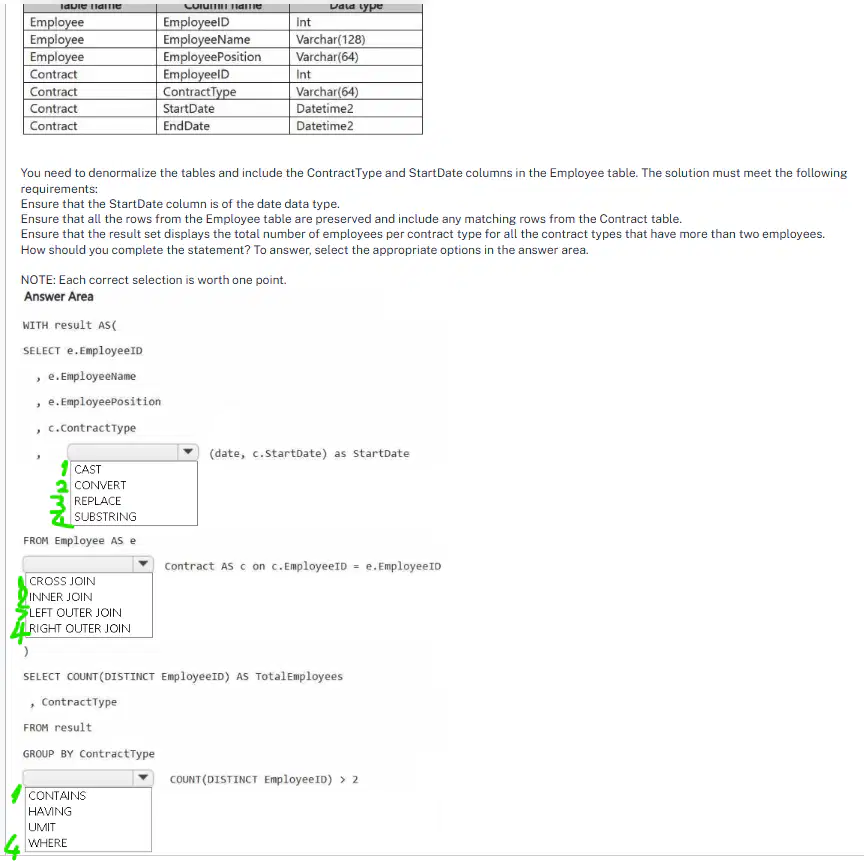
(a)
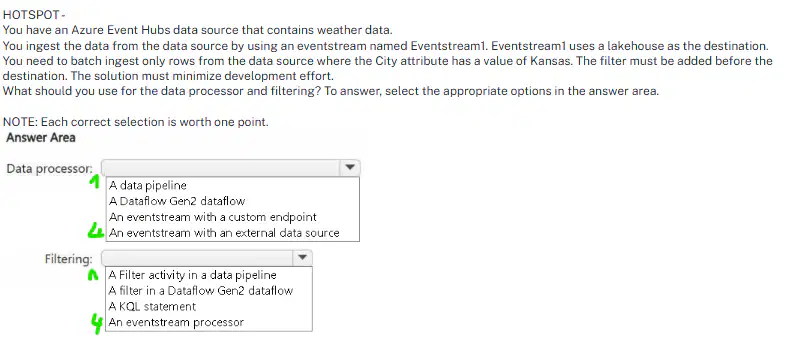
(a)
You have a Fabric workspace that contains an eventstream named Eventstream1. Eventstream1 processes data from a thermal sensor by using event stream processing, and then stores the data in a lakehouse.
You need to modify Eventstream1 to include the standard deviation of the temperature.
Which transform operator should you include in the Eventstream1 logic?
Expand
Group by
Union
Aggregate
You have an Azure event hub. Each event contains the following fields:
BikepointID -
Street -
Neighbourhood -
Latitude -
Longitude -
No_Bikes -
No_Empty_Docks -
You need to ingest the events. The solution must only retain events that have a Neighbourhood value of Chelsea, and then store the retained events in a Fabric lakehouse.
What should you use?
a KQL queryset
an eventstream
a streaming dataset
Apache Spark Structured Streaming
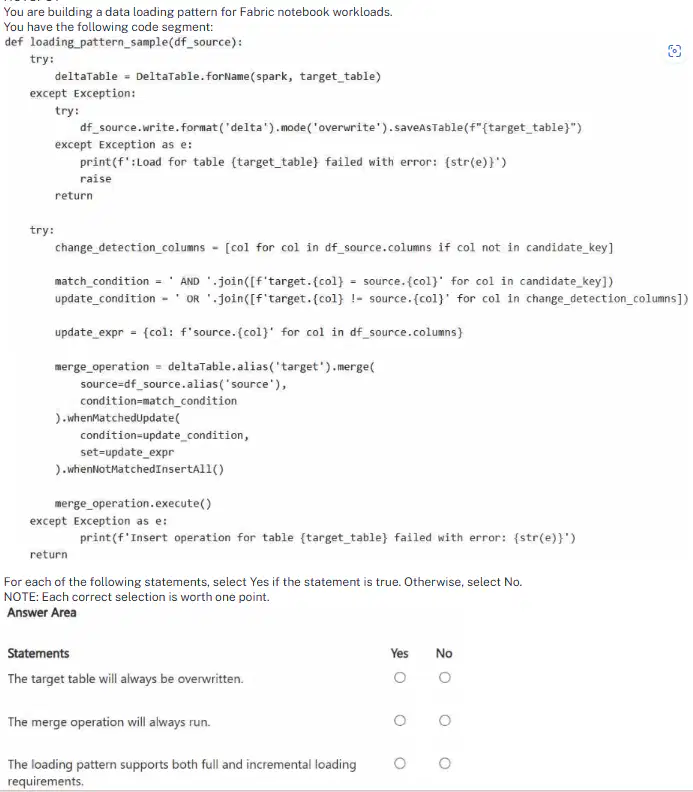
(a)
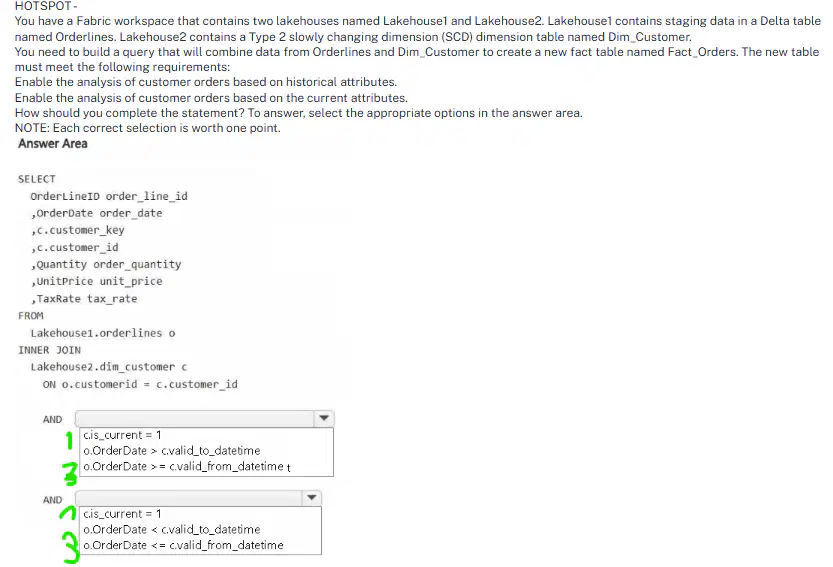
Q67
(a)
Q68=Q69 You have a Fabric workspace that contains a lakehouse named Lakehouse1.
In an external data source, you have data files that are 500 GB each. A new file is added every day.
You need to ingest the data into Lakehouse1 without applying any transformations. The solution must meet the following requirements
Trigger the process when a new file is added.
Provide the highest throughput.
Which type of item should you use to ingest the data?
Eventstream
Dataflow Gen2
Streaming dataset
Data pipeline


(a)
You are developing a data pipeline named Pipeline1.
You need to add a Copy data activity that will copy data from a Snowflake data source to a Fabric warehouse.
What should you configure?
Degree of copy parallelism
Fault tolerance
Enable staging
Enable logging
yes
no
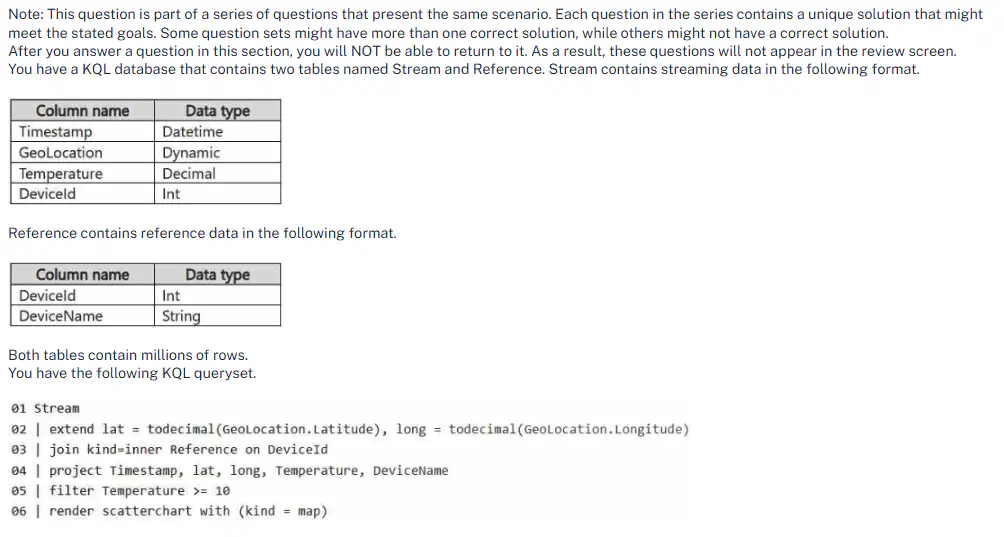
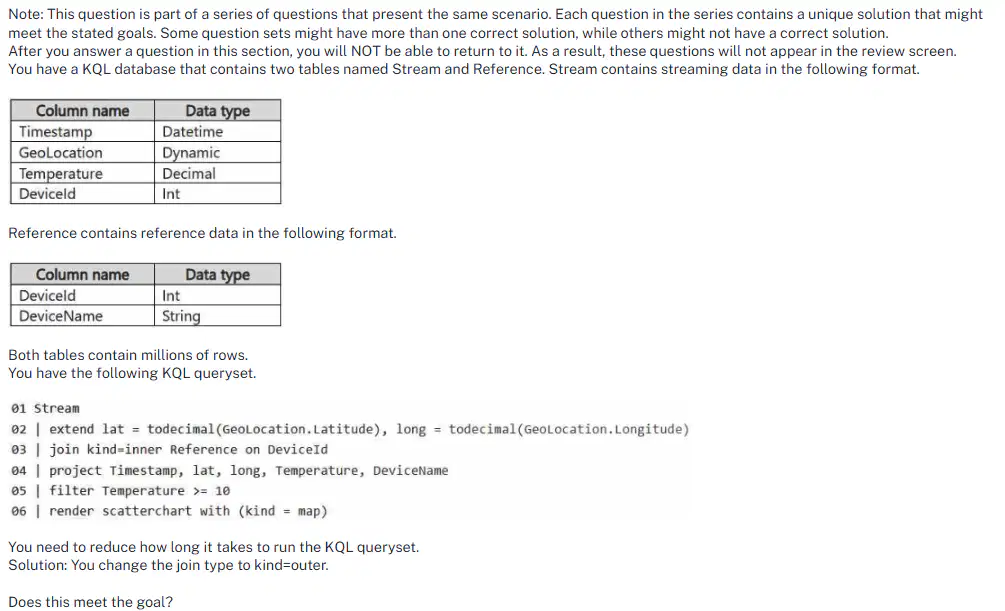
You need to reduce how long it takes to run the KQL queryset.
Solution: You change project to extend.
Does this meet the goal?
yes
no
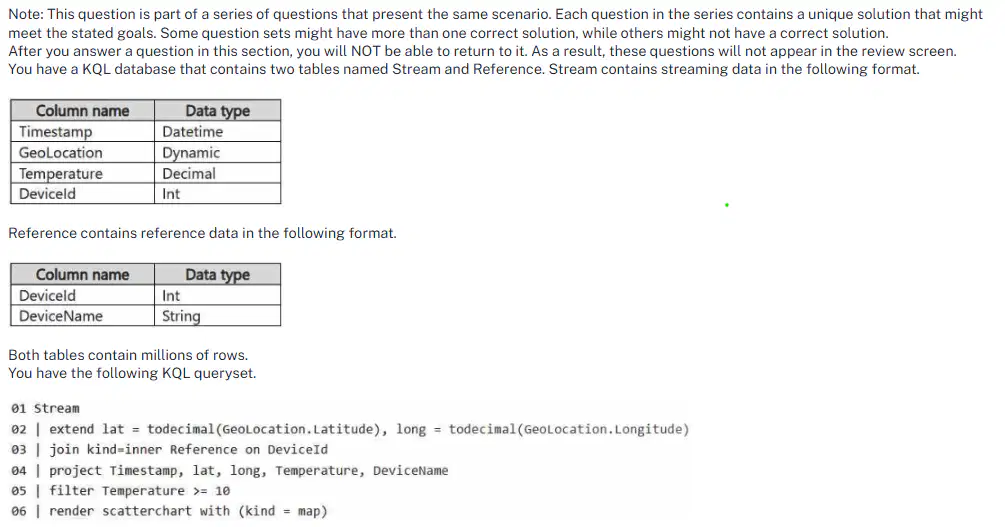
You need to reduce how long it takes to run the KQL queryset.
Solution: You move the filter to line 02.
Does this meet the goal?
yes
no
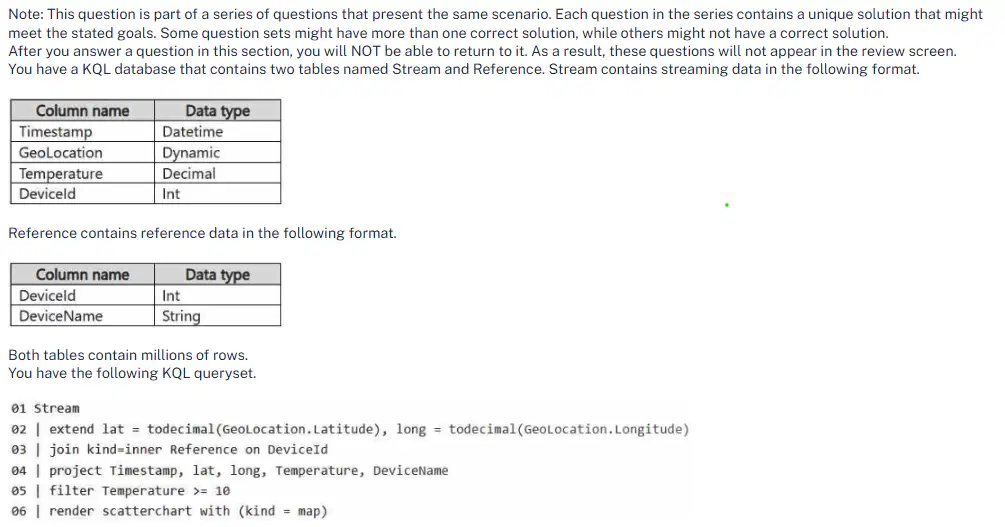
You need to reduce how long it takes to run the KQL queryset.
Solution: You add the make_list() function to the output columns.
Does this meet the goal?
yes
no
Overview -
Litware, Inc. is a publishing company that has an online bookstore and several retail bookstores worldwide. Litware also manages an online advertising business for the authors it represents.
Existing Environment. Fabric Environment
Litware has a Fabric workspace named Workspace1. High concurrency is enabled for Workspace1.
The company has a data engineering team that uses Python for data processing.
Existing Environment. Data Processing
The retail bookstores send sales data at the end of each business day, while the online bookstore constantly provides logs and sales data to a central enterprise resource planning (ERP) system.
Litware implements a medallion architecture by using the following three layers: bronze, silver, and gold. The sales data is ingested from the ERP system as Parquet files that land in the Files folder in a lakehouse. Notebooks are used to transform the files in a Delta table for the bronze and silver layers. The gold layer is in a warehouse that has V-Order disabled.
Litware has image files of book covers in Azure Blob Storage. The files are loaded into the Files folder.
Existing Environment. Sales Data
Month-end sales data is processed on the first calendar day of each month. Data that is older than one month never changes.
In the source system, the sales data refreshes every six hours starting at midnight each day.
The sales data is captured in a Dataflow Gen1 dataflow. When the dataflow runs, new and historical data is captured. The dataflow captures the following fields of the source:
•Sales Date
•Author
•Price
•Units
•SKU
A table named AuthorSales stores the sales data that relates to each author. The table contains a column named AuthorEmail. Authors authenticate to a guest Fabric tenant by using their email address.
Existing Environment. Security Groups
Litware has the following security groups:
•Sales
•Fabric Admins
•Streaming Admins
Existing Environment. Performance Issues
Business users perform ad-hoc queries against the warehouse. The business users indicate that reports against the warehouse sometimes run for two hours and fail to load as expected. Upon further investigation, the data engineering team receives the following error message when the reports fail to load: “The SQL query failed while running.”
The data engineering team wants to debug the issue and find queries that cause more than one failure.
When the authors have new book releases, there is often an increase in sales activity. This increase slows the data ingestion process.
The company’s sales team reports that during the last month, the sales data has NOT been up-to-date when they arrive at work in the morning.
Requirements. Planned Changes -
Litware recently signed a contract to receive book reviews. The provider of the reviews exposes the data in Amazon Simple Storage Service (Amazon S3) buckets.
Litware plans to manage Search Engine Optimization (SEO) for the authors. The SEO data will be streamed from a REST API.
Requirements. Version Control -
Litware plans to implement a version control solution in Fabric that will use GitHub integration and follow the principle of least privilege.
Requirements. Governance Requirements
To control data platform costs, the data platform must use only Fabric services and items. Additional Azure resources must NOT be provisioned.
Requirements. Data Requirements -
Litware identifies the following data requirements:
•Process the SEO data in near-real-time (NRT).
•Make the book reviews available in the lakehouse without making a copy of the data.
•When a new book cover image arrives in the Files folder, process the image as soon as possible.
You need to create a workflow for the new book cover images.
Which two components should you include in the workflow? Each correct answer presents part of the solution.
NOTE: Each correct selection is worth one point.
A.a time-based schedule
B.a streaming dataflow
C.a blob storage action
D.a data pipeline
E.a notebook that uses Apache Spark Structured Streaming
F.a reflex item
(a)
Overview -
Litware, Inc. is a publishing company that has an online bookstore and several retail bookstores worldwide. Litware also manages an online advertising business for the authors it represents.
Existing Environment. Fabric Environment
Litware has a Fabric workspace named Workspace1. High concurrency is enabled for Workspace1.
The company has a data engineering team that uses Python for data processing.
Existing Environment. Data Processing
The retail bookstores send sales data at the end of each business day, while the online bookstore constantly provides logs and sales data to a central enterprise resource planning (ERP) system.
Litware implements a medallion architecture by using the following three layers: bronze, silver, and gold. The sales data is ingested from the ERP system as Parquet files that land in the Files folder in a lakehouse. Notebooks are used to transform the files in a Delta table for the bronze and silver layers. The gold layer is in a warehouse that has V-Order disabled.
Litware has image files of book covers in Azure Blob Storage. The files are loaded into the Files folder.
Existing Environment. Sales Data
Month-end sales data is processed on the first calendar day of each month. Data that is older than one month never changes.
In the source system, the sales data refreshes every six hours starting at midnight each day.
The sales data is captured in a Dataflow Gen1 dataflow. When the dataflow runs, new and historical data is captured. The dataflow captures the following fields of the source:
•Sales Date
•Author
•Price
•Units
•SKU
A table named AuthorSales stores the sales data that relates to each author. The table contains a column named AuthorEmail. Authors authenticate to a guest Fabric tenant by using their email address.
Existing Environment. Security Groups
Litware has the following security groups:
•Sales
•Fabric Admins
•Streaming Admins
Existing Environment. Performance Issues
Business users perform ad-hoc queries against the warehouse. The business users indicate that reports against the warehouse sometimes run for two hours and fail to load as expected. Upon further investigation, the data engineering team receives the following error message when the reports fail to load: “The SQL query failed while running.”
The data engineering team wants to debug the issue and find queries that cause more than one failure.
When the authors have new book releases, there is often an increase in sales activity. This increase slows the data ingestion process.
The company’s sales team reports that during the last month, the sales data has NOT been up-to-date when they arrive at work in the morning.
Requirements. Planned Changes -
Litware recently signed a contract to receive book reviews. The provider of the reviews exposes the data in Amazon Simple Storage Service (Amazon S3) buckets.
Litware plans to manage Search Engine Optimization (SEO) for the authors. The SEO data will be streamed from a REST API.
Requirements. Version Control -
Litware plans to implement a version control solution in Fabric that will use GitHub integration and follow the principle of least privilege.
Requirements. Governance Requirements
To control data platform costs, the data platform must use only Fabric services and items. Additional Azure resources must NOT be provisioned.
Requirements. Data Requirements -
Litware identifies the following data requirements:
•Process the SEO data in near-real-time (NRT).
•Make the book reviews available in the lakehouse without making a copy of the data.
•When a new book cover image arrives in the Files folder, process the image as soon as possible.
What should you recommend that the data engineering team use to ingest the SEO data?
.a streaming dataflow
a streaming dataset
a notebook that uses Apache Spark Structured Streaming
an eventstream
(a)

(a)
(a)
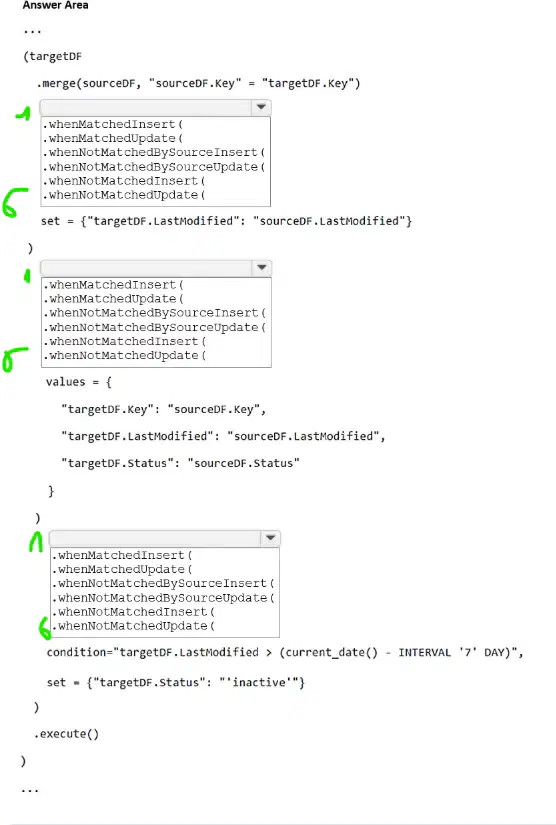
You have a Fabric workspace that contains a lakehouse named Lakehouse1. Lakehouse1 contains a table named Status_Target that has the following columns:
•Key
•Status
•LastModified
The data source contains a table named Status_Source that has the same columns as Status_Target. Status_Source is used to populate Status_Target.
In a notebook name Notebook1, you load Status_Source to a DataFrame named sourceDF and Status_Target to a DataFrame named targetDF.
You need to implement an incremental loading pattern by using Notebook1. The solution must meet the following requirements:
•For all the matching records that have the same value of key, update the value of LastModified in Status_Target to the value of LastModified in Status_Source.
•Insert all the records that exist in Status_Source that do NOT exist in Status_Target.
•Set the value of Status in Status_Target to inactive for all the records that were last modified more than seven days ago and that do NOT exist in Status_Source.
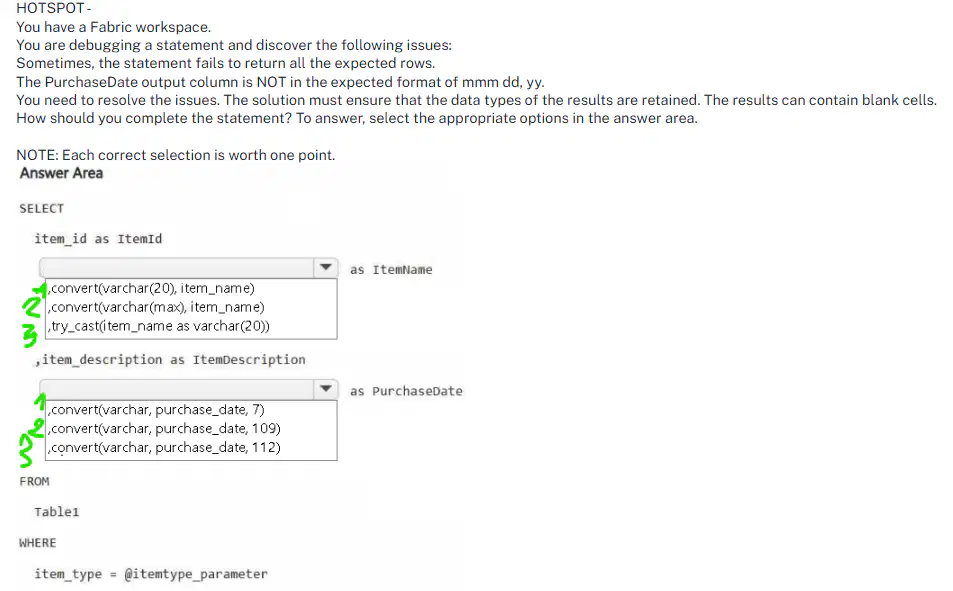
How should you complete the statement? To answer, select the appropriate options in the answer area.
NOTE: Each correct selection is worth one point.
(a)
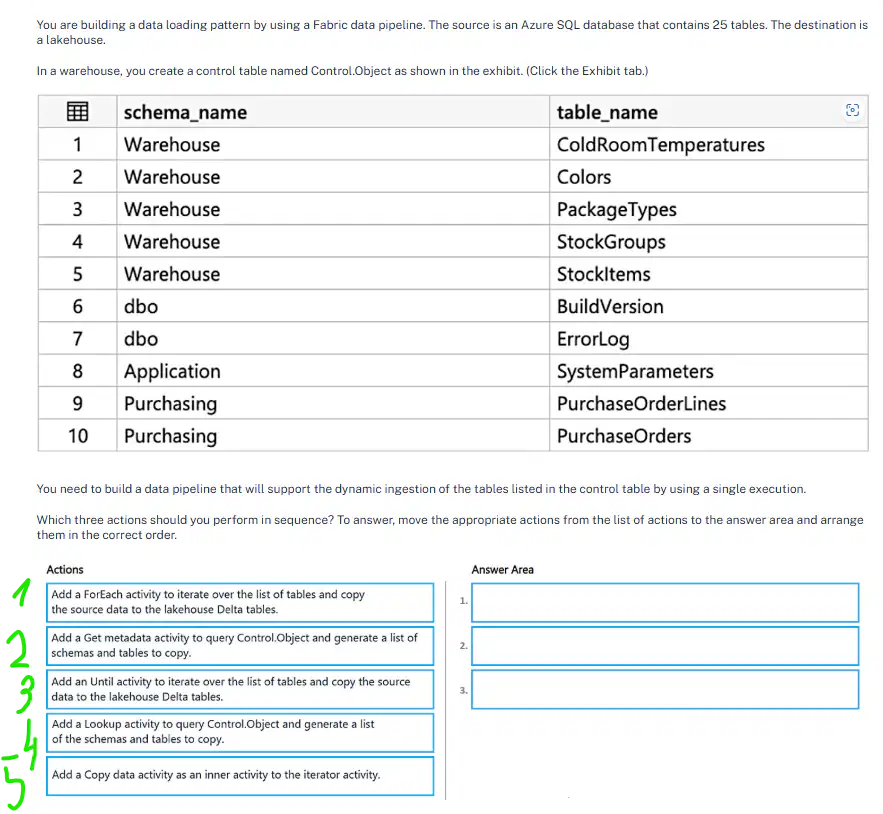
Q83
(a)
You are implementing a medallion architecture in a Fabric lakehouse.
You plan to create a dimension table that will contain the following columns:
•ID
•CustomerCode
•CustomerName
•CustomerAddress
•CustomerLocation
•ValidFrom
•ValidTo
You need to ensure that the table supports the analysis of historical sales data by customer location at the time of each sale.
Which type of slowly changing dimension (SCD) should you use?
Type 2
Type 0
Type 1
Type 3
You have a Fabric workspace that contains an eventstream named EventStream1. EventStream1 outputs events to a table named Table1 in a lakehouse. The streaming data is sourced from motorway sensors and represents the speed of cars.
You need to add a transformation to EventStream1 to average the car speeds. The speeds must be grouped by non-overlapping and contiguous time intervals of one minute. Each event must belong to exactly one window.
Which windowing function should you use?
sliding
hopping
tumbling
session
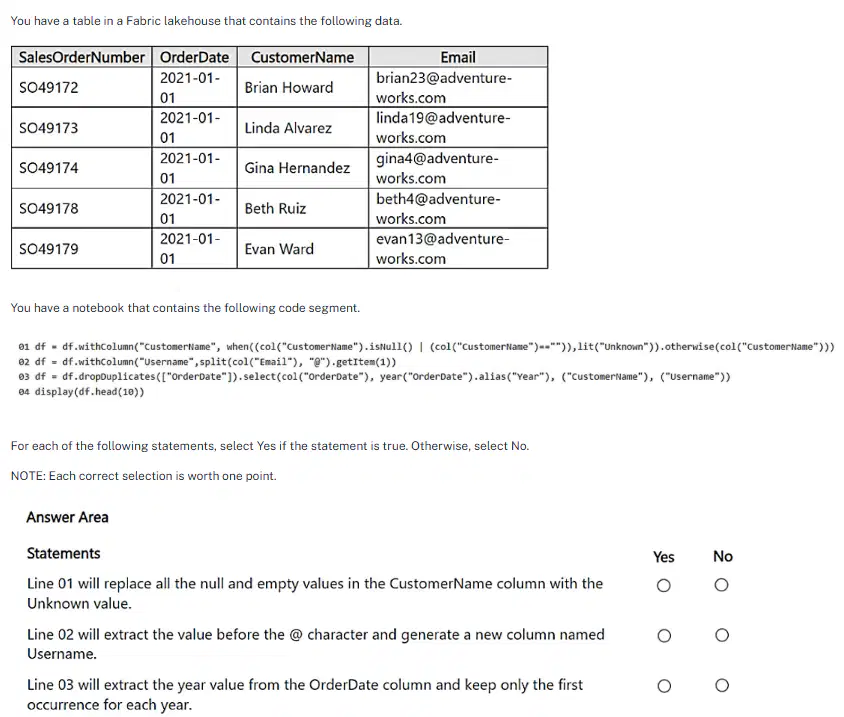
(a)
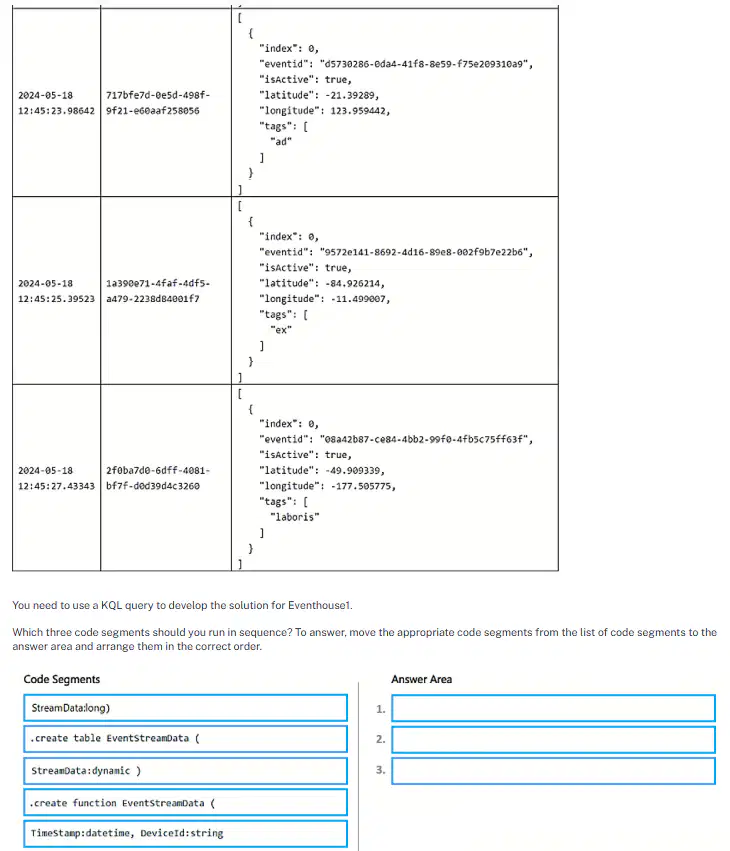
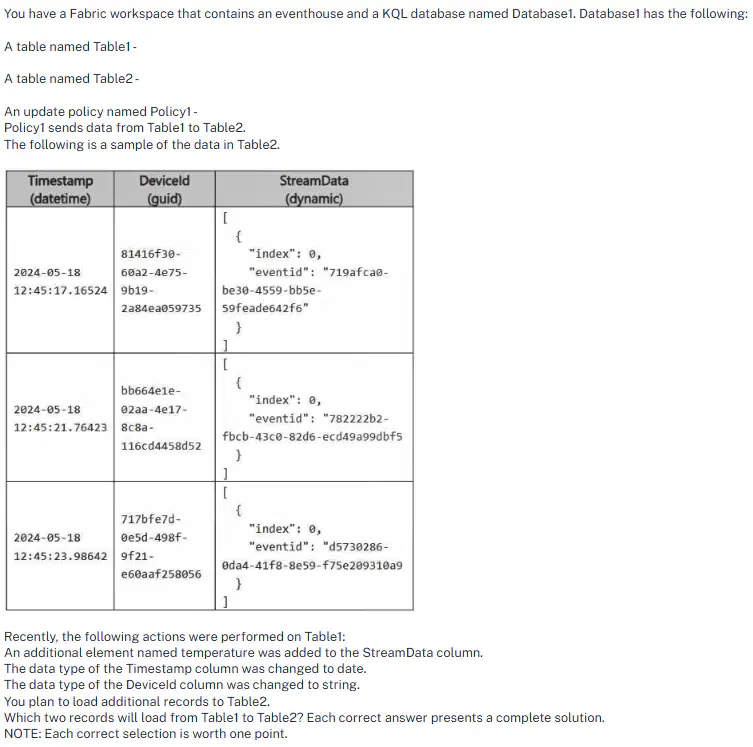
You have a Fabric workspace that contains an eventhouse named Eventhouse1.
In Eventhouse1, you plan to create a table named DeviceStreamData in a KQL database. The table will contain data based on the following sample.
(a)
You have a Fabric workspace that contains a warehouse named Warehouse1.
You have an on-premises Microsoft SQL Server database named Database1 that is accessed by using an on-premises data gateway.
You need to copy data from Database1 to Warehouse1.
Which item should you use?
a data pipeline
an Apache Spark job definition
a streaming dataflow
a notebook
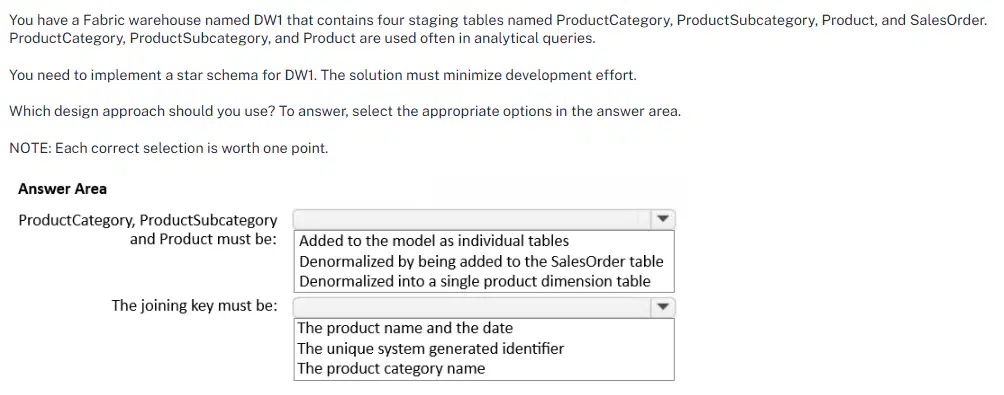
You have a Fabric warehouse named DW1 that contains a Type 2 slowly changing dimension (SCD) dimension table named DimCustomer. DimCustomer contains 100 columns and 20 million rows. The columns are of various data types, including int, varchar, date, and varbinary.
You need to identify incoming changes to the table and update the records when there is a change. The solution must minimize resource consumption.
What should you use to identify changes to attributes?
.a hash function to compare the attributes in the source table.
.a direct attributes comparison across the attributes in the DimCustomer table.
.a direct attributes comparison for the attributes in the source table.
.a hash function to compare the attributes in the DimCustomer table
You have an Azure SQL database named DB1.
In a Fabric workspace, you deploy an eventstream named EventStreamDB1 to stream record changes from DB1 into a lakehouse.
You discover that events are NOT being propagated to EventStreamDB1.
You need to ensure that the events are propagated to EventStreamDB1.
What should you do?
Create a read-only replica of DB1
Create an Azure Stream Analytics job.
Enable Extended Events for DB1.
Enable change data capture (CDC) for DB1.
Overview. Company Overview -
Contoso, Ltd. is an online retail company that wants to modernize its analytics platform by moving to Fabric. The company plans to begin using Fabric for marketing analytics.
Overview. IT Structure -
The company’s IT department has a team of data analysts and a team of data engineers that use analytics systems.
The data engineers perform the ingestion, transformation, and loading of data. They prefer to use Python or SQL to transform the data.
The data analysts query data and create semantic models and reports. They are qualified to write queries in Power Query and T-SQL.
Existing Environment. Fabric -
Contoso has an F64 capacity named Cap1. All Fabric users are allowed to create items.
Contoso has two workspaces named WorkspaceA and WorkspaceB that currently use Pro license mode.
Existing Environment. Source Systems
Contoso has a point of sale (POS) system named POS1 that uses an instance of SQL Server on Azure Virtual Machines in the same Microsoft Entra tenant as Fabric. The host virtual machine is on a private virtual network that has public access blocked. POS1 contains all the sales transactions that were processed on the company’s website.
The company has a software as a service (SaaS) online marketing app named MAR1. MAR1 has seven entities. The entities contain data that relates to email open rates and interaction rates, as well as website interactions. The data can be exported from MAR1 by calling REST APIs. Each entity has a different endpoint.
Contoso has been using MAR1 for one year. Data from prior years is stored in Parquet files in an Amazon Simple Storage Service (Amazon S3) bucket. There are 12 files that range in size from 300 MB to 900 MB and relate to email interactions.
Existing Environment. Product Data
POS1 contains a product list and related data. The data comes from the following three tables:
•Products
•ProductCategories
•ProductSubcategories
In the data, products are related to product subcategories, and subcategories are related to product categories.
Existing Environment. Azure -
Contoso has a Microsoft Entra tenant that has the following mail-enabled security groups:
•DataAnalysts: Contains the data analysts
•DataEngineers: Contains the data engineers
Contoso has an Azure subscription.
The company has an existing Azure DevOps organization and creates a new project for repositories that relate to Fabric.
Existing Environment. User Problems
The VP of marketing at Contoso requires analysis on the effectiveness of different types of email content. It typically takes a week to manually compile and analyze the data. Contoso wants to reduce the time to less than one day by using Fabric.
The data engineering team has successfully exported data from MAR1. The team experiences transient connectivity errors, which causes the data exports to fail.
Requirements. Planned Changes -
Contoso plans to create the following two lakehouses:
•Lakehouse1: Will store both raw and cleansed data from the sources
•Lakehouse2: Will serve data in a dimensional model to users for analytical queries
Additional items will be added to facilitate data ingestion and transformation.
Contoso plans to use Azure Repos for source control in Fabric.
Requirements. Technical Requirements
The new lakehouses must follow a medallion architecture by using the following three layers: bronze, silver, and gold. There will be extensive data cleansing required to populate the MAR1 data in the silver layer, including deduplication, the handling of missing values, and the standardizing of capitalization.
Each layer must be fully populated before moving on to the next layer. If any step in populating the lakehouses fails, an email must be sent to the data engineers.
Data imports must run simultaneously, when possible.
The use of email data from the Amazon S3 bucket must meet the following requirements:
•Minimize egress costs associated with cross-cloud data access.
•Prevent saving a copy of the raw data in the lakehouses.
Items that relate to data ingestion must meet the following requirements:
•The items must be source controlled alongside other workspace items.
•Ingested data must land in the bronze layer of Lakehouse1 in the Delta format.
•No changes other than changes to the file formats must be implemented before the data lands in the bronze layer.
•Development effort must be minimized and a built-in connection must be used to import the source data.
•In the event of a connectivity error, the ingestion processes must attempt the connection again.
Lakehouses, data pipelines, and notebooks must be stored in WorkspaceA. Semantic models, reports, and dataflows must be stored in WorkspaceB.
Once a week, old files that are no longer referenced by a Delta table log must be removed.
Requirements. Data Transformation
In the POS1 product data, ProductID values are unique. The product dimension in the gold layer must include only active products from product list. Active products are identified by an IsActive value of 1.
Some product categories and subcategories are NOT assigned to any product. They are NOT analytically relevant and must be omitted from the product dimension in the gold layer.
Requirements. Data Security -
Security in Fabric must meet the following requirements:
•The data engineers must have read and write access to all the lakehouses, including the underlying files.
•The data analysts must only have read access to the Delta tables in the gold layer.
•The data analysts must NOT have access to the data in the bronze and silver layers.
•The data engineers must be able to commit changes to source control in WorkspaceA.
You need to recommend a solution to resolve the MAR1 connectivity issues. The solution must minimize development effort.
What should you recommend?
Add a ForEach activity to the data pipeline.
Configure retries for the Copy data activity.
Call a notebook from the data pipeline.
Configure Fault tolerance for the Copy data activity.
Overview. Company Overview -
Contoso, Ltd. is an online retail company that wants to modernize its analytics platform by moving to Fabric. The company plans to begin using Fabric for marketing analytics.
Overview. IT Structure -
The company’s IT department has a team of data analysts and a team of data engineers that use analytics systems.
The data engineers perform the ingestion, transformation, and loading of data. They prefer to use Python or SQL to transform the data.
The data analysts query data and create semantic models and reports. They are qualified to write queries in Power Query and T-SQL.
Existing Environment. Fabric -
Contoso has an F64 capacity named Cap1. All Fabric users are allowed to create items.
Contoso has two workspaces named WorkspaceA and WorkspaceB that currently use Pro license mode.
Existing Environment. Source Systems
Contoso has a point of sale (POS) system named POS1 that uses an instance of SQL Server on Azure Virtual Machines in the same Microsoft Entra tenant as Fabric. The host virtual machine is on a private virtual network that has public access blocked. POS1 contains all the sales transactions that were processed on the company’s website.
The company has a software as a service (SaaS) online marketing app named MAR1. MAR1 has seven entities. The entities contain data that relates to email open rates and interaction rates, as well as website interactions. The data can be exported from MAR1 by calling REST APIs. Each entity has a different endpoint.
Contoso has been using MAR1 for one year. Data from prior years is stored in Parquet files in an Amazon Simple Storage Service (Amazon S3) bucket. There are 12 files that range in size from 300 MB to 900 MB and relate to email interactions.
Existing Environment. Product Data
POS1 contains a product list and related data. The data comes from the following three tables:
•Products
•ProductCategories
•ProductSubcategories
In the data, products are related to product subcategories, and subcategories are related to product categories.
Existing Environment. Azure -
Contoso has a Microsoft Entra tenant that has the following mail-enabled security groups:
•DataAnalysts: Contains the data analysts
•DataEngineers: Contains the data engineers
Contoso has an Azure subscription.
The company has an existing Azure DevOps organization and creates a new project for repositories that relate to Fabric.
Existing Environment. User Problems
The VP of marketing at Contoso requires analysis on the effectiveness of different types of email content. It typically takes a week to manually compile and analyze the data. Contoso wants to reduce the time to less than one day by using Fabric.
The data engineering team has successfully exported data from MAR1. The team experiences transient connectivity errors, which causes the data exports to fail.
Requirements. Planned Changes -
Contoso plans to create the following two lakehouses:
•Lakehouse1: Will store both raw and cleansed data from the sources
•Lakehouse2: Will serve data in a dimensional model to users for analytical queries
Additional items will be added to facilitate data ingestion and transformation.
Contoso plans to use Azure Repos for source control in Fabric.
Requirements. Technical Requirements
The new lakehouses must follow a medallion architecture by using the following three layers: bronze, silver, and gold. There will be extensive data cleansing required to populate the MAR1 data in the silver layer, including deduplication, the handling of missing values, and the standardizing of capitalization.
Each layer must be fully populated before moving on to the next layer. If any step in populating the lakehouses fails, an email must be sent to the data engineers.
Data imports must run simultaneously, when possible.
The use of email data from the Amazon S3 bucket must meet the following requirements:
•Minimize egress costs associated with cross-cloud data access.
•Prevent saving a copy of the raw data in the lakehouses.
Items that relate to data ingestion must meet the following requirements:
•The items must be source controlled alongside other workspace items.
•Ingested data must land in the bronze layer of Lakehouse1 in the Delta format.
•No changes other than changes to the file formats must be implemented before the data lands in the bronze layer.
•Development effort must be minimized and a built-in connection must be used to import the source data.
•In the event of a connectivity error, the ingestion processes must attempt the connection again.
Lakehouses, data pipelines, and notebooks must be stored in WorkspaceA. Semantic models, reports, and dataflows must be stored in WorkspaceB.
Once a week, old files that are no longer referenced by a Delta table log must be removed.
Requirements. Data Transformation
In the POS1 product data, ProductID values are unique. The product dimension in the gold layer must include only active products from product list. Active products are identified by an IsActive value of 1.
Some product categories and subcategories are NOT assigned to any product. They are NOT analytically relevant and must be omitted from the product dimension in the gold layer.
Requirements. Data Security -
Security in Fabric must meet the following requirements:
•The data engineers must have read and write access to all the lakehouses, including the underlying files.
•The data analysts must only have read access to the Delta tables in the gold layer.
•The data analysts must NOT have access to the data in the bronze and silver layers.
•The data engineers must be able to commit changes to source control in WorkspaceA.
You need to recommend a solution for handling old files. The solution must meet the technical requirements.
What should you include in the recommendation?
a data pipeline that includes a Copy data activity
a data pipeline that includes a Delete data activity
a notebook that runs the VACUUM command
a notebook that runs the OPTIMIZE command
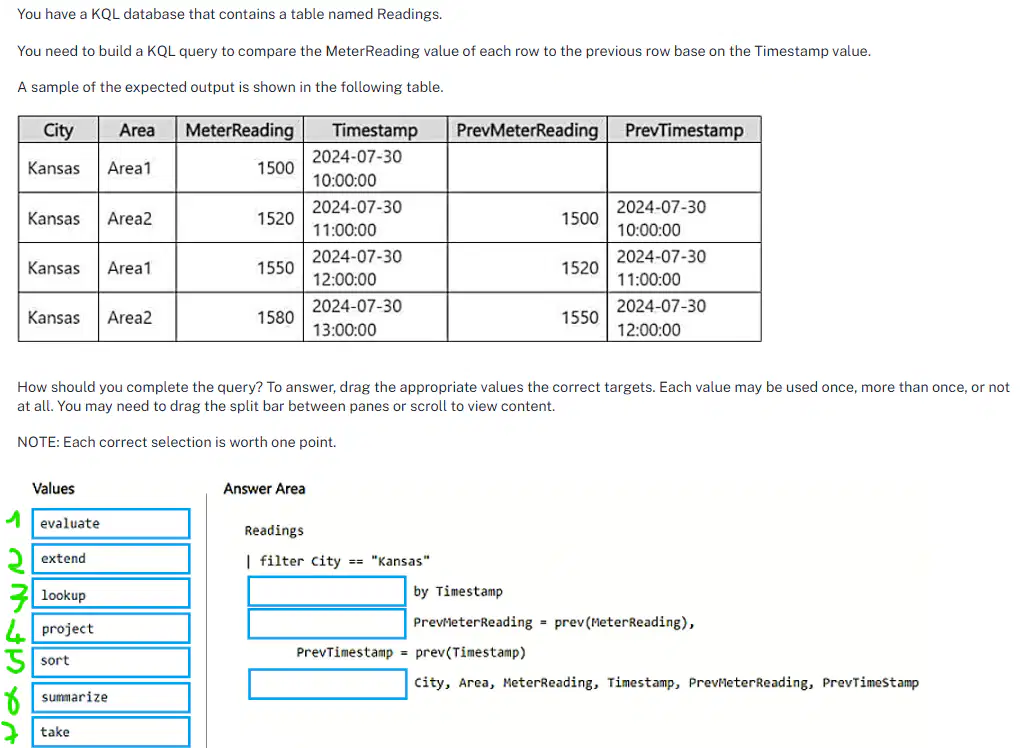
You have a KQL database that contains a table named Readings.
You need to build a KQL query to compare the MeterReading value of each row to the previous row base on the Timestamp value.
A sample of the expected output is shown in the following table.
(a)
belirsiz soru.stres yok
(a)
Overview -
Litware, Inc. is a publishing company that has an online bookstore and several retail bookstores worldwide. Litware also manages an online advertising business for the authors it represents.
Existing Environment. Fabric Environment
Litware has a Fabric workspace named Workspace1. High concurrency is enabled for Workspace1.
The company has a data engineering team that uses Python for data processing.
Existing Environment. Data Processing
The retail bookstores send sales data at the end of each business day, while the online bookstore constantly provides logs and sales data to a central enterprise resource planning (ERP) system.
Litware implements a medallion architecture by using the following three layers: bronze, silver, and gold. The sales data is ingested from the ERP system as Parquet files that land in the Files folder in a lakehouse. Notebooks are used to transform the files in a Delta table for the bronze and silver layers. The gold layer is in a warehouse that has V-Order disabled.
Litware has image files of book covers in Azure Blob Storage. The files are loaded into the Files folder.
Existing Environment. Sales Data
Month-end sales data is processed on the first calendar day of each month. Data that is older than one month never changes.
In the source system, the sales data refreshes every six hours starting at midnight each day.
The sales data is captured in a Dataflow Gen1 dataflow. When the dataflow runs, new and historical data is captured. The dataflow captures the following fields of the source:
Sales Date -
Author -
Price -
Units -
SKU -
A table named AuthorSales stores the sales data that relates to each author. The table contains a column named AuthorEmail. Authors authenticate to a guest Fabric tenant by using their email address.
Existing Environment. Security Groups
Litware has the following security groups:
Sales -
Fabric Admins -
Streaming Admins -
Existing Environment. Performance Issues
Business users perform ad-hoc queries against the warehouse. The business users indicate that reports against the warehouse sometimes run for two hours and fail to load as expected. Upon further investigation, the data engineering team receives the following error message when the reports fail to load: “The SQL query failed while running.”
The data engineering team wants to debug the issue and find queries that cause more than one failure.
When the authors have new book releases, there is often an increase in sales activity. This increase slows the data ingestion process.
The company’s sales team reports that during the last month, the sales data has NOT been up-to-date when they arrive at work in the morning.
Requirements. Planned Changes -
Litware recently signed a contract to receive book reviews. The provider of the reviews exposes the data in Amazon Simple Storage Service (Amazon S3) buckets.
Litware plans to manage Search Engine Optimization (SEO) for the authors. The SEO data will be streamed from a REST API.
Requirements. Version Control -
Litware plans to implement a version control solution in Fabric that will use GitHub integration and follow the principle of least privilege.
Requirements. Governance Requirements
To control data platform costs, the data platform must use only Fabric services and items. Additional Azure resources must NOT be provisioned.
Requirements. Data Requirements -
Litware identifies the following data requirements:
Process the SEO data in near-real-time (NRT).
Make the book reviews available in the lakehouse without making a copy of the data.
When a new book cover image arrives in the Files folder, process the image as soon as possible.
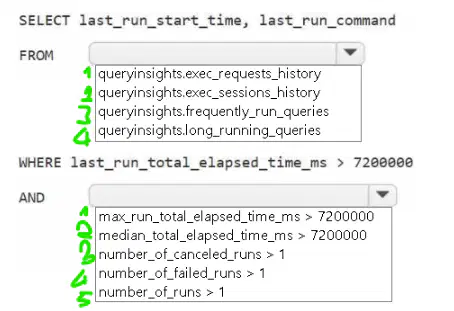
You need to troubleshoot the ad-hoc query issue.
How should you complete the statement? To answer, select the appropriate options in the answer area.
NOTE: Each correct selection is worth one point.
(a)
Overview. Company Overview -
Contoso, Ltd. is an online retail company that wants to modernize its analytics platform by moving to Fabric. The company plans to begin using Fabric for marketing analytics.
Overview. IT Structure -
The company’s IT department has a team of data analysts and a team of data engineers that use analytics systems.
The data engineers perform the ingestion, transformation, and loading of data. They prefer to use Python or SQL to transform the data.
The data analysts query data and create semantic models and reports. They are qualified to write queries in Power Query and T-SQL.
Existing Environment. Fabric -
Contoso has an F64 capacity named Cap1. All Fabric users are allowed to create items.
Contoso has two workspaces named WorkspaceA and WorkspaceB that currently use Pro license mode.
Existing Environment. Source Systems
Contoso has a point of sale (POS) system named POS1 that uses an instance of SQL Server on Azure Virtual Machines in the same Microsoft Entra tenant as Fabric. The host virtual machine is on a private virtual network that has public access blocked. POS1 contains all the sales transactions that were processed on the company’s website.
The company has a software as a service (SaaS) online marketing app named MAR1. MAR1 has seven entities. The entities contain data that relates to email open rates and interaction rates, as well as website interactions. The data can be exported from MAR1 by calling REST APIs. Each entity has a different endpoint.
Contoso has been using MAR1 for one year. Data from prior years is stored in Parquet files in an Amazon Simple Storage Service (Amazon S3) bucket. There are 12 files that range in size from 300 MB to 900 MB and relate to email interactions.
Existing Environment. Product Data
POS1 contains a product list and related data. The data comes from the following three tables:
Products -
ProductCategories -
ProductSubcategories -
In the data, products are related to product subcategories, and subcategories are related to product categories.
Existing Environment. Azure -
Contoso has a Microsoft Entra tenant that has the following mail-enabled security groups:
DataAnalysts: Contains the data analysts
DataEngineers: Contains the data engineers
Contoso has an Azure subscription.
The company has an existing Azure DevOps organization and creates a new project for repositories that relate to Fabric.
Existing Environment. User Problems
The VP of marketing at Contoso requires analysis on the effectiveness of different types of email content. It typically takes a week to manually compile and analyze the data. Contoso wants to reduce the time to less than one day by using Fabric.
The data engineering team has successfully exported data from MAR1. The team experiences transient connectivity errors, which causes the data exports to fail.
Requirements. Planned Changes -
Contoso plans to create the following two lakehouses:
Lakehouse1: Will store both raw and cleansed data from the sources
Lakehouse2: Will serve data in a dimensional model to users for analytical queries
Additional items will be added to facilitate data ingestion and transformation.
Contoso plans to use Azure Repos for source control in Fabric.
Requirements. Technical Requirements
The new lakehouses must follow a medallion architecture by using the following three layers: bronze, silver, and gold. There will be extensive data cleansing required to populate the MAR1 data in the silver layer, including deduplication, the handling of missing values, and the standardizing of capitalization.
Each layer must be fully populated before moving on to the next layer. If any step in populating the lakehouses fails, an email must be sent to the data engineers.
Data imports must run simultaneously, when possible.
The use of email data from the Amazon S3 bucket must meet the following requirements:
Minimize egress costs associated with cross-cloud data access.
Prevent saving a copy of the raw data in the lakehouses.
Items that relate to data ingestion must meet the following requirements:
The items must be source controlled alongside other workspace items.
Ingested data must land in the bronze layer of Lakehouse1 in the Delta format.
No changes other than changes to the file formats must be implemented before the data lands in the bronze layer.
Development effort must be minimized and a built-in connection must be used to import the source data.
In the event of a connectivity error, the ingestion processes must attempt the connection again.
Lakehouses, data pipelines, and notebooks must be stored in WorkspaceA. Semantic models, reports, and dataflows must be stored in WorkspaceB.
Once a week, old files that are no longer referenced by a Delta table log must be removed.
Requirements. Data Transformation
In the POS1 product data, ProductID values are unique. The product dimension in the gold layer must include only active products from product list. Active products are identified by an IsActive value of 1.
Some product categories and subcategories are NOT assigned to any product. They are NOT analytically relevant and must be omitted from the product dimension in the gold layer.
Requirements. Data Security -
Security in Fabric must meet the following requirements:
The data engineers must have read and write access to all the lakehouses, including the underlying files.
The data analysts must only have read access to the Delta tables in the gold layer.
The data analysts must NOT have access to the data in the bronze and silver layers.
The data engineers must be able to commit changes to source control in WorkspaceA.
You need to schedule the population of the medallion layers to meet the technical requirements.
What should you do?
Schedule a data pipeline that calls other data pipelines.
Schedule a notebook.
Schedule an Apache Spark job.
Schedule multiple data pipelines.
(a)
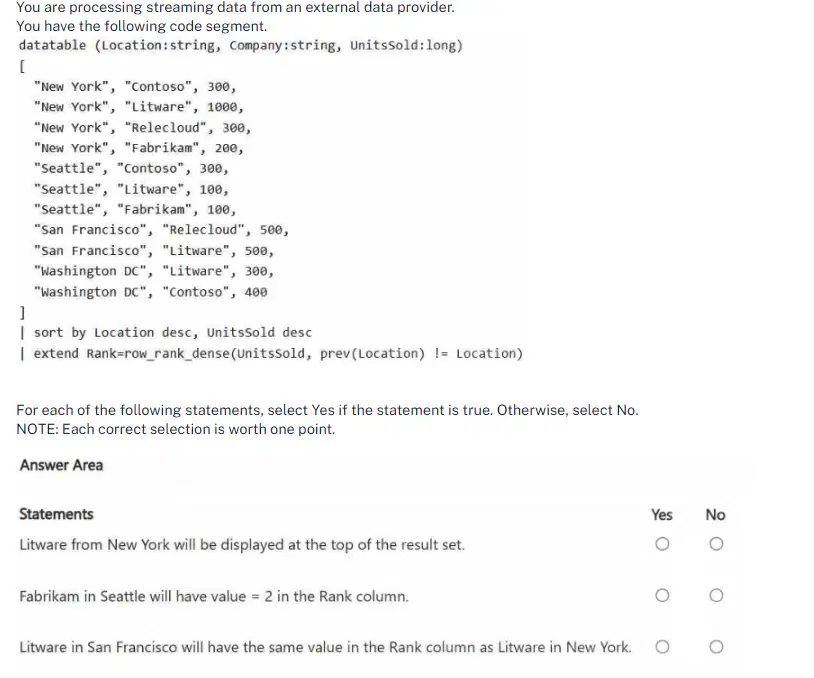
(a)
You have a Fabric workspace that contains a lakehouse named Lakehouse1. Lakehouse1 contains a Delta table named Table1.
You analyze Table1 and discover that Table1 contains 2,000 Parquet files of 1 MB each.
You need to minimize how long it takes to query Table1.
What should you do?
Disable V-Order and run the OPTIMIZE command.
Disable V-Order and run the VACUUM command.
Run the OPTIMIZE and VACUUM commands.
You have a Fabric workspace that contains a warehouse named Warehouse1. Data is loaded daily into Warehouse1 by using data pipelines and stored procedures.
You discover that the daily data load takes longer than expected.
You need to monitor Warehouse1 to identify the names of users that are actively running queries.
Which view should you use?
You have a Fabric workspace that contains an eventstream named EventStream1. EventStream1 outputs events to a table in a lakehouse.
You need to remove files that are older than seven days and are no longer in use.
Which command should you run?
VACUUM
COMPUTE
OPTIMIZE
CLONE
You have a Fabric warehouse named DW1 that loads data by using a data pipeline named Pipeline1. Pipeline1 uses a Copy data activity with a dynamic SQL source. Pipeline1 is scheduled to run every 15 minutes.
You discover that Pipeline1 keeps failing.
You need to identify which SQL query was executed when the pipeline failed.
What should you do?
From Monitoring hub, select the latest failed run of Pipeline1, and then view the output JSON.
From Monitoring hub, select the latest failed run of Pipeline1, and then view the input JSON.
From Real-time hub, select Fabric events, and then review the details of Microsoft.Fabric.ItemReadFailed.
From Real-time hub, select Fabric events, and then review the details of Microsoft. Fabric.ItemUpdateFailed.
You have a Fabric notebook named Notebook1 that has been executing successfully for the last week.
During the last run, Notebook1executed nine jobs.
You need to view the jobs in a timeline chart.
What should you use?
Real-Time hub
Monitoring hub
the job history from the application run
Spark History Server
the run series from the details of the application run
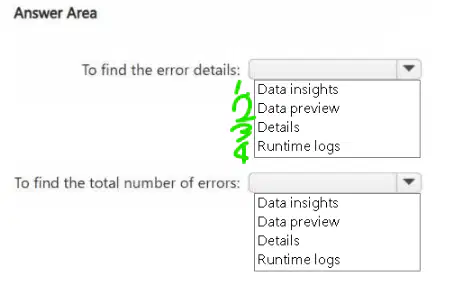
HOTSPOT -
You have a Fabric workspace that contains an eventstream named EventStream1.
You discover that an EventStream1 transformation fails.
You need to find the following error information:
The error details, including the occurrence time
The total number of errors -
What should you use? To answer, select the appropriate options in the answer area.
NOTE: Each correct selection is worth one point.
(a)
Overview -
Litware, Inc. is a publishing company that has an online bookstore and several retail bookstores worldwide. Litware also manages an online advertising business for the authors it represents.
Existing Environment. Fabric Environment
Litware has a Fabric workspace named Workspace1. High concurrency is enabled for Workspace1.
The company has a data engineering team that uses Python for data processing.
Existing Environment. Data Processing
The retail bookstores send sales data at the end of each business day, while the online bookstore constantly provides logs and sales data to a central enterprise resource planning (ERP) system.
Litware implements a medallion architecture by using the following three layers: bronze, silver, and gold. The sales data is ingested from the ERP system as Parquet files that land in the Files folder in a lakehouse. Notebooks are used to transform the files in a Delta table for the bronze and silver layers. The gold layer is in a warehouse that has V-Order disabled.
Litware has image files of book covers in Azure Blob Storage. The files are loaded into the Files folder.
Existing Environment. Sales Data
Month-end sales data is processed on the first calendar day of each month. Data that is older than one month never changes.
In the source system, the sales data refreshes every six hours starting at midnight each day.
The sales data is captured in a Dataflow Gen1 dataflow. When the dataflow runs, new and historical data is captured. The dataflow captures the following fields of the source:
•Sales Date
•Author
•Price
•Units
•SKU
A table named AuthorSales stores the sales data that relates to each author. The table contains a column named AuthorEmail. Authors authenticate to a guest Fabric tenant by using their email address.
Existing Environment. Security Groups
Litware has the following security groups:
•Sales
•Fabric Admins
•Streaming Admins
Existing Environment. Performance Issues
Business users perform ad-hoc queries against the warehouse. The business users indicate that reports against the warehouse sometimes run for two hours and fail to load as expected. Upon further investigation, the data engineering team receives the following error message when the reports fail to load: “The SQL query failed while running.”
The data engineering team wants to debug the issue and find queries that cause more than one failure.
When the authors have new book releases, there is often an increase in sales activity. This increase slows the data ingestion process.
The company’s sales team reports that during the last month, the sales data has NOT been up-to-date when they arrive at work in the morning.
Requirements. Planned Changes -
Litware recently signed a contract to receive book reviews. The provider of the reviews exposes the data in Amazon Simple Storage Service (Amazon S3) buckets.
Litware plans to manage Search Engine Optimization (SEO) for the authors. The SEO data will be streamed from a REST API.
Requirements. Version Control -
Litware plans to implement a version control solution in Fabric that will use GitHub integration and follow the principle of least privilege.
Requirements. Governance Requirements
To control data platform costs, the data platform must use only Fabric services and items. Additional Azure resources must NOT be provisioned.
Requirements. Data Requirements -
Litware identifies the following data requirements:
•Process the SEO data in near-real-time (NRT).
•Make the book reviews available in the lakehouse without making a copy of the data.
•When a new book cover image arrives in the Files folder, process the image as soon as possible.
What should you do to optimize the query experience for the business users?
Enable V-Order.
Create and update statistics.
Run the VACUUM command.
Introduce primary keys.
You have a Fabric workspace that contains a warehouse named Warehouse1.
While monitoring Warehouse1, you discover that query performance has degraded during the last 60 minutes.
You need to isolate all the queries that were run during the last 60 minutes. The results must include the username of the users that submitted the queries and the query statements.
What should you use?
the Microsoft Fabric Capacity Metrics app
views from the queryinsights schema
Query activity
the sys.dm_exec_requests dynamic management view
You have a Fabric workspace that contains a semantic model named Model1.
You need to monitor the refresh history of Model1 and visualize the refresh history in a chart.
What should you use?
the refresh history from the settings of Model1
a notebook
a Dataflow Gen2 dataflow
a data pipeline
You have a Fabric workspace that contains a write-intensive warehouse named DW1. DW1 stores staging tables that are used to load a dimensional model. The tables are often read once, dropped, and then recreated to process new data.
You need to minimize the load time of DW1.
What should you do?
Enable V-Order.
Create statistics.
Drop statistics.
Disable V-Order.

