
 Worksheets
Sem 2 History part 1
Total questions: 86
Worksheet time: 43mins
What happened to the population in the first two decades of the 1800s?
It stayed the same
It more than doubled
It decreased
It tripled
Who worked hard on expanding voting rights for men in the 1800s?
George Washington
Thomas Jefferson
Andrew Jackson
Abraham Lincoln
What was one of the changes in the first two decades of the 1800s?
Fewer states
More states
No new states
States disappeared
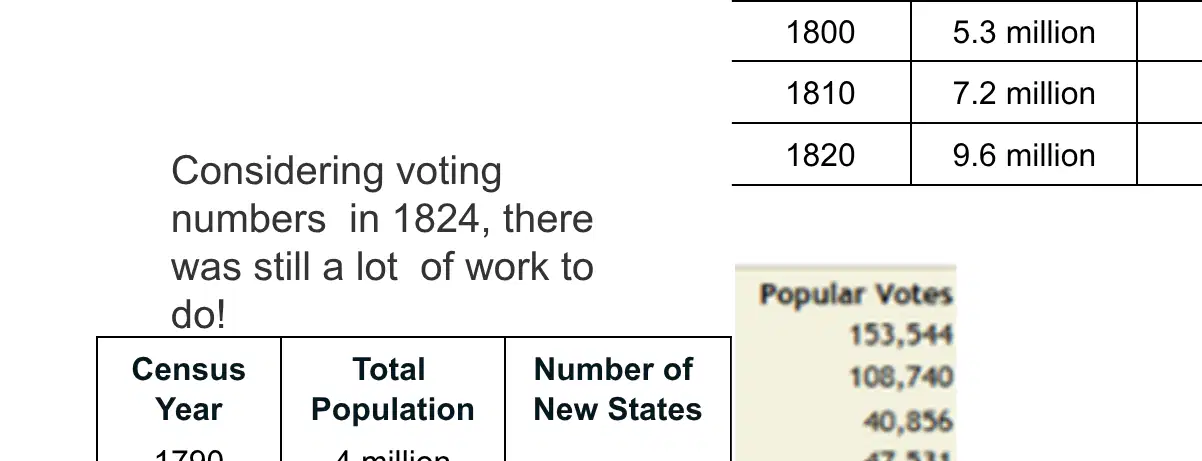
What was the total population of the United States in the year 1790 according to the census?
4 million
5.3 million
7.2 million
9.6 million
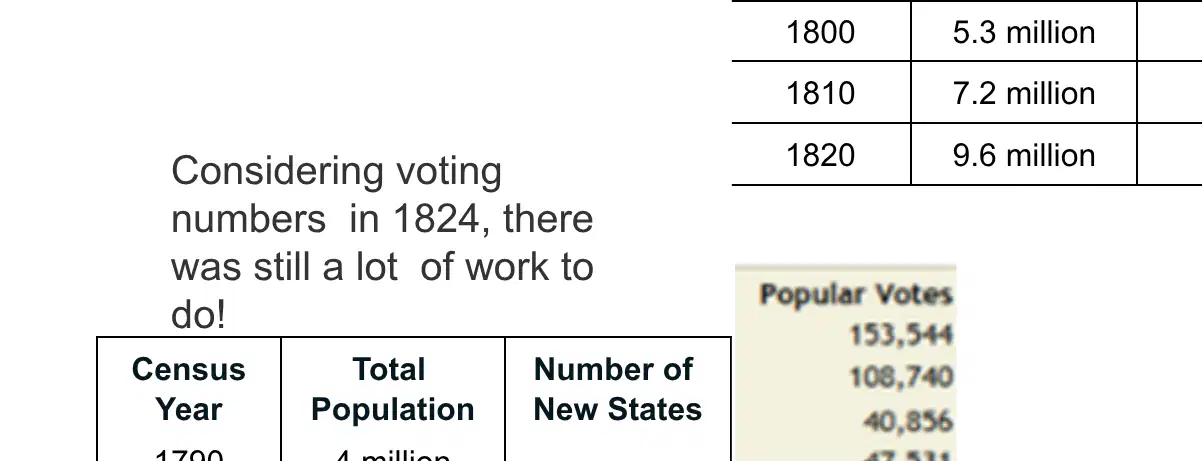
How many new states were added by the year 1820?
0
1
6
3
Who led the Representatives to vote among the top three as Speaker of the House?
John Q. Adams
Henry Clay
Thomas Jefferson
James Madison
What was the term used to describe the controversial decision in the 1824 election?
Fair Deal
Honest Election
Corrupt Bargain
Just Agreement
Who was recommended to be chosen in the 1824 election?
Andrew Jackson
John Quincy Adams
William H. Crawford
Henry Clay
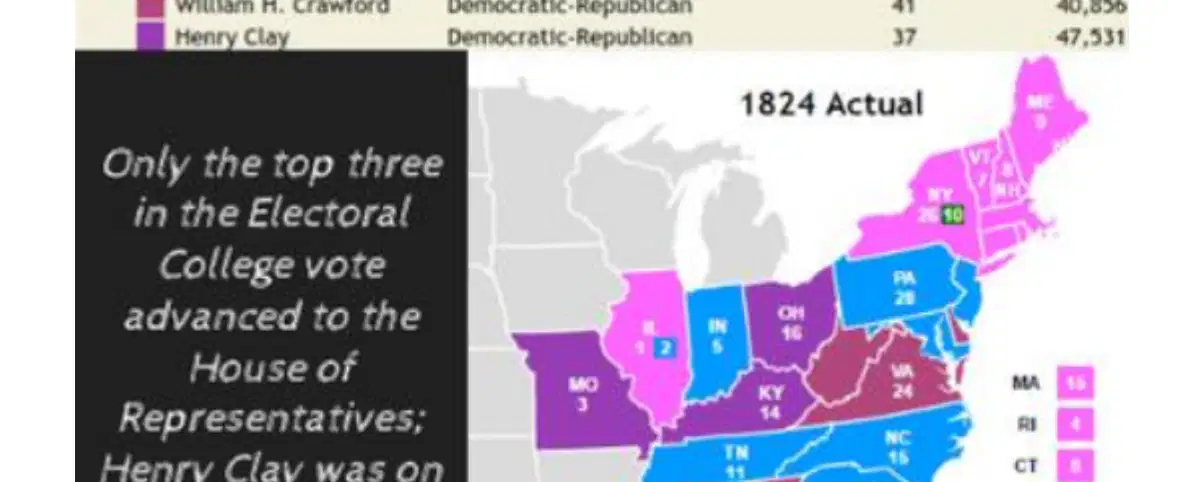
Which candidate was not among the top three in the Electoral College vote in 1824?
Andrew Jackson
John Quincy Adams
William H. Crawford
Henry Clay
Who was appointed as Secretary of State, making Jackson and his supporters furious?
John Quincy Adams
Henry Clay
Andrew Jackson
Thomas Jefferson
What did Congress approve during John Quincy Adams' presidency?
Expansion of federal government
National university
Expansion of roads and waterways
Scientific research
What happened to the Democratic-Republican Party by 1828?
It became more powerful
It split up
It formed a new government
It expanded internationally
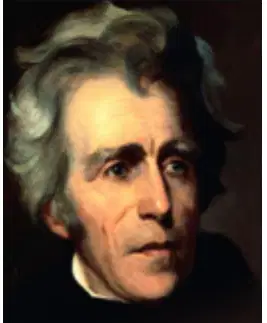
Who were Andrew Jackson's supporters?
People who wanted a strong federal government
People who distrusted the federal government
People who supported economic growth
People who liked John Q. Adams
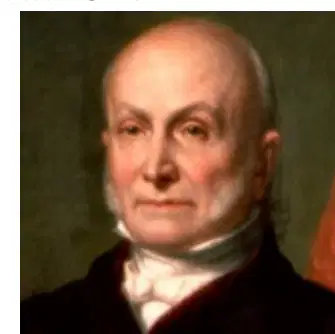
What did the National Republicans support?
States' rights
Distrusting the federal government
Economic growth and a strong federal government
Voters in Western states
How many more voters did Andrew Jackson have compared to 1824?
500,000 more voters
1,000,000 more voters
800,000 more voters
200,000 more voters
What did the Democrats call the person they were criticizing?
Aristocrat
Hero
Farmer
Teacher
What term did the Democrats use to describe a questionable agreement?
Honest deal
Corrupt bargain
Fair trade
Simple arrangement
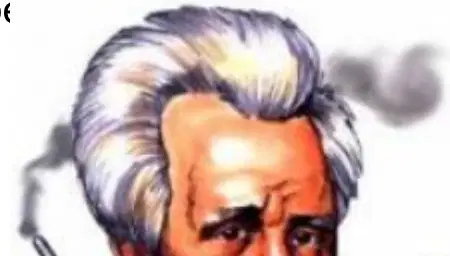
How did the National Republicans describe Andrew Jackson?
Peaceful and kind
Slave-trading, gambling, brawling
Educated and polite
Quiet and reserved
What did President Jackson promise to all Americans?
Equal protection and benefits
More taxes and regulations
Free education for all
A new national holiday
What action did President Jackson take right away after making his promise?
Fired lots of federal workers and gave jobs to his supporters
Built new schools across the country
Reduced the national debt significantly
Started a new war
Who defended Jackson's actions by saying, "... to the victor belong the spoils"?
Senator William L. Marcy
Andrew Jackson
King Andrew the First
Jackson's opponents
What did Jackson's opponents call him?
A hero
A tyrant
A banker
A senator
What was Andrew Jackson's opinion about banks?
He liked them
He disliked them
He was indifferent
He worked for them

What did President Jackson call the bank?
A house of gold
A den of vipers and thieves
A place of peace
A treasure chest
Why did Henry Clay and Daniel Webster ask President Jackson to renew the Bank Charter?
To support him
To help the bank grow
To turn people against him
To make him happy

Who was the President that chose not to continue the Bank's charter, leading to its closure in 1836?
George Washington
Thomas Jefferson
Andrew Jackson
Abraham Lincoln
What happened to the Bank in 1836?
It was expanded
It was closed
It was renamed
It was moved

What was the result of the Bank's closure in 1836?
More State Banks were created
Fewer loans were available
The economy collapsed
New currency was introduced
What did the government refuse to accept as payment?
Euros
Gold
Dollars
Silver
What happens when people panic, according to the text?
They celebrate
They blame the President
They go shopping
They stay calm
What year did the Panic of 1837 occur?
1837
1847
1827
1857
Who was blamed for not helping people during the Panic of 1837?
President Van Buren
President Lincoln
President Washington
President Jefferson
What was one of the effects of the economic depression during the Panic of 1837?
Companies closed
New companies opened
Prices increased
Employment rates rose
What happened to state banks during the crisis?
They opened more branches.
They closed.
They gave out more loans.
They increased interest rates.
Who were some of the people involved in forming the Whig Party?
Abraham Lincoln
Henry Clay
George Washington
Thomas Jefferson
What was one effect of the crisis on farmers?
They bought more land.
They couldn't buy the things they needed.
They hired more workers.
They sold more crops.
What happened to land values during the crisis?
They increased.
They stayed the same.
They dropped.
They doubled.
Who was the candidate in the Election of 1840?
Abraham Lincoln
William Henry Harrison
Thomas Jefferson
Andrew Jackson

What illness did William Henry Harrison die from?
Influenza
Pneumonia
Malaria
Tuberculosis
How many days after taking the oath of office did Harrison die?
10 days
20 days
32 days
50 days
Who was William Henry Harrison?
A famous explorer
A U.S. President
A scientist
A musician
What did white Americans want the U.S. government to do?
Build new schools
Force tribes off land
Create new laws
Start new businesses

In what year did President Jackson ask Congress to pass a Bill to remove Native Americans from tribal land?
1829
1835
1842
1850
Who wrote the decision of the Supreme Court in Worcester vs. Georgia?
Chief Justice John Marshall
President Andrew Jackson
The Cherokee
The State of Georgia
What was ruled to be unconstitutional in the Worcester vs. Georgia case?
The Indian Removal Act
The Cherokee's land ownership
The authority of the Supreme Court
The decision of President Andrew Jackson
What did the Supreme Court decide about the State of Georgia's authority over the Cherokee?
Georgia had full authority
Georgia had no authority
Georgia could regulate the Cherokee
Georgia could enforce federal laws
What was President Andrew Jackson's response to the Supreme Court's ruling?
He agreed with the decision
He enforced the decision
He challenged the decision
He said, "John Marshall made his decision. Now let him enforce it."
What did President Andrew Jackson say in response to the Supreme Court ruling?
The Congress will decide.
John Marshall made his decision. Now let him enforce it.
I will enforce the ruling.
The Constitution is clear.
What was Congress's role in the situation described?
They enforced the Supreme Court order.
They pushed the President to enforce the order.
They did not push the President to enforce the order.
They changed the Supreme Court's decision.
What was Congress's failure mentioned in the document?
Enforcing a Supreme Court Order
Expanding to the Pacific Ocean
Modeling democracy and freedom
Promoting John Quincy Adams
What political goal is mentioned in the document?
Expand to the Pacific Ocean
Enforce a Supreme Court Order
Model democracy and freedom
Promote John Quincy Adams
Who promoted the idea mentioned in 1819?
John Quincy Adams
The Supreme Court
Congress
The President
What was the political goal mentioned in the document?
Expand to the Atlantic Ocean
Expand to the Pacific Ocean
Expand to the Indian Ocean
Expand to the Arctic Ocean
What phrase did James Knox Polk use for his presidential campaign in 1844?
"Forty Four Forty or Fight!"
"Fifty Four Forty or Fight!"
"Sixty Four Forty or Fight!"
"Thirty Four Forty or Fight!"
What did Stephen Austin tell the President of Mexico?
Let us do what we want or we will secede from Mexico.
We will always follow your rules.
We want to join another country.
We are happy with your leadership.
Who refused to allow Texans to do what they wanted?
President of Mexico
President of the United States
Governor of Texas
King of Spain

What was the name of the Catholic mission building that Texans took over?
The Alamo
The Mission
The Fortress
The Independence
What did Texans declare when they took over The Alamo?
Texas independence
War on Mexico
Peace treaty
New government
What did Stephen Austin tell the President of Mexico?
"Let us do what we want or we will secede from Mexico"
"We want more land"
"We will follow your rules"
"We need more soldiers"
What did the President of Mexico refuse to allow Texans?
Freedom
Land
Money
Food
What was the name of the Catholic mission building taken over by Texans?
The Alamo
The Mission
The Fortress
The Castle
What was the outcome of the battle at The Alamo?
A huge loss but motivated Texans for other battles
A great victory
No significant impact
Texans surrendered immediately
What phrase became famous after the battle at The Alamo?
Remember the Alamo!
Victory at Alamo!
Alamo Forever!
Alamo Wins!

What did John Fremont's report in California fail to predict?
Discovery of gold
Discovery of oil
Discovery of silver
Discovery of diamonds
What percentage of gold rushers were American men?
50%
80%
30%
100%
Who set up the Public Land Commission according to the Land Law of 1851?
Chinese immigrants
Spanish government
U.S. government
Californio landowners
What was required to determine land ownership in California Territory?
A map
Proof of ownership
A gold nugget
A handshake
How many court cases were there according to the Land Law of 1851?
100
500
813
1,000
What was the outcome for Californios in the court cases?
Won 604 times
Lost 604 times
Won all cases
Lost all cases
What was the purpose of the Foreign Miners Tax Act of 1850?
To encourage more miners to come to the U.S.
To provide free mining equipment
To tax miners who were not U.S. citizens
To reduce the cost of mining licenses
How much was the tax required by the U.S. government under the Foreign Miners Tax Act of 1850?
$10/month
$15/month
$20/month
$25/month
What could the tax collector keep for himself according to the document?
$1
$2
$3
$4
Which groups of miners protested against the tax?
Irish, English, Canadian, and German
French, Spanish, Italian, and Dutch
American, Mexican, Brazilian, and Argentinian
Russian, Polish, Greek, and Turkish

What was the tax rewritten to exclude?
Any free black person
Any free white person
Any free Asian person
Any free Native American person
What did the Page Act of 1875 do?
Allowed Chinese women to immigrate to the U.S.
Banned Chinese women from immigrating to the U.S.
Encouraged Chinese women to work in the U.S.
Provided citizenship to Chinese women in the U.S.

What was the purpose of the Chinese Exclusion Act of 1882?
To allow Chinese laborers to work in the U.S. for 10 years
To prevent Chinese laborers from entering the U.S. for 10 years
To encourage Chinese immigration to the U.S.
To provide citizenship to Chinese immigrants
Who published the Book of Mormon?
Brigham Young
Joseph Smith
John Taylor
Wilford Woodruff
What religious group did Joseph Smith create?
The Catholic Church
The Baptist Church
The Church of Jesus Christ of Latter-Day Saints
The Methodist Church
What does the term "persecution" mean in the context of the Mormons?
Approval and support
Disapproval and bad treatment
Celebration and joy
Neutral and indifferent behavior
Who led the Mormons to Utah in 1846?
Joseph Smith
Brigham Young
John Taylor
Wilford Woodruff
How many Mormons migrated to Utah in 1846?
5,000
8,000
12,000
15,000

What was the largest single migration in American history called?
Oregon Trail
California Gold Rush
Mormon Trail
Santa Fe Trail
In the first phase, how was the manufacture of a product organized?
By using machines
By dividing into smaller steps or tasks
By building factories
By moving products quickly
What was one effect of changing the work in the first phase?
Workers became slower
Production decreased
Workers became experts
Products moved slowly
In the second phase, where did businessmen bring specialized work?
To different countries
To one location
To multiple locations
To homes
What was a result of using machines in the third phase?
Work became slower
Production stopped
Work was much faster
Workers did not need skills

