
NEW
Font size
 Worksheets
4E/5N Revision (Biobites generated)
Total questions: 62
Worksheet time: 31mins
State the difference between a plant cell and an animal cell.
Chloroplasts / cellulose cell wall / large central vacuole
Presence of mitochondria only in plant cells
Animal cells have a cell wall, plant cells do not
Plant cells lack a nucleus, animal cells have one
Organelles that can only be seen under electron microscope are:
Mitochondria
Ribosomes
Nucleus
Chloroplast
A plant/animal cell is placed in a solution of higher water potential. What change in appearance is observed?
The cell swells up
The cell shrinks
The cell remains unchanged
The cell bursts immediately
Explain what happened to a beaker of water when a drop of orange dye was released into the beaker.
dye molecules from the top to the rest of the solution in the beaker via diffusion down a concentration gradient
the dye instantly settles at the bottom without mixing
the dye evaporates immediately upon contact with water
the dye forms a solid layer on the surface of the water
A visking tubing containing starch and amylase solution was left submerged in a boiling tube of distilled water for an hour. The water in the boiling tube was then tested with Benedict’s solution and iodine solution. Explain the following results: Iodine solution remained brown.
Starch molecules are too big to diffuse through the partially permeable visking tubing.
Starch was broken down into glucose, which diffused out.
Iodine solution cannot detect starch in water.
Amylase prevented starch from reacting with iodine.
A visking tubing containing starch and amylase solution was left submerged in a boiling tube of distilled water for an hour. The water in the boiling tube was then tested with Benedict’s solution and iodine solution. Explain the following results: Benedict’s solution changed from blue solution to a brick-red precipitate.
Some starch has been digested by amylase to maltose.
The temperature was too low for the reaction to occur.
No starch was present in the visking tubing.
The amylase was denatured and did not act on starch.
A visking tubing containing starch and amylase solution was left submerged in a boiling tube of distilled water for an hour. The water in the boiling tube was then tested with Benedict’s solution and iodine solution. Explain the following results: Benedict’s solution changed from blue solution to a brick-red precipitate.
Maltose molecules are small enough to diffuse through the visking tubing into the water down a concentration gradient.
Starch molecules are small enough to diffuse through the visking tubing into the water down a concentration gradient.
Amylase molecules are large enough to diffuse through the visking tubing into the water down a concentration gradient.
The visking tubing allows all molecules to pass through regardless of size.
Describe the positive results of the four food tests. Nutrient: Starch Test: Iodine test Positive test result: The solution changes from brown to _________.
blue-black
red
green
yellow
Describe the positive results of the four food tests. Nutrient: Reducing sugars Test: Benedict’s test (Benedict’s solution + Boiling water bath) Positive test result: The blue solution changes to a green, orange and then a _________
brick-red precipitate
blue precipitate
yellow solution
purple color
Describe the positive results of the four food tests. Nutrient: Proteins Test: Biuret test (Biuret reagent) Positive test result: The solution changes from blue to _________
violet
green
red
yellow
Describe the positive results of the four food tests. Nutrient: Fats Test: Ethanol emulsion test (ethanol + water) Positive test result: It changes from a clear solution to form a _________
cloudy white emulsion
blue-black solution
brick red precipitate
purple solution
According to the lock and key hypothesis, why will the enzyme amylase only act on the substrate maltose?
Because amylase and maltose have complementary shapes that fit together specifically.
Because amylase can act on any substrate with a similar size.
Because maltose changes its shape to fit amylase.
Because amylase breaks down all types of sugars.
The rate of enzyme reaction increases with temperature up to an optimum point, then decreases if the temperature continues to rise. What happens to the rate of enzyme reaction when the temperature increases beyond the optimum?
It increases rapidly
It decreases
It remains constant
It is unaffected
Explain the rate of enzyme reaction at a temperature of 37°C.
1. The optimum temperature is 37°C at which the enzyme works best / is most active. 2. Rate of reaction is the highest.
1. The enzyme is completely inactive at 37°C. 2. Rate of reaction is the lowest.
1. The enzyme denatures at 37°C. 2. Rate of reaction stops completely.
1. The enzyme works slowly at 37°C. 2. Rate of reaction is minimal.
Explain the rate of enzyme reaction at very high temperatures beyond the optimum temperature.
1. Enzymes are denatured and lose their active site. 2. Substrate molecules are no longer complementary and unable to bind to the enzyme at its active site. 3. Less enzyme-substrate complexes and thus products formed per unit time. 4. Rate of reaction thus decreases.
At very high temperatures, enzymes become more efficient and the rate of reaction increases indefinitely.
Enzymes at high temperatures form more stable enzyme-substrate complexes, increasing product formation.
High temperatures cause enzymes to replicate, increasing the number of active sites available.
Explain the rate of reaction when an enzyme with an optimum pH of 7 is placed in the stomach of pH 2.
The rate of reaction decreases because any small changes in pH will denature the enzyme, causing it to lose its active site. As a result, substrate molecules are unable to bind to the enzyme at its active site, leading to fewer enzyme-substrate complexes and thus fewer products formed per unit time.
The rate of reaction increases because the acidic environment activates the enzyme, allowing more substrate molecules to bind to the active site.
The rate of reaction remains unchanged because enzymes are not affected by changes in pH.
The rate of reaction increases because the enzyme adapts to the new pH and forms more enzyme-substrate complexes.
Describe and explain the role of the gall bladder.
1. The gall bladder stores bile that is produced by the liver. 2. Bile breaks up larger fat droplets into smaller fat droplets via emulsification. 3. To increase surface area to volume ratio for faster rate of fats digestion by lipases.
The gall bladder produces digestive enzymes that break down proteins.
The gall bladder absorbs nutrients from digested food into the bloodstream.
The gall bladder secretes insulin to regulate blood sugar levels.
Which of the following is a way in which the small intestine is adapted for absorption?
It has villi to increase surface area
It produces insulin
It stores bile
It secretes pepsin
Which of the following is a function of the liver?
Production of bile
Pumping blood
Gas exchange
Transmission of nerve impulses
Hydrochloric acid in the stomach plays which of the following roles?
Aids in protein digestion and kills bacteria
Produces bile for fat digestion
Absorbs nutrients directly into the blood
Regulates blood sugar levels
Define hormones.
Hormones are chemical substances which are produced by endocrine glands in minute amounts and transported by blood to target organs and exert their effect on one or more target organs. After performing their functions, they are destroyed in the liver and excreted by the kidneys.
Hormones are enzymes that help in the digestion of food in the stomach and intestines.
Hormones are structural proteins that provide support to body tissues and organs.
Hormones are waste products produced by the body and excreted through sweat glands.
Explain how the blood glucose concentration changes after a meal.
1. Blood glucose concentration increases above normal after a meal 2. Islets of Langerhans on pancreas secrete more insulin into the bloodstream 3. Insulin decreases blood glucose concentration back to normal by: - increasing permeability of cell membrane to glucose thus increasing rate of glucose uptake into cells - increasing the rate of respiration in cells - stimulating conversion of excess glucose to glycogen and stored in the liver
1. Blood glucose concentration decreases below normal after a meal 2. Islets of Langerhans on pancreas secrete more glucagon into the bloodstream 3. Glucagon increases blood glucose concentration by stimulating conversion of glycogen to glucose in the liver
1. Blood glucose concentration remains unchanged after a meal 2. No hormones are secreted by the pancreas 3. Glucose is neither stored nor used by the cells
1. Blood glucose concentration increases above normal after a meal 2. Islets of Langerhans on pancreas secrete more adrenaline into the bloodstream 3. Adrenaline increases blood glucose concentration by breaking down glycogen in the muscles
Explain what happens when a person undergoes fasting.
1. Blood glucose concentration decreases below normal during fasting 2. Islets of Langerhans on pancreas secrete more glucagon into the bloodstream 3. Glucagon increases blood glucose concentration back to normal by stimulating the conversion of: - glycogen to glucose - fats and amino acids to glucose
1. Blood glucose concentration increases above normal during fasting 2. Islets of Langerhans on pancreas secrete more insulin into the bloodstream 3. Insulin decreases blood glucose concentration by stimulating the conversion of glucose to glycogen
1. Blood glucose concentration remains constant during fasting 2. The pancreas stops hormone secretion 3. No conversion of glycogen or fats occurs
1. Blood glucose concentration decreases below normal during fasting 2. The liver secretes more insulin into the bloodstream 3. Insulin increases blood glucose concentration by stimulating the conversion of fats to glucose
Which of the following correctly describes the differences between arteries, veins, and blood capillaries?
Arteries carry blood away from the heart, veins carry blood to the heart, and capillaries connect arteries and veins.
Arteries carry blood to the heart, veins carry blood away from the heart, and capillaries only carry oxygenated blood.
Arteries and veins both carry blood away from the heart, while capillaries carry blood to the heart.
Capillaries are thicker than arteries and veins.
State and explain the difference in blood pressure in the artery and vein.
Blood pressure is higher in arteries than in veins due to the direct pumping action of the heart.
Blood pressure is higher in veins than in arteries due to the presence of valves.
Blood pressure is the same in both arteries and veins.
Blood pressure fluctuates equally in both arteries and veins.
Explain the function of valves in veins.
To ensure blood flows in one direction by preventing the backflow of blood from veins to the heart.
To increase the pressure of blood in arteries.
To filter waste products from the blood.
To transport oxygen directly to tissues.
The wall of the left ventricle is thicker than that of the right ventricle because:
The left ventricle needs to produce a higher pressure to pump blood to the rest of the body, which is further away, while the right ventricle only needs to produce a low pressure to pump blood to the nearby lungs.
The right ventricle needs to produce a higher pressure to pump blood to the rest of the body, which is further away, while the left ventricle only needs to produce a low pressure to pump blood to the nearby lungs.
Both ventricles pump blood at the same pressure and distance.
The thickness of the ventricle walls is unrelated to pressure or distance.
A diet rich in saturated fats leads to coronary heart disease because it:
increases blood cholesterol levels
decreases blood pressure
improves heart function
reduces body fat
Smoking can lead to coronary heart disease because:
It increases blood pressure and damages blood vessels.
It improves heart function.
It reduces cholesterol levels.
It strengthens artery walls.
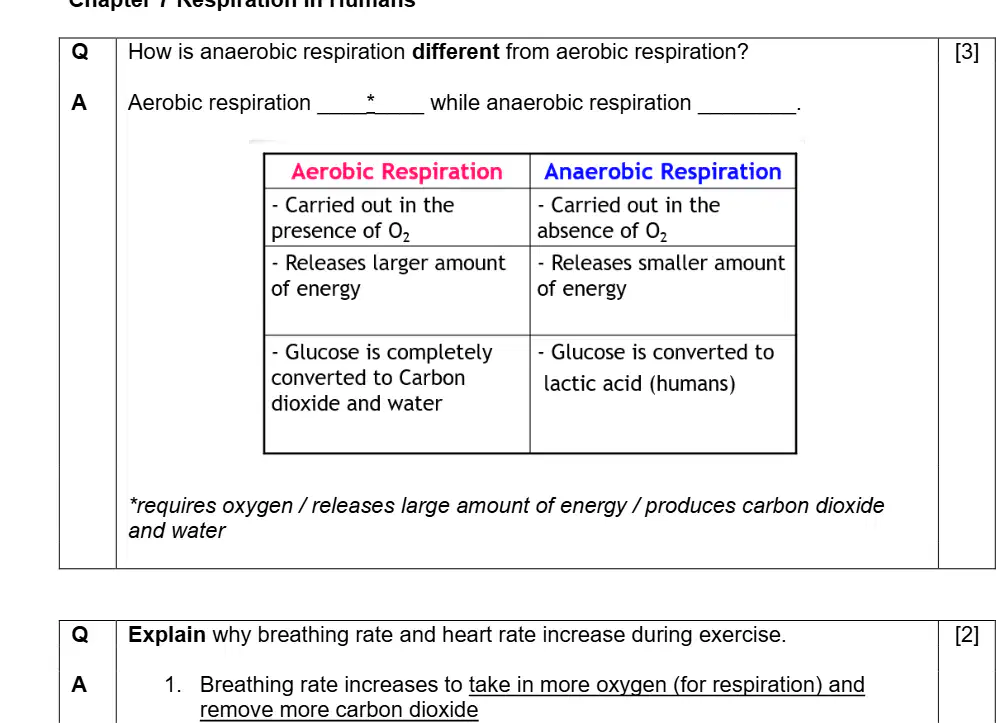
How is anaerobic respiration different from aerobic respiration?
Aerobic respiration requires oxygen, releases large amount of energy, and produces carbon dioxide and water, while anaerobic respiration does not require oxygen, releases smaller amount of energy, and produces lactic acid (in humans).
Anaerobic respiration requires oxygen, releases large amount of energy, and produces carbon dioxide and water, while aerobic respiration does not require oxygen, releases smaller amount of energy, and produces lactic acid (in humans).
Both aerobic and anaerobic respiration require oxygen and release the same amount of energy.
Aerobic respiration does not require oxygen, releases smaller amount of energy, and produces lactic acid, while anaerobic respiration requires oxygen and releases large amount of energy.
Breathing rate and heart rate increase during exercise because:
The body needs more oxygen and energy.
The body needs less oxygen and energy.
Exercise decreases the need for oxygen.
Heart and breathing rates are unrelated to exercise.
Lactic acid concentration in an athlete’s muscles increases during vigorous exercise and decreases after exercise. Which of the following best explains this change?
Lactic acid builds up due to anaerobic respiration during exercise and is broken down after exercise when oxygen is available.
Lactic acid is produced only after exercise is completed.
Lactic acid concentration remains constant during and after exercise.
Lactic acid is not related to exercise at all.
Describe characteristics of an alveolus that enables fast transfer of oxygen to the blood.
1. Thin film of moisture 2. One-cell thick walls 3. Numerous blood capillaries 4. Numerous alveoli
1. Thick walls 2. Few blood capillaries 3. Dry surface 4. Few alveoli
1. Multi-layered walls 2. No blood capillaries 3. Thick mucus lining 4. Large air spaces
1. Thick film of moisture 2. Many layers of cells 3. Sparse blood supply 4. Small surface area
Explain how the oxygen from the air in the alveoli enters the blood (2018 P4 Q1c)
Oxygen dissolves in the moisture lining the alveoli, diffuses through the alveolar wall into the blood capillaries, and binds to hemoglobin in red blood cells.
Oxygen is absorbed directly through the skin and enters the blood vessels.
Oxygen is pumped into the blood by the heart without any diffusion process.
Oxygen is converted into carbon dioxide before entering the blood.
Narrowing of blood vessels causes:
Decrease in blood pressure
Increase in blood pressure
No effect on blood pressure
Decrease in heart rate
A vaccine is:
A substance used to stimulate the production of antibodies and provide immunity against diseases
A type of antibiotic used to treat infections
A surgical instrument used in medical procedures
A vitamin supplement for general health
A vaccine works by:
Directly killing pathogens
Stimulating the immune system to recognize and fight pathogens
Curing diseases instantly
Preventing all infections forever
There are concerns about vaccine effectiveness against new highly-mutated strains of SARS-CoV-2 because:
The new strains may evade immune responses generated by existing vaccines.
Vaccines are only effective against bacteria, not viruses.
Highly-mutated strains are less contagious.
Vaccines cause the virus to mutate faster.
The overuse of antibiotics will promote the development of antibiotic-resistant bacteria because:
It kills all bacteria, including resistant ones.
It allows resistant bacteria to survive and multiply.
It makes bacteria weaker over time.
It prevents bacteria from mutating.
Antibiotics are not used to treat influenza because:
Influenza is caused by a virus, not bacteria.
Antibiotics are effective against all infections.
Antibiotics can cure viral diseases.
Influenza does not require any treatment.
Describe and explain the distribution of chloroplasts in relation to photosynthesis in the leaf of a plant.
Presence of MOST chloroplasts in the upper palisade mesophyll layer. So that maximum light energy can be absorbed near the leaf surface. To maximise the Rate of photosynthesis. Note: Palisade mesophyll, spongy mesophyll and guard cells contain chloroplasts.
Chloroplasts are evenly distributed throughout all leaf tissues to ensure equal light absorption.
Most chloroplasts are found in the lower epidermis to protect them from excessive sunlight.
Chloroplasts are only present in the spongy mesophyll to facilitate gas exchange.
Describe ways how a dicotyledonous leaf is adapted for photosynthesis.
- Palisade mesophyll cells have highest number of chloroplasts / closely packed together to absorb maximum light energy near the leaf surface to maximise rate of photosynthesis. - Broad lamina (leaf blade) to provide large surface area to absorb maximum light energy to maximise rate of photosynthesis. - Thin film of moisture on spongy mesophyll cell to allow carbon dioxide to dissolve.
- Thick cuticle to prevent all light from entering the leaf, reducing photosynthesis. - Stomata only on the upper surface to minimize gas exchange. - Narrow lamina to reduce surface area for light absorption.
- Palisade mesophyll cells have no chloroplasts to avoid light absorption. - Rolled leaf margins to trap air and prevent gas exchange. - Waxy surface to reflect all light away from the leaf.
- Spongy mesophyll cells are tightly packed to prevent air spaces. - No stomata present to avoid water loss. - Leaf blade is needle-shaped to minimize light absorption.
What happened to glucose after it is made in the leaf?
Converted to sucrose and transported to other parts of the plant through the phloem.
Released as oxygen gas through the stomata.
Used directly as a pigment in photosynthesis.
Evaporated from the leaf surface.
Describe how the effect of temperature on photosynthesis can be investigated.
Place a test-tube containing an aquatic plant like hydrilla and sodium hydrogen carbonate into a water bath of a specific temperature. Place a lamp 20 cm from the hydrilla. After 5 minutes, count the number of bubbles released by the hydrilla for 2 minutes. Repeat the experiment for 5 different temperatures, 10, 20, 30, 40 and 50 degree Celsius. The rate of reaction is calculated by the number of bubbles released per minute. (number of bubbles / time)
Place a test-tube containing an aquatic plant like hydrilla in a dark room and measure the amount of water absorbed at different temperatures.
Place a test-tube containing an aquatic plant like hydrilla and sodium hydrogen carbonate into a water bath and measure the change in leaf color at different temperatures.
Place a test-tube containing an aquatic plant like hydrilla in a water bath and count the number of leaves produced at different temperatures.
Describe the functions of the xylem and phloem.
1. Xylem transports water and mineral salts from roots to the stem and leaves of the plant. 2. Xylem also provides mechanical support for the plant. 3. Phloem transports manufactured food (sucrose and amino acids) between the leaves and other parts of the plant.
1. Xylem transports manufactured food (sucrose and amino acids) between the leaves and other parts of the plant. 2. Xylem also provides mechanical support for the plant. 3. Phloem transports water and mineral salts from roots to the stem and leaves of the plant.
1. Xylem transports oxygen from the leaves to the roots. 2. Xylem also stores food for the plant. 3. Phloem transports carbon dioxide from the roots to the leaves.
1. Xylem transports hormones from the roots to the leaves. 2. Xylem also provides energy for the plant. 3. Phloem transports water and mineral salts from the leaves to the roots.
Describe wilting and explain what caused wilting.
1. Wilting causes the leaves to droop as the rate of transpiration exceeds the rate of absorption of water through the roots. 2. Plant cells lose turgidity as the central vacuoles shrink. 3. With reduced turgidity, the leaves do not have the necessary support to hold the leaves out firmly.
Wilting is caused by excessive sunlight, which increases photosynthesis and makes leaves stand upright.
Wilting occurs when plants absorb too much water, causing cells to burst and leaves to stiffen.
Wilting is a result of nutrient overload, making the plant cells rigid and leaves curl upwards.
Effect of environmental conditions on the rate of transpiration (2016 P4B Q6b)
1. Decrease in temperature, lower rate of transpiration as lower temperature reduce the rate of water evaporating from the thin film of moisture. 2. Decrease in air movement / wind speed, lower rate of transpiration as the water vapour concentration gradient between the inside of the leaves and the environment is less steep / more gentle. 3. Decrease in light intensity, lower rate of transpiration. Lower light intensity caused guard cells to become flaccid and reduce the stomatal size / close stomata. 4. Increase in relative humidity, lower rate of transpiration as increase humidity makes the water vapour concentration gradient between the inside of the leaves and the environment less steep / more gentle (intercellular air spaces).
A. Increase in temperature, lower rate of transpiration as higher temperature reduces the rate of water evaporating from the thin film of moisture.
B. Increase in air movement / wind speed, lower rate of transpiration as the water vapour concentration gradient between the inside of the leaves and the environment is less steep / more gentle.
C. Decrease in relative humidity, lower rate of transpiration as decrease humidity makes the water vapour concentration gradient between the inside of the leaves and the environment less steep / more gentle (intercellular air spaces).
The pathway of water through a plant from entering the roots to leaving the leaves is called:
Transpiration stream
Photosynthesis
Respiration
Translocation
Food chains seldom have more than four trophic levels because:
energy is lost at each trophic level, limiting the number of levels
there are not enough species to form more levels
organisms at higher levels reproduce faster
producers cannot support any consumers
Short food chains are advantageous because:
They reduce energy loss between trophic levels
They increase the number of trophic levels
They decrease the efficiency of photosynthesis
They allow more energy to be lost as heat
The carbon cycle describes the movement of carbon through which of the following?
Ecosystems
Water cycle
Nitrogen cycle
Oxygen cycle
A carbon sink is:
A source of carbon emissions
A natural system that absorbs and stores carbon dioxide from the atmosphere
A type of fossil fuel
A process of burning carbon-based materials
The relationship between DNA, genes, and chromosomes is that:
Genes are made of DNA and are located on chromosomes.
Chromosomes are made of genes and are located on DNA.
DNA is made of chromosomes and genes are not related.
Genes and chromosomes are the same thing.
DNA and genes are related because:
Genes are segments of DNA that carry genetic information.
DNA is made up of proteins called genes.
Genes and DNA are completely unrelated.
Genes are larger structures that contain DNA.
DNA controls the production of a particular protein (e.g., insulin) by:
coding for the sequence of amino acids in the protein
breaking down proteins into amino acids
transporting proteins out of the cell
providing energy for protein synthesis
About 85% of the DNA of a mouse is identical to that of a human. With reference to the function of DNA and genes, mice are very different in appearance from humans because:
The sequence and expression of genes differ between mice and humans.
Mice have more chromosomes than humans.
Humans have no genes in common with mice.
DNA does not determine appearance.
The uterine lining changes from Day 0 to Day 28 of the menstrual cycle. Which of the following best describes how oestrogen and progesterone affect the uterine lining during this period?
Oestrogen thickens the lining in the first half, and progesterone maintains it in the second half.
Oestrogen and progesterone both thin the lining throughout the cycle.
Oestrogen maintains the lining, while progesterone causes it to shed.
Oestrogen and progesterone have no effect on the uterine lining.
What are the fertile and infertile period?
The fertile phase is between day 10 – 15. The infertile phase is outside of day 10 – 15 / Day 1-9 & Day 16-28.
The fertile phase is between day 1 – 5. The infertile phase is between day 6 – 28.
The fertile phase is between day 20 – 25. The infertile phase is between day 1 – 19.
The fertile phase is between day 16 – 28. The infertile phase is between day 1 – 15.
What is the probability of a man without dimples marrying a woman without dimples producing a child with dimples?
0
1/2
1/4
1
The allele for yellow seeds is dominant over that for green seeds in pea plants. A pea plant with yellow seeds is crossed with a pea plant with green seeds. Approximately half of the offspring produced has yellow seeds and half with green seeds. What are the likely genotypes of the parent plants?
Both parents are homozygous dominant
Yellow-seeded parent is heterozygous, green-seeded parent is homozygous recessive
Both parents are homozygous recessive
Yellow-seeded parent is homozygous dominant, green-seeded parent is heterozygous
Describe what is meant by mutation.
1. A sudden and random change in the number of chromosome or in the structure of the gene or chromosome. 2. Mutagens such as ionizing radiation: UV light, and chemicals: LSD, tar which cause DNA breakage, increase the rate of mutation.
A process by which cells divide to produce identical daughter cells.
A gradual adaptation of an organism to its environment over generations.
The process of protein synthesis from mRNA templates.
Guide to answer family tree question: 1. As xxx is homozygous recessive, he must have received / inherit one recessive allele from each parent. 2. The parents who are normal, must contain 1 dominant allele and hence they are heterozygous. Refer to parents, siblings and offspring for hints to the question.
1. Inherit one recessive allele from each parent. 2. Must contain 1 dominant allele and hence they are heterozygous.
1. Inherit one dominant allele from each parent. 2. Must contain 2 recessive alleles and hence they are homozygous.
1. Inherit one dominant allele from each parent. 2. Must contain 1 recessive allele and hence they are heterozygous.
1. Inherit one recessive allele from each parent. 2. Must contain 2 dominant alleles and hence they are homozygous.

