
NEW
Font size
 Worksheets
Unit 316 Central heating
Total questions: 17
Worksheet time: 9mins
In a two pipe central heating system:
The flow and return water mixes.
The flow and return water is kept separate.
The flow and return water is at the same temperature.
The flow water is at a lower temperature than the return water.
The boiler position can be higher than the hot water cylinder in a:
System with microbore heating with gravity primaries.
Combined hot water and heating system with vented primaries.
One pipe gravity system.
Fully pumped sealed system.
Which of the following components could be fitted with a remote sensor?
A thermostatic radiator valve.
A kickboard convector heater.
A diverter valve.
A two port zone valve.
Which of the following assists in the removal of flux from central heating pipework?
Adding an inhibitor to the system after commissioning.
Setting the working temperature of the system to a maximum of 65°C.
Flushing the system out prior to the handover.
Setting the circulator to maximum for 1 hour after soundness testing.
The steps to take prior to temporarily de-commissioning a central heating system, so that an additional radiator can be installed, would include:
Check for safe isolation of central heating system, then drain down.
Switch off programmer so there is no call for heat, then drain down.
Apply temporary continuity bonding to system, then drain down.
Bung F&E and apply temporary continuity bonding to flow and return pipework.
If a customer complains that the downstairs radiators are cold and the upstairs radiators are only lukewarm, where can the fault most likely be identified?
Boiler.
Three port mid-position valve.
Room thermostat.
Circulator.
Hot water circulates to each radiator by gravity in which of the following systems?
One pipe system.
Fully pumped system.
Microbore system.
Two pipe reverse system.
A zone valve in an S plan central heating system is designed to:
Allow the central heating system never to reach 100°C.
Stop the circulator noise from entering the central heating system.
Isolate the central heating circuit when there is no demand.
Prevent the flow and return waters from mixing.
When installing a central heating system using polybutylene pipe, the most common jointing method used is:
Compression type A fittings.
Solvent welded fittings.
End feed solder fittings.
Push fit fittings.
Which Building Regulation covers the energy efficiency requirements for central heating systems?
L1.
P.
H.
6700.
One advantage of installing a fully pumped central heating system is:
It is cheap to install.
It allows each room to be heated to a regulated temperature.
It controls the heat recovery time economically.
There is no danger of overheating.
The type of copper commonly used in the installation of central heating systems within domestic properties is:
R290 hard.
R250 half hard.
R220 half hard.
R290 soft coils.
In which of the following situations is it important to insulate central heating pipework?
Bathroom and north facing kitchen.
From the boiler to the index radiator.
The loft area and under the suspended timber floor downstairs.
Any run of pipework over 3 metres in length, as per BS 12828.
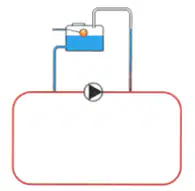
What would be the main effect on the central heating system if the circulator was installed in the position shown in this diagram?
The system would be under negative pressure.
The system would be mostly under negative pressure.
The system would be pumping over the open vent.
The neutral position would be at the base of the open vent.
What would be the Delta T temperature between a system with a flow temperature of 60°C, a return temperature of 40°C, and an ambient air temperature of 20°C?
10°C.
20°C.
30°C.
40°C.
Identify one advantage of underfloor heating:
Cheap and easy to install.
No requirement for balancing the system.
Even spread of heat in each room.
Does not need to be fully pumped.
Out of the following locations, where would the air vents be located on a central heating system?
Immediately above the circulator.
At the top of every radiator.
Just prior to each zone valve.
On the cold feed to the air separator.

