
 Worksheets
C4 War for Independence -
Total questions: 100
Worksheet time: 50mins
Who published a new edition of the Declaration of Independence in January 1777, for the first time carrying the names of the signers?
Mary Katherine Goddard
Benjamin Franklin
Thomas Jefferson
John Dunlap
In what year did Mary Katherine Goddard publish a new edition of the Declaration of Independence that included the names of the signers?
1777
1776
1781
1783
According to the passage, who put the records on record?
Benjamin Franklin
Katherine Goddard
John Adams
Beaumarchais
Why did the Americans need help from France during the war for independence?
They needed military help.
They wanted to expand their territory.
They needed help with trade agreements.
They wanted to learn the French language.
Who sailed for France in October 1776 and received an enthusiastic greeting in Paris?
John Adams
Katherine Goddard
Benjamin Franklin
Beaumarchais
Who formed a dummy corporation to ship muskets and gunpowder to the Americans?
King Louis XVI
Beaumarchais
John Adams
Katherine Goddard
How much money did King Louis XVI secretly loan to the Americans?
A million livres ($200,000)
Ten million livres ($2,000,000)
Five hundred thousand livres ($100,000)
Fifty thousand livres ($10,000)
How many French muskets reached America in 1777? Fill in the blank: ________ French muskets reached America in 1777.
Eleven thousand
Five thousand
Twenty thousand
Thirty thousand
By 1783, France would send the Americans £48 million ($1.4 billion today) worth of supplies and weapons.
True
False
Who insisted on an appointment as major general in charge of artillery and engineers during the American Revolution? Fill in the blank: French artillery officer ________ insisted on an appointment as major general in charge of artillery and engineers.
Phillippe Charles Tronson du Coudray
Marquis de Lafayette
Jean-Baptiste Donatien de Vimeur
Comte de Rochambeau
Which of the following was NOT part of the retinue demanded by Phillippe Charles Tronson du Coudray?
A) A secretary
B) A designer
C) Three servants
D) Two captains
According to the passage, who assured that he would bring a hundred more French officers into the American cause?
du Coudray
Lafayette
Rochambeau
De Grasse
What was the main reason given in the passage for agreeing to bring more French officers into the American cause?
To gain more territory
Because du Coudray assured he would bring a hundred more French officers
To sign a peace treaty
To increase trade with France
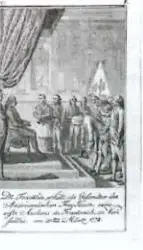
Look at the illustration provided. What event or scene do you think is being depicted, based on the passage and the image?
A historical battle
A family picnic
A science experiment
A sports event
Who was presented to King Louis XVI of France in March 1778, after France recognized American independence and declared war on England?
George Washington
Benjamin Franklin
John Sullivan
Nathanael Greene
Fill in the blank: Congress offered du Coudray the post of _______ after he refused to become a major general.
inspector general
adjutant general
quartermaster general
brigadier general
Who was the wealthy young nobleman that arrived in July 1777 with Johann Kalb?
Marie Joseph Paul de Lafayette
Baron von Steuben
Charles Cornwallis
Benedict Arnold
According to the passage, who wrote: “Monsieur du Coudray has just put Congress much at ease by his death.”?
A) Edward Gibbon
B) Johann Kalb
C) Lord Germaine
D) King George III
Which king invited Lafayette to inspect naval fortifications?
King Louis XVI
King George III
King Henry VIII
King Edward VII
Where did Lafayette and his party land in America?
South Carolina
Virginia
Massachusetts
New York
Why did Congress not let Lafayette into the building when he arrived in Philadelphia?
Congress had wearied of French generals seeking ranks and paychecks.
Lafayette did not have the proper identification papers.
The building was closed for renovations.
Lafayette arrived on a national holiday when Congress was not in session.
Who was the only member of Congress who spoke French and was sent to meet Lafayette?
James Lovell
John Adams
Benjamin Franklin
Thomas Jefferson
What did Lafayette request from Congress after summarizing the difficulties he endured?
He requested two favors: to serve at his own expense and another favor (not fully shown in the image).
He requested to return to France immediately.
He asked for a promotion to general.
He requested financial compensation for his service.
A French officer wanting to serve, not command, was a _______.
novelty
tradition
commander
volunteer
Who did Lafayette meet a few days after wanting to serve?
Washington
Jefferson
Franklin
Adams
General John Burgoyne proposed a campaign from Canada, cutting off New England by securing _______ and the Hudson.
Lake Champlain
Lake Erie
Lake Ontario
Lake Michigan
Who preferred Howe's modesty and said, 'At least if he does nothing,' Howe 'does not break his word.'?
Horace Walpole
Samuel Johnson
Edmund Burke
Charles James Fox
How many British and Brunswick soldiers did Burgoyne reach Canada with?
Four thousand British and three thousand Brunswick soldiers
Two thousand British and one thousand Brunswick soldiers
Five thousand British and two thousand Brunswick soldiers
Three thousand British and four thousand Brunswick soldiers
Why did Governor Carleton resign?
He resigned when he learned that Burgoyne had come to do what Carleton, with fewer men, had nearly done the previous year.
He resigned due to health issues that prevented him from fulfilling his duties.
He resigned after being offered a higher position in the British government.
He resigned because of disagreements with the local legislative assembly.
What did the governor do after the king refused Carleton's resignation?
The governor enlisted Canadian militia and provisions and helped Burgoyne get his forces to Lake Champlain.
The governor resigned immediately and left for England.
The governor declared independence from the king.
The governor disbanded the Canadian militia and withdrew support from Burgoyne.
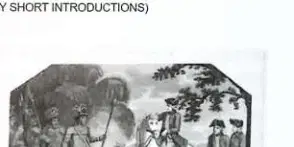
Which group did General John Burgoyne enlist for his campaign into New York?
The French
The Iroquois
The British Navy
The Spanish
According to the passage, how many vessels did Burgoyne load for Philadelphia in early summer?
100
266
500
50
Who wrote, "The Howes are gone the Lord knows whither, and have carried the American war with them"?
George Washington
Horace Walpole
Colonel Barry St. Leger
Burgoyne
Fill in the blank: Late in July the fleet appeared off the ________, then vanished again for three weeks.
Delaware
Hudson
Potomac
James
What did Burgoyne find more difficult than he had appeared on London maps?
The Canadian and New York terrain
The British weather
The French language
The London traffic
According to the passage, which Native American groups were invited by St. Leger to Fort Stanwix?
Mohawk, Seneca, and Cayuga
Oneida and Tuscarora
Cherokee and Creek
Sioux and Apache
Fill in the blank: The militia in Fort Stanwix (the Americans called it Fort ________) held off the siege.
Schuyler
Ticonderoga
Niagara
Saratoga
The Oneida and Tuscarora warriors sided with the Americans during the siege of Fort Stanwix.
True
False
What happened to St. Leger's forces after Benedict Arnold brought a column to relieve Fort Stanwix?
St. Leger's forces were dispersed in a hasty, chaotic retreat.
St. Leger's forces successfully captured Fort Stanwix.
St. Leger's forces negotiated a peaceful surrender.
St. Leger's forces received reinforcements and continued the siege.
According to the passage, what happened to the nine hundred Germans foraging in Vermont?
They joined the American army
They were killed or captured at Bennington
They marched to Philadelphia
They met General Horatio Gates
Who did the New England militia move on to join at Bemis Heights, above the Hudson near Saratoga, New York?
General Washington
General Horatio Gates
General Cornwallis
General Knyphausen
Fill in the blank: Burgoyne expected a ______ army to meet him on the Hudson, but instead, he expected a British, not an American, army.
British
French
Spanish
German
Where was Howe's army, which Burgoyne expected to meet, according to the passage?
In Pennsylvania
In New York
In Virginia
In Massachusetts
How many troops did Washington have when he tried to defend Philadelphia from Howe's seventeen thousand men?
Eleven thousand
Twenty thousand
Five thousand
Fifteen thousand
According to the passage, where did Congress flee to while Washington retreated to Chester?
York, Pennsylvania
Boston, Massachusetts
Richmond, Virginia
Albany, New York
Who rallied an American unit breaking under the British attack, as mentioned in the passage?
Lafayette
Cornwallis
Benedict Arnold
George Washington
How many men on the American side were wounded, killed, or captured, according to the passage?
Seven hundred
One hundred
Fifty
Nine hundred
Two weeks after the events described, which two groups occupied Philadelphia?
The British and Germans
The French and Spanish
The Americans and Dutch
The British and French
Howe had taken the capital. He needed reinforcements because:
he wanted to launch further attacks
his army was weakened and needed support
the capital was not strategically important
he was planning to retreat
According to the passage, what did Washington do after being defeated on the Brandywine and driven from Philadelphia?
He surrendered to the British
He attacked the superior British force at Germantown
He retreated to New York
He joined forces with Burgoyne
Fill in the blank: Though the British killed, wounded, or captured more than a thousand of Washington's men, his attack reminded Howe of Washington's _____
tenacity.
cowardice.
indifference.
ignorance.
What did Frederick the Great say when he heard about the attack at Germantown a month later?
The Americans had lost the war
The Americans, if led by Washington, must win
The British would always win
The Americans should surrender
On the Hudson, whose forces closed in on Burgoyne?
The British army
The New England militias and Gates's forces
Washington's army
Frederick the Great's army
Fill in the blank: Burgoyne had counted on the Hudson Valley's rich _____ to sustain his troops.
farmlands.
forests.
rivers.
mountains.
Who destroyed their own crops to deprive Burgoyne's men from the harvest?
General Philip Schuyler
King Louis XVI
American women
British soldiers
On October 17, how many British and German prisoners were marched to Boston?
Two thousand
Five thousand
Ten thousand
One thousand
Fill in the blank: In February 1778, King Louis XVI recognized the independence of the ________.
United States
Canada
Mexico
Brazil
France pledged to fight until the British recognized ________ independence.
American
French
Spanish
Dutch
France could send men and arms to America after recognizing American independence.
True
False
According to the passage, why were the ships currently blockading the American coast needed elsewhere?
To protect the home islands and the routes to India.
To transport goods to the colonies.
To escort merchant ships across the Atlantic.
To support a military campaign in Africa.
Who sailed from Toulon in April with a fleet of twelve ships of the line and five frigates carrying two infantry brigades?
French admiral Comte d'Estaing.
British admiral Lord Howe.
Spanish admiral Don Juan de Lángara.
Dutch admiral Willem de Ruyter.
What did Lord Camden accuse Prime Minister North of?
Starting a war on the premise that Americans were cowards and the French, idiots.
Mismanaging the British economy during the war.
Conspiring with foreign powers against Parliament.
Refusing to negotiate peace with the American colonies.
Lord North knew the Americans would fight until their independence was recognized.
True
False
What did Lord North promise regarding the Declaratory Act and taxation of the colonies?
He had Parliament rescind the Declaratory Act and promised not to tax the colonies directly.
He promised to increase taxes on the colonies to pay for the war debt.
He declared that the colonies would have full representation in Parliament.
He insisted that the Declaratory Act would be strictly enforced in all colonies.
Who were the commissioners sent by North to negotiate with the Americans in 1778?
The Earl of Carlisle, George Johnstone, and William Eden
Benjamin Franklin, Thomas Jefferson, and John Adams
Joseph Galloway, William Penn, and George Washington
The Quakers, Loyalists, and Patriots
Fill in the blank: Occupying Philadelphia gave the British an opportunity at _________
conciliation
retreat
surrender
negotiation
Who was put in charge of city government in Philadelphia after the British occupation?
George Johnstone
Joseph Galloway
William Eden
The Earl of Carlisle
The city's Quakers were against all wars.
True
False
What did the city's Loyalists blame their rebellious neighbors for?
Starting the war.
Raising taxes.
Inviting foreign armies.
Destroying city property.
With Howe and the British army occupying Philadelphia, Washington and his ten thousand men, and several hundred women who accompanied them, built a winter camp at ________, twenty miles from the city. The bitterly cold winter has become part of American folklore, a defining time for Washington and his army.
Valley Forge
Yorktown
Saratoga
Trenton
What was a defining time for Washington and his army during the American Revolution?
The Battle of Bunker Hill
The winter at Valley Forge
The capture of New York
The signing of the Declaration of Independence
Washington's men faced a persistent lack of which of the following at Valley Forge?
Food
Money
Clothing
All of the above
Who helped prevent starvation and maintain an orderly camp at Princeton and Brandywine Creek?
Friedrich Wilhelm von Steuben
Frederick the Great
Greene
Washington
Friedrich Wilhelm von Steuben claimed to be a lieutenant general under whom?
George Washington
Frederick the Great
Greene
Lafayette
What did Steuben ask for when he arrived at the camp?
Money
A chance to volunteer
A promotion
Food
Washington let Steuben train a hundred men after two weeks because the results were so ________.
impressive
disappointing
uncertain
slow
Steuben taught the men tactics and drilled them as he would ________.
Prussians
Romans
Spartans
Vikings
According to the passage, what did Washington have to do to lead his army effectively during the American Revolution?
Replace Congress members
Feed and train his army
Retreat from battles
Invade Canada
Who did members of Congress, particularly New Englanders, consider as a possible replacement for Washington after the victory at Saratoga?
Thomas Conway
Lafayette
Gates
Greene
Fill in the blank: By winter's end, Washington's soldiers were already _________?
veterans
defeated
hungry
deserters
Congress wanted Washington to drive the British from Philadelphia and also wanted Lafayette to invade Canada.
True
False
Who arrived in Philadelphia in early May to replace the Howes?
Clinton
Cornwallis
Burgoyne
Gage
What were Clinton's new orders after arriving in Philadelphia?
Hold Philadelphia and attack New York
Give up Philadelphia, hold New York, and send most men to Florida and the Caribbean
Surrender to the Loyalists
Move to Canada
Why were Philadelphia's Loyalists thrown into a state of 'Horror & melancholy'?
They were upset by news that the British were leaving.
They were celebrating a British victory.
They were happy about new trade laws.
They were planning a festival.
What did Lord Howe's secretary write about the ability to declare for the British?
'No man can be expected to declare for us, when he cannot be assured of a Fortnight's Protection.'
'Every man is eager to join our cause, regardless of the risks.'
'The colonies have already pledged their unwavering support.'
'Protection is guaranteed to all who declare for us.'
Who was Grace Growden Galloway?
The wife of a British officer
The daughter of one of Pennsylvania's leading men
A patriot leader
A British general's daughter
Fill in the blank: Grace Growden Galloway stayed in ________ after the British evacuation.
Philadelphia
Boston
New York
Charleston
What event did the Loyalists and British officers honor the Howes with before they left?
A dinner
A meschianza with fireworks and a parade
A secret meeting
A battle reenactment
According to the passage, how did Grace Growden Galloway react when the patriots evicted her from her home?
She maintained her dignity and said she was the happiest woman in town, even after being stripped and turned out of doors.
She pleaded with the patriots to let her stay and promised to support their cause.
She immediately left the city and never returned to her home.
She organized a protest with her neighbors against the eviction.
According to the passage, who dressed as knights in the jousting tournament?
British officers
French soldiers
Local villagers
American colonists
Who were the British officers competing for in the jousting tournament?
The favor of young Philadelphia women
The approval of King George III
A chest of gold coins
The title of best swordsman
A diplomatic post in France
What did Lord Howe's secretary note about the event?
It was a cheap event
It cost a great Sum of Money
It was ignored by enemies
It was a failure
What was the reaction of North's three commissioners when they arrived in Philadelphia?
They were stunned to find Philadelphia being abandoned.
They immediately joined the local militia.
They were welcomed with a grand parade.
They decided to leave the city at once.
According to the passage, why did Clinton place half his army in front of the baggage train?
To protect the baggage from a possible attack by Washington
To move faster
To avoid the rain
To attack New Jersey's people
Fill in the blank: Every third Hessian collapsed from ________ during the march through New Jersey.
heat stroke
exhaustion
starvation
cold
What did rebellious New Jerseyans do to slow the march of the British and German armies?
Destroyed bridges
Joined the British army
Hid in the villages
Attacked the baggage train
New Jersey's people, particularly women, hid from the retreating armies in 1776 because:
They feared violence and looting from the soldiers.
They wanted to join the army.
They were celebrating a festival.
They were moving to a new city.
Who did Washington and his officers debate with about what to do after Brunswick?
Charles Lee
Horatio Gates
Benedict Arnold
John Burgoyne
What did Charles Lee think the French alliance meant for Washington?
He should attack immediately
He no longer needed to fight
He should surrender
He should retreat
Which aide said the modest plan would have 'done honor to the most honorable body of midwives and to them only'?
Greene
Steuben
Wayne
Alexander Hamilton

