
NEW
Font size
 Worksheets
PLTW Unit 2 test review quizs
Total questions: 20
Worksheet time: 10mins
How many simple machines are there?
4
5
6
7
A gear ratio is.....
The ratio of the sizes of two gears
The speed at which gears rotate
The number of teeth on a gear
The distance between gears
What is not a simple machine?
Pulley
Lever
Screw
Engine

Which gear is the idler gear? (Refer to the image of three gears: red, blue, and gray)
Red
Blue
Gray
None
If the driver (input) gear turns clockwise, the output or driven gear will turn:
Clockwise
Counterclockwise
Both
Neither
The MA of a gear train, the driver gear (input gear) is 10 N and the driven gear (output gear) is 60N? GR = N out/N IN
0.16
6
60
10
Why use simple machines?
To make work easier
To make work harder
To increase the amount of work needed
To decrease efficiency
3D printing is an example of _______.
additive manufacturing
subtractive manufacturing
casting
forging
What are not the parts of a lever?
Load
Effort
Fulcrum
Wheel
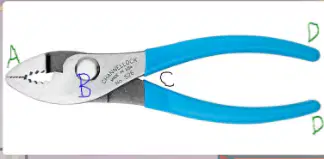
Where is the fulcrum for these two levers?
A
B
C
D
An idler gear allows ....
Change in direction of rotation
Increase in speed
Decrease in speed
No change in direction
How does the mechanical advantage of a class 1 lever change based on the placement of the fulcrum?
The mechanical advantage increases as the fulcrum moves closer to the load and decreases as it moves closer to the effort.
The mechanical advantage increases as the fulcrum moves closer to the effort and decreases as it moves closer to the load.
The mechanical advantage remains constant regardless of fulcrum placement.
The mechanical advantage is not affected by the position of the fulcrum in a class 1 lever.
What happens to the speed of the output gear when the driver gear is larger than the driven gear in a gear system?
The speed increases.
The speed decreases.
The speed remains the same.
The system stops working.
What is a gear train?
A gear train is a system of two or more gears that transmit motion from one shaft to another.
A gear train is a device used to measure electrical current.
A gear train is a type of pulley system used to lift heavy objects.
A gear train is a machine that converts chemical energy into electrical energy.
Speed and torque are _______.
inversely related (the opposite)
directly proportional (the same)
unrelated
always equal
What type of projection shows a 3D object using two or more 2D views?
Isometric projection
Orthographic projection
Perspective projection
Freehand drawing
If the output/driven gear is bigger than the input/driver gear, the ouput gear will spin _______.
slower
faster
backwards
noisily
Simple machines put together are known as…
Compound machines
Simple machines
Tools
Levers
What is a concept model?
A) A physical or digital representation of an idea
B) A finished product
C) A type of machine
D) A type of drawing
What is the mechanical advantage of a lever with an effort arm of 4 meters and a load arm of 2 meters?
0.5
2
4
8

