wayground logo

Free Printable Worksheets

Font size

S
M
L
XL
Worksheets

Final Review

Total questions: 86

Worksheet time: 44mins

Name
Class
Date
1.

What was the Great Migration?

a)
A relocation of Native Americans to reservations.
b)
The Great Migration was a mass movement of African Americans from the rural South to urban areas in the North and West.
c)
A campaign for civil rights in the 1960s.
d)
A movement of European immigrants to the Americas.
2.

During the Great Migration, where did Black Americans from the South mainly migrate to?
a)
Southern states like Texas and Florida
b)
Western cities like Los Angeles and Seattle
c)
Northern cities like Chicago, Detroit, New York, and Philadelphia.
d)
Rural areas in the Midwest
3.

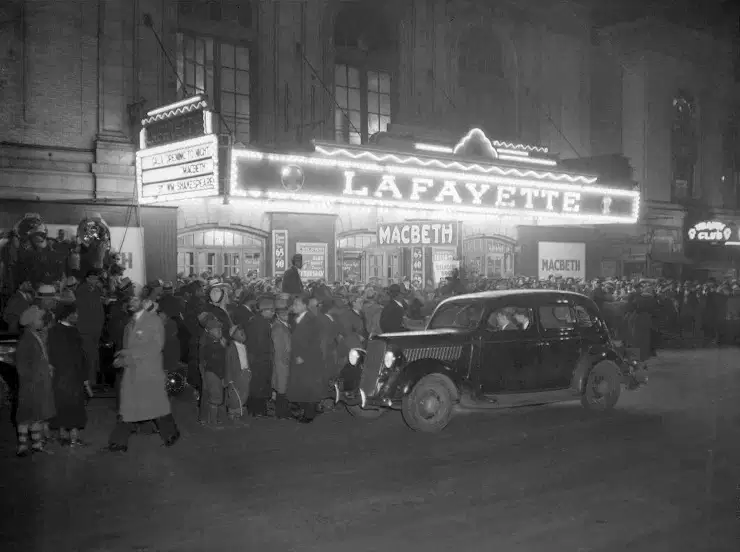
Theatres like the one pictured here, were most popular in what major city in the early 20th century?

a)
Chicago
b)
Los Angeles
c)
Miami
d)
New York City
4.

Which of the following was NOT a Republican president during the 1920s?

a)

Warren Harding

b)

Calvin Coolidge

c)

Herbert Hoover

d)

Franklin Delano Roosevelt

5.

In the 1920s, what was a major political priority for the Republican government?

a)

Managing the Spanish Flu

b)
Economic growth and stability.
c)

Growing international influence

d)
Expansion of colonial territories.
6.

In the 1920s, who were the "flappers?"

a)

Flappers were dancers who did a certain type of dance popular in the 1920s.

b)

Flappers were young men who wore oversized suits and pleated pants

c)

Flappers were young women in the 1920s known for their bold fashion and behavior.

d)
Flappers were a group of artists known for their paintings.
7.

How did the role of women in society change during the 1920s?

a)
The 1920s saw a decline in women's rights and freedoms compared to previous decades.
b)
The role of women in society changed significantly as they gained more independence, entered the workforce, pursued education, and embraced new social freedoms.
c)
Women were largely confined to domestic roles and had little influence in society.
d)
Women were primarily focused on traditional family roles and avoided education and work.
8.

Which of the following was NOT a new technology that became popular in the 1920s?

a)

Washing Machine

b)
Automobile
c)
Radio
d)

Television

9.

The Model T was created by what company?

a)

Ford

b)

General Motors

c)

Chrysler

d)

US Steel

10.

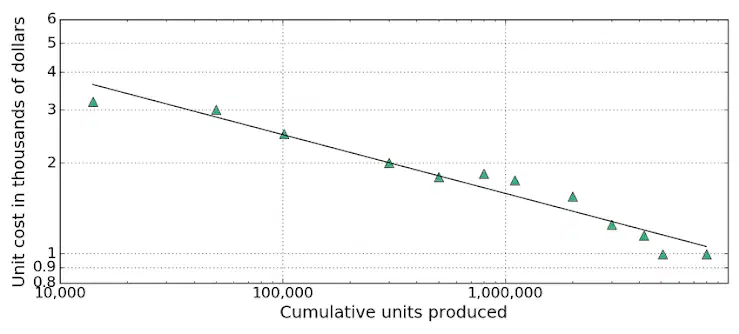
Based on this chart, in mass production, what happens if you create more of a product?

a)

individual cost per product goes up

b)

individual cost per product goes down

c)

individual costs stay the same

d)

individual cost per product will increase exponentially

11.

Why did Henry Ford utilize the assembly line process in order to maximize his profits?

a)

The more cars that Ford produced, the more it cost to make them.

b)

The more cars that Ford produced, the less it cost to make them.

c)

The more Ford charged for its vehicles, the fewer cars they sold

d)

The lower Ford made car prices, the more cars they sold.

12.

What 1920's invention greatly contributed to the explosive growth of the advertising industry?

a)
Television
b)

Newspapers

c)

Magazines

d)
Radio
13.

What is NOT a reason for increasing anti-immigrant legislation in the 1920s?

a)

Red Scare fears following the Russian Revolution

b)
Rise of anti-immigrant sentiment
c)

After WWI we wanted a more active role in global affairs

d)

Fear of economic competition from new immigrant populations

e)

New Immigrants were Catholic and Jewish, while the majority of the American population was protestant.

14.

What was the Emergency Quota Act of 1921?

a)
The Emergency Quota Act of 1921 established a free immigration policy for Europe.
b)
The Emergency Quota Act of 1921 abolished all immigration restrictions.
c)
The Emergency Quota Act of 1921 limited immigration by establishing quotas based on national origins.
d)
The Emergency Quota Act of 1921 increased immigration from all countries.
15.

What was the Immigration Act of 1924?

a)
A law that increased immigration from all countries equally.
b)
An act that abolished all immigration restrictions.
c)
The Immigration Act of 1924 was a law that established quotas to limit immigration, particularly from Southern and Eastern Europe, and excluded Asian immigrants.
d)
A policy that allowed unlimited immigration from Europe.
16.

What were the Palmer Raids?

a)
A set of laws regulating immigration in the 1930s.
b)
A military operation to invade foreign countries in 1918.
c)

The Palmer Raids were government actions to arrest and deport radicals (primarily communists in the U.S. during 1919-1920.

d)
A series of peaceful protests against government policies in 1921.
17.

What was the Dust Bowl?

a)
A government program to promote urban development
b)
A type of agricultural equipment used in farming
c)
A famous novel written during the 1940s
d)
The Dust Bowl was a period of severe drought and dust storms in the 1930s that devastated agriculture in the U.S.
18.

Where was the Dust Bowl?

a)
The Great Plains region of the United States.
b)
The Pacific Coast
c)
The Appalachian region
d)
The Rocky Mountains
19.

What was FDR's Court Packing Scandal?

a)
FDR's plan to reduce the number of justices on the Supreme Court.
b)
FDR's initiative to create a new federal court system.
c)
FDR's proposal to eliminate the Supreme Court altogether.
d)
FDR's attempt to expand the Supreme Court to secure favorable rulings for his New Deal policies.
20.

How did Republicans respond to FDR's Court Packing Scandal?

a)
Republicans supported FDR's Court Packing plan as a necessary reform.
b)
Republicans endorsed the plan, believing it would strengthen the judiciary.
c)
Republicans opposed FDR's Court Packing plan, viewing it as a threat to judicial independence and the Constitution.
d)
Republicans remained neutral and did not take a stance on the plan.
21.

What distressing historical event was underway in America when FDR took office?

a)
The Civil Rights Movement
b)
World War II
c)
The Dust Bowl
d)
The Great Depression
22.

True or False: The Hawley-Smoot Tariff passed by Hoover improved the economy during the Great Depression

a)

True

b)

False

23.

Who was Huey Long?

a)
Huey Long was a famous musician from Louisiana.
b)

Huey Long was a prominent populist American politician and Governor of Louisiana.

c)
Huey Long was a military general during World War II.
d)
Huey Long was a renowned author and playwright.
24.

True or False: During the Great Depression there were radicals like Huey Long and Father Coughlin who believed FDR's New Deal Policies did not go far enough.

a)

True

b)

False

25.

What were FDR's Fireside Chats?

a)
FDR's Fireside Chats were radio addresses to the American public by President Franklin D. Roosevelt.
b)
FDR's Fireside Chats were televised speeches to Congress.
c)
FDR's Fireside Chats were newspaper articles published weekly.
d)
FDR's Fireside Chats were public speeches held in town halls.
26.

Which of the following is NOT a New Deal Program?

a)
Social Security Act
b)
GI Bill
c)
Works Progress Administration
d)
Civilian Conservation Corps
27.

What did the Social Security Act do?

a)
The Social Security Act eliminated all forms of welfare.
b)
The Social Security Act only provided benefits for veterans.
c)
The Social Security Act was a tax increase for all citizens.
d)
The Social Security Act created a social insurance program providing retirement and disability benefits.
28.

What did the creation of the Federal Deposit Insurance Corporation do?

a)
It regulated the stock market to prevent crashes.
b)
It provided insurance for bank deposits to protect depositors.
c)
It established a central bank to control interest rates.
d)
It created a government agency to oversee all financial institutions.
29.

What was the Works Progress Administration?

a)
The Works Progress Administration was a New Deal agency that provided jobs through public works projects.
b)
A military organization established during World War II.
c)
An agency that provided loans to private businesses.
d)
A government program that focused solely on education.
30.

What was the Civilian Conservation Corps?

a)
A military program for training soldiers during World War II.
b)
A social club for community gatherings and events.
c)
The Civilian Conservation Corps was a New Deal program that provided jobs and environmental conservation efforts during the Great Depression.
d)
A government initiative to build highways and roads.
31.

What ended the Great Depression?

a)
World War II mobilization
b)
Increased agricultural production
c)
Stock market recovery
d)
The New Deal programs
32.

True or False: The New Deal lowered the unemployment rate.

a)

True

b)

False

33.

What was the Bonus Army?

a)
The Bonus Army was a group of World War I veterans who protested in Washington, D.C. in 1932 for early payment of their service bonuses.
b)
A group of politicians advocating for veterans' rights
c)
A military unit deployed to Europe during World War I
d)
A protest against the New Deal policies in 1932
34.

What happened to the Bonus Army's March?

a)
The Bonus Army's March ended violently when the U.S. Army forcibly removed the veterans from Washington, D.C.
b)
The Bonus Army's March was celebrated with a parade in Washington, D.C.
c)
The Bonus Army successfully negotiated their demands without conflict.
d)
The Bonus Army's March ended with the veterans receiving immediate bonuses.
35.

True or False: Many people during the Great Depression believed that the Depression would not last long.

a)

True

b)

False

36.

How did the US get involved in World War II?

a)
The US joined the war after the sinking of the Lusitania in 1915.
b)
The US was already involved due to economic support to the Allies before 1941.
c)
The US got involved in World War II after the attack on Pearl Harbor by Japan on December 7, 1941.
d)
The US entered the war after Germany invaded Poland in 1939.
37.

What is the Lend-Lease Act?

a)
A program to provide financial loans to European countries after World War II.
b)
A military strategy used by the Axis powers during World War II.
c)
A treaty that ended World War I between the U.S. and Germany.
d)
The Lend-Lease Act was a U.S. program to provide military aid to Allied nations during World War II.
38.

Which of the following describes the attack on Pearl Harbor?

a)
A surprise military attack by Japan on the U.S. naval base at Pearl Harbor.
b)
A coordinated attack by the U.S. on Japan's naval bases.
c)
A peaceful negotiation between the U.S. and Japan.
d)
A surprise attack by Germany on the U.S. naval base.
39.

What event is this a photo of?

a)

The Explosion of the USS Maine

b)

The Bombing of the Lusitania

c)

The attack on Pearl Harbor

d)

9/11

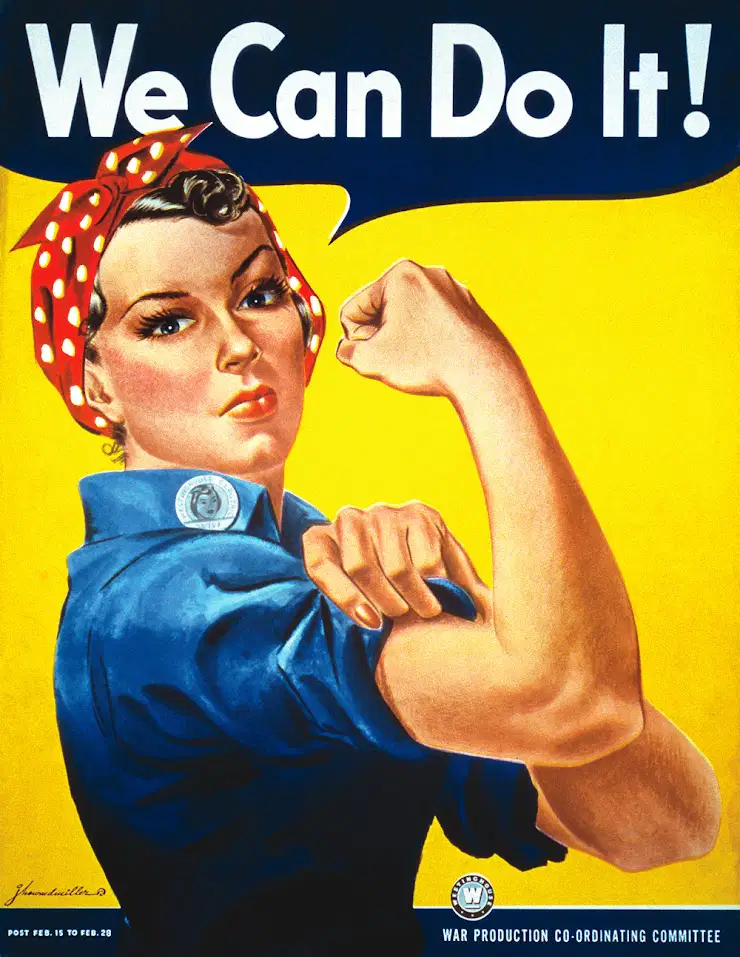
40.

Who is "Rosie the Riveter?"

a)
A famous singer from the 1940s.
b)
A character in a popular movie.
c)
A cultural icon representing women workers during World War II.
d)
A nickname for a famous airplane.
41.

Who is this?

a)

Wilma the Worker

b)
Rosie the Riveter
c)

Lucy the Laborer

d)

Milly the Mill Worker

42.

What was the purpose of the Lend-Lease Act of 1941, and how did it represent a shift in U.S. foreign policy before officially entering World War II?

a)

It allowed the U.S. to loan money to Axis powers to promote peace.

b)

It provided military aid to Allied nations, signaling increased U.S. involvement in the war without direct combat.

c)

It established a permanent U.S. military presence in Europe.

d)

It restricted the U.S. from exporting weapons or materials to any foreign nation.

43.

True or False: In the Lend-Lease Strategy, we wanted our weapons returned from Europe after the War?

a)

True

b)

False

44.

What was D-Day?

a)
A military strategy used in the Vietnam War
b)
The first manned moon landing in 1969
c)
A peace treaty signed after World War I
d)
D-Day was the Allied invasion of Normandy during World War II on June 6, 1944.
45.

What was the strategy used on D-Day?

a)

Invasion from North by sea coordinated attacks by land, air, and naval forces.
b)
Covert operations behind enemy lines.
c)
Naval blockade to cut off supplies.
d)
Aerial bombardment without ground support.
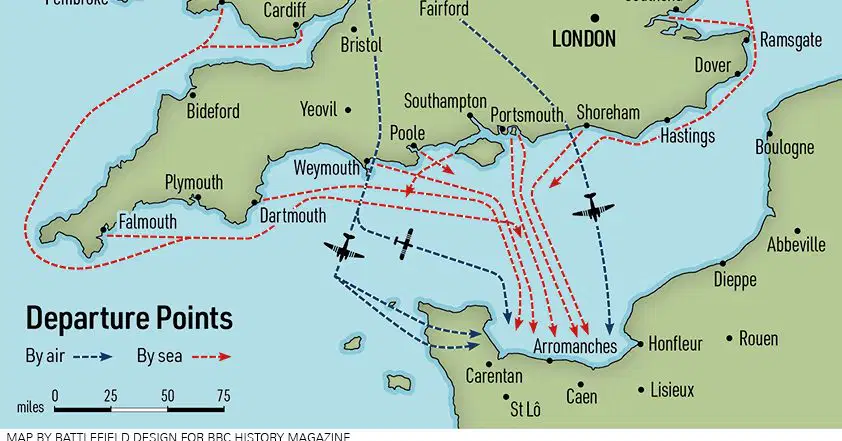
46.

What does this map depict?

a)

D-Day Invasion of Normandy

b)

Battle of Bulge

c)

Firebombing of Berlin

d)

Berlin Blockade

47.

What was the America First Committee?

a)
A pro-war organization supporting U.S. involvement in World War II.
b)
A political party advocating for isolationist policies in the 1960s.
c)

A non-interventionist organization opposing U.S. involvement in World War II.

d)
A civil rights group focused on domestic issues during the 1940s.
48.

Charles Lindbergh was a prominent member of what organization?

a)
American Pilots Association
b)

National Aeronautics Association

c)
America First Committee
d)

Students Nonviolent Coordinating Committee

49.

Korematsu v. United States was what?

a)

A Supreme Court case regarding who could or could not be citizens in the United States.

b)
A landmark Supreme Court case regarding Japanese American internment during World War II.
c)
A Supreme Court decision on immigration policy.
d)
A case concerning voting rights in the 1960s.
50.

What did Korematsu v. United States rule?

a)
The ruling mandated reparations for Japanese Americans.
b)
The ruling declared the internment of Japanese Americans unconstitutional.
c)
The ruling upheld the internment of Japanese Americans as constitutional.
d)
The ruling allowed for the immediate release of all interned individuals.
51.

Who are the "Big 3?" after the US enters World War II?

a)

Franklin Delano Roosevelt

b)

Joseph Stalin

c)

Winston Churchill

d)

Benito Mussolini

52.

Who are the "Big Three" at the end of WW2?

a)

Harry Truman

b)

Joseph Stalin

c)

Clement Atlee

d)

Michinomiya Hirohito

53.

What was the reasoning behind the US not intervening in the Holocaust?

a)

American leadership did not believe the Holocaust was really happening.

b)

American leadership did not think they could successfully launch missions against German camps

c)

American leadership prioritized winning the war over all other goals.

d)

They needed time to prepare for the refugees they would bring into the country after the war

54.

Which president dropped the atomic bombs on Japan in 1945?

a)

Hoover

b)

Roosevelt

c)

Truman

d)

Eisenhower

55.

In his famous speech, Winston Churchill described the boundary between Eastern Communist countries and Western Capitalist countries as

a)

The Iron Curtain

b)

The Metal Wall

c)

The Berlin Wall

d)

The Drastic Drapery

56.

What was the Berlin Airlift?

a)
A military operation to invade East Berlin.
b)
A peace treaty signed between the US and the USSR.
c)
A humanitarian mission to rescue refugees from Germany.
d)
The Berlin Airlift was a military operation to supply West Berlin during the Soviet blockade.
57.

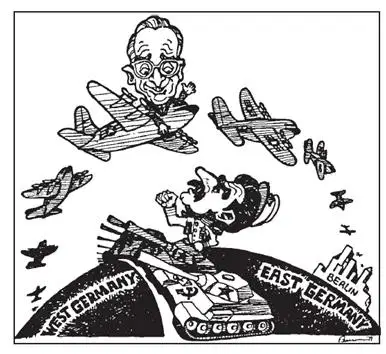
What Cold War event is being referred to by this political cartoon?

a)

Berlin Airlift

b)

Marshall Plan

c)

Creation of NATO

d)

Berlin Wall

58.

What Cold War event is being referred to by this political cartoon?

a)

Berlin Airlift

b)

Santa Claus Delivering Presents

c)

Berlin Wall

d)

Atomic Bomb Drop

59.

Which president had the US enter the Korean War?

a)

Truman

b)

Eisenhower

c)

Kennedy

d)

Johnson

60.

Why did the US get involved in the Korean War?

a)

To help Korean civilians threatened by the North Koreans

b)

They attacked Pearl Harbor, a major naval base for the United States

c)

To divert attention away from the developing situation in Vietnam

d)
To contain the spread of communism in Asia.
61.

Why was the Berlin Wall created?

a)
The Berlin Wall was created to stop East Germans from fleeing to West Germany.
b)
To create a cultural exchange program between the two sides.
c)
To establish a trade route between East and West Germany.
d)
To promote tourism in East Germany.
62.

Did the Berlin Wall prevent more people from crossing between East and West Berlin?

a)
No, the Berlin Wall had no impact on crossings.
b)
Yes, but only for a short period before it was built.
c)
No, the Berlin Wall allowed free movement between East and West Berlin.
d)
Yes, the Berlin Wall prevented more people from crossing between East and West Berlin.
63.

Joseph McCarthy is a US senator during the 1950s best known for

a)
his role in the Civil Rights Movement
b)
his support for the New Deal
c)
his advocacy for environmental policies
d)
his anti-communist witch hunts during the Red Scare
64.

What was the Second Red Scare?

a)
An international treaty signed to prevent the spread of communism.
b)
A period of economic prosperity in the U.S. after World War II.
c)
A period of intense anti-communist sentiment in the U.S. after World War II.
d)
A movement to promote communism in the U.S. during the 1960s.
65.

The "Thirteen Days in May" is a reference to which of the following Cold War events?*

a)

Yuri Gagarin becoming the first man to orbit the Earth

b)

the U2 Spy Plane Incident

c)

the Cuban Missile Crisis

d)

Fidel Castro leading a successful revolution in Cuba

66.

What was Sputnik?

a)
A type of space telescope developed by NASA.
b)
The first human-crewed spacecraft to orbit Earth.
c)
The first artificial satellite launched by the Soviet Union.
d)
A satellite used for weather forecasting.
67.

What was the significance of Sputnik?

a)
Sputnik's significance lies in its role as the first artificial satellite, initiating the space race and advancing satellite technology.
b)
It was the first human-crewed spacecraft.
c)
It was a military weapon developed by the U.S.
d)
It marked the end of the Cold War.
68.

What woman's arrest lead to what 381 day event that many consider the starting point of the Civil Rights movement of the 1950s and 60s?

a)

Claudette Colvin

b)

Ella Baker

c)

Fannie Lou Hamer

d)

Rosa Parks

69.

Brown v. Board of Education ruled

a)
All schools should be privately funded.
b)
Racial segregation is beneficial for education.
c)
Racial segregation in public schools is unconstitutional.
d)
Public schools must remain segregated.
70.

Brown v. Board of Education meant overturning what previous ruling?

a)
Roe v. Wade
b)
Plessy v. Ferguson
c)
Marbury v. Madison
d)

Gibbons v. Ogden

71.

Overall, did Black voter participation increase after the Voting Rights Act of 1965?

a)
Black voter participation remained the same after the Voting Rights Act of 1965.
b)
No, Black voter participation decreased after the Voting Rights Act of 1965.
c)
Yes, Black voter participation increased after the Voting Rights Act of 1965.
d)
Black voter participation was not affected by the Voting Rights Act of 1965.
72.

What act, signed into law by President Lyndon Johnson on prohibited discrimination in public places, provided for the integration of schools and other public facilities, and made employment discrimination illegal. It was the most sweeping civil rights legislation since Reconstruction?

a)
Fair Housing Act of 1968
b)
Civil Rights Act of 1957
c)
Civil Rights Act of 1964
d)
Voting Rights Act of 1965
73.

What were the Freedom Rides?

a)
The Freedom Rides were a series of concerts in 1961.
b)
The Freedom Rides were protests against the Vietnam War.
c)
The Freedom Rides were civil rights demonstrations in 1961 aimed at ending segregation in interstate bus travel.
d)
The Freedom Rides were a campaign to promote voting rights in Europe.
74.

What historic Civil Rights era event is plotted out on the map below?

a)

Freedom Rides

b)

Montgomery Bus Boycott

c)

The March On Washington

d)

The Freedom Rides

75.

What Civil Rights era organization was founded by Huey Newton and Bobby Seale in California?

a)

the Congress of Racial Equality (CORE)

b)
Southern Christian Leadership Conference
c)

the Student Non-Violent Coordinating Committee (SNCC)

d)
Black Panther Party
76.

National Organization of Women's advocacy led to the passage of Title IX, which did what?

a)
Increased funding for male-only sports programs.
b)
Prohibited sex-based discrimination in education and athletics.
c)
Allowed gender segregation in schools.
d)
Mandated co-ed classrooms for all educational institutions.
77.

Which of the following was also a labor movement led by people like Cesar Chavez and Dolores Huerta?

a)

Chicano Movement

b)

Yellow Power Movement

c)

Red Power Movement

d)

Women's Movement

78.

Which of the following quotes was delivered by John F. Kennedy at his inauguration in 1960?

a)

"We have been too quiet for too long. There comes a time when you have to say something. You have to make a little noise. You have to move your feet. This is the time"


b)

"Free at last! Free at last! Thank God Almighty, we are free at last!"


c)

The Great Society rests on abundance and liberty for all. It demands an end to poverty and racial injustice, to which we are totally committed in our time.


d)

"And so, my fellow Americans: ask not what your country can do for you — ask what you can do for your country."


79.

Which of the following events was used to give President Lyndon Johnson wide ranging powers in Vietnam?

a)

Assassination of John F. Kennedy

b)

Tet Offensive

c)

My Lai Massacre

d)

Gulf of Tonkin Resolution

80.

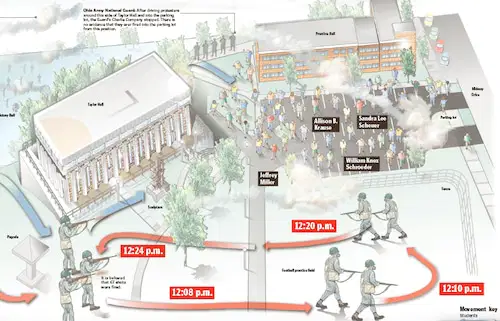
What Vietnam era event is plotted out on the map below? 

a)

The Newark Riots

b)

The Tet Offensive

c)

The My Lai Massacre

d)

The Kent State Shootings

81.

What happened at My Lai?

a)

The American military was soundly defeated leading to the US leaving Vietnam

b)

President Richard Nixon ordered attacks on farmers across the border in Cambodia

c)

An American ship was attacked by the Vietcong leading to the passage of the Tonkin Gulf Resolution

d)

American soldiers massacred unarmed Vietnamese civilians

82.

What was a the Iranian Hostage Crisis?
a)
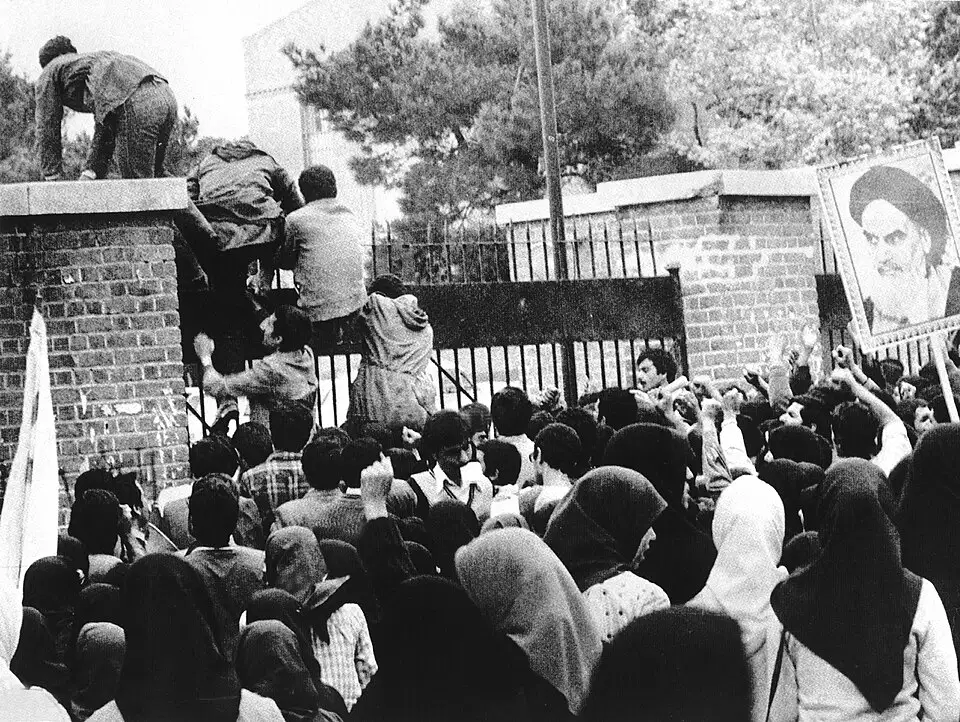
The Iranian Hostage Crisis was a 444-day period during which 52 American hostages were held in Iran.
b)
A peaceful negotiation between the US and Iran.
c)
A military invasion of Iran by the US.
d)
A trade agreement signed by both countries.
83.

This image shows the first moments of a US Embassy being overrun which led to a 444 day standoff known as what?


a)

Iran Hostage Crisis

b)

Watergate

c)

Berlin Airlift

d)

Oil Embargo of 1973-1974

84.

In the past few days, however, it has become evident to me that I no longer have a strong enough political base in the Congress to justify continuing that effort. As long as there was such a base, I felt strongly that it was necessary to see the constitutional process through to its conclusion, that to do otherwise would be unfaithful to the spirit of that deliberately difficult process and a dangerously destabilizing precedent for the future.

But with the disappearance of that base, I now believe that the constitutional purpose has been served, and there is no longer a need for the process to be prolonged.

I would have preferred to carry through to the finish whatever the personal agony it would have involved, and my family unanimously urged me to do so. But the interest of the Nation must always come before any personal considerations...

...Therefore, I shall resign the Presidency effective at noon tomorrow. Vice President Ford will be sworn in as President at that hour in this office.

- Richard Nixon speech, August 8th, 1974

What event was brought to a conclusion by the speech quoted above?

a)

SALT Treaty

b)

Watergate Scandal

c)

Vietnam War

d)

American Unwillingness to recognize Communist China

85.

The police raid of the Stonewall Inn in New York City became a catalyst for what group's civil rights movement?

a)

El Movimiento

b)

The American Indian Movement (AIM)

c)

The Women's Rights Movement

d)

The LGBTQ+ Movement

86.

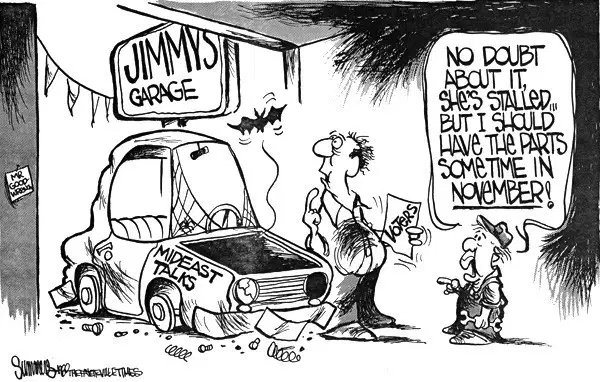
Which presidential campaign is being criticized in the political cartoon below?

a)

Johnson Presidency

b)

Ford Presidency

c)

Carter Presidency

d)

Nixon Presidency