
 Worksheets
HBHD Ch 22
Total questions: 68
Worksheet time: 34mins
What is the definition of acid-base balance?
The process of maintaining the pH level in the body fluids
The ability to neutralize acids with bases
The measurement of acidity in a solution
The conversion of acids into bases
How is the pH scale used?
To measure the temperature of a solution
To determine the acidity or alkalinity of a solution
To calculate the density of a liquid
To assess the color of a solution
What does the pH unit represent?
The concentration of hydrogen ions in a solution
The volume of a solution
The weight of a solution
The temperature of a solution
What is the definition of a base?
A substance that donates protons
A substance that accepts protons
A substance that releases hydrogen gas
A substance that increases acidity
What is the difference between strong and weak acids?
Strong acids completely dissociate in water, while weak acids do not
Strong acids have a higher pH than weak acids
Strong acids are solid, while weak acids are liquid
Strong acids are organic, while weak acids are inorganic
What are the three chemical mechanisms that control pH of body fluids?
Buffers, respiration, and renal function
Digestion, absorption, and excretion
Circulation, filtration, and diffusion
Metabolism, synthesis, and degradation
What is the role of buffers as a compensatory mechanism?
To maintain a constant temperature
To resist changes in pH
To increase the acidity of a solution
To decrease the alkalinity of a solution
What is the primary difference between respiratory and urinary mechanisms of pH control?
Respiratory mechanisms are faster but less effective than urinary mechanisms.
Urinary mechanisms are faster but less effective than respiratory mechanisms.
Both mechanisms work at the same speed and effectiveness.
Neither mechanism affects pH control.
How would you define acidosis?
A condition where blood pH is higher than normal.
A condition where blood pH is lower than normal.
A condition where blood pH remains constant.
A condition unrelated to blood pH.
What are the two types of disturbances discussed in the context of acid-base balance?
Metabolic and respiratory disturbances.
Chemical and physical disturbances.
Neurological and cardiovascular disturbances.
Thermal and electrical disturbances.
Which compensatory mechanism helps return blood pH to near healthy levels in cases of pH imbalances?
Increased heart rate.
Respiratory and renal adjustments.
Enhanced digestion.
Muscle contraction.
What does a pH of 7.0 indicate about a solution?
Acidity
Neutrality
Alkalinity
Basicity
If a solution has a pH higher than 7.0, what does it indicate?
Neutrality
Acidity
Alkalinity
Salinity
What does a pH less than 7.0 indicate about a solution?
Neutrality
Alkalinity
Acidity
Basicity
What is the normal range of blood pH?
6.5 to 7.0
7.35 to 7.45
7.5 to 8.0
6.0 to 6.5
What is the approximate pH of arterial blood?
7.35
7.45
7.25
7.55
How does the H+ concentration change for each pH unit on the pH scale?
It doubles
It changes by 5 times
It changes by 10 times
It remains constant
What is the approximate pH of venous blood?
7.25
7.35
7.45
7.55
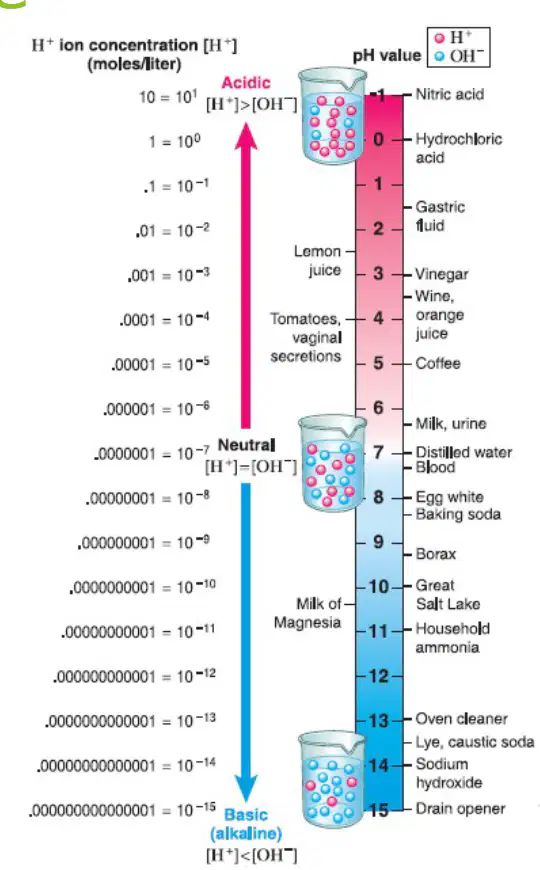
What is the pH value of a neutral solution?
0
7
14
1
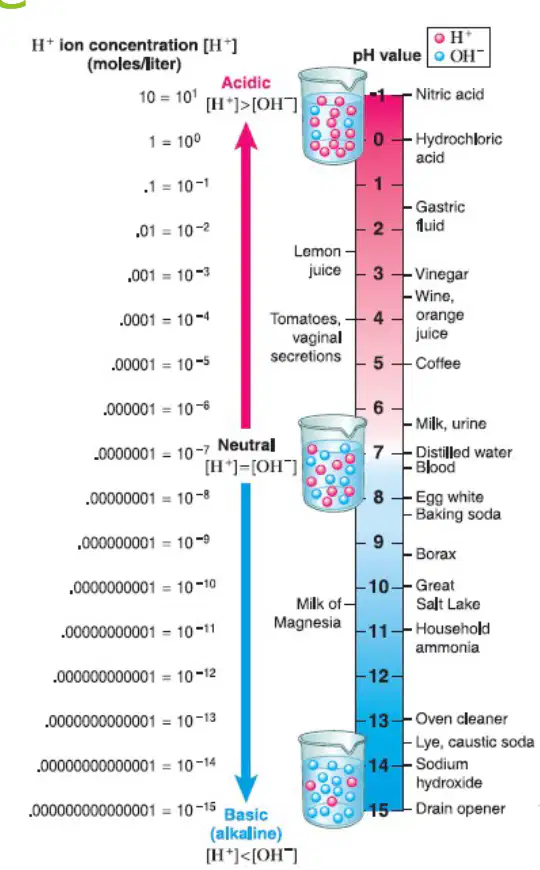
Which of the following substances is considered acidic?
Baking soda
Lemon juice
Distilled water
Milk of magnesia

At what pH value does hydrochloric acid fall on the pH scale?
1
7
10
14

Which substance is more basic: household ammonia or baking soda?
Household ammonia
Baking soda
Both are equally basic
Neither is basic
Which of the following is a mechanism that helps control the pH of body fluids?
Digestive mechanism
Chemical/buffer mechanism
Muscular mechanism
Nervous mechanism
What is the primary function of the respiratory mechanism in pH homeostasis?
To digest food
To regulate blood pressure
To maintain normal pH of body fluids
To control muscle movement
Which mechanism is NOT involved in maintaining the normal pH of body fluids?
Urinary mechanism
Respiratory mechanism
Chemical/buffer mechanism
Endocrine mechanism
What happens to carbonic acid once it is formed in the blood?
It remains in the blood indefinitely.
It is converted into oxygen.
It needs to be removed.
It turns into glucose.
How do the lungs help in the removal of carbonic acid from the body?
By converting it into water.
By eliminating carbon dioxide (CO₂).
By storing it in the lungs.
By turning it into oxygen.
Approximately how much carbonic acid do the lungs remove each day?
10 L
20 L
30 L
40 L
Why is carbonic acid buffered in the blood?
To increase the blood pressure.
To keep the pH of venous blood close to that of arterial blood.
To enhance oxygen absorption.
To decrease blood sugar levels.
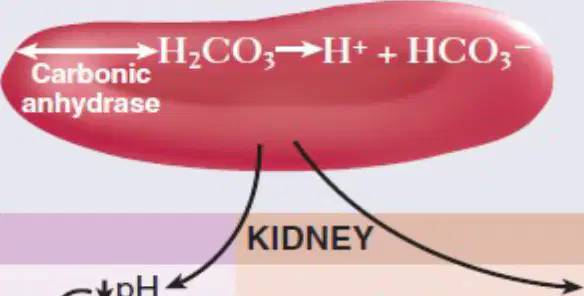
What enzyme is involved in the conversion of CO2 and H2O into H2CO3 in the blood?
Carbonic anhydrase
Amylase
Lipase
Pepsin

Which organ is responsible for adjusting the rate of H+ secretion to control blood pH?
Liver
Kidney
Heart
Pancreas
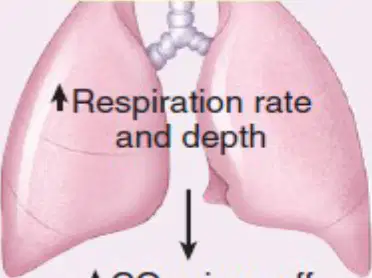
How does the respiratory system respond to an increase in blood CO2 levels?
Decreases respiration rate
Increases respiration rate
Stops respiration
No change in respiration rate
What is the basis of chemical pH control mechanisms in the body?
Changes in respiratory rate
Buffers in blood/RBCs and body fluids
Altered renal activity
Hormonal regulation
How quickly do chemical pH control mechanisms act?
Within hours
Within days
Immediately
Within minutes
What physiological mechanism regulates pH by altering respiratory rate?
Buffers in blood
Renal activity
Changes in blood CO₂
Hormonal changes
How long does it take for physiological pH control mechanisms involving renal activity to act?
Immediately
Within minutes
Within hours
Within days
What is the primary function of buffers in a fluid?
To increase the temperature
To prevent a sharp change in pH
To enhance the color
To solidify the fluid
Which compound mainly buffers "fixed" acids?
Sodium chloride (NaCl)
Sodium bicarbonate (NaHCO₃)
Potassium iodide (KI)
Calcium carbonate (CaCO₃)
Why are more acids than bases added to body fluids?
Due to photosynthesis
Because of catabolism
As a result of evaporation
Due to condensation
What effect do buffer salts have on acids when they enter the blood?
Strengthen the acids
Weaken the acids
Neutralize the acids completely
Convert acids to bases
What are the two substances that buffers consist of?
Sodium chloride and carbonic acid
Sodium bicarbonate and hydrochloric acid
Sodium bicarbonate and carbonic acid
Sodium chloride and hydrochloric acid
What happens to the amount of carbonic acid (H₂CO₃) in the blood?
It decreases significantly
It remains constant
It increases slightly
It decreases slightly
What is the normal ratio of NaHCO₃ to H₂CO₃ in the blood?
10:1
20:1
15:1
5:1
What happens to the blood pH level according to the document?
It increases significantly above arterial level
It remains constant
It decreases slightly below arterial level
It increases slightly below arterial level

What is the role of carbonic acid in the buffering action of sodium bicarbonate?
It acts as a strong acid.
It dissociates completely in solution.
It helps maintain pH by switching places with Na+ and H+.
It increases the concentration of OH- ions.

Which compound dissociates almost completely, adding many OH- ions to the solution?
Sodium bicarbonate
Water
Carbonic acid
Sodium hydroxide

What happens to sodium bicarbonate in the buffering action process?
It dissociates almost completely.
It dissociates very little.
It forms a strong acid.
It releases many H+ ions.

What is the role of sodium bicarbonate in the buffering action depicted in the diagram?
It acts as a strong acid.
It acts as a buffer by exchanging ions.
It acts as a catalyst for the reaction.
It acts as a solvent for the reaction.

Which compound dissociates almost completely in the solution according to the diagram?
Sodium chloride
Carbonic acid
Hydrochloric acid
Sodium bicarbonate
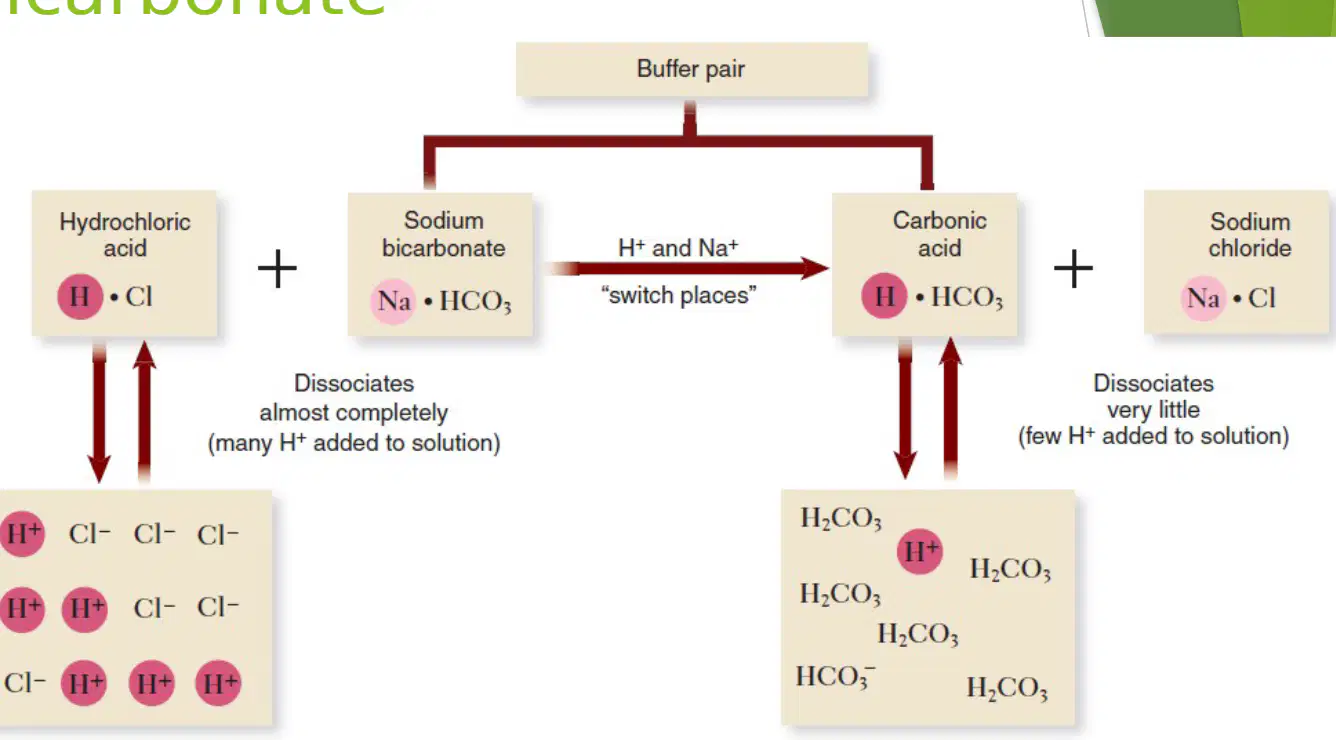
What is formed when sodium bicarbonate reacts with hydrochloric acid as shown in the diagram?
Water and salt
Carbonic acid and sodium chloride
Sodium hydroxide and carbon dioxide
Hydrochloric acid and sodium bicarbonate
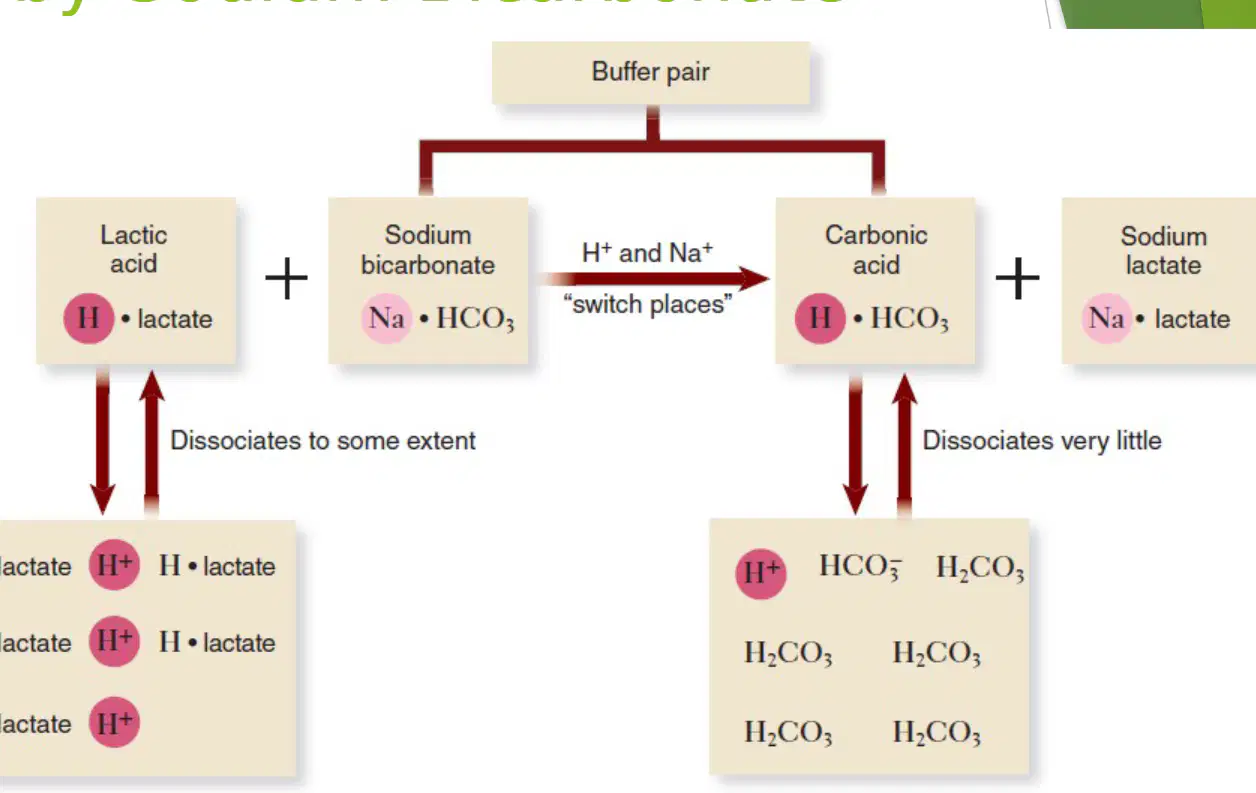
What is the role of sodium bicarbonate in the buffering of lactic acid?
It acts as a strong acid.
It acts as a buffer pair with lactic acid.
It dissociates completely in water.
It forms a precipitate with lactic acid.
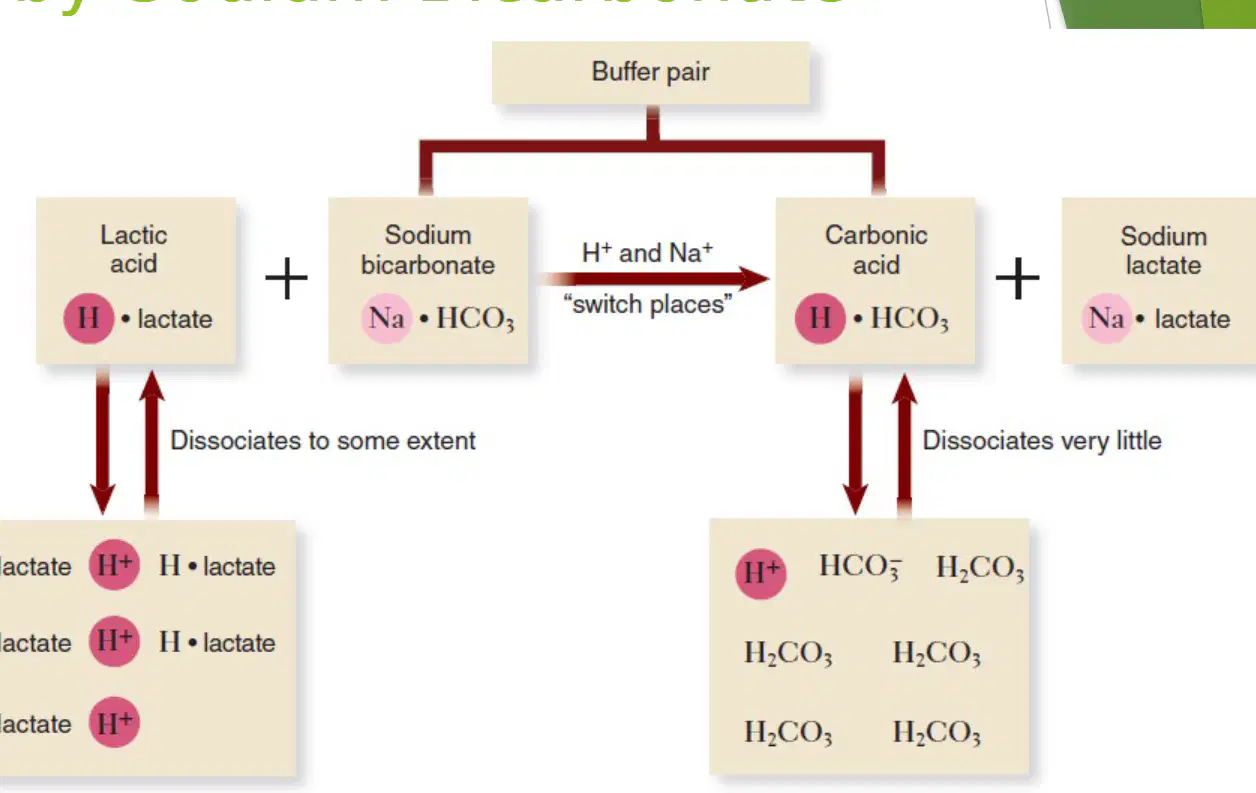
What happens to lactic acid in the presence of sodium bicarbonate?
It dissociates completely.
It forms a solid compound.
It dissociates to some extent.
It remains unchanged.

Which compound is formed when H+ and Na+ switch places in the buffering process?
Sodium chloride
Carbonic acid
Hydrochloric acid
Sulfuric acid
What happens to CO₂ in the blood during respiration?
It increases
It decreases
It remains the same
It turns into oxygen
How does a decrease in H₂CO₃ affect blood pH?
Blood pH decreases
Blood pH remains constant
Blood pH increases
Blood pH turns acidic
What is the response of respiratory control centers in the brainstem to a drop in pH?
Decrease respirations
Increase respirations
No change in respirations
Stop respirations
What is the body's most effective regulator of blood pH?
Liver
Lungs
Kidneys
Heart
How is urine usually acidified in the body?
By secreting sodium ions into the urine
By secreting hydrogen ions and ammonia into the urine
By reabsorbing glucose into the blood
By secreting potassium ions into the urine
What is reabsorbed into the blood in exchange for hydrogen ions and ammonia during urine acidification?
NaCl
NaHCO₃
H₂O
CO₂
What are the two kinds of pH imbalances mentioned in the text?
Acidosis and alkalosis
Acidosis and acidosis
Alkalosis and alkalosis
Neutral and acidic
Which two components' relative quantities affect acid-base balance in the blood?
NaCl and HCl
NaHCO₃ and H₂CO₃
H₂O and CO₂
NaOH and H₂SO₄
How does the body regulate the NaHCO₃-H₂CO₃ buffer system?
NaHCO₃ by lungs, H₂CO₃ by kidneys
NaHCO₃ by kidneys, H₂CO₃ by lungs
Both by kidneys
Both by lungs
What happens in the brainstem when you hold your breath too long?
It detects rising oxygen levels
It detects dropping pH and rising CO₂
It detects stable pH levels
It detects decreasing CO₂ levels
What results from anything that causes decreased respirations over time?
Alkalosis
Hyperventilation
Acidosis
Hypoxia
What results from anything that causes increased respirations over time?
Acidosis
Alkalosis
Hypoventilation
Hypercapnia
What is the normal ratio of NaHCO₃ to H₂CO₃ in blood?
20:1
10:1
5:1
1:1
What condition is characterized by a bicarbonate (NaHCO₃) deficit?
Metabolic acidosis
Metabolic alkalosis
Respiratory acidosis
Respiratory alkalosis
What is a complication associated with metabolic alkalosis?
Severe vomiting
Diarrhea
Fever
Dehydration

