
 Worksheets
Female Pelvis
Total questions: 118
Worksheet time: 59mins
What are the external accessory organs of the female reproductive system?
labia majora/minora, clitoris, vestibule gland
Iliac crest, ischial spine, sacral promontory, pubic symphysis
Ovaries, fallopian tubes, uterus, cervix
Rectum, sigmoid colon, coccyx, sacrum
The bony pelvis is divided into true and false pelvis by the ________.
pelvic brim
sacral promontory
ischial spine
pubic symphysis
Which of the following bones is not part of the bony pelvis?
2 Innominate bones
Sacrum
Coccyx
All of the above are bones of the bony pelvis
Which of the following is not located in the lesser pelvis?
Ovaries
Ureters
Bladder
Uterus
kidneys
Which muscle forms the floor (pelvic diaphragm) of the true pelvis?
Levator ani & coccygeus
Rectus abdominis
Gluteus maximus
Psoas major
The piriformis & coccygeus muscle form the posterolateral walls of the true pelvis.
True
False
Which two muscles of the false pelvis join together to make the iliopsoas muscle?
Psoas major & iliacus
Gluteus maximus & gluteus Medius
Rectus abdominis & external oblique
Adductor longus & gracilis
What are the muscles that make up the abdominal wall?
Rectus abdominis, external/internal obliques, transversus abdominis
Biceps brachii, triceps brachii, deltoid
Gluteus maximus, sartorius, gracilis
Pectoralis major, latissimus dorsi, trapezius
Which organ has its apex posterior to the pubic bones, base anterior to the vagina, and neck resting on the diaphragm?
Bladder
Uterus
Rectum
Ovary
What arteries supply blood to the vagina?
Vaginal and uterine arteries
Ovarian and renal arteries
Femoral and popliteal arteries
Internal thoracic and subclavian arteries
The cervix projects into the vagina and forms what 4 recesses?
Fornices
Rugae
Labia minora
Hymen
What are the 4 parts of the uterus?
Fundus, body, isthmus, cervix
Ovary, fallopian tube, vagina
Endometrium, myometrium, perimetrium
Isthmus, ampulla, infundibulum
What is the typical uterine size in a postmenopausal woman?
3.5–5.5 cm
6–8 cm
2–3 cm
8–10 cm
Which uterine layer is the outer serosa?
Perimetrium
Endometrium
Myometrium
Epimetrium
Which uterine layer is muscular & the middle layer?
Myometrium
Endometrium
Perimetrium
Epimetrium
Which uterine layer is the inner mucosa responsive to hormones?
Endometrium
Myometrium
Perimetrium
Serosa
Which ligament supports the cervix?
Broad ligament
Round ligament
Cardinal & uterosacral ligament
Suspensory & ovarian ligament
The broad ligament of the uterus contains which of the following?
Mesovarium & mesosalpinx
Ovarian arteries
Tunica albuginea
Fimbriae
The round ligament connects the fundus of the uterus to the ______ pelvic wall.
anterior
posterior
lateral
inferior
Which ligament supports the ovaries?
Broad ligament
Round ligament
Cardinal ligament
Suspensory, ovarian ligament, & broad ligament
Name the segments of the fallopian tube.
Infundibulum (fimbriae), ampulla (fertilization), isthmus, interstitial (mural)
Cervix, fundus, body, isthmus
Infundibulum, cervix, ampulla, body
Ampulla, isthmus, cervix, fundus
The blood supply to the fallopian tubes is provided by:
Uterine arteries
Ovarian arteries/veins
Renal arteries
Mesenteric arteries
Where are the ovaries located?
Ovarian fossa but highly variable, attached to posterior part of broad ligament (mesovarium)
Pelvic inlet, anterior to the bladder
Within the uterine cavity, attached to the endometrium
In the abdominal wall, lateral to the rectus abdominis
What does the tunica albuginea surround in the female pelvis?
Ovaries
fallopian tubes
vagina
uterus
Which vein does the right ovarian vein drain into?
Inferior vena cava (IVC)
Left renal vein
Portal vein
Femoral vein
The ______ arteries supply which uterine layer and shed during menses?
The spiral arteries supply the zona functionalis, which sheds during menses.
The spiral arteries supply the zona basalis, which sheds during menses.
The straight arteries supply the myometrium, which sheds during menses.
The straight arteries supply the perimetrium, which sheds during menses
During which days does ovulation typically occur?
Ovulation typically occurs around day 14 of the menstrual cycle when LH is high.
Ovulation typically occurs around day 1 of the menstrual cycle.
Ovulation typically occurs around day 21 of the menstrual cycle.
Ovulation typically occurs around day 28 of the menstrual cycle.
What is the typical duration of the menstrual cycle?
~28 days
~14 days
~7 days
~40 days
What is the term for the onset of normal physiologic and endocrine processes of puberty before the age of 8?
Menarche
Menopause
Precocious puberty
Premenarche
Menarche refers to:
Before puberty
the first menstrual period
Cessation of menses
Painful periods
Menopause is the ________ of menses.
cessation
beginning
increase
continuation
Menorrhagia refers to:
Painful periods
Heavy bleeding
No periods
Short cycles
Which hormone triggers ovulation?
GnRH
FSH
LH
Estrogen
FSH is responsible for ________ growth.
follicular
muscular
cartilage
epidermal
If pregnancy does not occur, the corpus luteum regresses and leads to ________.
menses
ovulation
fertilization
implantation
Which hormone increases during the Proliferative phase, leading to endometrial thickening?
Estrogen
Progesterone
Testosterone
Cortisol
What is the 'Three-line sign' associated with?
Menstrual phase
Proliferative phase
Secretory phase
Postmenopausal phase
What happens to the endometrium during the Secretory phase (Days 15–28)?
Progesterone increases, thickens endometrium & becomes echogenic
Estrogen decreases, endometrium thins, becomes hypoechoic
LH surges, endometrium sheds completely
FSH increases, endometrium remains unchanged
Which of the following is a sonographic change in the endometrium during Menses'?
3-line sign
Thin line, fluid/debris possible
echogenic SUPER THICK
Isoechoic
The movement of an egg cell down a uterine tube is aided by
ciliary action
peristaltic contractions
both ciliary action and peristaltic contractions
flagellum on the egg cell
Salpingitis is an infection of:
Fallopian tube
uterus
vagina
ovary
the hormone that releases from the corpus luteum from the ruptured ovarian follicle is:
Estrogen
FSH
LH
Progesterone
All are parts of fallopian tube except:
Ampulla
infundibulum
Corpus
Intramural
The foramen ovale is an opening that allows fetal blood to pass from the
right atrium to the left atrium
left atrium to the right atrium
right ventricle to the left ventricle
left ventricle to the right ventricle
What is the most common cystic lesion of the vagina?
Gartner Duct cyst
Hematoma
Pyocele
adenocarcinoma
What is the most common congenital abnormality of the female genital tract?
Imperforate Hymen
didelphic uterus
two horned uterus
bicornuate uterus
The hormone oxytocin aids the birth process by stimulating
Fetal muscular movement
Uterine wall contractions
an increase in progesterone secretion
an increase in estrogen secretion
In the female reproductive cycle, menstrual flow occurs when the concentrations of
estrogen and progesterone are low
estrogen and progesterone are high
estrogen is high and progesterone is low
progesterone is high and estrogen is low
All are parts of ovi duct except:
Fimbriae
Calpo
Ampulla
Infundibulum
The tubular portion of the uterus that extends downward into the upper part of the vagina is the
Fundus
cervix
Perimetrium
Endometrium
Metritis means:
Infection of Fallopian Tube
Infection of the vaginal canal
Infection of the ovaries
Infection of the uterus
The postnatal period extends from:
the fertilized egg until the end of life.
fertilization until birth.
Birth to death
becoming a parent until death.
All are parts of uterus except:
Fundus
Vagina
Body
Cervix
Ductus venosus constricts and becomes:
Ligamentum Arteriosum
Umbilical ligament
Ligamentum teres
none of the above
The fertilization of an egg occurs in the uterine tube
True
False
Estrogen and progesterone are produced by ovaries:
True
False
Uterine wall contain layers from outside to inside:
Perimetrium, Myometrium, Endometrium
Myometrium, Endometrium, Perimetrium
The cortex of the ovaries contain:
Blood vessels
Follicles
Connective tissues
Lymphatic vessels
The fetal stage of development begins at the end of the
Seventh week
Fourth week
Tenth week
Second week
FSH stimulates a primordial follicle to start the maturation process.
True
False
Meiosis occurs during
spermatogenesis only
oogenesis only
both spermatogenesis and oogenesis
neither spermatogenesis nor oogenesis
The hormone that stimulates the mammary glands to secrete milk is
Estrogen
Oxytocin
Prolactin
Progesterone
All are parts of uterus except:
Corpus
fundus
cervix
ampulla
All hormones are from pituitary gland except:
FSH
Estrogen
Prolactin
Oxytocin
The combining of egg and sperm chromosomes is called
Fertilization
Implantation
Cleavage
Labor
An increase in the hormone FSH at approximately day 14 causes ovulation
False
True
The fallopian tube is attached to the lateral border of uterus:
True
False
The cells of a blastocyst that give rise to the body of the developing offspring constitute the
Blastomere
Inner cell mass
Trophoblast
Zona pellucida
Blood rich in oxygen and nutrients is transported from the placenta to the fetus in a(an)
Umbilical vein
Umbilical artery
ductus venosus
ductus arteriosus
Which of the following best describes the numbers of blood vessels usually found in the umbilical cord?
One artery and one vein
One artery and two veins
Two arteries and one vein
Two arteries and two veins
Oogenesis takes place in the ___, and produces ___ for each cell that undergoes the process.
Follicles/two egg cells
Ovaries/three egg cells
Follicles/four egg cells
Ovaries/one egg cell
Androgens are
male sex hormones
female sex hormones
releasing hormones
gonadotropins
The primary organs of the female reproductive system are the uterus and vagina.
True
False
The uterine artery arises from the?
Ovarian artery
External iliac artery
Internal iliac artery aka hypogastric artery
Aorta
The uterus and vagina arise from which embryonic duct?
Vistuble duct
Urosinus
paramesonephric duct aka Mullerian duct
mesonephric duct aka wolffin duct
The adnexa is located?
posterior the rectum
Posterior to the broad ligament
Anterior to broad ligament
Anterior to bladder
The vessels seen in the periphery of the uterus are called?
Arcuate
uterine
ovarian
tubal
The texture of the myometrium of the uterus may be described as?
heterogenous
Homogenous with smooth borders
Heterogenous with smooth borders
homogenous with irregular borders
The mullerian duct is important to development of the?
Fallopian tube
ovary
Female internal reproductive organs
Uterine canal
The ovary is located lateral to the____ and anteromedial to the ____.
round ligament, broad ligament.
uterus, internal iliac vessels
external iliac vessels, piriformis.
obturator internus, internal iliac vessels.
The highest oxygenated blood is found in what fetal chamber?
right atrium
right ventricle
left atrium
left ventricle
Polycystic ovaries usually have cysts that are:
Around the periphery of the ovary
Throughout the ovary
large and septated
infected
Teratomas are:
Complex masses
cystic masses
always malignant
lethal
which of the following is not an adnexal structure?
Ovarian ligaments
ovaries
uterus
fallopian tubes
broad ligament
Theca lutein cysts are:
Large cystic masses with prominent septations
benign teratomas in which ectodermal elements are preponderant
the most common large cystic masses which may contain a lattice of internal thin walled septations
The largest of the functional cysts associated with trophoblastic disease or hyperstimulation of hCG
Which of the following can cause obstruction and lead to hydrocalpometrium?
Imperforate hymen
Vaginal cuff
Bicornuate uterus
Didelphys uterus
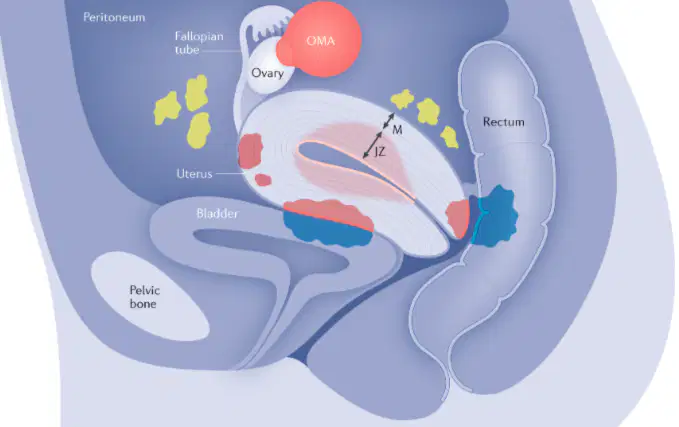
Which recess is located between the pubic bone and the bladder?
Space of Retziu
rectouterine pouch
vesicouterine pouch
Morrisons pouch
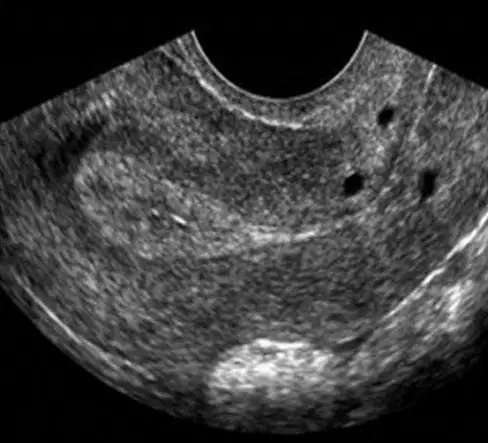
What is the most common lesion of the cervix? This lesion usually results from chronic cervicitis or an obstructed transcervical gland.
Swiss cheese or honeycomb lesion
Nabothian cyst aka Epithelial inclusion cyst
Gartner duct cyst
chocolate cyst
What is the most common Gynecologic tumor of the uterus mostly seen in 30yo African women, composed of smooth muscle cells arranged in a whorl-like pattern & is also estrogen dependent?
Endometriosis
Leiomyoma aka fibroids
Adenomyosis
AVMS
what is the most common cause of uterine calcifications?
Leiomyomas (fibroids)
monckeberg arteriosclerosis
endometrial hyperplasia
Adenomyosis
Which of the following is a benign disease where ectopic tissue invades the myometrium described on ultrasound as swiss cheese or honeycomb pattern?
fibroids
Adenomyosis
endometriosis
Theca luteal cyst
Which of the following is a common condition where ectopic endometrial tissue is found almost anywhere in the pelvis, is referred to as a chocolate cyst.
Gartner cyst
stromal tumor
Endometriosis or Endometrioma
Granulosa
Which of the following is known as intrauterine adhesions that form after trauma or surgery especially in curettage, that can lead to infertility and miscarriages?
none of the above
endometrial carcinoma
Synechia or Asherman syndrome
Endomitrial hyperplasia
Which of the following is the most common gynecologic malignancy in north America mostly seen in postmenopausal women, may arise from endometrial hyperplasia
Adenomyosis
Endometrial carcinoma or Adenocarcinoma
Nabothian cyst
chocolate cyst
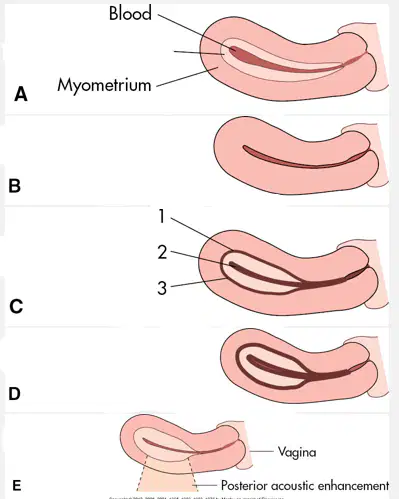
which endometrial phase is E.?
luteal
Secretory
proliferative phase
menstrual phase
when only the body and the fundus of the uterus are flexed posteriorly it is
Anteflexed
anteverted
retroflexed
retroverted
The failure of fusion that has two vaginas, two cervices, two uterine bodies is known as?
bicornuate uterus
didelphys uterus
bicornis unicollis uterus
arcuate uterus
The area of attachment of the fallopian tubes to the uterus is the:
Fundus
corpus
Isthmus
Cornua
The recesses of the vagina are the:
Cornu
isthmi
Fornices
Parity
The location of a fibroid within the myometrium is termed:
subserosal
intracavitary
intramural
submucosal
which of the following would typically not be associated with amenorrhea?
asherman syndrome
polycystic ovarian syndrome
pregnancy
adenomyosis
All of the following are associated with acute pelvic pain except:
Pelvic inflammatory disease
Ruptured ovarian hemorrhagic cyst
Perforated intrauterine contraceptive device
Asherman syndrome
which of the following would most likely be associated with hirsutism?
polycystic ovarian syndrome
Meigs syndrome
Adenomyosis
Adenomyomatosis
What artifact would be seen posterior to a tooth within a cystic teratoma?
Ring-down
Reverberation
Trough transmission
Shadowing
Both the straight and spiral arteries are branches of the:
Common iliac artery
Radial artery
arcuate artery
external iliac artery
The anterior cul-de-sac is also refered to as the:
Space of retzuis
Rectouterine pouch
Pouch of douglas
Vesicouterine pouch
What is the relationship of the lesser pelvis to the greater pelvis?
located more inferiorly
located more laterally
located more anteriorly
located more superiorly
What part of the cervix is closest to the vagina
Internal os
internal canal
adventitia
External os
Arcuate artery calcification of the uterus is less commonly caused by underlying disease such as diabetes, hypertension, chronic renal failure these calcifications are termed:
Arteriovenous malformations
Cervical stenosis
Monckeberg arteriosclerosis
Adenomyosis
All of the following are associated with small fluid collections in the endometrium except:
Recent abortions
Ectopic pregnancy
Endometritis
Imperforate hymen
which of the following is associated with the "whirlpool sign"?
Ovarian Torsion
Hyrdosalpinx
OHS
Ovarian carcinoma
The ovarian cyst that are often bilateral & associated with high levels of hCG are the:
Corpus luteum cyst
paraovarian cyst
granulosa cysts
theca lutein cysts
The cystic mass commonly seen with pregnancy is the:
Corpus luteum
Dermoid cyst
dysgerminoma
serous cystadenoma
The most common benign ovarian tumor:
Cystic teratoma
mucinous cystadenoma
fibroma
sertoli-leydig cell tumor
With what ovarian tumor is meigs syndrome most likely associated with?
Dysgerminoma
Cystic teratoma
Fibroma
Yolk sac tumor
What ovarian tumor will most likely have a moth-eaten appearance on ultrasound?
Cystic teratoma
Serous cystadenocarcinoma
Krukenberg tumor
Sertoli-leydig tumor
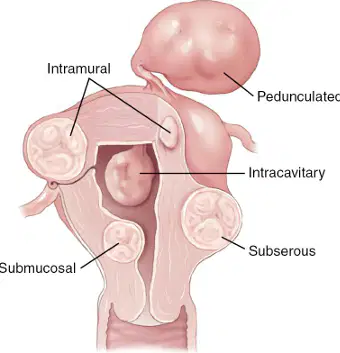
A leiomyoma that deforms the endometrial cavity and may cause irregular or heavy menstrual bleeding is known as:
Pedunculated fibroid
subserosal fibroid
Submucosal fibroid
intramural fibroid
What is the most common hormone active estrogen tumor of the ovary that resembles the graafin follicle. Common after menopause it is a feminizing tumor though leading to precocious puberty?
mucinous cystadenoma
dysgerminoma
Granulosa
Thecoma

