
 Worksheets
QUIZ ON URINE VOLUME & RHEUMATOLOGY
Total questions: 26
Worksheet time: 26mins
Mr. John, a 68 yr old male, complained of chronic right knee pain & stiffness for 2 years, worse with activity & improved with rest. He has hypertension, diabetes & leads a sedentary lifestyle. He is obese (BMI of 31). His right knee shows varus deformity, crepitus, reduced range of motion, & tenderness. Investigations such as X-ray showed decreased right knee joint space, laboratory studies were done with normal ESR, CRP and rheumatoid factor was negative. He was diagnosed with primary osteoarthritis of the right knee. What will be the other finding in the X-ray for this patient?
BONY EROSIONS
OSTEOPHYTES
SOFT TISSUE SWELLING
ANKYLOSIS / FUSION
Mr. Ahmad Bin Ismail, a 62-year-old man with Stage 3 CKD secondary to diabetes & hypertension, has a blood pressure reading of 150/95 mmHg on his current medications.
Which of the following antihypertensive agents is preferred to help slow CKD progression in this patient?
METOPROLOL
VERAPAMIL
ENALAPRIL
HYDROCHLOROTHIAZIDE
Mr. John, a 34 years old man presents with low back pain and stiffness of 3 years duration. He started having lower central back pain 3 years ago. No history of lifting weights. It has become progressively worse, needing higher doses of analgesics. The pain worsens in the early morning before he gets up from bed associated with stiffness which lasts for an average of 1.5 to 2 hours before it improves gradually by the evening. His wife also notices that his posture has changed over the past few months, being more stooped.
What type of joint pain does Mr John have?
INFLAMMATORY
DEGENERATIVE
INFECTION
MALIGNANCY
A 75-year-old man presents to the emergency department after being found in an acutely confused state by his family. Whilst taking a collateral history, his wife states that he has been suffering from a 3-day bout of suspected diverticulitis, for which he was prescribed oral amoxicillin in the community. The wife is concerned that her husband has not passed urine in the past 12 hours. Observations are taken, which reveal a heart rate of 88 bpm, a BP of 111/82 mmHg, and a temperature of 37.9 ºC. He has a past medical history of hypertension and atrial fibrillation.
What medication should be stopped?
AMOXICILLIN
ATORVASTATIN
BISOPROLOL
LOSARTAN
A 32-year-old woman presents to the clinic with a 6-month history of joint pain, fatigue, and intermittent low-grade fever. She complains of morning stiffness lasting over an hour, which improves with movement. On examination, she has swelling and tenderness in the metacarpophalangeal (MCP) and proximal interphalangeal (PIP) joints bilaterally. Laboratory results reveal positive rheumatoid factor and anti-cyclic citrullinated peptide (anti-CCP) antibodies, with a mildly elevated ESR and CRP.
Which of the following is the most appropriate next step in management?
Start high-dose oral corticosteroids as monotherapy
Refer for joint aspiration and delay treatment until synovial fluid analysis is available
Initiate a disease-modifying anti-rheumatic drug (DMARD) such as methotrexate
Reassure the patient and advise lifestyle modifications without medication
A 70-year-old woman with diabetes and hypertension is admitted for treatment of sepsis secondary to a UTI. On admission, her serum creatinine was 85 µmol/L. After 3 days of treatment, her creatinine rises to 190 µmol/L, and her urine output has decreased to 0.4 mL/kg/hour. She is alert but mildly hypotensive (BP 95/60 mmHg). Her medications include metformin, perindopril, and ceftriaxone.
What is the most appropriate next step in management of her AKI?
Continue perindopril and start intravenous fluids
Stop perindopril and optimize fluid resuscitation
Initiate emergency dialysis
Start intravenous loop diuretics to increase urine output
A 48-year-old woman presents with progressive muscle weakness over the past 2 months. She has difficulty climbing stairs and raising her arms above her head. On examination, she has a heliotrope rash around her eyes and violaceous papules over her knuckles. Muscle power is reduced symmetrically in the proximal limbs. Laboratory tests reveal elevated creatine kinase (CK) and positive anti-Mi-2 antibodies.
What is the most appropriate next step in her management?
Start high-dose corticosteroids
Refer for electromyography (EMG)
Screen for underlying malignancy
Begin physiotherapy
Prescribe topical steroids for rash
A 60-year-old man with end-stage renal disease presents for his routine dialysis. He has an AV fistula in his left forearm. During the session, he complains of nausea, headache, & confusion. On examination, he is hypertensive & disoriented.
Which complication is he most likely experiencing?
Peritonitis
Dialysis disequilibrium syndrome
Hypotension
AV fistula thrombosis
An 80 year old lady presented with a 6 month history of stiffness in her hand, bilaterally. This stiffness gets worse in the morning and quickly subsides as the patient begins daily activities. She has no other significant medical problems. On examination the patient has bilateral bony swellings at the margins of the distal interphalangeal joints on the (2nd-5th) digits. No other abnormalities were found on the physical examination.
These swellings represent?
Heberden’s nodes
Bouchard's nodes
Synovial thickenings
Subcutaneous nodules
A 62 year-old man presents with shortness of breath which came on suddenly during the night. He has noticed a wheeze, but no cough or sputum. He has end-stage kidney disease due to diabetic nephropathy, he is anuric and has been on haemodialysis for 2 years and is due his regular dialysis session the next day. His observations are: temp 37.6°C, SaO, 88% on FiO, 35%, pulse 120 bpm, BP 178/100 mmHg. What is the most likely cause of his shortness of breath?
Acidosis due to renal failure
Exacerbation of obstructive airways disease
Pleural effusion
Pulmonary oedema
Renal anaemia
A 50 year old man has a swollen right foot which is red,hot and tender when he puts his socks on. He cannot recall injury to the foot or any other provoking factors. His social history indicates that he smokes 15 cigarettes a day and drinks 40 units of alcohol per week. Which one of the following is the most appropriate treatment for this man?
Colchicine
Allopurinol
Morphine
Indomethacin
Amoxicillin
A 2-year-old boy is brought to the clinic with a high-grade continuous fever, chills and rigor, wet cough, facial swelling, and decreased urine output. On examination, pitting edema is noted on both legs.
Laboratory investigations reveal proteinuria, hypoalbuminemia, low serum C3 levels, prolonged APTT, elevated urine protein/creatinine ratio, and hyperlipidemia.
Which of the following is the most likely diagnosis?
Minimal change disease
Post-streptococcal glomerulonephritis (PSGN)
Nephrotic syndrome with secondary infection
Hemolytic uremic syndrome (HUS)
Acute interstitial nephritis
A 25-year-old woman presents with a one week history of fatigue, fever and sharp right sided chest pain, which is worse on inspiration. She also complains of intermittent join pain in her hands which has been present for approximately 4 months. On examination there is mild erythema over her cheeks.
Which of the following investigations is the most sensitive for this condition?
ANA
c-ANCA
Anti-dsDNA
Antistreptolysin O titre
Rheumatoid factor
A 64-year-old man with ESRD has been on hemodialysis for 1 year. He now reports no urine output for several months. His dialysis sessions are otherwise stable, and volume status is well controlled. What is the most likely reason for his anuria?
Hemodialysis decreases glomerular filtration pressure permanently
Hemodialysis gradually reduces residual kidney function over time
Chronic dialysis suppresses the release of antidiuretic hormone
Anuria occurs due to obstructive uropathy in most HD patients
A 12y/o boy presents to the clinic by his parents with facial puffiness & decreased urine output over the past 2 days. It was noted that he recovered from a sore throat about 1 week ago. Upon examination, he has mild hypertension and periorbital edema. A urinalysis was conducted & results indicated mild proteinuria, hematuria, & presence of RBC casts.
Which lab value would be expected to be normal/mildly affected in nephritic syndrome, as opposed to nephrotic syndrome?
Serum creatinine
Serum albumin
Serum urea
Urine RBC count
A 28-year-old man presents with lower back pain and stiffness that improves with exercise but not with rest. On examination, there is reduced lumbar spine flexion. Which of the following is most likely to be positive in this patient?
Anti-dsDNA antibody
HLA-B27 antigen
Rheumatoid factor
Anti-CCP antibody
A 70-year-old man complains of fever and pain in his left knee. Several days previously, he suffered an abrasion of his knee while working in his garage. The knee is red, warm, and swollen. An arthrocentesis is performed, which shows 200,000 leukocytes/µL and a glucose of 20 mg/dL. No crystals are noted. Which of the following is the most important next step?
Gram stain and culture of joint fluid
Urethral culture
Uric acid level
Antinuclear antibody
Antineutrophil cytoplasmic antibody
A 55-year-old man has been admitted and is being treated for a pneumonia. He is currently receiving co-amoxiclav treatment. He also takes losartan for hypertension & metformin for T2DM (both well controlled). Recent observations reveal his heart rate to be 130 bpm and his blood pressure has dropped to 90/60 mmHg. His urine output has been decreasing and he has only produced 10 mL of urine over the past hour. Fluid resuscitation is initiated and blood tests reveal the following results.
Urea 14 mmol/L (2.0 - 7.0)
Creatinine 260 µmol/L (55 - 120)
What is the most appropriate action regarding his medication?
Continue metformin
Start gentamicin
Stop losartan
Swap losartan for amlodipine
Swap losartan for enalapril
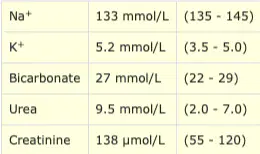
A 45-year-old woman presents to her GP with a history of fever and rash. The symptoms have worsened during the day, and she has been unable to pass only a small amount of urine. She has a medical history of HIV with undetectable viral load and chronic back pain. She suffered from a sore throat in the last week. She is immediately transferred to the ED, where blood tests show the above:
Urinalysis shows an increased number of white blood cells due to a rise in eosinophils.
What is the most likely diagnosis?
Acute interstitial nephritis
Focal segmental glomerulosclerosis
IgA nephropathy
Post-streptococcal glomerulonephritis
Rapidly progressive glomerulonephritis
A 25-year-old male patient presents with symptoms of right knee pain starting 2 days ago. He also complains of a burning sensation when he urinates, with no blood or frothy urine. On examination, his temperature was 36℃, BP was 126/87mmHg. His eyes are red with no conjunctival pallor. What is the most likely diagnosis of this patient?
Ankylosing spondylitis
Septic arthritis
Gout
Reactive arthritis (Reiter’s syndrome)
A 46 year old malay gentleman, who has been on continuous ambulatory peritoneal dialysis for the past 2 years, is presenting with complains of abdominal pain and fever. It is associated with mild diarrhea and bloating of the abdomen. After peritoneal dialysis the collected fluid was found to be cloudy. The PD fluid white cell count was 850/mm^3. What is the most likely causative organism?
Escherichia Coli
Coagulase Positive Staphylococcus
Coagulase Negative Staphylococcus
Mycobacterium Tuberculosis
A 69-year-old woman presents to the A&E with sudden onset pain and swelling in her left knee. She has HTN and hypercholesterolaemia. She is currently taking aspirin, ramipril and simvastatin. On examination, her right knee is swollen, has a reduced range of motion due to the swelling and pain. What is the most likely diagnosis?
Osteoarthritis
Reactive arthritis
Pseudo-gout
Gout
Septic arthritis
A 30-year-old woman presents with symmetrical arthritis, malar rash, photosensitivity, and oral ulcers. Labs show positive ANA and anti-dsDNA.
Which of the following diagnoses is most likely?
Rheumatoid arthritis
Systemic lupus erythematosus
Psoriatic arthritis
Ankylosing spondylitis
A 35-year-old woman presents with excessive thirst and frequent urination for 2 months. She reports drinking over 5 liters of water per day and wakes up multiple times at night to urinate. Her blood glucose is normal. On further testing, her urine osmolality remains low despite fluid restriction. After administration of desmopressin, her urine osmolality increases significantly.
What is the most likely diagnosis?
Primary polydipsia
Central diabetes insipidus
Nephrogenic diabetes insipidus
Diabetes mellitus
Acute kidney injury
A 42-year-old woman presents with a 6-month history of joint pain affecting her wrists and fingers. She reports morning stiffness lasting over an hour that improves with activity. On examination, there is bilateral swelling and tenderness over the metacarpophalangeal (MCP) and proximal interphalangeal (PIP) joints. Laboratory findings shows positive Rheumatoid factor and Anti-CCP antibodies. ESR and CRP are elevated
Which of the following best explains the joint damage seen in this condition?
Crystal deposition in the synovial fluid causing neutrophilic inflammation
CD8+ T-cell–mediated destruction of cartilage and subchondral bone
Chronic synovial inflammation with pannus formation eroding cartilage and bone
Mechanical wear and tear causing loss of articular cartilage
(AUTONOMY)
A 45-year-old woman with early-stage breast cancer refuses surgery, stating she prefers to pursue alternative treatments. She is alert, oriented, and demonstrates understanding of her diagnosis and prognosis.
What is the most appropriate response by the doctor?
Persuade her by emphasizing that surgery offers the best chance of cure
Educate the patient first on the pros and cons of each treatment options, respect her decision and document the discussion
Involve her family to convince her to reconsider
Seek a psychiatric evaluation to assess her judgment

