
Font size
 Worksheets
HBC_Vocab_PartA
Total questions: 66
Worksheet time: 33mins
Fill in the blank: The absolute value of a number is its ______ from zero on the number line.
distance
direction
color
shape
What is the absolute value of -3?
3
-3
0
1
The addition property of equality states: If a = b, then a + c = b + ___
c
a
b
0
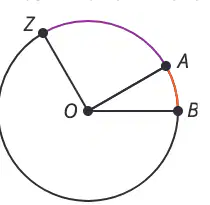
What are adjacent arcs?
Adjacent arcs are two arcs of the same circle sharing a common endpoint.
Adjacent arcs are two arcs of different circles that do not touch.
Adjacent arcs are two arcs that have no common points.
Adjacent arcs are two arcs that form a straight line.
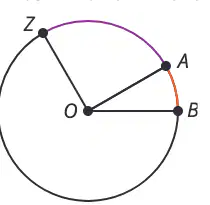
In the given diagram, which arcs are adjacent arcs?
ZA and AB
ZA and BC
AB and BC
ZA and AC
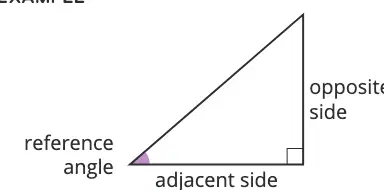
What is the adjacent side of a triangle?
The adjacent side of a triangle is the side next to to the reference angle that is not the hypotenuse.
The adjacent side of a triangle is always the longest side.
The adjacent side of a triangle is the side opposite to the reference angle.
The adjacent side of a triangle is the same as the hypotenuse.
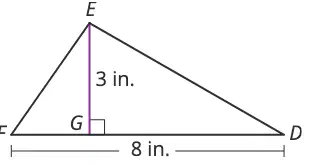
What is an altitude in a triangle?
An altitude is a line segment perpendicular to the line containing the opposite side and has one endpoint at the opposite vertex.
An altitude is a line segment that bisects the angle at the vertex.
An altitude is a line segment that connects the midpoints of two sides.
An altitude is a line segment that is parallel to one side of the triangle.
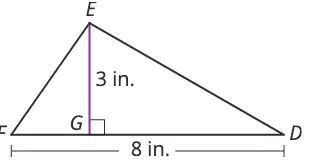
In the triangle diagram, which segment is the altitude?
EG
EF
FG
EH
What is an angle?
A set of points consisting of a vertex point and two rays extending from the vertex point.
A straight line with no endpoints.
A closed figure with three or more sides.
A curve that does not touch itself.
What is the angle of incidence?
The angle formed by the incidence ray and a line perpendicular to the surface of a mirror.
The angle formed by the reflected ray and the surface of a mirror.
The angle formed by the incidence ray and the surface of a mirror.
The angle formed by the reflected ray and a line parallel to the surface of a mirror.
What is the angle of reflection?
The angle formed by the reflected ray and a line perpendicular to the surface of a mirror.
The angle formed by the incident ray and the surface of a mirror.
The angle formed by the incident ray and the reflected ray.
The angle formed by the reflected ray and the surface of a mirror.
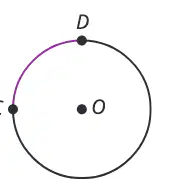
What is an arc?
A part of the circumference of a circle and is the curve between two points on the circle.
A straight line passing through the center of a circle.
A point outside the circle.
A polygon with three sides.
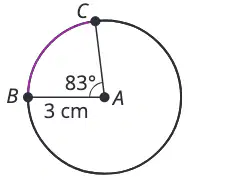
What is the formula for the arc length of a circle?
2πr
πr2
2πr · (x°/360°)
r2/2
The number of square units needed to cover a two-dimensional shape or the surface of an object is called the _____.
area
volume
perimeter
length
In the function f(x + 5) = 32, what is the argument?
x
x + 5
32
f
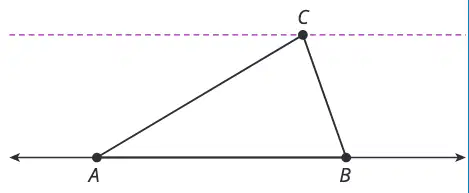
An auxiliary line is a line or line segment added to a diagram to help in solving or proving a concept.
True
False
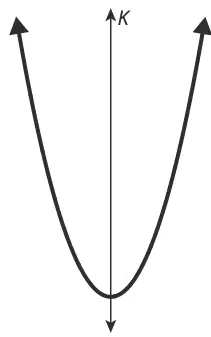
The axis of symmetry of a parabola is the vertical line that passes through the vertex and divides the parabola into two mirror images.
True
False
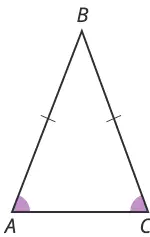
What are the base angles of an isosceles triangle? (Refer to the diagram of triangle ABC)
The base angles of an isosceles triangle are the angles between the base and the congruent sides of the triangle. In triangle ABC, angles A and C are the base angles.
The base angles of an isosceles triangle are the angles between the congruent sides only. In triangle ABC, angles B and C are the base angles.
The base angles of an isosceles triangle are the angles opposite the congruent sides. In triangle ABC, angles A and B are the base angles.
The base angles of an isosceles triangle are the angles adjacent to the base. In triangle ABC, angles B and C are the base angles.
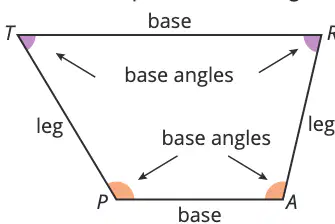
What are the base angles of a trapezoid?
The base angles of a trapezoid are either pair of angles that share a base as a common side. In trapezoid PART, angle T and angle R are one pair of base angles, and angle P and angle A are another pair.
The base angles of a trapezoid are the angles that are opposite each other.
The base angles of a trapezoid are always right angles.
The base angles of a trapezoid are the angles that are adjacent to the non-parallel sides.
What is a binomial? Give an example.
A binomial is a polynomial with exactly two terms. Example: 3x + 5 is a binomial.
A binomial is a polynomial with only one term. Example: 7x is a binomial.
A binomial is a number that can only be divided by 2. Example: 4 is a binomial.
A binomial is a polynomial with three terms. Example: x2+2x+1 is a binomial.
What is categorical data (qualitative data)?
Data that fit into exactly one of several different groups or categories
Data that can be measured on a numerical scale
Data that is always quantitative
Data that cannot be grouped
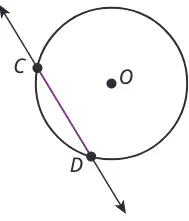
A chord is a line segment whose endpoints are points on a _______.
circle
triangle
square
rectangle
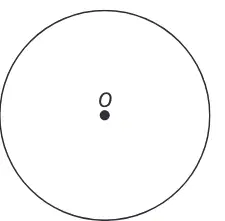
What is the name of the collection of points on the same plane equidistant from the same point?
Chord
Circle
Centroid
Segment
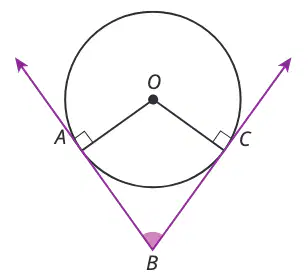
A circumscribed angle has its two sides tangent to a _______.
circle
square
triangle
rectangle
When you perform an operation on any of the numbers in a set and the result is a number that is also in the same set, the set is said to be _______ under that operation.
closed (or has closure)
open
finite
commutative
Two line segments are _______ when they lie exactly on top of each other.
coincident
parallel
perpendicular
intersecting
Two angles are complementary angles when the sum of their angle measures is equal to ____.
90°
180°
60°
120°
A compound inequality combines two simple inequalities, using the word ____ or the word ____.
and, or
if, then
but, so
when, because
Completing the square is a process for writing a quadratic expression in ____ form, which then allows you to solve for the zeros.
vertex
standard
factored
linear
The set of complex numbers is the set of all numbers in the form ____ where a and b are real numbers.
a + bi
a - bi
ab + i
a2+b2
A conclusion is the '____' part of an 'if-then' statement.
then
if
only
when
Fill in the blank: A _______ statement is a statement written in the form 'If p, then q.'
conditional
biconditional
converse
inverse
Fill in the blank: A _______ is a mathematical statement that appears valid but you need to formally prove.
conjecture
theorem
axiom
corollary
Fill in the blank: To state the _______ of a conditional statement, interchange the hypothesis and the conclusion.
converse
inverse
contrapositive
biconditional
Fill in the blank: _______ parts are sides or angles that have the same relative positions in geometric figures.
Corresponding
Vertical
Alternate
Adjacent
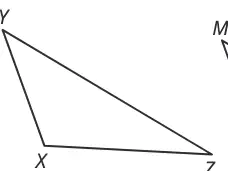
What does CPCTC stand for in geometry?
Corresponding Parts of Congruent Triangles are Congruent
Congruent Parts of Corresponding Triangles are Congruent
Congruent Parts of Congruent Triangles are Corresponding
Corresponding Parts of Congruent Triangles are Corresponding
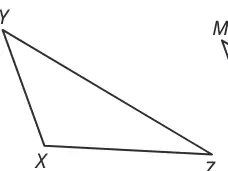
Fill in the blank: According to CPCTC, if ΔXYZ ≅ ΔLMN, then ∠X ≅ ___.
∠L
∠M
∠N
∠Y
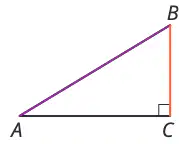
What is the formula for the cosine (cos) of angle A in a right triangle?
length of side opposite ∠A / length of hypotenuse
length of side adjacent to ∠A / length of hypotenuse
length of hypotenuse / length of side adjacent to ∠A
length of side adjacent to ∠A / length of side opposite ∠A
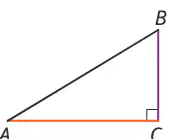
Fill in the blank: The cosecant (csc) of angle A is defined as the ratio of the length of the hypotenuse to the length of the side ______ the angle.
opposite
adjacent
next to
below
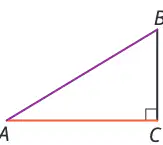
What is the formula for cotangent (cot) of angle A in a right triangle?
length of side opposite ∠A / length of hypotenuse
length of side adjacent to ∠A / length of side opposite ∠A
length of hypotenuse / length of side adjacent to ∠A
length of side adjacent to ∠A / length of hypotenuse
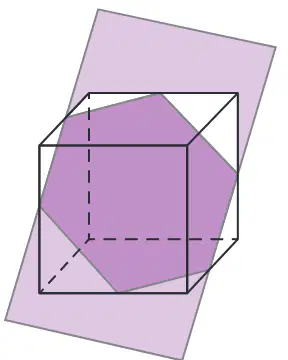
A cross-section of a solid is the two-dimensional figure formed by the intersection of a plane and a solid when a plane passes through the solid. When a plane intersects a cube through all six faces, the cross-section is a ________.
hexagon
square
triangle
pentagon
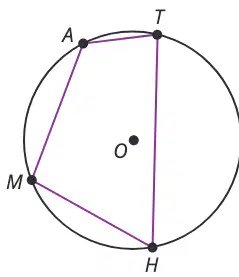
A cyclic quadrilateral is a quadrilateral whose vertices all lie on a single ________.
circle
triangle
square
line
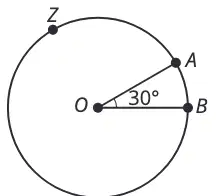
The degree measure of a minor arc is equal to the degree measure of its central angle. If the measure of minor arc AB is 30°, what is the measure of major arc BZA in the circle?
330°
30°
60°
180°
What is the greatest exponent for any variable term in a polynomial called?
degree of a polynomial
coefficient of a polynomial
constant of a polynomial
term of a polynomial
A diagonal is a line segment joining two non-consecutive vertices of the polygon.
True
False
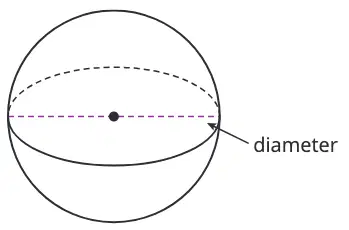
What is the diameter of a sphere?
The diameter of a sphere is a line segment with each endpoint on the sphere that passes through the center of the sphere.
The diameter of a sphere is the distance around the sphere.
The diameter of a sphere is the area of the sphere's surface.
The diameter of a sphere is the volume inside the sphere.
The difference of two squares is an expression in the form a^2 - b^2 that you can factor as (a+b)(a−b) .
True
False
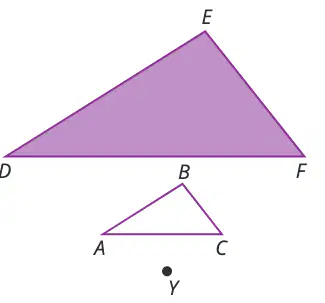
A dilation is a transformation of the figure in which the figure stretches or shrinks with respect to a fixed point, or center of dilation.
True
False
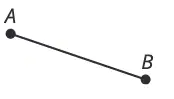
What is a directed line segment? Provide an example.
A directed line segment is assigned a direction from one endpoint to the other. Example: Directed line segment AB is mathematically different from directed line segment BA.
A directed line segment is a line with no endpoints and no direction. Example: Line AB is the same as line BA.
A directed line segment is a segment that can only be drawn vertically. Example: AB must be a vertical segment.
A directed line segment is a segment that has equal length regardless of direction. Example: AB and BA are always the same.
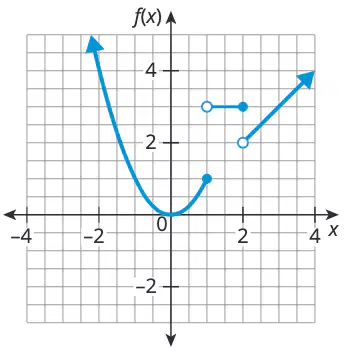
What is a discontinuous graph? Provide an example.
A discontinuous graph is a graph that is continuous for some values of the domain with at least one disjoint area between consecutive x-values. Example: The graph shown is a discontinuous graph.
A discontinuous graph is a graph that is always increasing and never has any breaks. Example: The graph shown is a discontinuous graph.
A discontinuous graph is a graph that is continuous for all values of the domain with no breaks. Example: The graph shown is a discontinuous graph.
A discontinuous graph is a graph that only has straight lines and no curves. Example: The graph shown is a discontinuous graph.
What is the discriminant in the Quadratic Formula? Provide an example.
The discriminant is the radicand expression in the Quadratic Formula that 'discriminates' the number of real roots of a quadratic equation. Example: The discriminant in the Quadratic Formula is the expression b2−4ac .
The discriminant is the sum of the coefficients in the Quadratic Formula. Example: The discriminant is a + b + c.
The discriminant is the product of the roots of the quadratic equation. Example: The discriminant is x1 * x2.
The discriminant is the denominator in the Quadratic Formula. Example: The discriminant is 2a.
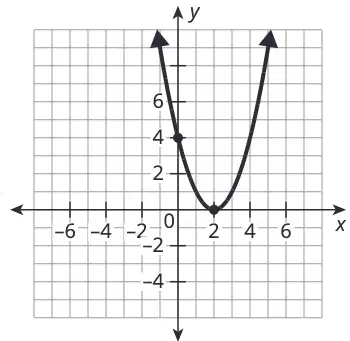
What is a double root in the context of a quadratic equation?
A double root occurs when the graph just touches the x-axis but does not cross it.
A double root occurs when the graph crosses the x-axis at two distinct points.
A double root occurs when the graph never touches the x-axis.
A double root occurs when the graph oscillates above and below the x-axis.
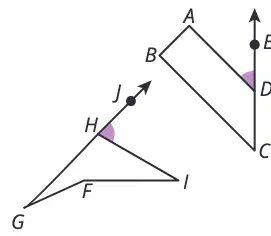
What is an exterior angle of a polygon? Example: Angle JHI is an exterior angle of Quadrilateral FGHI. Angle EDA is an exterior angle of Quadrilateral ABCD.
An exterior angle of a polygon is an angle that forms a linear pair with an interior angle of the polygon.
An exterior angle of a polygon is an angle found only inside the polygon.
An exterior angle of a polygon is always a right angle.
An exterior angle of a polygon is the sum of all the interior angles.
What is the process of removing all perfect square numbers from under the radical symbol called?
extract the roots
rationalizing the denominator
factoring the expression
completing the square
Fill in the blank: To simplify the root for 18 a ___ would get extracted from the radical.
3
2
6
9
A quadratic equation in the form f(x) = a(x − r₁)(x − r₂), where a ≠ 0, is in what form?
factored form
vertex form
standard form
expanded form
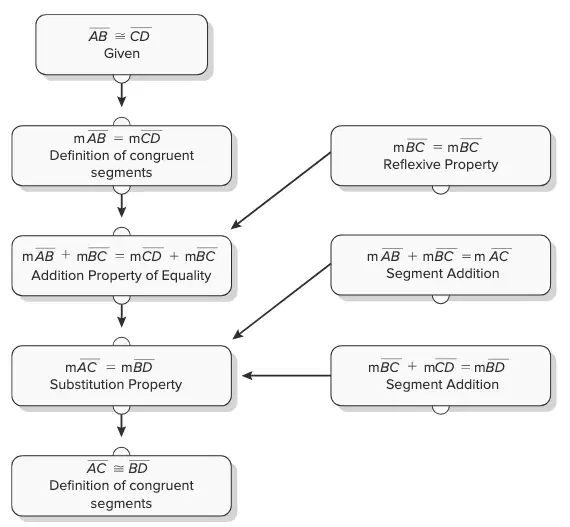
What property is used to go from mAB + mBC = mCD + mBC to mAC = mBD?
Substitution Property
Distributive Property
Transitive Property
Addition Property of Equality
What does a frequency table show?
The average of a set of numbers
The frequency of an item, number, or event appearing in a sample space
The sum of all numbers in a set
The probability of an event
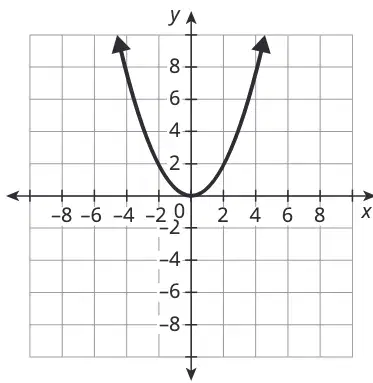
What is the general form of a parabola centered at the origin?
The general form of a parabola centered at the origin is Ax^2 + Dy = 0 or By^2 + Cx = 0.
The general form of a parabola centered at the origin is Ax + By = 0.
The general form of a parabola centered at the origin is Ax^2 + Bx + C = 0.
The general form of a parabola centered at the origin is Ax^2 + By^2 + C = 0.
What is the general form (standard form) of a quadratic function?
The general form (standard form) of a quadratic function is f(x) = ax2+bx+c , where a ≠ 0.
The general form (standard form) of a quadratic function is f(x) = ax^3 + bx^2 + c, where a ≠ 0.
The general form (standard form) of a quadratic function is f(x) = ax + b, where a ≠ 0.
The general form (standard form) of a quadratic function is f(x) = a/x + b, where a ≠ 0.
What is the geometric mean of 3 and 12?
6
9
4
7
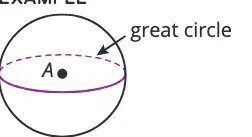
What is the great circle of a sphere?
The largest circle that can be drawn on a sphere
A cross-section of a sphere when a plane passes through the center of the sphere
The smallest circle on a sphere
The circle at the top of a sphere
The greatest integer function, also known as the floor function, is the greatest integer less than or equal to x. For f(x) = ⌊x⌋, if x = 3.16, f(x) = ____.
3
4
2
3.16
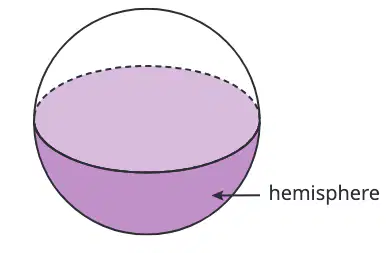
What is a hemisphere?
A hemisphere is half of a sphere bounded by a great circle.
A hemisphere is a type of triangle with three equal sides.
A hemisphere is a flat surface with no volume.
A hemisphere is a cube divided into two equal parts.
A hypothesis is the 'if' part of an 'if–then' statement. In the statement, “If the last digit of a number is a 5, then the number is divisible by 5,” what is the hypothesis?
If the last digit of a number is a 5.
The number is divisible by 5.
If the number is divisible by 5.
The last digit of a number is not 5.
The set of imaginary numbers is the set of all numbers in the form a + bi, where a and b are real numbers and b is not equal to 0. Which of the following is an imaginary number? Choose all that apply.
5
3 + 2i
7 - 0i
4i

