wayground logo

Free Printable Worksheets

NEW

Font size

S
M
L
XL
Worksheets

7th Grade Final Review (Units 1-5)

Total questions: 56

Worksheet time: 45mins

Name
Class
Date
1.
Name Continent A!
a)
North America
b)
Africa
c)
South America
d)
Europe
2.
Name Continent C!
a)
Antarctica
b)
Europe
c)
Asia
d)
Africa
3.

What river is highlighted on the map?

a)

Missouri River

b)

Rio Grande River

c)

Mississippi River

d)

Ohio River

4.
The set of beliefs, values, and practices that a group of people have in common.
a)
culture
b)
culture trait
c)
culture region
d)
culture diffusion
5.
What is the best title for the above map, which shows how the New World could have been settled over 10,000 years ago?
a)
The Transcontinental Railroad
b)
The Middle Passage 
c)
The Columbian Exchange 
d)
The Landbridge Theory 
6.
What two continents were connected by Beringia?
a)
Africa and Asia 
b)
Asia and North America
c)
Asia and Australia 
d)
South America and North America
7.
Land known to the Europeans as the Americans
a)
New World
b)
New York
c)
Caravel
d)
Voyage
8.
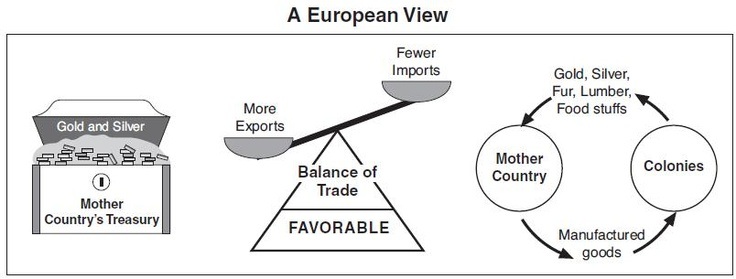
Settled in a new territory or land while the mother country maintains control 
a)
Colony 
b)
exploration 
c)
Mercantilism 
d)
economy 
9.
Mother countries growing wealthy via controlled trade with colonies 
a)
trade 
b)
stealing 
c)
colonies 
d)
Mercantilism 
10.
The exchange of new goods, resources and ideas between east and west is called...
a)
Columbian Exchange
b)
Triangle trade
c)
Westward Expansion
d)
The Exploration Revolution
11.
Goods left markets in Europe and were traded for slaves in Africa. Slaves were traded in the Americas for resources. Resources were brought back to Europe.
a)
Columbian Exchange
b)
Triangle Trade
c)
East/West Exchange
12.

Which of the following is a negative impact that the Columbian Exchange had on the native peoples of the Americas?

a)

The spread of disease killed millions of people.

b)

Agriculture spread to more regions.

c)

The use of the horse caused native peoples to leave.

d)

Native peoples were no longer allowed to use their languages.

e)

Europeans established global trade networks that brought maize to Europe, chili peppers to India, and wheat to the Americas.

13.

The impact of mercantilism was that

a)

The rate of slavery in the Americas went down

b)

Trade was limited in the Atlantic

c)

The Colony grew wealthy

d)

The Mother Country grew wealthy

14.
The thirteen colonies were ruled by what country?
a)
England
b)
Portland
c)
Ireland
d)
Cuba
15.

What was the climate of the Southern Colonies?

a)

Humid, hot summers with mild winters

b)

Cold winters and mild summers

c)

Warm, humid weather all year

d)

Rainy, cool summers and hot winters

16.

The South had ________ where cash crops were grown.

a)

Adobe homes

b)

Plantations

c)

Log Cabins

d)

Wigwams

17.
What is the Middle Passage?
a)
Water Route Through North America
b)
European slave trade with India
c)
European Slave trade with North America
d)
European slave trade with the Americas
18.
This restricted colonists to settle west of the Appalachian Mountains. 
a)
Proclamation of 1763
b)
Stamp Act of 1765
c)
Treaty of Paris 
d)
Proclamation of Moving
19.
The ____________ started because a British soldier standing guard hit a colonists during an argument. 
a)
Boston Massacre
b)
Boston Tea Party 
c)
French & Indian War
d)
Battle of Lexington 
20.
This famous engraving was drawn by Paul Revere to spread propaganda of what event? 
a)
The Boston Massacre
b)
The Boston Tea Party 
c)
The Battle of Lexington
d)
The Battle of Bunker Hill 
21.
Happened because colonists were upset about the new Tea Act. 
a)
Boston Massacre
b)
Boston Tea Party 
c)
Intolerable Acts
d)
1st Continental Congress
22.
Closed the port of Boston, canceled Massachusetts's charter, and increased colonists' anger at Britain. 
a)
Intolerable Acts
b)
Townshend Acts
c)
Proclamation of 1763
d)
Stamp Act of 1765
23.
Common sense was a pamphlet written by?
a)
Thomas Paine
b)
Thomas Jefferson
c)
John Adams
d)
Mercy Otis Warren 
24.
Group of patriots who protested British laws. 
a)
Sons of Liberty 
b)
1st Continental Army
c)
Minutemen
25.

A colonists opposing British rule is

a)

Ally

b)

minutemen

c)

delegate

d)

patriot

26.

A group of people refusing to buy, sell or use certain goods is called

a)

a boycott

b)

a rebellion

c)

a delegate

d)

an ally

27.
What was the common slogan used in the Colonies?
a)
"Give me liberty or Give me death"
b)
"No Taxation without Representation"
c)
"No Stamp Act, No Sugar Act"
28.

Who won the battles of Saratoga?

a)

Hessians

b)

British Army

c)

French Army

d)

Continental Army

29.

What was the name of the camp the Continental Army trained at during the winter of 1777-1778?

a)

Valley Gorge

b)

Valley Forge

c)

Valley Rabalais

d)

Valley Bender

30.

What army allied/helped the Continental Army after recognizing their independence?

a)

British Army

b)

French Army

c)

Grecian Army

d)

Polish Army

31.

Who was the commander of the Continental Army?

a)

Baron Friedrich von Steuben

b)

Alexander Hamilton

c)

George Washington

d)

Charles Cornwallis

32.

The study of the world and all that is in it, is the definition of ___________________

a)

geometry

b)

geography

c)

geosciences

33.
Which colonial region was settled by Puritans and Pilgrims seeking religious freedom?
a)
New England
b)
Southern
c)
Middle
d)
Backcountry
34.
Which colonial region contained rocky soil and cold climate?
a)
New England
b)
Middle
c)
Southern
d)
Backcountry
35.
How was the agreement which bonded Pilgrims called?
a)
Mayflower Compact
b)
Declaration of Independence
c)
Napoleonic Code
d)
Geneva Conventions
36.
Why were slaves needed in the Americas?
a)
To trade for rum
b)
To produce cash crops
c)
To trade for weapons from England
d)
None of the above
37.

What is mercantilism?

a)

A system where a mother countries gains money and power from natural resources that come from its colonies.

b)

where colonies trade gold and silver with each other.

c)

Wars that start over money.

d)

Plantation colonies trading slaves for money.

38.
Colonists who sided with the British. 
a)
Patriots
b)
Loyalists
c)
Neutralists 
39.

What was the first European country to settle in New York

a)

The English

b)

The Spanish

c)

The Dutch

d)

The French

40.

The Mayflower Compact and the Virginia House of Burgesses both were important because they

a)

Showed that even in the early days, colonies had a form of government

b)

They were really not important

c)

Showed that the colonists were ready to go to war

d)

Formed good relationships with Native American tribes

41.

Who would be able to vote in a British colony in the Americas?

a)

A 25 year old woman

b)

An African American male

c)

A white male who owned no property

d)

A white male who owned property

42.

What was the purpose of the Declaration of Independence?

a)

To make up with Great Britain

b)

To explain why the colonies wanted to separate from Great Britain

c)

To show that the colonists wanted to join Great Britain and fight France

d)

To encourage more British citizens to move to the New World

43.

What was one purpose of the Declaration of Independence?

a)

to establish a framework for government

b)

to express reasons for limiting immigration

c)

to state the reasons for the colonies to separate from England

d)

to list arguments for women’s suffrage

44.

to stop buying or using the goods or services of a certain company or country as a protest

a)

Boycott

b)

Taxation

c)

Quartering

d)

Grievance

45.
What was the significance of the pamphlet Common Sense? 
a)
It presented a convincing case for independence, using plain language.
b)
It counteracted the Great Awakening by arguing against religion.
c)
It clearly described how increased trade could benefit the colonies.
d)
It considered early arguments against using slave labor in America.
46.

In the American Revolution, which side had the advantage of fighting on home ground?

a)

America

b)

England

47.

In the American Revolution, which side had the advantage in military size?

a)

America

b)

England

48.

In the American Revolution, which side had the advantage of military power?

a)

America

b)

England

49.

What was the biggest Patriot advantage in the war?

a)

The Patriot soldiers had better training than the British soldiers

b)

They were fighting on their own land

c)

The Americans had the support of the Spanish

d)

They were equipped with better guns

50.

What were the strengths of the British Army?

a)

Powerful navy

b)

Well trained army

c)

a lot of money and resources

d)

All of the above

51.

Which of the following is most direct cause of the British applying the Stamp Act to the colonies?

a)

It was a punishment for the Boston Tea Party

b)

It was a punishment for earlier poor treatment of tax collectors

c)

It was intended to raise money to pay off debts from the French and Indian War

d)

It was intended to replace the failed Sugar Act

52.
"No taxation without representation" means?
a)
Colonists shouldn't be taxed if they had no one representing them in Parliament
b)
The representative can tax me
c)
Seize weapons right away
d)
None of the above
53.
_______ was an incident where British soldiers panicked and shot and killed five colonists in Boston.
a)
Stamp Act
b)
Boston Tea Party
c)
Quartering Act
d)
Boston Massacre
54.
_______ forced colonists to provide housing, food, and supplies for British troops.
a)
Stamp Act
b)
Boston Tea Party
c)
Quartering Act
d)
Boston Massacre
55.

The Albany Plan of Union was:

a)

An early attempt to unite the colonies

b)

A plan to declare independence

c)

A protest against British taxes

d)

An alliance between colonists and Native Americans

56.

Which battle is considered the turning point of the American Revolution due to French agreeing to help the colonists?

a)

Lexington and Concord

b)

Yorktown

c)

Saratoga

d)

Valley Forge