
Font size
 Worksheets
Motor 10
Total questions: 50
Worksheet time: 25mins
When replacing tubes in a water-tube auxiliary boiler, to eliminate the possibility of leaks at the tube seats, the replacement tubes should be __________.
stress relieved to ensure expansion when rolled
annealed to prevent cracking when rolled
fitted with a welded backing ring in the seat area
rolled, beaded, and seal welded around the bead edge
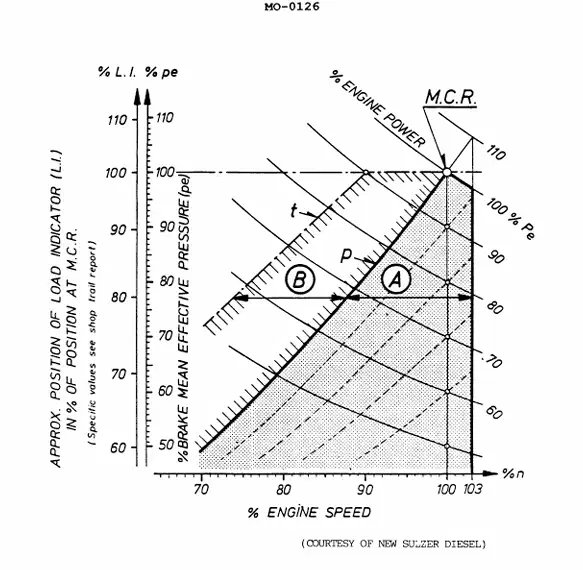
The diagram shown in the illustration may be used to determine the proper operation of the engine. Which of the following statements represents an accurate interpretation of the diagram?
The engine may be operated in any area of the diagram provided steps are taken to reposition the load indicator.
Operation within area "B" is permitted for extended time periods provided no changes are made to the air intake system.
Ideally the engine should be operated in area "A", however, it is permissible to intermittently operate the engine in area "B".
Assuming the load indicator reads 90% and the engine speed is at 80% the engine can be operated until maintenance requirements become apparent.
If the valve tappets in a diesel engine are set at greater clearances than those specified by the engine manufacturer, those valves will __________.
open late and close early
open late and close late
fail to open when the engine is cold
fail to open at normal operating temperature
What is to be installed on an internal combustion engine if its cylinder bore exceeds eight inches?
Crankcase vapor monitors
Engine exhaust silencers
Constant pressure type turbochargers
Explosion relief valves
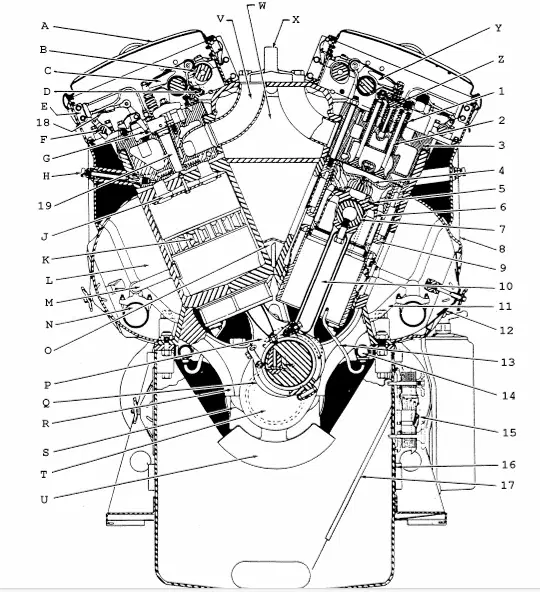
Component "F" shown in the illustration is called the __________.
camshaft adjusting screw
permadjust assembly
injector control shaft
cylinder head locking device
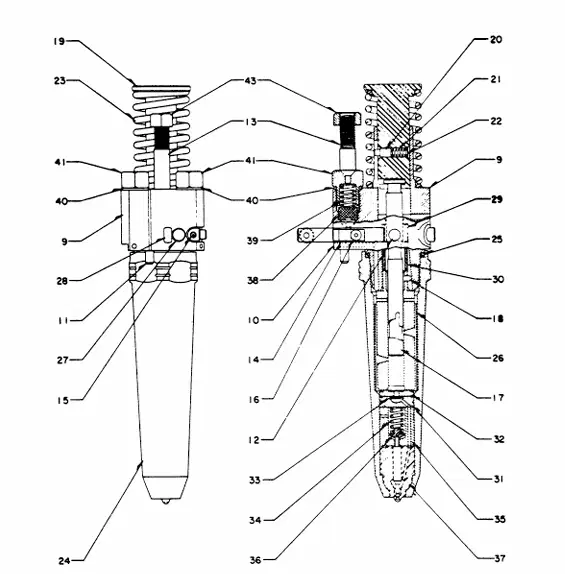
The fuel injector shown in the illustration is opened by fuel pressure acting upward on __________.
part #33
part #36
the needle valve
the plunger
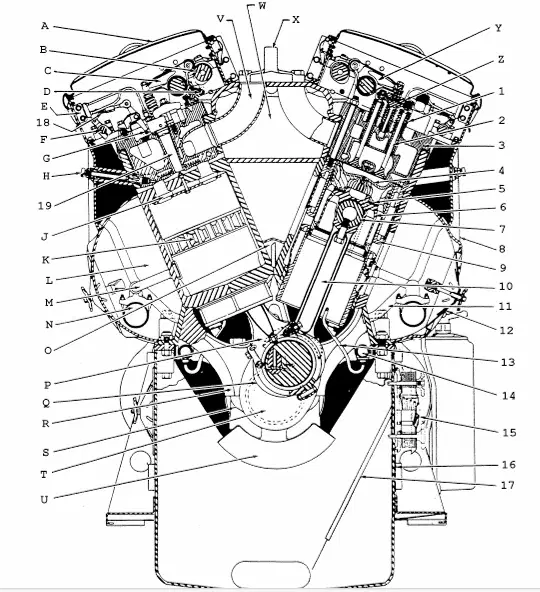
The fuel injector for the diesel engine shown in the illustration, is identified as __________.
"H"
"19"
"M"
"Z"
Control of the fuel oil metering valve in an automatically fired auxiliary boiler is accomplished by a __________.
pressure magnifying device in the steam coil outlet
steam pressure sensing device with linkage to the damper air vanes
metering device in the air supply line
signal from the feedwater electrode
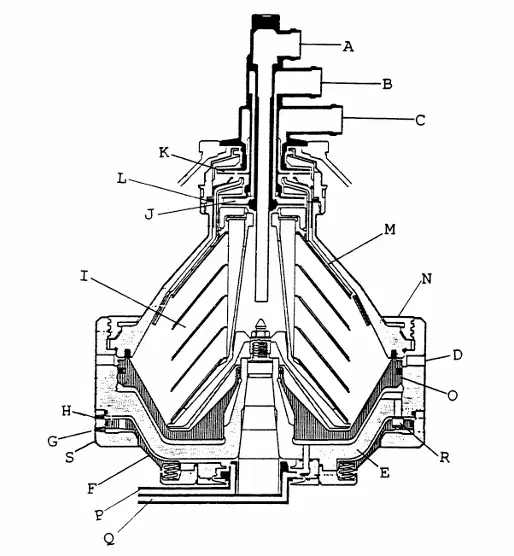
Part "G" of the device shown in the illustration is used __________.
to bleed off accumulated water that would prevent the operating slide from moving down
as the sole means for moving the operating slide into the reseated position
to externally discharge the sludge
solely to hydro-dynamically balance the bowl while in operation
Loss of lubricating oil pressure to the main propulsion diesel engine will actuate a/an __________.
overspeed trip
audible/visual alarm
the ships/boats general alarm
reserve oil storage tank
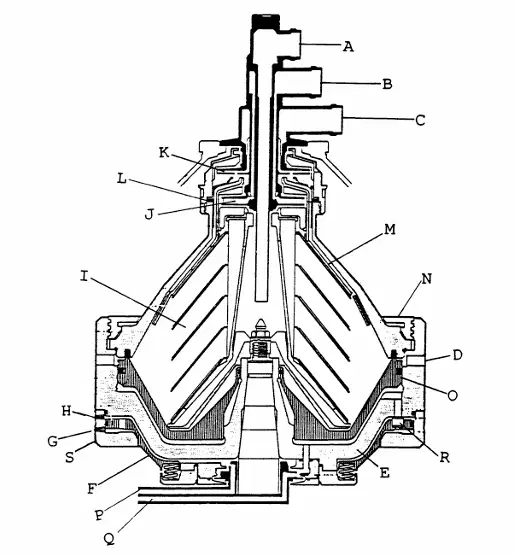
The temperature of contaminated heavy fuel oil fed to the centrifuge, shown in the illustration, should be at 95°C (203°F) to no greater than 99°C (210°F) in order to __________.
avoid vaporizing the water entrained in the fuel oil
prevent the fuel oil from attaining its flash point
prevent the melting of the tin plate on the bowl interior
avoid warping of the disks in the bowl
Constant capacity, pressure atomizing, fuel burners designed to meet a wide variation in steaming loads on an auxiliary boiler, are __________.
automatically supplied with warmer air on demand
automatically supplied with more fuel on demand
equipped with standard variable capacity atomizers
cycled on and off in response to steam demand
Theoretical perfect combustion in a diesel engine yields by-products of __________.
aldehydes and carbon dioxide
water vapor and carbon monoxide
nitrogen and carbon monoxide
water vapor and carbon dioxide
Air receivers installed in starting air systems are to be __________.
cylindrical in shape with service connections located at the top and bottom
opened and made available for inspection during biannual inspections
provided with automatic drain traps for the removal of moisture
so installed as to make the drain connections effective under extreme conditions of trim
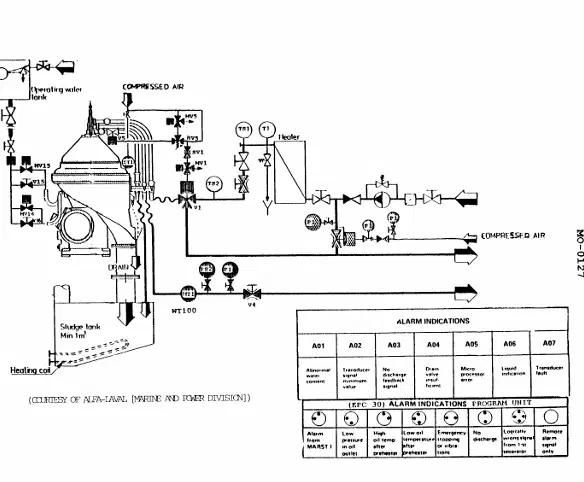
Which of the following precautions should be taken prior to starting the separator shown in the illustration?
Make sure the separator is properly assembled.
Check for the correct oil level in the gear housing.
Release the bowl brake and confirm proper valve line up.
All of the above are correct.
If control air systems are supplied from starting air receivers, the capacity of the receivers should be sufficient __________.
to provide for intermittent starting procedures
for continued operation of these systems after capacity for the required number of consecutive starts has been used
to provide a nonreversible engine a minimum of twelve consecutive starts
to enable six consecutive starts of a reversible engine
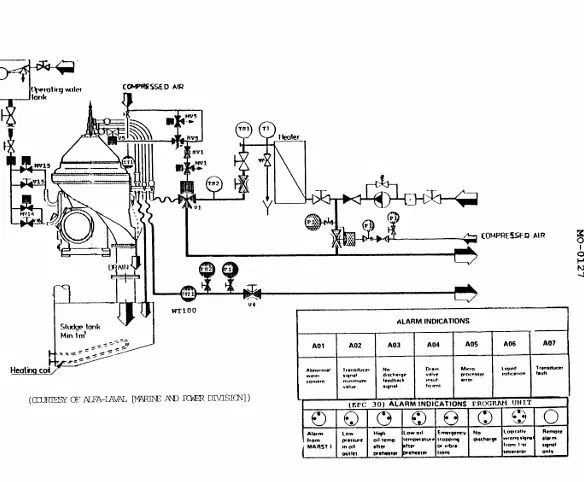
Which of the following statements represents the working principle of the water transducer used with the separator shown in the illustration?
The dielectric constant of the liquid flowing through the sensor increases with an increase in temperature.
As the water content in the oil increases, so does the dielectric constant and consequently its capacitive reactance.
The capacitor completes part of the inductive circuit which monitors pressure changes.
All of the above are correct.
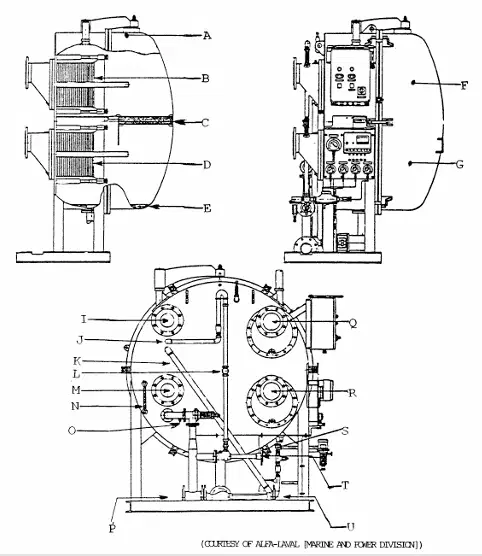
Line "K" shown in the illustration is the __________.
distillate pump suction
brine eductor suction
brine eductor inlet
feed water inlet
Which of the following operational conditions will occur to the diesel engine lube oil at extremely high temperatures?
The oil oxidizes and forms carbon deposits.
The viscosity increases.
Engine oil consumption decreases.
Lubricating qualities of the oil are enhanced.
In a diesel engine cooling system, the high temperature alarm contact maker will be activated on excessively high water discharge temperature from the __________.
raw water pump discharge
expansion tank outlet
cooling water heat exchanger outlet
engine jacket water outlet
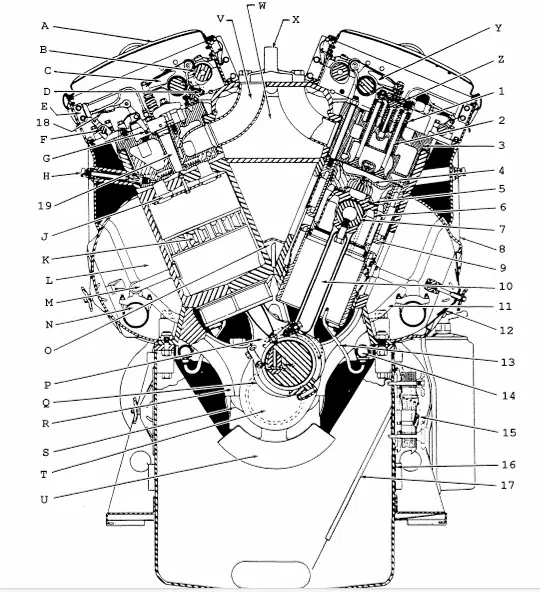
The device labeled "B", shown in the illustration rotates at __________.
one half the speed of the component labeled "10"
a speed not equal to that of the camshaft
the same speed of the device labeled "T"
the same speed of the device labeled "N"
The direct acting mechanical governor used with some small diesel engines, controls fuel flow to the engine by __________.
governor flyweight action on a pilot valve which controls fuel injection
governor flyweight motion acting on fuel controls through suitable linkage
positioning a butterfly valve in the fuel delivery system
positioning a servomotor piston attached to the fuel controls
A distorted furnace in a fire-tube auxiliary boiler may be the result of __________.
firing for extended periods in the low fire mode
overheating, due to waterside deposits
varying the water level above the crown sheet
carrying excessive alkalinity in the boiler water
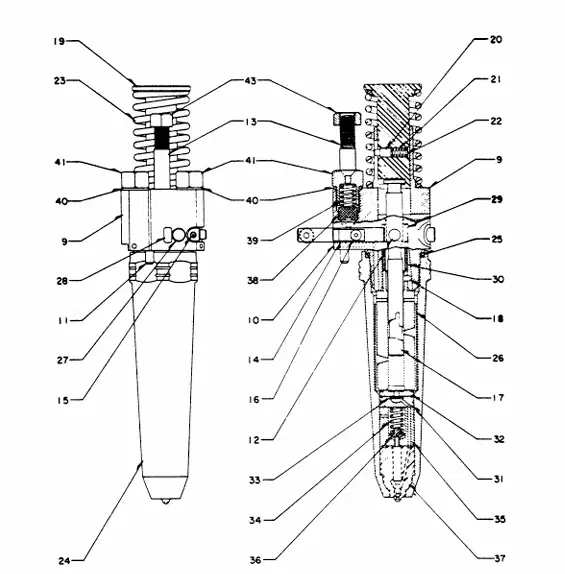
Regarding the fuel injector shown in the illustration, the purpose of piece No. 38 is to __________.
filter the fuel
maintain fuel pressure at a preset level
adjust the fuel rack spring tension
relieve excess fuel pressure to the suction side of the pump
While standing watch underway, you notice carryover occurring in a low pressure distilling plant. This can be a result of __________.
faulty operation of the brine overboard pump
a pressure drop through the loop seal
high distillate conductivity
low distillate conductivity
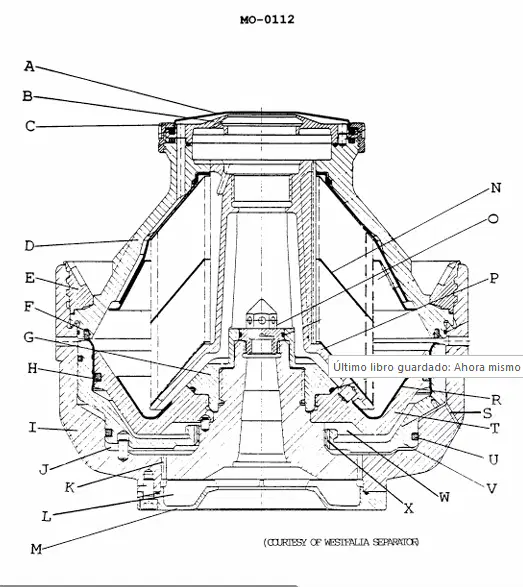
During normal operation, the liquid retained in space "J" of the device shown in the illustration is __________.
directly forcing the sliding piston upward to keep the bowl closed
maintaining the bowl oil-water seal interface
lubricating the shaft bearings
maintaining oil pump pressure
Air is normally bled from a diesel engine fuel system by __________.
blowing down the air tanks
loosening the compression nuts at the injectors
changing fuel filters
pumping down the day tanks
If a two-stroke/cycle diesel engine is overspeeding due to leakage of lube oil into the cylinders, what should you do to stop the engine?
Move the fuel control mechanism to the no fuel position.
Block the fuel supply by closing the master fuel valve.
Shut off the fuel supply and block the flow of intake air.
Relieve all pressure in the fuel system.
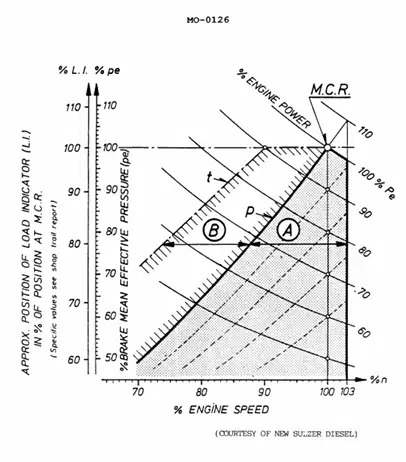
Which of the following conditions will cause the engine to operate in area "A" of the diagram shown in the illustration?
Fouled hull
Inclement weather
Excessive propeller cavitation
Damaged propeller blades
The piston wrist pin used in some diesel engine pistons is prevented from contacting the cylinder wall by a __________.
piston relief groove
cotter pin
snap ring
bronze bushing
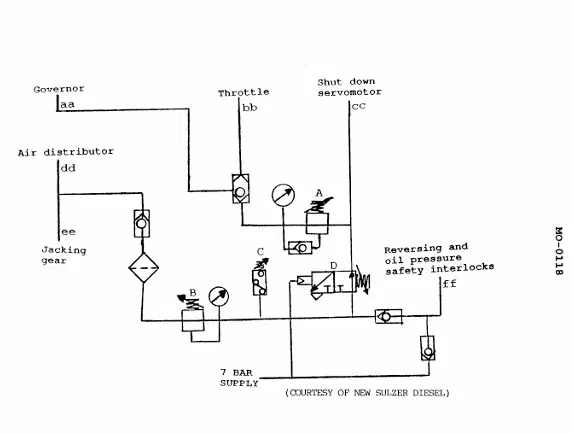
The 7 bar control air supply shown in the illustration has failed. Which of the following statements represents the automatic action that will occur?
The pressure switch, labeled as "C", will energize the automatic shutdown circuitry, preventing any additional operating casualty.
Valve "D" will shift to the position shown, with the signal generated from line 'ff' determining the speed of the engine, as the signal is modified by device "A".
By regulating the reduction of the 30 bar air pressure at device "B", the engine speed may be varied proportionally, operating independently of any other control.
Valve "D" will shift, no longer venting line 'cc', 30 bar air pressure is reduced by "B", and is supplied to "A" for speed control, and other functions of lines 'cc' and 'ff'.Valve "D" will shift, no longer venting line 'cc', 30 bar air pressure is reduced by "B", and is supplied to "A" for speed control, and other functions of lines 'cc' and 'ff'.
Which of the following precautions must be taken if an electric immersion heater is used to keep the coolant warm in a diesel engine when the engine is secured?
The coolant temperature must be maintained at 180°F.
The thermostatic bypass valves must be manually opened before the engine is started.
The pressure cap must be removed while the engine is secured.
Electrical power to the heater must be secured if the cooling system is to be drained.
To measure bearing clearances, a special small diameter plastic rod (plasti-gage) is placed between the crankshaft journal and the connecting rod bearing shell. The actual reading is obtained by __________.
using a micrometer to determine the thickness of the crushed plastic rod
accurately measuring the elongation of the plastic rod along the bearing surface
using the paper or cardboard gauge printed on the plastic rod package to measure the flattened width
using the paper or cardboard gauge printed on the plastic rod package to measure the flattened width
Hydraulic starters are installed on many lifeboat diesel engines instead of comparable air start systems, because __________.
hydraulic starters are the least expensive of all starting systems
the system does not require high pressure piping
hydraulic systems turn diesel engines at higher rates of speed than air starters
the system can be manually recharged
Which of the conditions listed could cause the cylinder relief valves on a large, low-speed, propulsion diesel engine to lift?
Plugged injector nozzles
Excessive fuel injection
Very late injection timing
Incorrect crankshaft clearances
Combustion knock will most likely occur as a result of using a fuel with __________.
low ignition quality
a high volatility
low ignition delay
a high cetane number
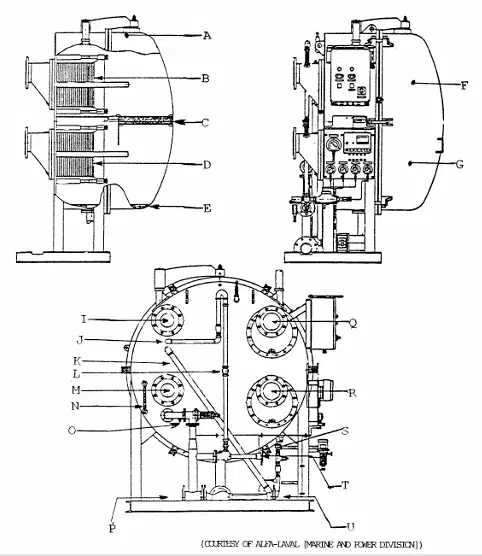
What is the function of device "C" shown in the illustration?
It removes moisture entrained in the vapors produced in section "G".
It allows for access into section "F".
It controls the amount of vapor produced in section "F".
The division plate creates a pressure drop between the two stages.
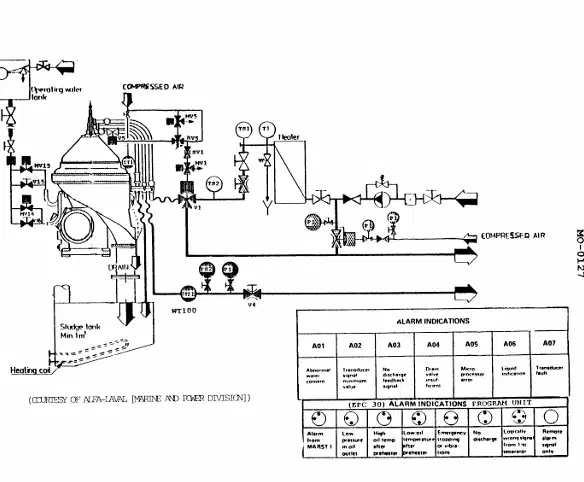
As shown in the illustration, the alarm indicated by 'emergency stopping or vibrations' may be caused by __________.
the rotating action of the centrifugal switch
new foundation bolt assemblies and dampeners
a failure to reset the emergency stop button
the emulsification of water and fuel within the parting chamber
The minimum speed an engine must attain before ignition can occur depends upon __________.
Move the fuel control mechanism to the no fuel position.
the condition of the engine
ambient temperature
all of the above
Opposed piston diesel engines are classified as __________.
two-stroke/cycle single acting
two-stroke/cycle double acting
four-stroke/cycle single acting
four-stroke/cycle double acting
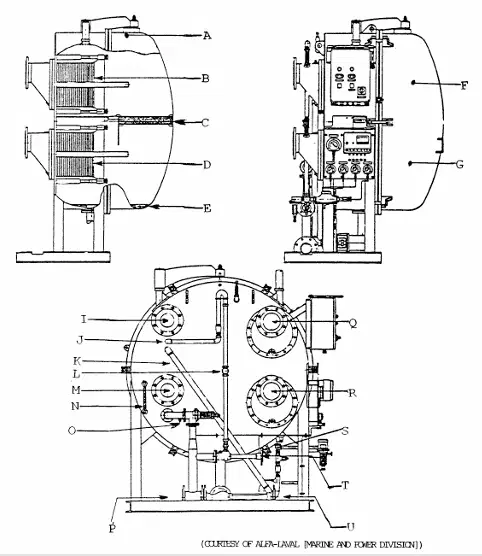
The heat exchanger plates, used in the device shown in the illustration, are produced from which of the listed materials?
Titanium
Anodized aluminum
Phosphor bronze
Copper
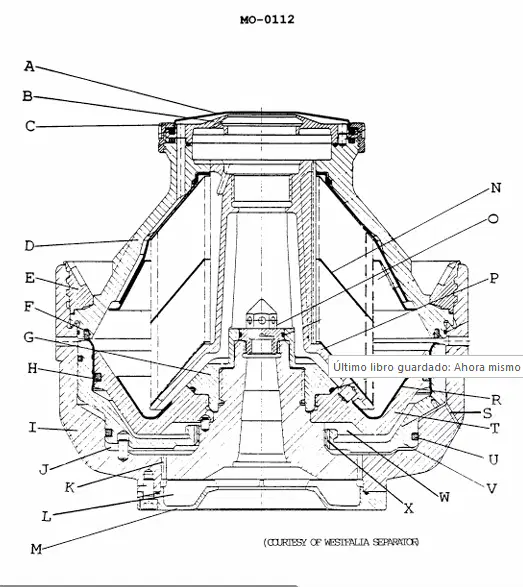
The area indicated by the letter "W", shown in the illustration is correctly termed the __________.
closing chamber
parting chamber
upper sliding piston chamber
opening chamber
In a trunk type diesel engine piston, the thickness of the head or crown is determined by the __________.
I. strength requirement
II. heat dissipation requirement
I only
II only
both I and II
neither I nor II
A method of finishing diesel engine cylinder walls to aid in the proper ring seating and lubrication is known as __________.
ribbed honing
angled honing
cross hatch honing
doubled honing
When conducting a hydrostatic test on a water-tube auxiliary boiler, the test water should be heated to a temperature of at least 70°F. This is done to __________.
minimize the coefficient of expansion within the varying types of metals used in boiler construction
help prevent the formation of condensation on the tube exteriors
eliminate oxygen being carried into the system
all of the above
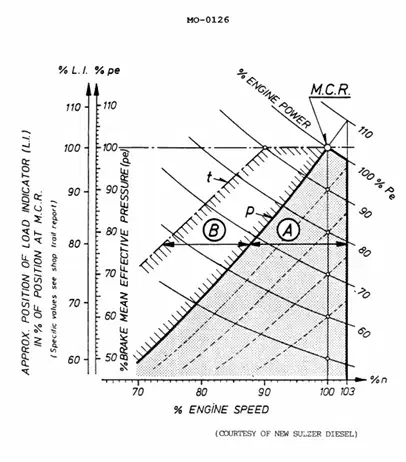
Which of the following conditions would NOT be considered a valid reason for the diesel engine to operate in the area indicated by letter "B" shown in the illustration?
Operating the vessel in shallow water
Operating the vessel against high winds and current
Operating with minimal hull drag and under light draft
Operating with a fouled or damaged propeller
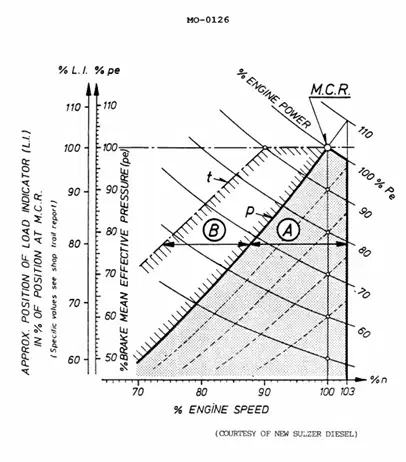
Line "P" in the illustration is called the __________.
exponential line
line of maximum horsepower
line of maximum speed
propeller curve
Starting a large propulsion diesel engine using diesel fuel during cold weather conditions can be made easier by __________.
increasing the quantity of starting air
increasing the lube oil pressure
heating the engine fuel supply
heating the engine jacket water
In a turbocharger, inlet air velocity is increased in the __________.
inlet nozzle ring
stationary diffuser passages
compressor outlet volute
rotating impeller vanes
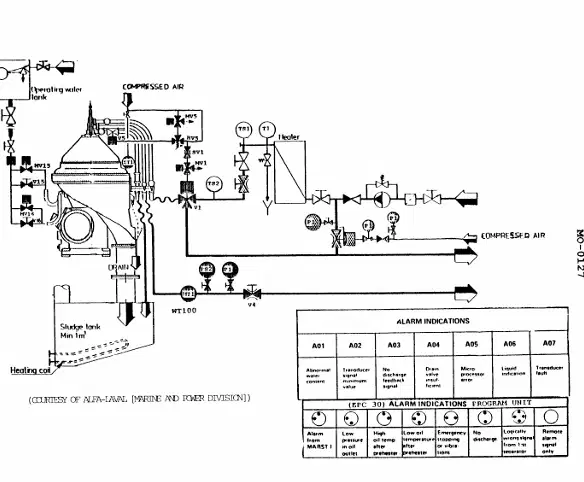
Which of the following conditions would be the most probable cause for the 'low oil temperature after preheater' LED indicators, as shown in the illustration, to be illuminated?
Steam trap bypass valve leaking.
Incorrect steam control valve setting.
Too high a temperature in settling tank.
Too low a temperature in day tank.

