
 Worksheets
Chapter 25 Health Test
Total questions: 41
Worksheet time: 21mins
Correct the sentence below by replacing the italicized term with the correct vocabulary term.
Heart attack is an acute injury in which blood flow to the brain is interrupted.
Stroke
Seizure
Aneurysm
Concussion
Correct the sentence below by replacing the italicized term with the correct vocabulary term.
High blood pressure is also known as atherosclerosis.
Hypertension
Diabetes
Anemia
Osteoporosis
Correct the sentence below by replacing the italicized term with the correct vocabulary term.
A disease that affects the heart or blood vessels is called a noncommunicable disease.
Cardiovascular disease
Respiratory disease
Digestive disease
Neurological disease
Which of the following behaviors is a preventive measure against cardiovascular disease?
Avoiding exposure to loud noises
Maintaining a healthy weight
Waking up early every morning
Taking vitamin supplements
Which of the following statements is true about stroke?
A stroke can cause paralysis.
A stroke is an acute injury that affects the liver.
During a stroke, blood flow to the brain increases.
During a stroke, the brain gets too much oxygen.
Which of the following statements is not true about tobacco use?
About 20 percent of deaths from cardiovascular disease are smoking related.
People who smoke less than a pack a day are generally safe from cardiovascular disease.
Cardiovascular disease can be caused by exposure to secondhand smoke.
For teens, tobacco use is the number one risk factor for cardiovascular disease.
The difference between a communicable disease and a noncommunicable disease is:
Communicable diseases can be spread from person to person, while noncommunicable diseases cannot.
Noncommunicable diseases can be spread from person to person, while communicable diseases cannot.
Both can be spread from person to person.
Neither can be spread from person to person.
A high cholesterol level can cause atherosclerosis by:
Narrowing and hardening the arteries due to plaque buildup
Increasing the oxygen supply to tissues
Decreasing blood pressure
Improving blood flow in the arteries
What happens during congestive heart failure?
The heart pumps blood efficiently.
The heart is unable to pump blood effectively, leading to fluid buildup in the lungs and body.
The heart stops beating suddenly.
The heart rate becomes extremely slow.
It is important to learn about cardiovascular disease as a teen, rather than waiting until you are older, because:
Early education helps prevent future health problems.
It is only relevant for older adults.
Teens cannot develop cardiovascular disease.
Learning later is more effective.
A(n) ________ is an abnormal mass of tissue that has no natural role in the body.
tumor
artery
enzyme
ligament
Cancer-causing substances are called ________.
carcinogens
antibiotics
mutagens
vaccines
During a(n) ________, a doctor removes a small piece of tissue for examination.
biopsy
transplant
injection
ultrasound
Which of the following is true about malignant tumors?
They are inconvenient but harmless.
They stay in their original location.
They travel to other parts of the body via the blood or lymph.
They occur only in older adults.
Which of the following statements is true about cancer?
Smoking is the leading cause of cancer deaths in the United States.
Cancer is a hereditary disease.
People who live in moderate or cool climates have a low risk for cancer.
Metastasis can be stopped with a healthful diet.
What percentage of all cancer deaths are caused by dietary risk factors?
10
20
30
40
Metastasis is the process in which:
Cancer cells spread to other parts of the body
Cells undergo normal division
Cells die naturally
Tissues repair themselves
It is important to pay attention to the moles on your skin because:
They can indicate changes that may signal skin cancer.
They help regulate body temperature.
They are a source of vitamin D.
They protect against sunburn.
Which of the following are three cancers that can be detected through self-examination?
Breast, skin, and testicular cancer
Lung, colon, and pancreatic cancer
Brain, liver, and stomach cancer
Ovarian, prostate, and thyroid cancer
Abstaining from sexual activity can reduce the risk of which type of cancer?
Lung cancer
Cervical cancer
Skin cancer
Breast cancer
Chemicals that can stimulate mucus and fluid production are called ___.
allergens
antibodies
histamines
hormones
Correct the sentence below by replacing the italicized term with the correct vocabulary term.
Arthritis affects the way body cells convert sugar into energy.
diabetes
hypertension
osteoporosis
asthma
Correct the sentence below by replacing the italicized term with the correct vocabulary term.
Allergy is a condition in which the airways in the lungs become narrowed.
asthma
bronchitis
pneumonia
influenza
Severe hives and difficulty swallowing are symptoms of a serious
asthma attack.
diabetic seizure.
allergic reaction.
arthritic condition.
The only way to diagnose diabetes is by
watching for the key symptoms.
undergoing a biopsy procedure.
receiving an eye exam.
getting a blood test.
The main areas affected by osteoarthritis are
internal organs, such as the liver.
weight-bearing joints, such as the knees.
the neck and shoulders.
the sinuses.
What are four strategies for managing asthma?
Taking prescribed medications, avoiding triggers, monitoring symptoms, and having an action plan
Exercising without limits, ignoring symptoms, avoiding medication, and eating junk food
Only using inhalers during attacks, not seeing a doctor, avoiding all physical activity, and not monitoring symptoms
Relying on home remedies, skipping doctor visits, not using an action plan, and ignoring triggers
Some scientists are concerned that type 2 diabetes will become an epidemic because:
It is spreading rapidly due to lifestyle and dietary changes.
It is caused by a rare genetic mutation.
It only affects children.
It has already been eradicated.
Your family can reduce asthma triggers in your home by:
Keeping windows closed during high pollen seasons
Using strong chemical cleaners frequently
Allowing pets to sleep on beds
Smoking indoors
__________ is hearing loss so severe that hearing aids have no effect.
Profound deafness
Mild hearing loss
Conductive hearing loss
Temporary hearing loss
The __________ is a law that prohibits discrimination against people with disabilities.
Americans with Disabilities Act (ADA)
Civil Rights Act of 1964
Family and Medical Leave Act (FMLA)
Occupational Safety and Health Act (OSHA)
Glaucoma and diabetes complications are two common causes of
deafness.
mental illness.
blindness.
paralysis.
What percentage of Americans have some type of disability?
5
10
20
40
Advocates for people with physical and mental challenges believe that
people are defined by their disabilities.
people with disabilities should have different opportunities.
everyone must learn to read braille.
buses and building entrances should be wheelchair accessible.
Identify the three main categories of physical challenges.
Sensory, Motor, Cognitive
Physical, Emotional, Social
Visual, Auditory, Speech
Mental, Physical, Emotional
Heredity plays a significant role in which of the following conditions related to hearing?
Hearing impairment
Vision impairment
Speech impairment
Motor impairment
Three ways that assistive devices help people with motor impairments are:
Improving mobility, increasing independence, and enhancing daily living activities.
Providing entertainment, increasing screen time, and reducing physical activity.
Limiting access to technology, increasing dependence, and reducing communication.
Decreasing social interaction, increasing isolation, and limiting opportunities.
The Americans with Disabilities Act impacts the lives of people with physical and mental challenges by:
Providing legal protections and ensuring accessibility
Limiting their rights in the workplace
Reducing access to public spaces
Eliminating all forms of discrimination
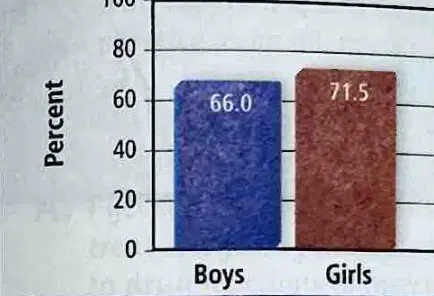
The graph shows summer sunburn prevalence for youth ages 11-18.
Which group makes up the greatest percentage of all youth surveyed?
Girls who got a sunburn that summer
Girls who did not get a sunburn that summer
Boys who got a sunburn that summer
Boys who did not get a sunburn that summer
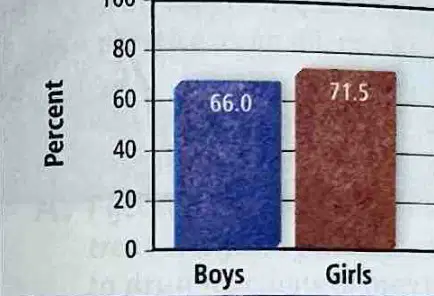
The graph shows summer sunburn prevalence for youth ages 11-18.
What percentage of boys did not get a sunburn that summer?
28.5%
34.0%
66.0%
71.5%
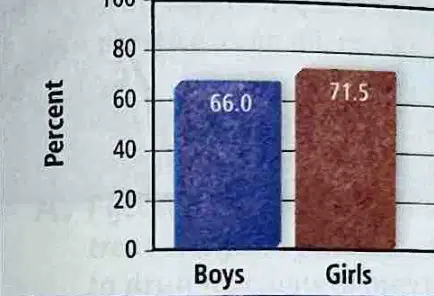
The graph shows summer sunburn prevalence for youth ages 11-18.
If you examined a representative sample that consisted of 500 boys, how many would have gotten a sunburn that summer?
330 boys (66% of 500 = 330)
250 boys (50% of 500 = 250)
100 boys (20% of 500 = 100)
400 boys (80% of 500 = 400)

