
 Worksheets
medicine
Total questions: 76
Worksheet time: 38mins
Which of the following is a primary responsibility of a Certified Nurse Assistant (CNA)?
Prescribing medication
Performing surgery
Providing basic patient care
Diagnosing illnesses
What is one of the main purposes of health care agencies?
To entertain patients
To provide and organize health care services
To sell medical equipment
To conduct only research
Which of the following best describes the nursing service department?
It is responsible for hospital finances
It provides direct care to patients
It manages hospital food services
It handles hospital security
What is an important requirement for nurse assistant certification?
Owning a hospital
Completing a nurse assistant training program
Becoming a doctor
Publishing a research paper
Why is ethics and confidentiality important in health care?
To increase hospital profits
To protect patient privacy and ensure trust
To advertise hospital services
To speed up patient discharge
Which of the following is NOT typically a role of the nursing care team?
Providing patient care
Organizing recreational activities
Supporting health care delivery
Assisting with patient recovery
Which of the following is NOT a purpose of health care agencies?
Health promotion
Disease prevention
Entertainment and recreation
Detection and treatment of disease
What is the main goal of health promotion in health care agencies?
To increase the number of hospitals
To reduce the risk of illnesses
To provide entertainment
To train only doctors
Which of the following is an example of a type of health care agency?
Shopping malls
Hospitals
Movie theaters
Restaurants
Which type of agency provides care for people who need rehabilitation or subacute care?
Mental health centers
Rehabilitation and subacute care agencies
Home care agencies
Hospices
Many agencies are learning sites for students. What is the primary role of students in these agencies?
To entertain patients
To assist in the purposes of health care
To manage finances
To provide transportation
Which of the following agencies is most likely to provide end-of-life care?
Hospitals
Hospices
Mental health centers
Home care agencies
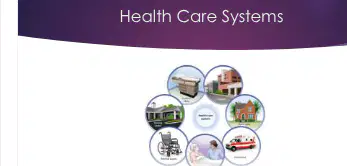
Which of the following best describes a health care system?
A group of entertainment venues
A network of agencies and organizations that provide health care services
A collection of restaurants and cafes
A set of transportation services
What is the main responsibility of the board of trustees or board of directors in a health care agency?
To make policies
To provide direct patient care
To manage nursing shifts
To deliver medications
Who manages the agency in a health care organization?
An administrator
A nurse manager
A nursing assistant
A patient
Which of the following best describes the focus of the health team (interdisciplinary health care team)?
The person’s total care
The agency’s financial goals
The administrator’s preferences
The board’s policies
What is the main goal of the health team in a health care setting?
To provide high-quality care
To increase profits
To reduce staff numbers
To limit patient interaction
Who is the director of nursing (DON) in a health care organization?
A registered nurse (RN)
A licensed practical nurse (LPN)
A nursing assistant
A board member
Which of the following is part of nursing services in a health care organization?
Nursing education (staff development)
Board of trustees
Administrative staff
Patients’ families
Which members of the health team provide nursing care? (Select the best answer.)
Registered nurses, licensed practical/vocational nurses, and nursing assistants
Board of directors and administrators
Patients and their families
Pharmacists and dietitians
A nurse manager is most likely to assist which of the following individuals?
The director of nursing (DON)
The board of trustees
The administrator
The patient’s family
Which of the following tasks would most likely require strategic thinking by a nurse manager? (DoK Level 3)
Planning staff assignments to ensure high-quality care for all patients on a shift
Recalling the names of all staff members
Listing the policies made by the board
Identifying the location of the administrator’s office
Which factor does NOT influence the pattern of nursing care used in a healthcare setting?
Number of persons needing care
The staff available
The cost of care
The color of the uniforms
What is the main responsibility of a case manager (an RN) in nursing care patterns?
Administering medication
Coordinating a person's care
Cleaning patient rooms
Scheduling staff shifts
Which nursing care pattern involves a team of nursing staff led by an RN?
Functional nursing
Team nursing
Primary nursing
Case management
In which nursing care pattern does one RN provide total care for a person?
Functional nursing
Team nursing
Primary nursing
Case management
Why might a healthcare facility choose to use functional nursing over other care patterns?
It is the most expensive option
It allows for specialized care by dividing tasks among staff
It requires fewer staff members
It provides the most personalized care

Which department is NOT typically found in a health care agency's organizational chart?
Housekeeping
Laboratory
Public relations
Automobile sales
Which of the following best describes private insurance?
It is bought by individuals and families.
It is provided only by the government.
It is only for people over 65 years old.
It is free for everyone.
What is the main difference between private insurance and group insurance?
Private insurance is for organizations, group insurance is for individuals.
Private insurance is bought by individuals and families, while group insurance is bought by groups or organizations for individuals.
Group insurance is only for people over 65, private insurance is for everyone.
Group insurance is more expensive than private insurance.
Which federal health insurance program covers persons 65 years of age or older?
Medicaid
Private insurance
Medicare
Group insurance
Which of the following statements about Medicaid is correct?
Medicaid is only for people over 65 years old.
Medicaid is a health care payment program sponsored by the federal government and operated by the states.
Medicaid is a type of private insurance.
Medicaid is only available to families.
What is the purpose of prospective payment systems in health care?
To increase the amount paid by insurers.
To limit the amount paid by insurers, Medicare, and Medicaid.
To provide free health care to everyone.
To eliminate the need for insurance.
Which of the following is used for hospital costs under prospective payment systems?
Resource utilization groups (RUGs)
Case mix groups (CMGs)
Diagnostic related groups (DRGs)
Home health resource groups (HHRGs)
Resource utilization groups (RUGs) are used for which type of health care payment?
Hospital costs
Skilled nursing facility payments
Home health care
Outpatient surgery
A patient receiving home health care would most likely be classified under which payment group?
Diagnostic related groups (DRGs)
Resource utilization groups (RUGs)
Case mix groups (CMGs)
Home health resource groups (HHRGs)
Explain how prospective payment systems impact the amount paid for health care services.
They increase the total payment for each service.
They limit the amount paid by insurers, Medicare, and Medicaid by using specific groupings for different types of care.
They allow patients to choose their payment amount.
They eliminate the need for government involvement in health care payments.
What is the main focus of managed care in health care delivery?
To deal with health care delivery and payment.
To provide only emergency services.
To offer free health care to everyone.
To eliminate the need for insurance.
Which of the following is required before many insurers approve the need for health care services?
Pre-approval for services.
Immediate payment.
No documentation.
Direct payment to the patient.
Who sets the standards that agencies must meet in health care?
State and federal governments and accrediting agencies.
Patients and their families.
Insurance companies only.
Hospitals themselves.
For which of the following must a health care agency meet standards?
License, certification, and accreditation.
Advertising and marketing.
Patient entertainment.
Staff uniforms.
What happens if a health care agency does not meet set standards during a survey?
It is given time to correct them, can be fined, or can lose its license, certification, or accreditation.
It is immediately shut down.
It receives a reward.
It is allowed to continue without changes.
Why are surveys conducted in health care agencies?
To see if the agency meets set standards.
To increase the agency’s profits.
To entertain patients.
To hire new staff.
Suppose a health care agency is found to have serious deficiencies during a survey. What is a possible consequence?
The agency can lose its license, certification, or accreditation.
The agency will receive more funding.
The agency will be promoted.
The agency will be ignored.
If a health care service is not approved by the insurer, who pays for the cost?
The person pays the cost.
The government pays the cost.
The hospital pays the cost.
The doctor pays the cost.
What is the main purpose of the learning material introduced on this page?
To introduce students to regulations, roles, professionalism, ethics, and OBRA
To teach students advanced medical procedures
To provide a history of healthcare in California
To explain the financial aspects of healthcare
Which California regulation establishes licensing and certification standards for health care facilities?
California Code of Regulations Title 22, Division 5
Omnibus Budget Reconciliation Act of 1987
California Penal Code
California Health and Safety Code Section 11362.5
What is one of the requirements of the Omnibus Budget Reconciliation Act of 1987 (OBRA) for nursing aides?
They must receive training and pass a competency exam within four months of employment in a skilled nursing facility.
They must have a college degree in nursing.
They must work for at least ten years before certification.
They must only work in hospitals, not nursing facilities.
Which of the following is NOT a function of the California Code of Regulations Title 22, Division 5?
Licensing and certification standards of health care facilities
Maintaining standards of care for the resident
Regulating the CNA training program
Providing financial aid to nursing students
How does OBRA impact the quality of care in nursing facilities? (DoK Level 3: Strategic Thinking)
By establishing standards of resident care and authorizing compliance surveys
By increasing the number of nursing facilities
By reducing the number of required staff
By eliminating the need for training programs
Which of the following is a requirement for completing a Certified Nursing Assistance Training Program?
Complete CNA training course approved by the Department of Health Services (DHS)
Complete 200 hours of online training only
Pass a written exam without any clinical hours
Attend a seminar on hospital administration
How many minimum hours of clinical training in a skilled nursing facility are required for CNA certification?
100 hours
50 hours
200 hours
20 hours
What does the Health Insurance Portability and Accountability Act of 1996 (HIPAA) protect?
The privacy and security of a person's health information
The cost of health insurance premiums
The number of hours worked by nurses
The quality of hospital food
Which of the following is included in the protections under HIPAA?
Identifying information and information about a person's health care maintained or sent in any form
Only paper records of a patient's health
Only electronic records of a patient's health
Only oral communication about a patient's health
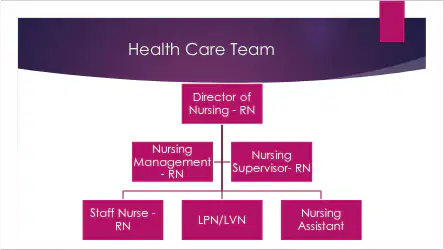
Based on the health care team structure, who is directly under the Director of Nursing - RN?
Nursing Management - RN and Nursing Supervisor - RN
Nursing Assistant and LPN/LVN
Staff Nurse - RN and Nursing Assistant
Only Nursing Assistant
Which role is NOT typically part of the health care team as shown in the diagram?
Pharmacist
Nursing Assistant
LPN/LVN
Staff Nurse - RN
Why is it important for health care workers to understand HIPAA regulations?
To ensure patient information is kept private and secure
To increase the number of patients in a facility
To reduce the cost of medical supplies
To improve hospital cafeteria services

Which of the following is a primary responsibility of a Certified Nursing Assistant (CNA)?
Prescribing medication to patients
Assisting and supervising nurses
Performing surgery
Diagnosing illnesses
Which task is a CNA NOT allowed to perform?
Reporting observations about the person’s care
Giving medication to patients
Following the nurse’s directions
Performing tasks that you are trained to do
What should a CNA do before providing care to a patient?
Make a diagnosis
Review the care plan and receive directions from the nurse
Prescribe treatment
Change the care plan
Which of the following is a role limit for CNAs?
Performing procedures that require sterile technique
Reporting changes in the patient’s condition
Assisting with daily living activities
Observing and recording patient information
Why is it important for a CNA to never take oral or phone orders from a doctor?
It is outside their scope of practice and could lead to errors
It saves time for the nurse
It helps the CNA learn new skills
It is required for certification

What is a requirement for becoming a certified nursing assistant?
Completing a minimum number of training hours
Prescribing medication
Performing surgery
Writing care plans
A CNA is asked by a family member about the person’s diagnosis. What should the CNA do?
Provide the diagnosis to the family member
Refer the family member to the nurse
Make up an answer
Ignore the question
Which of the following best describes the focus of CNA training programs?
Advanced medical procedures
Common and direct care instruction
Prescribing medication
Diagnosing illnesses
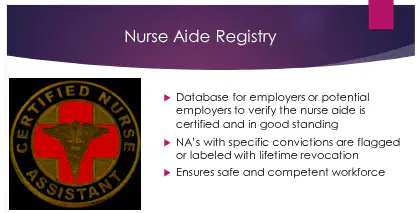
What is the primary purpose of the Nurse Aide Registry?
To provide a list of available jobs for nurse aides
To verify that a nurse aide is certified and in good standing
To offer training programs for nurse aides
To schedule shifts for nurse aides
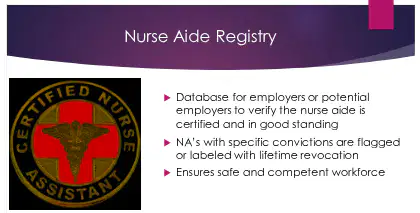
Which of the following is a consequence for nurse aides with specific convictions according to the Nurse Aide Registry?
They receive a warning letter
They are given a temporary suspension
They are flagged or labeled with lifetime revocation
They are promoted to supervisor

Why is continuing education important for nurse aides?
It allows them to change careers easily
It is required by most states to remain current and competent
It increases their salary automatically
It is only necessary for supervisors
Which of the following is NOT a way nurse aides can complete continuing education requirements?
Attending conferences
Taking classes at community colleges
Independent study
Ignoring the requirements

Which of the following is an example of professionalism for a Certified Nurse Assistant (CNA)?
Following the law
Arriving late to work
Ignoring patient needs
Sharing confidential information

A CNA who is knowledgeable, committed, and caring is demonstrating which quality?
Professionalism
Laziness
Disinterest
Incompetence
A nurse aide wants to ensure they are meeting state requirements for continuing education. What should they do first?
Check the specific requirements for their state
Skip all training sessions
Only attend online classes
Wait for their employer to remind them
Which of the following is an example of ethical behavior expected of a CNA?
Protecting a resident's life
Ignoring a resident's needs
Sharing confidential information
Accepting gifts from residents
What should a CNA do to maintain ethical behavior regarding patient information?
Keep patient information confidential
Discuss patient details with friends
Post about patients on social media
Share patient information with other residents
Which quality is NOT listed as a characteristic of a successful CNA?
Dependable
Dishonest
Empathetic
Flexible
A resident offers a CNA a gift to show appreciation. What is the most ethical response?
Politely decline the gift and explain the policy
Accept the gift and thank the resident
Share the gift with other staff members
Ignore the resident's gesture

