
 Worksheets
Treating Pressure Ulcers and Chronic Wounds
Total questions: 88
Worksheet time: 44mins
What is the most common type of chronic wound in the hospital or long-term care setting?
Diabetic ulcers
Pressure ulcers
Venous ulcers
Arterial ulcers
What is the primary cause of injury in a pressure ulcer?
Infection from bacteria
Local ischemia due to continuous compression of capillaries
Allergic reaction to dressings
Excessive moisture exposure
Explain why pressure ulcers are particularly common in hospital or long-term care settings, using evidence from the provided material.
Patients in these settings are often immobile, leading to continuous compression of capillaries.
Hospitals have poor hygiene standards.
Only elderly patients get pressure ulcers.
Pressure ulcers are caused by poor nutrition alone.
A patient in a long-term care facility develops a wound due to continuous compression of capillaries. Based on your understanding, what type of wound is this most likely to be, and what is the underlying mechanism?
Venous ulcer; caused by poor blood return
Pressure ulcer; caused by local ischemia
Diabetic ulcer; caused by high blood sugar
Arterial ulcer; caused by arterial blockage
Why is it important to understand both pressure and shear forces in the context of pressure injuries?
Only pressure causes tissue damage, not shear.
Shear forces are more important than pressure in all cases.
Both pressure and shear contribute to tissue deformation and injury, especially near bony prominences.
Shear forces only occur when patients are standing.
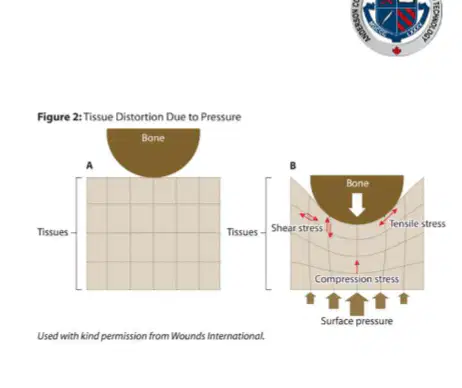
Based on the diagram and description, how does shear force contribute to tissue injury in patients?
Shear force only affects the skin surface and not deeper tissues.
Shear force results from two oppositely directed parallel forces, causing tissue deformation, such as when patients slip down in bed.
Shear force is not relevant in the development of pressure injuries.
Shear force increases blood flow to the tissues.
Which of the following is a recommended technique to prevent pressure ulcers in patients who are lying or sitting for extended periods?
Repositioning the patient frequently
Applying ice packs to pressure points
Massaging the skin over bony areas
Using only standard hospital beds without adjustment
Why is it important to prop a patient at a 30-degree angle when lying in bed?
To avoid pressure on major pressure points
To help the patient sleep better
To improve blood circulation in the arms
To reduce the risk of falls from the bed
When a patient is admitted to the hospital, what is a key step in preventing pressure ulcers?
Identifying patients at risk and using appropriate beds/mattresses
Giving the patient extra blankets
Encouraging the patient to eat more protein
Applying topical antibiotics to all patients
A nurse observes that a pressure ulcer appears minor on the surface. What should the nurse consider when planning treatment?
The ulcer may be worse than it appears from the surface
The ulcer will heal on its own without intervention
The ulcer is not a priority for care
The ulcer only affects the outermost layer of skin
A patient has been lying in the same position for several hours without being turned. What is the most likely consequence if pressure redistribution techniques are not used?
Development of pressure ulcers
Improved muscle strength
Faster wound healing
Reduced risk of infection
How might a pictorial guide assist clinicians in wound assessment?
By providing visual references to improve consistency and accuracy in identifying wound characteristics.
By replacing the need for any written documentation.
By eliminating the need for patient input.
By speeding up the healing process directly.
Why can a small skin wound in a pressure ulcer indicate a more serious underlying injury?
Because the skin is more resistant to pressure than the underlying tissue, so a small wound may be the top of a larger injury below.
Because the skin heals faster than underlying tissue.
Because pressure ulcers only affect the skin.
Because underlying tissue is always visible in pressure ulcers.
What is a potential consequence of deeper tissue breakdown in pressure ulcers?
Hidden pockets form, sheltering bacteria from superficial cleansings.
The wound heals more quickly.
The skin becomes more resistant to pressure.
Superficial cleansings remove all bacteria.
A patient presents with a small skin wound over a bony prominence. Using your understanding of pressure ulcers, what should you consider when planning treatment?
There may be a larger injury in the subcutaneous tissue and muscle below the visible wound.
The wound is likely to heal without intervention.
Only the skin is affected, so deep cleaning is unnecessary.
The wound should be left uncovered to heal faster.
Why might superficial cleansing be insufficient for treating some pressure ulcers?
Because hidden pockets formed by deeper tissue breakdown can shelter bacteria from being reached by superficial cleansing.
Because superficial cleansing always causes more tissue damage.
Because pressure ulcers do not contain bacteria.
Because only the skin needs to be cleaned in pressure ulcers.
Which of the following best describes a Stage 1 sore?
The skin is broken and forms an ulcer.
The skin is painful but has no breaks or tears.
The sore is filled with clear fluid.
The sore expands into deeper layers of the skin.
Which of the following is true about Stage 2 wounds?
The skin remains intact with no breaks.
The sore only affects the outermost layer of skin.
The skin breaks open, wears away, or forms an ulcer.
The sore is not painful or tender.
A patient presents with a sore that looks like a shallow crater in the skin and is filled with clear fluid. Based on the information provided, which stage is this wound most likely in?
Stage 1
Stage 2
Stage 3
Stage 4
Explain why a Stage 2 wound may be more serious than a Stage 1 wound, using evidence from the characteristics described.
Stage 2 wounds are less painful than Stage 1 wounds.
Stage 2 wounds involve deeper layers of skin and may result in permanent damage or skin death.
Stage 1 wounds always have blisters, while Stage 2 wounds do not.
Stage 1 wounds are more likely to become infected than Stage 2 wounds.
Which of the following best describes a stage 3 pressure sore?
The sore is superficial and only affects the outer layer of skin.
The sore extends into the tissue beneath the skin, forming a small crater, and fat may show in the sore but not muscle, tendon, or bone.
The sore reaches into muscle and bone, causing extensive damage.
The sore is limited to redness and does not break the skin.
What is a possible complication if a pressure injury progresses to stage 4?
Mild skin irritation
Infection of the bone (osteomyelitis) or blood (sepsis)
Temporary redness
Minor swelling
Compare the tissue involvement in stage 3 and stage 4 pressure injuries. Which statement is accurate?
Both stages involve only the outer layer of skin.
Stage 3 involves fat but not muscle, tendon, or bone, while stage 4 reaches into muscle and bone.
Stage 3 and stage 4 both involve only fat tissue.
Stage 4 is less severe than stage 3.
Why might there be little or no pain in stages 3 and 4 of pressure injuries?
The nerves are not affected in these stages.
The tissue damage is so significant that pain sensation is reduced or lost.
The wound is too small to cause pain.
The skin heals quickly in these stages.
Which of the following best describes a suspected deep tissue injury?
Area of localized discolored intact skin that is purple or maroon-red in color
Full-thickness loss where the base of the ulcer is covered by slough or eschar
Open wound with exposed bone
Superficial abrasion with minimal tissue damage
What is a key sign that may precede a suspected deep tissue injury?
Skin that is painful, firm, boggy, or a different temperature compared with the surrounding skin
Presence of pus and foul odor
Complete loss of skin layers with visible muscle
Formation of a dry scab over the wound
Why is the true depth of an unstageable pressure ulcer difficult to determine initially?
The base of the ulcer is covered by slough or an eschar
The wound is too small to measure
The ulcer is always superficial
The patient cannot feel pain in the area
A patient has a stable eschar on their heel. According to best practices, what should be avoided?
Debridement of the eschar
Monitoring the wound
Keeping the area clean and dry
Applying a protective dressing
A nurse observes a blood-filled blister on a patient’s skin, resulting from damage to underlying soft tissue. What type of wound is this most likely to be?
Suspected deep tissue injury
Unstageable pressure ulcer
Superficial abrasion
Stage 1 pressure ulcer
Explain why debridement should be avoided in the case of a stable eschar on the heels.
Removing a stable eschar can increase the risk of infection and delay healing
Debridement is always necessary for all wounds
Eschar removal is only needed for superficial wounds
Stable eschar is a sign of healthy tissue
Which of the following is NOT typically required in the treatment of pressure ulcers?
Irrigation
Debridement
Packing with moist gauze
Application of dry bandages only
Why is it important to manage both bacterial and moisture balance when treating wounds?
To ensure the wound heals faster and reduces the risk of infection
To make the wound look cleaner
To avoid using too many dressings
To prevent the patient from feeling pain
How should appropriate dressings for wounds be chosen?
Based on the color of the wound
Based on the amount of exudate and absorbency needed
Based on the patient’s age
Based on the time of day
A patient with a pressure ulcer has increased drainage that soaks through the dressing. What is the most appropriate action?
Wait until the next scheduled dressing change
Change the dressing as needed for strikethrough drainage
Add more tape to secure the dressing
Ignore the drainage
Explain why the use of special mattresses and pressure redistribution techniques is important for patients at risk for pressure ulcers.
They help prevent the development and worsening of pressure ulcers by reducing prolonged pressure on vulnerable areas.
They make the bed more comfortable for the patient.
They are required by hospital policy.
They help keep the patient warm.
Which of the following is an appropriate strategy for preventing pressure injuries in patients who are bedridden?
Position the patient every two to four hours while in bed.
Keep the patient in the same position for at least six hours.
Only reposition the patient once a day.
Avoid using any schedule for repositioning.
How can occupational or physical therapists assist in the care of patients with pressure injuries?
By teaching specific transfer techniques to minimize shearing effects.
By prescribing medication for pain relief.
By providing nutritional advice.
By recommending bed rest at all times.
What is the recommended maximum head-of-bed elevation for patients with pressure injuries, if their medical condition allows?
30 degrees
45 degrees
60 degrees
90 degrees
A patient with a pressure injury needs assistance with body alignment. Which of the following is the best approach?
Use pillows or wedges for proper positioning.
Use donut-type devices for support.
Avoid using any assistive devices.
Elevate the head of the bed to 90 degrees.
Why is it important to utilize assistive devices such as bed rails and transfer boards for patients with pressure injuries?
To increase the patient’s independence and safety with repositioning and transfers.
To make the bed look more comfortable.
To reduce the need for any movement.
To avoid using pillows or wedges.
Which of the following is an appropriate action to minimize shearing effects and maintain a patient's independence when treating wounds?
Ask an occupational therapist or physical therapist for patient-specific transfer techniques.
Increase the frequency of dressing changes.
Apply heat packs to the wound area.
Encourage the patient to avoid movement.
Why is it important to inform the patient, family, and caregivers about the positioning schedule and proper transferring techniques?
To ensure proper nutrition is maintained.
To prevent pressure injuries and promote safe weight-shifting.
To reduce the need for medication.
To increase the frequency of wound dressing changes.
A patient with known pressure injuries on the ischial tuberosities should have which of the following assessed by an occupational therapist?
The wheelchair and cushion for proper support.
The patient's medication schedule.
The patient's dietary intake.
The frequency of wound cleaning.
Which of the following is NOT one of the three types of lower extremity ulcers commonly seen in hospitals, clinics, and home health settings?
Pressure ulcers
Arterial ulcers
Venous leg ulcers
Diabetic/neuropathic ulcers
A healthcare provider is developing a care plan for a patient at risk of lower extremity ulcers. Which combination of ulcers should they be most concerned about in this context?
Arterial ulcers, venous leg ulcers, and diabetic/neuropathic ulcers
Pressure ulcers, arterial ulcers, and burn wounds
Venous leg ulcers, pressure ulcers, and surgical wounds
Diabetic/neuropathic ulcers, burn wounds, and arterial ulcers
Which of the following conditions is most commonly associated with the development of arterial ulcers?
Peripheral artery disease (PAD)
Venous insufficiency
Hypertension
Deep vein thrombosis
What is the primary cause of arterial ulcers as described in the material?
Bacterial infection
Ischemia, oxygen and nutrient deprivation, and decreased circulation
Excessive moisture
Allergic reaction
Which of the following is NOT listed as a predisposing factor for arterial ulcers?
Diabetes
Advanced age
High cholesterol
Decreased circulation
Where are arterial ulcers most commonly found according to the material?
On the heels and ankles
On the tips of toes, between the toes, over the phalangeal heads just proximal to the toes, at sites subjected to pressure or rubbing of shoes, and around the outer (lateral) malleolus
On the palms and fingers
On the back and shoulders
A patient presents with ulcers on the tips of their toes and around the outer malleolus. Based on the information provided, what underlying condition should you suspect and why?
Venous insufficiency, because these ulcers are caused by pooling of blood in the veins.
Peripheral artery disease, because arterial ulcers are commonly found in these locations due to reduced blood flow.
Diabetes, because diabetic ulcers only occur on the toes.
Hypertension, because high blood pressure causes ulcers in these areas.
Based on the image and description, what is a likely contributing factor to the development of the ulcers shown?
Increased blood flow to the extremities
Ischemia and decreased circulation
Excessive sweating
Fungal infection
Which of the following is a characteristic feature of wounds caused by arterial ulcers?
Wounds have irregular, jagged margins
Wounds have even margins with a "punched out" look
Wounds are highly exudative
Wounds are shallow and red
When assessing a patient with arterial ulcers, what would you most likely observe in the tissue surrounding the wound?
The tissue is red and swollen
The tissue is blanched or purpuric (purplish mottling)
The tissue is moist and warm
The tissue is covered with thick hair
Which of the following best describes the exudate from wounds characteristic of arterial ulcers?
Heavy and purulent
Minimal, if any
Moderate and serous
Copious and bloody
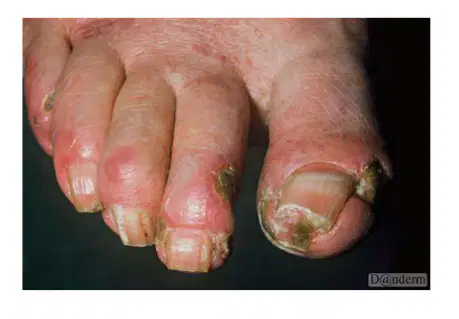
A patient presents with thickened toenails, loss of hair on the shin, and shiny skin on the ankle and foot. What additional finding would most likely be present?
Increased temperature in the lower extremities
Diminished or absent toe/pedal pulses
Excessive sweating of the foot
Swelling and redness of the toes
Explain why temperature in the lower extremities is decreased in patients with arterial ulcers, and how this finding helps in clinical assessment.
Decreased temperature is due to increased blood flow, indicating infection.
Decreased temperature is due to reduced arterial blood supply, helping to distinguish arterial ulcers from other types of wounds.
Decreased temperature is caused by nerve damage, which is unrelated to wound type.
Decreased temperature is a result of excessive sweating, which is common in venous ulcers.
Which of the following best describes the progression of pain in patients with Peripheral Arterial Disease (PAD)?
Pain is constant and does not change with activity or position.
Pain starts as intermittent claudication and can progress to nocturnal, postural, and eventually resting pain.
Pain only occurs during sleep and disappears during the day.
Pain is only present when the patient is sitting.
A PAD patient is experiencing pain relief by hanging a foot off the edge of the bed. What does this behavior most likely indicate?
The patient is trying to increase arterial blood flow to the lower extremity.
The patient is attempting to reduce swelling in the foot.
The patient is preventing infection in the wound.
The patient is trying to keep the foot warm.
How do the lower extremities of PAD patients typically respond to elevation and dependency?
They become red when elevated and pale when down.
They remain unchanged regardless of position.
They pale on elevation and display dependent rubor (redness) when down.
They swell when elevated and shrink when down.
Why might cellulitis develop in patients with advanced PAD?
Due to increased arterial blood flow.
Because of infection of the connective tissue of the skin.
As a result of improved wound healing.
Due to excessive exercise.
A patient with PAD is experiencing severe pain and arterial blockage. What stage of PAD does this most likely represent?
Early stage PAD
Middle stage PAD
Last stage PAD
No PAD present
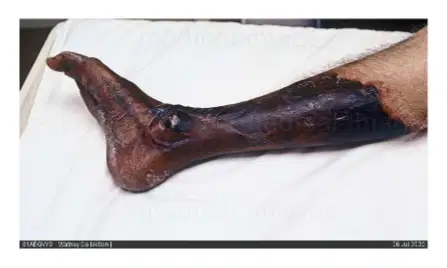
Which of the following is an important diagnostic feature of dry gangrene?
A distinct line between gangrenous and healthy tissue
A foul-smelling discharge from the wound
Rapid spreading of redness up the leg
Formation of blisters filled with clear fluid
What is likely to happen if gangrenous portions of a toe are left untreated?
The gangrenous portions will eventually separate and the toe will be lost
The tissue will heal on its own without intervention
The affected area will turn bright red and swell
The infection will immediately spread to the entire foot
Explain how the appearance of gangrene can help in its diagnosis and what this indicates about the underlying tissue.
A dark brown to black color with hard tissue indicates necrosis and a clear boundary with healthy tissue
A bright red color with soft tissue indicates healthy blood flow
A yellowish color with soft tissue indicates early infection
A blue color with swollen tissue indicates poor circulation but not necrosis
If unstable (wet) gangrene is present, what is the most likely outcome if it is not treated?
It will progress, causing extreme pain and destroying more tissue
It will heal slowly without intervention
It will remain stable and not cause further damage
It will turn into dry gangrene and become less dangerous
Which of the following is a primary goal in the treatment of wounds in the lower extremities?
To improve circulation by stent placement in blocked arteries
To immediately amputate the affected limb
To only use topical antibiotics
To avoid any surgical intervention
What is the purpose of revascularization by means of arterial bypass grafting in wound treatment?
To improve local wound healing by restoring blood flow
To prevent infection by removing dead tissue
To reduce pain by numbing the area
To increase the size of the wound for better drainage
Why is it important to address circulation issues before treating wounds locally?
True progress in wound healing can only be made after improving circulation
Local treatment is always sufficient regardless of circulation
Circulation has no effect on wound healing
Local treatment is more effective than improving circulation
If circulation to the lower extremities is not corrected, what is a likely consequence?
Ulceration and gangrene may progress, leading to amputation
The wound will heal faster
There will be no change in the wound condition
Only minor discomfort will occur
Which diagnostic test is considered the best for evaluating circulation issues in the lower extremities?
Angiogram/arteriogram
X-ray
Complete blood count
Skin biopsy
What is the usual non-invasive test performed before an angiogram to assess circulation in the lower extremities?
Ankle-brachial index (ABI) using a Doppler
Blood glucose test
MRI scan
Urinalysis
Which of the following is the correct procedure if stable gangrene is present in a wound?
Keep the area dry with no debridement.
Apply sharp debridement immediately.
Use antibiotics to resolve infection.
Apply pressure to the area.
Why is infection difficult to resolve in wounds with poor circulation?
Because antibiotics are less effective due to lack of circulation.
Because the wound is always dry.
Because the wound is always wet.
Because the wound is exposed to air.
A patient presents with an opening in the skin of the leg, and blood appears to be pooling in the veins. Which condition is most likely present, and what is its primary cause?
Venous leg ulcer caused by venous insufficiency (CVI)
Arterial ulcer caused by high blood pressure
Diabetic ulcer caused by high blood sugar
Pressure ulcer caused by immobility
A nurse is treating a patient with unstable gangrene. What is the most appropriate action to take?
Perform sharp debridement.
Keep the area dry with no debridement.
Apply only tincture of benzoin.
Use only antibiotics.
Explain why care must be taken to avoid pressure or rubbing of extremities by ill-fitting, tight shoes in wound management.
To prevent further injury and reduce the risk of infection.
To increase blood flow to the area.
To help antibiotics work better.
To dry the wound faster.
Which of the following is the most commonly held theory for the cause of venous leg ulcers?
Damage to the valves of the lower extremity veins
Bacterial infection of the skin
Poor arterial blood supply
Excessive sun exposure
Which condition in the lower limb is a risk factor for lymphedema and may lead to secondary lymphedema?
Chronic venous insufficiency
Acute arterial occlusion
Diabetic neuropathy
Osteoarthritis
A patient presents with venous ulcers. Which combination of risk factors would most likely contribute to their development?
Venous hypertension, obesity, history of DVT, decreased activity
High blood sugar, low calcium, frequent exercise, young age
Allergies, asthma, high protein diet, regular swimming
Vitamin deficiency, frequent headaches, low blood pressure, insomnia
How might advanced age and congestive heart failure (CHF) contribute to the development of venous ulcers?
Both can impair venous return, increasing venous pressure and risk of ulceration
Both increase arterial blood flow, preventing ulcer formation
Both improve skin elasticity, reducing ulcer risk
Both decrease the risk of blood clots, preventing ulcers
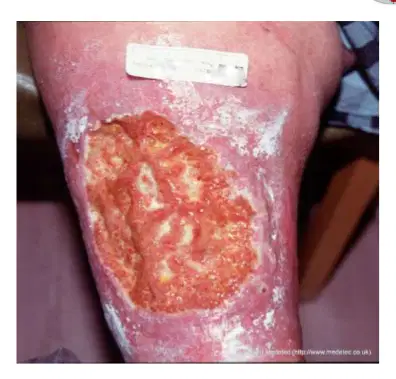
Which of the following best describes the appearance of wound bed tissue in superficial wounds with irregular margins?
Pale and smooth
Ruddy with granular texture
Yellow and leathery
Black and necrotic
What is a common characteristic of exudate from wounds with irregular margins and fine slough?
It is always minimal
It is frequently moderate to heavy
It is always dry
It is always purulent
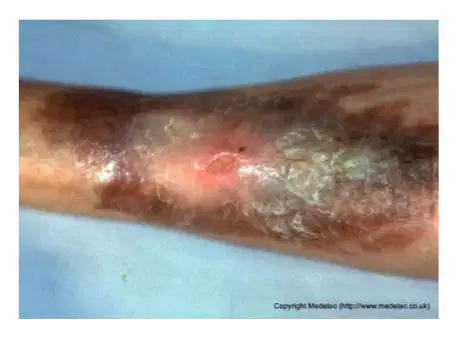
A patient presents with a darkened, brownish discoloration to the lower leg. Which underlying process is most likely responsible for this appearance?
Infection by bacteria
Hemorrhage from a deep vein
Hemoglobin breakdown and hemosiderin staining due to fluid buildup and blood leakage
Allergic reaction to medication
Given a wound with superficial, irregular margins and moderate to heavy exudate, what would be the most appropriate initial step in wound management?
Apply a dry dressing and leave it undisturbed
Cleanse the wound and use a dressing that manages exudate while maintaining a moist environment
Use only topical antibiotics
Immediately suture the wound closed
Which of the following locations is most commonly associated with venous ulcers?
Lateral (outer) leg
Medial (inner) leg
Plantar surface of the foot
Dorsal surface of the hand
A patient with a venous ulcer reports moderate to little pain. Which intervention is most likely to relieve their discomfort?
Applying heat packs to the wound
Elevating the lower extremities
Massaging the wound area
Keeping the leg in a dependent position
The skin surrounding a venous ulcer is most likely to be:
Thick and leathery
Scaling and weeping
Smooth and unbroken
Covered in blisters
Based on the comparison between arterial and venous ulcers, which of the following statements is correct?
Venous ulcers are usually found below the ankle, at the tip of the toes.
Arterial ulcers are associated with varicose veins and edema.
Venous ulcers often have shallow, irregular, and larger lesions.
Arterial ulcers are surrounded by scaling and weeping skin.

