wayground logo

Free Printable Worksheets

Font size

S
M
L
XL
Worksheets

A2 Gen Final Review

Total questions: 50

Worksheet time: 3hrs 32mins

Name
Class
Date
1.

To which intervals could we restrict the domain of f(x) to make it an invertible function? Choose all answers that apply.

a)

-6 ≤ x ≤ -2

b)

-4 ≤ x ≤ 4

c)

-2 ≤ x ≤ 2

d)

none of the above

2.

Find the inverse function

a)

A) f(x) = 1/x

b)

B) f(x) = x^2

c)

C) f(x) = x + 1

d)

D) f(x) = e^x

3.

Find the inverse function

a)

A) x + 1

b)

B) x - 1

c)

C) 1/x

d)

D) x^2

4.

g(g(5))g\left(g\left(-5\right)\right)  

a)

1

b)

-0.25

c)

3

d)

-1

5.
a)
9 - 8/3
b)
9 + 8/3
c)
3
d)
1/3
6.

Decompose the following composite function:  f(g(x))=h(x)=(x210)+3f\left(g\left(x\right)\right)=h\left(x\right)=\left(x^2-10\right)+3  

a)

f(x)=x210f\left(x\right)=x^2-10  

b)

f(x)=x+3f\left(x\right)=x+3  

c)

g(x)=x210g\left(x\right)=x^2-10  

d)

g(x)=x+3g\left(x\right)=x+3  

7.

Decompose the following composite function:  f(g(x))=h(x)=1x+2f\left(g\left(x\right)\right)=h\left(x\right)=\frac{1}{x+2}  

a)

f(x)=1xf\left(x\right)=\frac{1}{x}  

b)

f(x)=x+2f\left(x\right)=x+2  

c)

g(x)=x+2g\left(x\right)=x+2  

d)

g(x)=1xg\left(x\right)=\frac{1}{x}  

8.

Evaluate the following logarithm:


log3(1/3)

a)

-2

b)

-1/2

c)

-1

d)

1/2

9.

ln(2x2yz4)\ln\left(\frac{2x^2y}{z^4}\right)  

a)

ln2+2lnx+lny+4lnz

b)

ln2+2lnx+lny-4lnz

c)

2ln(2xy)-4lnz

d)

2ln2x+lny-4lnz

10.

Evaluate log61Evaluate\ \log_61  


(a)  

11.

Choose the correct expanded common logarithm:

log(3x)2\log(3x)^2  

a)

2log(3+x)2\log(3+x)  

b)

2log3+logx2\log3+\log x  

c)

log3+2logx\log3+2\log x  

d)

2(log3+logx)2(\log3+\log x)  

12.

If logBA=logAlogB\log_BA=\frac{\log A}{\log B} , then log12245=\log_{12}245=

a)

log24512\log\frac{245}{12}

b)

log12245\log\frac{12}{245}

c)

None of these

13.
a)

x = 5 and x = -2

b)

x = -2

c)

x = 5

d)

x = -10 and x = 10

14.

Solve log7+log(x24)=log35\log7+\log\left(x^2-4\right)=\log35

a)

x=3x=3

b)

x=2x=-2

c)

x=4x=4

d)

x=3x=-3

15.
Describe the transformation from dotted to solid.
a)
f(x + 5) + 3
b)
f(x +3) + 5
c)
f(x - 5) + 3
d)
f(x - 3) + 5
16.

The graph of f(x) is represented below...

Which graph represents f(-x)?

a)
b)
c)
d)
17.

State the domain and range using "inequality" notation.

a)

x ≥ -4 and y ≥ 2

b)

x ≥ 4 and y ≥ 2

c)

x > -4 and y > 2

d)

D: [-4, ∞) and R: [2, ∞)

18.

Simplify:

(87i)2\left(8-7i\right)^2

a)

64 - 49i

b)

16 - 14i

c)
  • 15 - 112i

d)

64 + 49i

19.

Which of the following represents the graph below?
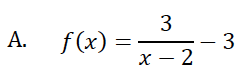
a)
b)
c)
d)
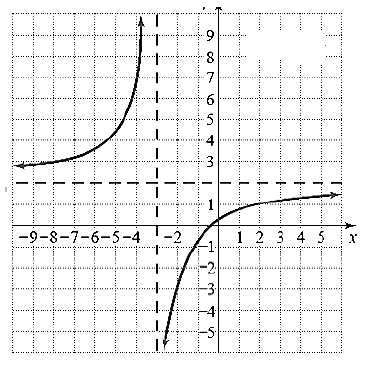
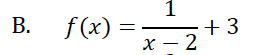
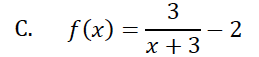
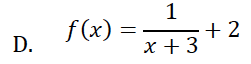
20.

Which is the graph of the rational equation:

a)
b)
c)
d)
21.

Choose all of the functions that have a hole:

a)

f(x)=x2+7xx26x7f\left(x\right)=\frac{x^2+7x}{x^2-6x-7}  

b)

f(x)=(x+8)(x2)(x+2)(x+8)f\left(x\right)=\frac{\left(x+8\right)\left(x-2\right)}{\left(x+2\right)\left(x+8\right)}  

c)

f(x)=x5(x+5)(x1)f\left(x\right)=\frac{x-5}{\left(x+5\right)\left(x-1\right)}  

d)

f(x)=x292x6f\left(x\right)=\frac{x^2-9}{2x-6}  

e)

f(x)=x2+3x5xf\left(x\right)=\frac{x^2+3x}{5x}  

22.

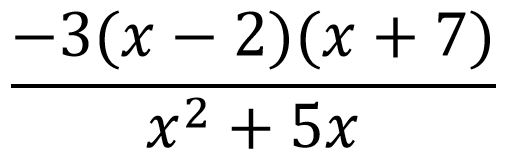
Find the vertical asymptote(s).

a)

x = 3 and x = -7

b)

x = 3

c)

x = -7

d)

x = -4

23.

Which of the following is the equation of a rational function with a hole at x=1x = 1 ?

a)

f(x)=x21x1f(x) = \frac{x^2 - 1}{x - 1}

b)

f(x)=x21x21f(x) = \frac{x^2 - 1}{x^2 - 1}

c)

f(x)=x21x+1f(x) = \frac{x^2 - 1}{x + 1}

d)

f(x)=x21x2f(x) = \frac{x^2 - 1}{x - 2}

24.

Write the equation of a rational function with vertical asymptotes at x=3x = -3 and x=2x = 2 , and a horizontal asymptote at y=0y = 0 .

a)

f(x)=1(x+3)(x2)f(x) = \frac{1}{(x + 3)(x - 2)}

b)

f(x)=x(x+3)(x2)f(x) = \frac{x}{(x + 3)(x - 2)}

c)

f(x)=x2(x+3)(x2)f(x) = \frac{x^2}{(x + 3)(x - 2)}

d)

f(x)=1x2+x6f(x) = \frac{1}{x^2 + x - 6}

25.

What is the horizontal asymptote of f(x)?

f(x)=x225x+5f\left(x\right)=\frac{x^2-25}{x+5}  

a)

y = 0

b)

y = x

c)

x = 0

d)

There is no horizontal asymptote.

26.
What are the Vertical Asymptotes of...
a)
x = 0, -5
b)
x=0, 5
c)
x = 2, -7
d)
x = -2, 7
27.

What is the equation of the graph?

a)
b)
c)
d)
28.
Write an equation for a rational function with an x-intercept of (–1, 0), a hole at x = 3, and a VA at   x = 4. 
a)
y= (x-1)(x+3) / (x+4)(x+3)
b)
y= (x-4)(x-3) / (x+1)(x-3)
c)
y= (x+1)(x-3) / (x-4)(x-3)
d)
y= (x+4)(x+3) / (x+1)(x+3)
29.
Which function has this end behavior?
a)
-x2-3x+1
b)
-x3+2x2+3
c)
x4+3x3-4x+1
d)
x5-4x4+2x2-1
30.

Which root has a multiplicity of 2?

a)

-1

b)

2

c)

4

d)

-4

31.
Where is the graph increasing?
a)
(-∞, -2.55) U (2.55, ∞)
b)
(0, ∞)
c)
(-2.55, 0) U (2.55, ∞)
d)
(-6.25, 36)
32.

Pick the statements that does apply to this polynomial.

a)

It is an odd degree function.

b)

It is an even degree function.

c)

It has a negative leading coefficient.

d)

It has 3 real roots.

e)

It has an absolute maximum

33.

Find all rational zeros, one zero has been given.
f(x) = x3-3x2-x+3;   3

a)

2,4,3

b)

-1,1,3

c)

3,2,1

d)

4,5,6

34.

Find the zeros of the polynomial.
f(x) = (x-5)(2x+3)(7x-4)(x+6)

a)

x = 5, (2/3), 6, (7/4)

b)

x= -5, (3/2), (-4/7), 6

c)

x= 5, (-3/2), (4/7), -6

d)

x= 6, 5, -2/3, -4/7

35.

What are the zeros for this function?

a)
b)
c)
d)
36.

Solve for all zeros:

x(x1)(x+2)(3x5)(x2+1) = 0x\left(x-1\right)\left(x+2\right)\left(3x-5\right)\left(x^2+1\right)\ =\ 0  

a)

x=1, 2, 53, ±ix=-1,\ 2,\ -\frac{5}{3},\ \pm i  

b)

x=0, 1, 2, 53, ±ix=0,\ -1,\ 2,\ -\frac{5}{3},\ \pm i  

c)

x=0, 1, 2, 53, ±ix=0,\ 1,\ -2,\ \frac{5}{3},\ \pm i  

d)

No solution

37.

Factor: 2x2+7x +62x^2+7x\ +6  

a)

(2x+3)(x+2)\left(2x+3\right)\left(x+2\right)  

b)

(x+4)(x+3)\left(x+4\right)\left(x+3\right)  

c)

(x+2)(x+6)\left(x+2\right)\left(x+6\right)  

d)

(x+1)(x+6)\left(x+1\right)\left(x+6\right)  

38.

Solve:

2x3+5x2=7x2x^3+5x^2=7x  

a)

x= 72 and x= 1x=\ -\frac{7}{2}\ and\ x=\ 1  

b)

x = 2, x = 0, & x= 7x\ =\ -2,\ x\ =\ 0,\ \&\ x=\ 7  

c)

x=2, x = 0, & x = 72x=-2,\ x\ =\ 0,\ \&\ x\ =\ \frac{7}{2}  

d)

x= 72, x= 0, & x = 1x=\ -\frac{7}{2},\ x=\ 0,\ \&\ x\ =\ 1  

39.

Identify the domain and range of each. Then sketch the graph.

a)
b)
c)
d)
40.

Find the zeros: y = x(x - 1)(x + 3)

a)

0, 1, -3

b)

-3, 1

c)

-1, 3, 0

d)

-1, 3

41.
What is the relative max of this function?
a)
x = 5
b)
infinity
c)
there is no relative maximum
d)
2.5 and it occurs at x = 5
42.

What is the Range of the function being graphed?

a)

(-∞, ∞)

b)

(7, ∞)

c)

(-∞, 7)

d)

(-1, 1)

43.

Check all the intervals where this graph is increasing.

a)

(-∞, -1)

b)

(-1, 0)

c)

(0, 1)

d)

(1, ∞)

44.

What is the equation of the Vertical Asymptote of y=3x4+2y=\frac{3}{x-4}+2  

a)

x=2x=2  

b)

y=2y=2  

c)

x=4x=4  

d)

y=4y=4  

e)

No Vertical Asymptote

45.

Rewrite as a single logarithm:

log260  log210\log_260\ -\ \log_210  

a)

log26\log_26  

b)

log250\log_250  

c)

log260log210\frac{\log_260}{\log_210}  

d)

log270\log_270  

46.

Solve for x: log(x+9)+logx=log22\log\left(x+9\right)+\log x=\log22  

a)

2, -11

b)

2

c)

-11

d)

11

47.
a)
-10
b)
5
c)
-6
d)
10
48.

a)

i

b)

ii

c)

iii

d)

iv

49.
Which is the inverse for the function
a)
a.
b)
b.
c)
c.
d)
d.
50.

Solve. Check for extraneous solutions.


ln(x+1)-ln(2)=5

a)

x=(e5-1)/2

b)

No Solution

c)

x=2e5-1

d)

x=2e5+1