
Font size
 Worksheets
SS Final Study Guide - Early Humans Chart
Total questions: 104
Worksheet time: 1hrs 2mins
What is the nickname and meaning of the name for Australopithecus afarensis?
‘LUCY’ Beatles song
‘ALICE’ Wonderland
‘MOLLY’ Moon
‘SALLY’ Ride
What is the nickname and meaning of the name for Homo habilis?
HandyMan Made tools
Upright Walker
Fire Maker
Cave Dweller
What is the nickname and meaning of the name for Homo erectus?
Upright Man Stood upright
Wise Man Intelligent
Handy Man Tool user
Modern Man Thinker
What is the nickname and meaning of the name for Homo sapiens neanderthalensis?
Wise man Bones found in Neander Valley in Germany
Modern human Discovered in Africa
Cave dweller Found in France
Stone tool maker Discovered in Asia
What is the nickname and meaning of the name for Homo sapiens sapiens?
Doubly Wise Man
Modern Human
Thinking Man
Ancient Human
How many years ago did Australopithecus afarensis exist?
4 - 3 Million Years Ago (mya)
10 - 8 Million Years Ago (mya)
1 - 0.5 Million Years Ago (mya)
20 - 15 Million Years Ago (mya)
How many years ago did Homo habilis exist?
2 - 1.5 mya
5 - 4 mya
10 - 8 mya
500,000 - 400,000 years ago
How many years ago did Homo erectus exist?
1.8 mya – 200,000 thousand years ago
500,000 – 50,000 years ago
10 million – 1 million years ago
100,000 – 10,000 years ago
How many years ago did Homo sapiens neanderthalensis exist?
230,000 - 30,000 thousand years ago
500,000 - 400,000 thousand years ago
10,000 - 2,000 thousand years ago
1,000,000 - 800,000 thousand years ago
How many years ago did Homo sapiens sapiens exist?
35,000 - 12,000 thousand years ago
100,000 - 80,000 thousand years ago
5,000 - 2,000 thousand years ago
200,000 - 150,000 thousand years ago
What color is associated with Australopithecus afarensis and what does it mean?
No Color
Red, Used Tools
Blue, Built Shelters
Green, Discovered Agriculture
What color is associated with Homo habilis and what does it mean?
Black, No Fire
Red, Used Fire
Yellow, Tool Maker
Green, Hunter
What color is associated with Homo erectus and what does it mean?
Red, Control of Fire
Blue, Use of Tools
Green, Development of Language
Yellow, Discovery of Agriculture
What color is associated with Homo sapiens neanderthalensis and what does it mean?
Blue, Migrated to colder places
Red, Lived in deserts
Green, Inhabited rainforests
Yellow, Adapted to high altitudes
What color is associated with Homo sapiens sapiens and what does it mean?
Green, Traveled to 6 continents
Blue, Lives in oceans
Red, Endangered species
Yellow, Nocturnal behavior
On which continent was Australopithecus afarensis found?
Africa
Asia
Europe
Australia
On which continent was Homo habilis found?
Africa
Asia
Europe
Australia
On which continents was Homo erectus found?
Africa, Europe, Asia
Africa only
Asia only
Europe only
On which continents was Homo sapiens neanderthalensis found?
Africa, Europe, Asia
Africa, North America, Australia
South America, Europe, Antarctica
Asia, Australia, North America
On which continents was Homo sapiens sapiens found?
Africa, Europe, Asia, North America, South America
Africa, Australia, Antarctica, Europe
Asia, Europe, Australia, South America
North America, Antarctica, Europe, Asia
What are the physical features of Australopithecus afarensis?
3 - 3 ½ feet tall, Biped (walk on two feet), Opposable thumb, 1/3 brain size of human, Very hairy
6 feet tall, Quadrupedal (walk on four feet), No opposable thumb, Same brain size as human, No body hair
4 feet tall, Wings for flying, No opposable thumb, Twice the brain size of human, Scaly skin
5 feet tall, Bipedal, No opposable thumb, 1/2 brain size of human, Feathers
What are the physical features of Homo habilis?
4 - 4 ½ feet tall, 2/3 brain size of human, Ape/human like features
6 feet tall, same brain size as modern humans, fully upright posture
Short stature, no use of tools, completely arboreal lifestyle
Over 7 feet tall, large canine teeth, tail present
What are the physical features of Homo erectus?
5-5 ½ feet tall, Foreheads round and smooth, Large eyebrow ridge, Tall and thin, Good walkers & runners, Stood up straight
Short and stocky, Small braincase, No eyebrow ridge, Could not walk upright
Covered in thick fur, Lived in trees, Had tails, Could not use tools
Wings for flying, Webbed feet, Lived underwater, No legs
What are the physical features of Homo sapiens neanderthalensis?
Short and stocky, Very Strong, Thick bones and ridge above eyes, Larger brain
Tall and thin, Weak bones, Small brain, No ridge above eyes
Slender build, Delicate features, Small hands and feet, Small brain
Tall and muscular, Thin bones, No ridge above eyes, Smaller brain
What are the physical features of Homo sapiens sapiens?
5 ½ -6 feet tall, Large brain, rounded skull, small teeth, Bodies not made for the cold, Not as well adapted to the cold
Short stature, elongated arms, large canines, heavy brow ridges
Thick body hair, projecting jaw, small brain, flat nose
Long arms, curved fingers, large teeth, sloping forehead
What were the capabilities of Australopithecus afarensis and how did it impact their life?
First biped! Carry things, pick up things, and defend themselves with their hands
Invented written language and built large cities
Could fly short distances and swim long distances
Used advanced tools made of metal for hunting
What were the capabilities of Homo habilis and how did it impact their life?
Tool making helped live longer, Lived in small groups
Could fly long distances, Built large cities
Invented writing, Practiced agriculture
Used advanced mathematics, Built pyramids
What were the capabilities of Homo erectus and how did it impact their life?
Control of FIRE!!!, Lived in groups, Travel longer and farther, Complex tools, First to leave Africa
Only used simple stone tools, Did not travel far, Lived alone, No use of fire
Built large cities, Invented writing, Used metal tools, Developed agriculture
Could fly, Used electricity, Built skyscrapers, Had modern technology
What were the capabilities of Homo sapiens neanderthalensis and how did it impact their life?
Sense of community, Cared for their sick, buried their dead, Sharp thin blades for weapons, Skilled tool makers, Work together to hunt
Only used basic stone tools, Did not care for their sick, Lived alone
Could not make weapons, Did not hunt in groups, Did not bury their dead
Lacked sense of community, Did not use tools, Did not care for their sick
What were the capabilities of Homo sapiens sapiens and how did it impact their life?
Creating better tools, shelter and clothes to survive, Sewing needles, fish hooks, spear thrower, Cave paintings, Complex language
Building pyramids and inventing the wheel
Domesticating all animals and inventing agriculture
Inventing electricity and the steam engine
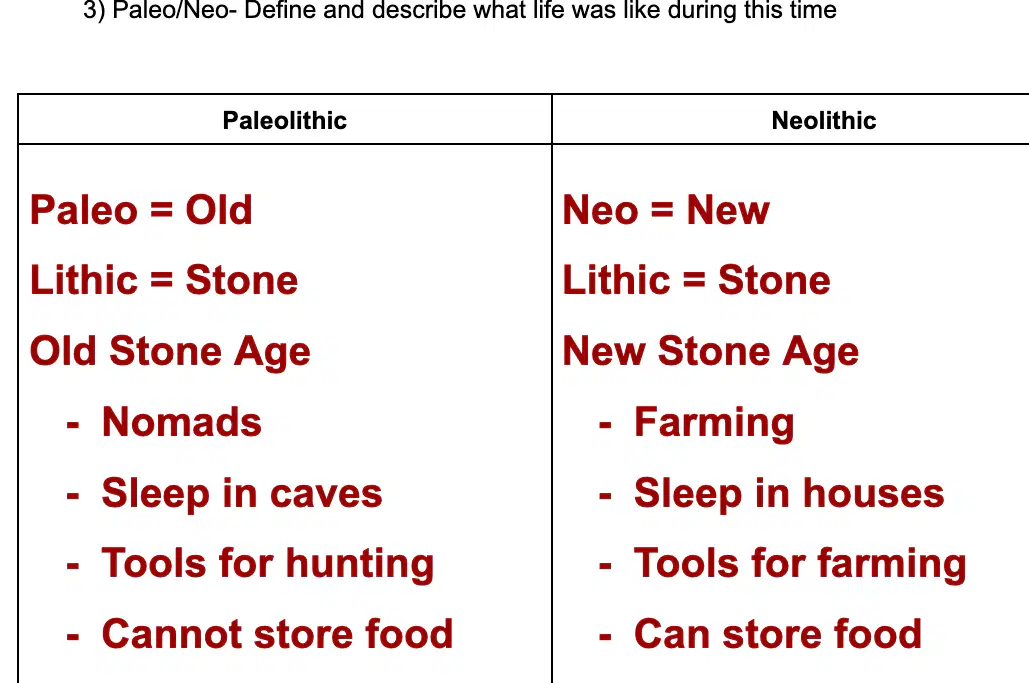
Life during the Paleolithic era was characterized by which of the following?
Nomadic hunter-gatherer lifestyle
Development of agriculture and permanent settlements
Use of advanced metal tools
Establishment of large cities
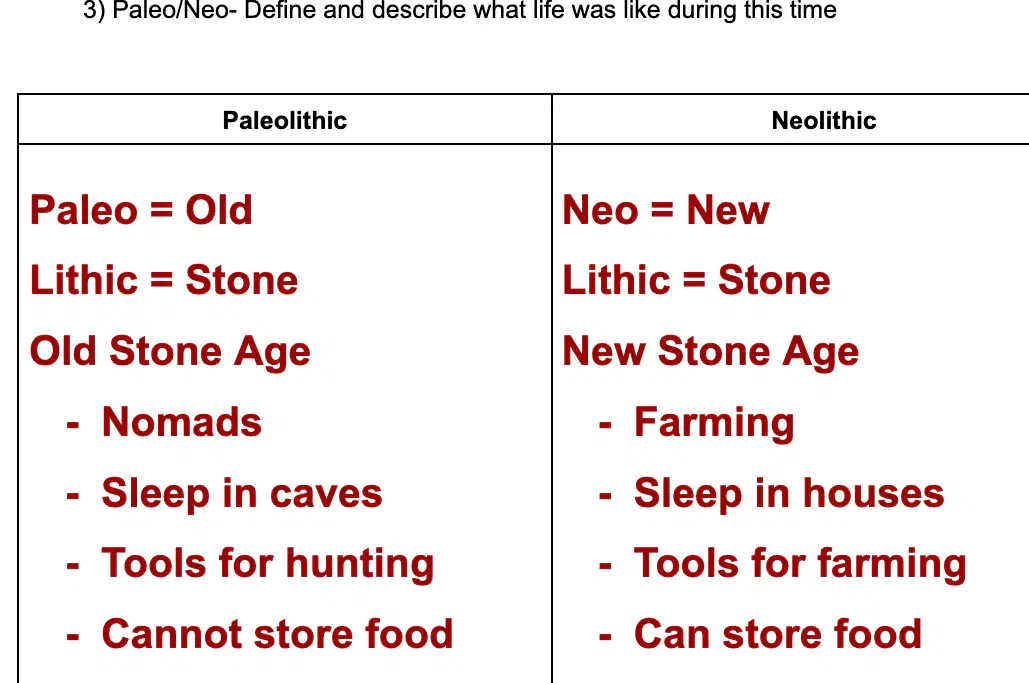
Life during the Neolithic era was characterized by which of the following?
The development of agriculture and permanent settlements
Nomadic hunting and gathering
The rise of large industrial cities
The invention of writing and complex governments
The Great Leap Forward was:
The 1000’s of years between the Paleolithic and Neolithic that show advancements in life due to AGRICULTURE = Farming and Domestication of animals
a peace treaty signed between China and the Soviet Union.
a movement to promote traditional Chinese culture and values.
an economic reform in Japan to boost technology exports.
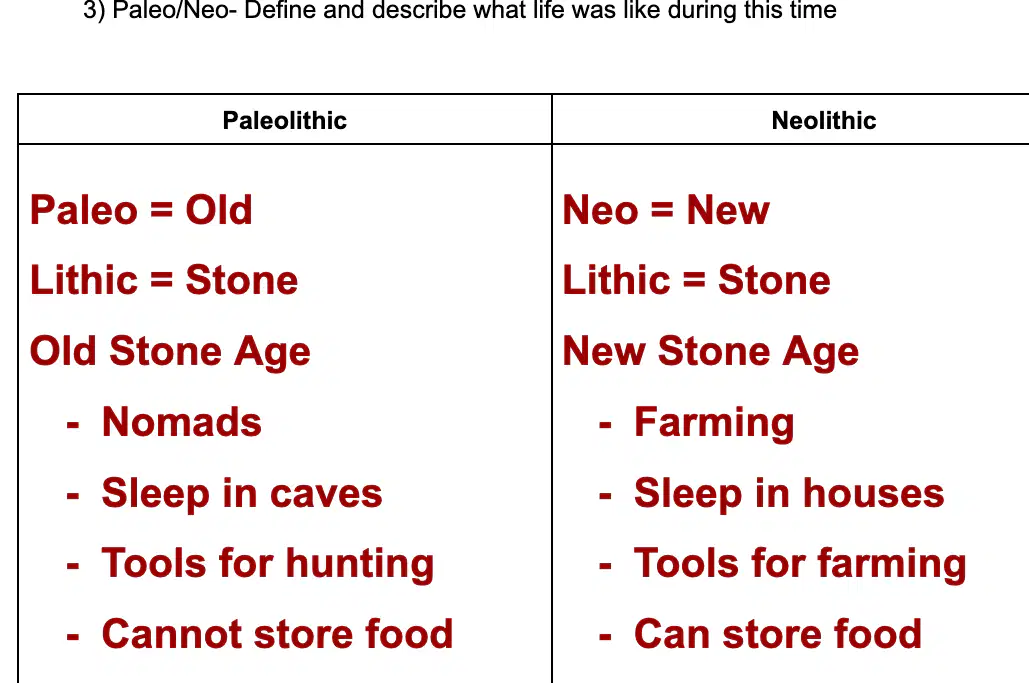
Which era is associated with nomads and sleeping in caves?
Paleolithic era
Neolithic era
Bronze Age
Iron Age
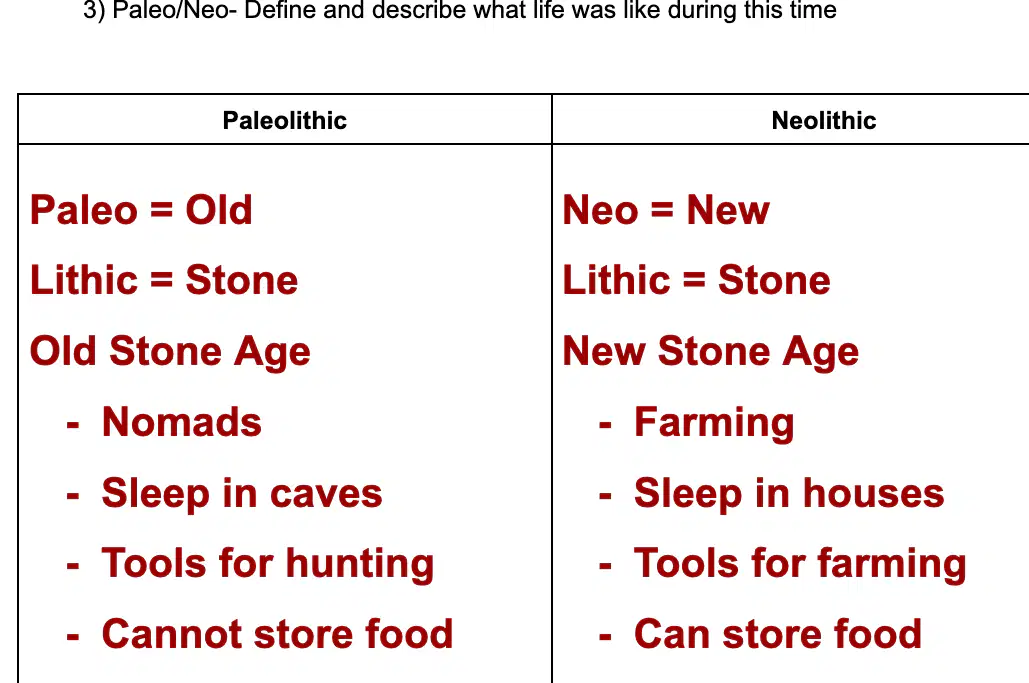
Which era is associated with farming and sleeping in houses?
Neolithic era
Paleolithic era
Bronze Age
Iron Age
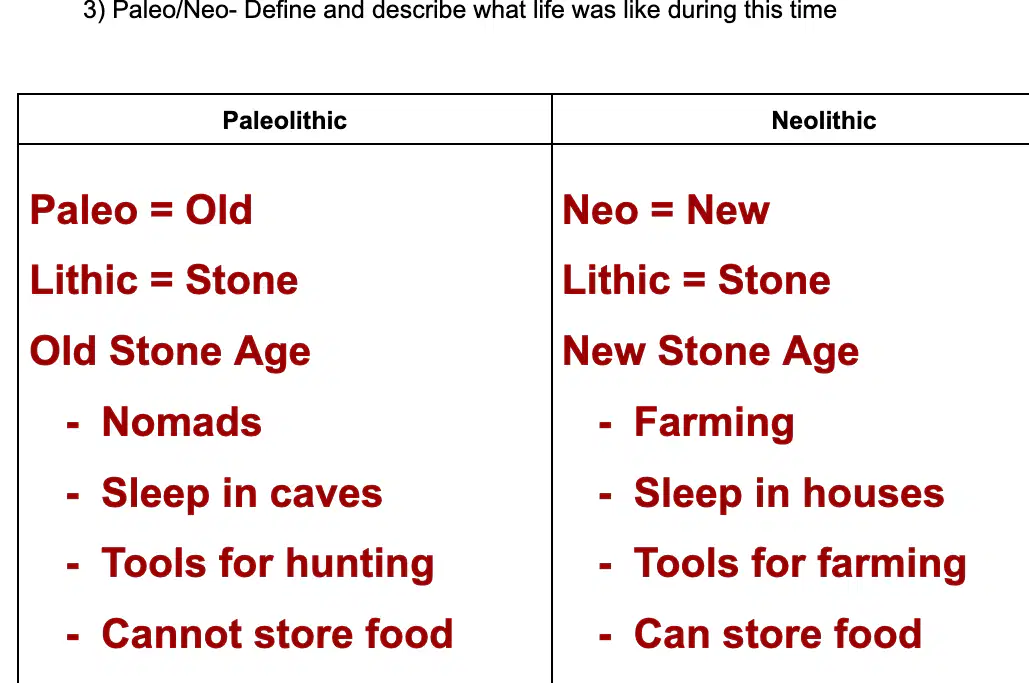
Which of the following is NOT a characteristic of the Paleolithic era?
A) Nomads
B) Tools for hunting
C) Farming
D) Sleep in caves
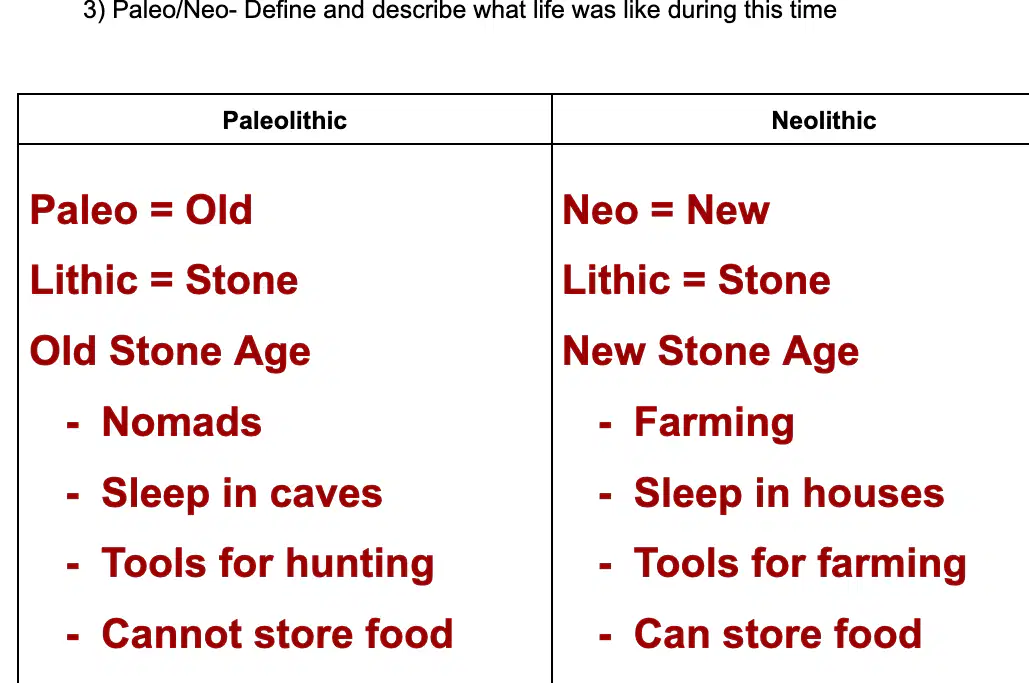
Which of the following is a characteristic of the Neolithic era?
Cannot store food
Domestication of animals
Sleep in caves
Tools for hunting
Write the chain reaction that occurred as a result of the Great Leap Forward.
Stable food supply ⇨ Permanent Shelter ⇨ Communities develop ⇨ Specialized jobs ⇨ Trade ⇨ Spread of ideas
Rapid industrialization ⇨ Increased agricultural output ⇨ Urban migration ⇨ Population boom ⇨ Economic stability
Collectivization of farms ⇨ Surplus grain production ⇨ Export of food ⇨ Improved living standards ⇨ Technological advancement
Government reforms ⇨ Private land ownership ⇨ Market-driven economy ⇨ Wealth distribution ⇨ Social harmony
Complete the following using your knowledge of Mesopotamia: What were the achievements of Akkadian Empire/Civilization?
Achievements: World's first empire, Formation fighting, Political strategies, Steles, Hereditary rule; Notable rulers: Sargon: Created the world’s first empire
Achievements: First written code of laws, Hanging Gardens, Ziggurats; Notable rulers: Hammurabi: Created a famous code of laws
Achievements: Advanced seafaring, Alphabet, Trade networks; Notable rulers: None known for empire-building
Achievements: Monumental pyramids, Hieroglyphics, Pharaohs; Notable rulers: Ramses II: Expanded territory into Nubia
Which civilization is known for the written code of laws?
Babylonian
Egyptian
Greek
Chinese
Who is a notable ruler, known for his written code of laws?
Hammurabi
Julius Caesar
Confucius
Socrates
Which civilization unified the empire and brought order to the people?
Babylonian
Sumerian
Assyrian
Persian
In which civilization did slaves have rights and could buy their freedom?
Babylonian
Roman
Greek
Egyptian
Which civilization is associated with siege warfare, use of horses, and iron weapons?
Assyrian
Egyptian
Harappan
Minoan
Which civilization is known for battering rams, siege towers, and aqueducts?
Assyrian
Greek
Roman
Egyptian
Which ancient civilization is associated with the Hanging Gardens?
Neo-Babylonian
Ancient Egyptian
Indus Valley
Ancient Greek
Which timekeeping device was used by the Neo-Babylonians?
Sun dial
Hourglass
Mechanical clock
Atomic clock
How many minutes are in an hour and how many seconds are in a minute according to the Neo-Babylonians?
60 minutes in an hour, 60 seconds in a minute
100 minutes in an hour, 100 seconds in a minute
24 minutes in an hour, 60 seconds in a minute
60 minutes in an hour, 100 seconds in a minute
How many days are there in a week as established by the Neo-Babylonians?
7 days in a week
5 days in a week
10 days in a week
8 days in a week
How many hours are there in a day according to the Neo-Babylonians?
24 hours in a day
12 hours in a day
10 hours in a day
20 hours in a day
Which subject related to numbers did the Neo-Babylonians contribute to?
Mathematics
Biology
Geography
Literature
Which science related to stars and planets did the Neo-Babylonians study?
Astronomy
Biology
Geology
Chemistry
Who is a notable ruler that rebuilt Babylon and created the Hanging Gardens?
Nebuchadnezzar
Ramses II
Sargon the Great
Hammurabi
What is the nickname of the Old Kingdom?
Age of the Pyramids
Valley of the Kings
Era of Pharaohs
Land of the Sphinx
Complete the following using your knowledge of ancient Egypt: Select the one that is NOT an achievement of the Old Kingdom.
Pyramids
Central Government
Unification of Upper and Lower Egypt
Great Wall
Who was a notable ruler of the Old Kingdom who created a strong central government and united Upper and Lower Egypt?
Pharaoh Djoser
Pharaoh Tutankhamun
Pharaoh Ramses II
Pharaoh Akhenaten
What is the nickname of the Middle Kingdom?
Period of Reunification
Land of the Rising Sun
Cradle of Civilization
Land of the Pharaohs
Complete the following using your knowledge of ancient Egypt: Select one that is NOT an achievement of the Middle Kingdom.
Trade (barter) and double crown
Expansion of Egypt took place
Innovations in war (composite bow & Horse drawn chariot)
Building the Parthenon
Who was a notable ruler of the Middle Kingdom who re-unified Upper and Lower Egypt?
Mentuhotep II
Ramses II
Akhenaten
Khufu
Which time period in ancient Egypt was known for wealth, prosperity, and power, where gold was mined, pharaohs built many monuments, the first major peace treaty was signed, the first woman pharaoh ruled, there was a brief period of monotheism, and a strong military was present?
The Golden Age
The Old Kingdom
The Middle Kingdom
The Predynastic Period
Who were the famous rulers during the Golden Age of ancient Egypt?
Ramses II, King Tut, and Queen Hatshepsut
Alexander the Great, Julius Caesar, and Cleopatra
Akhenaten, Nefertiti, and Imhotep
Sargon, Hammurabi, and Nebuchadnezzar
When was the first major peace treaty signed?
The first major peace treaty was signed during the Golden Age of ancient Egypt.
The Treaty of Babylon was signed during the Golden Age of ancient Egypt.
The Treaty of Thebes was signed during the Golden Age of ancient Egypt.
The Treaty of Memphis was signed during the Golden Age of ancient Egypt.
Who was the first woman pharaoh during the Golden Age of ancient Egypt?
Queen Hatshepsut
Cleopatra VII
Nefertiti
Sobekneferu
What natural barriers helped isolate ancient China from other civilizations?
Mountains (Himalayas), deserts (Gobi & Taklamakan), rivers (Huang He/Yellow River, Yangtze River)
Dense forests and rainforests only
Large lakes and plateaus only
Oceans and tundra regions only
Complete the following using your knowledge of ancient China: Ancient China was _______ from other civilizations due to its natural barriers.
isolated
united
welcomed
connected
Fill in the blank: __________ emphasizes respect, family, education, order, and leading by example. What philosophy is this?
Confucianism
Legalism
Daoism
Buddhism
Fill in the blank: ______________ emphasizes harmony with nature, balance, and ruling as little as possible?
Daoism
Legalism
Confucianism
Buddhism
Fill in the blank: _____________ emphasizes strict laws and harsh punishments. What philosophy is this?
Legalism
Confucianism
Daoism
Buddhism
Who was the emperor that united China, built the Great Wall, and used Legalism?
Emperor Qin Shi Huang Di
Emperor Wu of Han
Emperor Taizong of Tang
Emperor Gaozu of Han
Is Lu Zhi a notable leader of ancient china?
Yes
No
Is Liu Bang a notable leader of ancient china?
Yes
No
Which is NOT a notable leader of Ancient China?
Liu Bang
Lu Zhi
Gao Zu
Zhang Fei
Which achievement involved building a massive defensive structure in China?
Great Wall of China
Taj Mahal
Eiffel Tower
Colosseum
Which achievement involved creating a large clay army to protect an emperor in the afterlife?
Terracotta Army
Great Wall of China
Mona Lisa
Rosetta Stone
Which achievement was a major trade route connecting China to the West?
Silk Road trade
Great Wall construction
Terracotta Army creation
Forbidden City building
Which is NOT an achievement of ancient china?
Paper
Iron tools
compass
Printing press
Which achievement refers to a system for selecting government officials during the Han dynasty?
Civil service exams under Han dynasty
The construction of the Great Wall
The invention of paper money
The establishment of the Silk Road
Which achievement refers to the development of a method for written communication in ancient China?
Writing system
Agriculture
Pottery
Wheel
Which ancient China achievement is an instrument for detecting earthquakes?
Seismograph
Barometer
Thermometer
Hygrometer
Which ancient China achievement is a chemical invention used in weapons and fireworks?
Gunpowder
Papyrus
Compass
Printing Press
Complete the following using your knowledge of ancient Greece: The mountainous terrain of Greece led to the development of _________.
isolated city-states (polis)
pharaohs
empires
colonies
Complete the following using your knowledge of ancient Greece: Greece is surrounded by seas such as the ________ and ________ seas.
Aegean, Mediterranean
Baltic, North
Red, Arabian
Caribbean, Coral
Complete the following using your knowledge of ancient Greece: Limited farmland in Greece led to increased ________ and colonization.
trade
warfare
farming
isolation
Complete the following using your knowledge of ancient Greece: Greece is made up of thousands of ________.
islands
mountains
rivers
forests
Complete the following using your knowledge of ancient Greece: Athens is known as the birthplace of ________.
democracy
philosophy
architecture
mythology
Complete the following using your knowledge of ancient Greece: Athens focused on education, arts, and ________.
philosophy
farming
military training
hunting
Complete the following using your knowledge of ancient Greece: In Athens, citizens participated in ________.
government
theater only
military parades only
religious festivals only
Complete the following using your knowledge of ancient Greece: Athens had a strong ________.
navy
army
economy
government
Complete the following using your knowledge of ancient Greece: Athens relied on ________ for its economy.
trade
farming
mining
hunting
Sparta was a __________-focused society.
Military
Art
Trade
Religious
In Sparta, boys were trained as __________ from a young age.
soldiers
farmers
merchants
artists
What type of government did Sparta have?
Democracy
Oligarchy
Monarchy
Republic
Women had more rights in Sparta than in Athens.
True
False
Which famous building is an example of Greek architecture?
Colosseum
Parthenon
Eiffel Tower
Pyramids
Select one that is NOT a famous Greek philosopher.
Socrates
Plato
Leonardo da Vinci
Aristotle
The __________ originated in ancient Greece.
Olympics
World Cup
Tour de France
Super Bowl
Drama and __________ were important parts of Greek culture.
theater
farming
mathematics
architecture
Which subject did the Greeks contribute ideas to?
Math
Science
Both A and B
Social Studies
Which form of government began in ancient Greece?
Monarchy
Democracy
Dictatorship
Oligarchy
What type of farming did the Greeks develop?
Terrace farming
Slash-and-burn farming
Hydroponic farming
Nomadic herding
How does geography impact a civilization?
Why do empires rise and fall?
What role did religion play in the everyday life of ancient people?
What legacies did the ancient world leave to the modern world?

