
 Worksheets
End of Year SS Review
Total questions: 100
Worksheet time: 18mins
The first skeletons of humans were found in _______________.
Africa
Asia
North America
Europe
The civilization of Mesopotamia invented _____________.
pyramids
terrace farming
writing
arches
The ancient Egyptians built ____________.
aqueducts
pyramids
arches
terraces
What is the name of the river in Egypt which is also the world's longest river?
Tigris River
Euphrates River
Yangtze River
Nile River
A mountain range that isolated India from other civilizations was __________.
the Alps
the Himalayas
the Caucasus Mountains
the Balkans
Which of these was NOT a religion that developed/began in Asia?
Judaism
Islam
Buddhism
Hinduism
Roman Catholicism
What was built in China to protect the kingdom from invaders?
Hadrian's Wall
the Great Wall
the Wailing Wall
the Berlin Wall
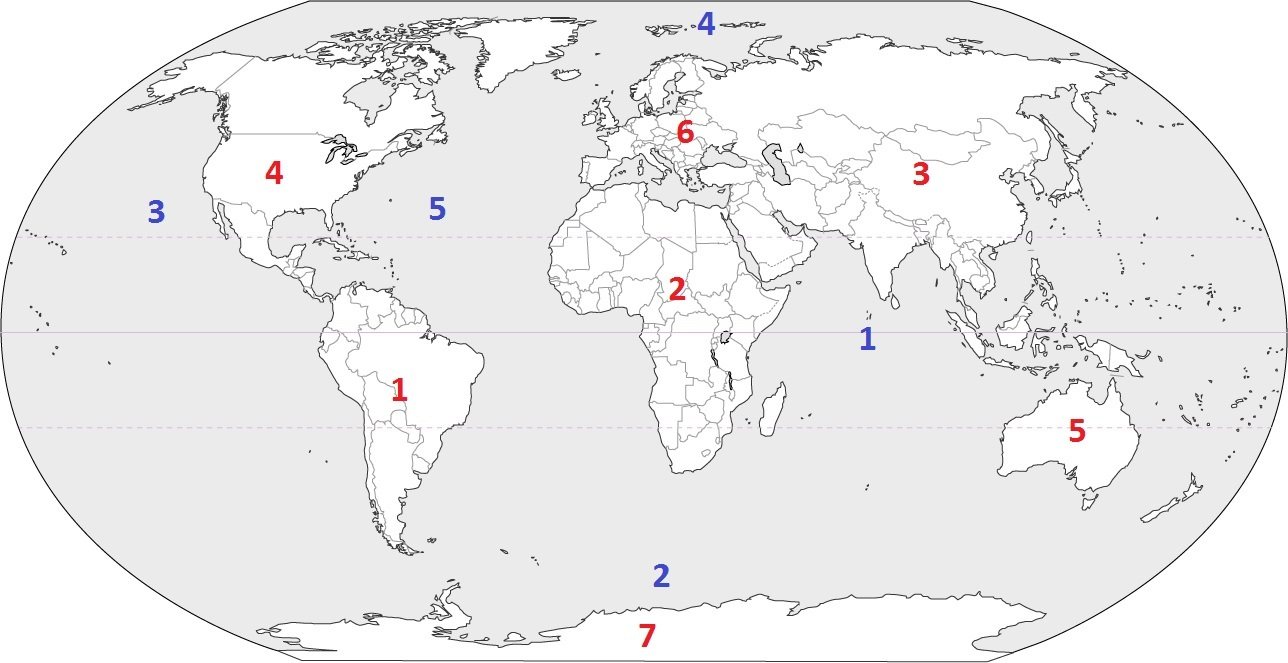
Which continent is located at #5?
South America
Asia
Australia
Antarctica
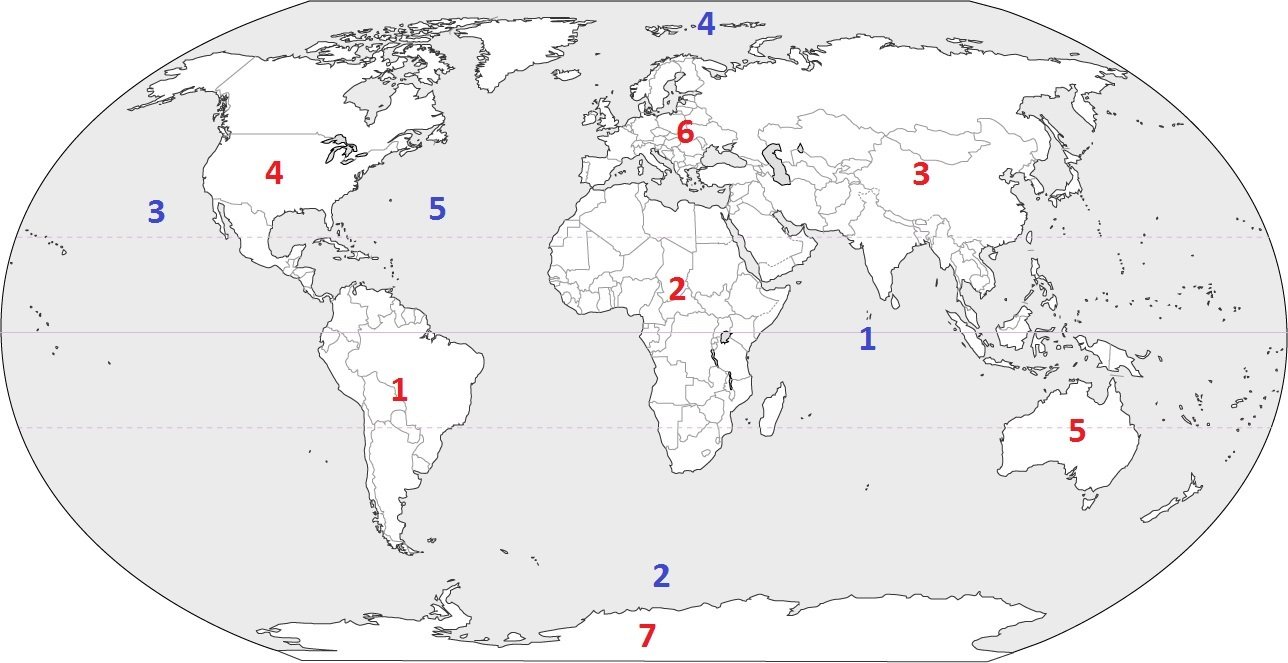
Which continent is located at #4?
South America
North America
Europe
Africa
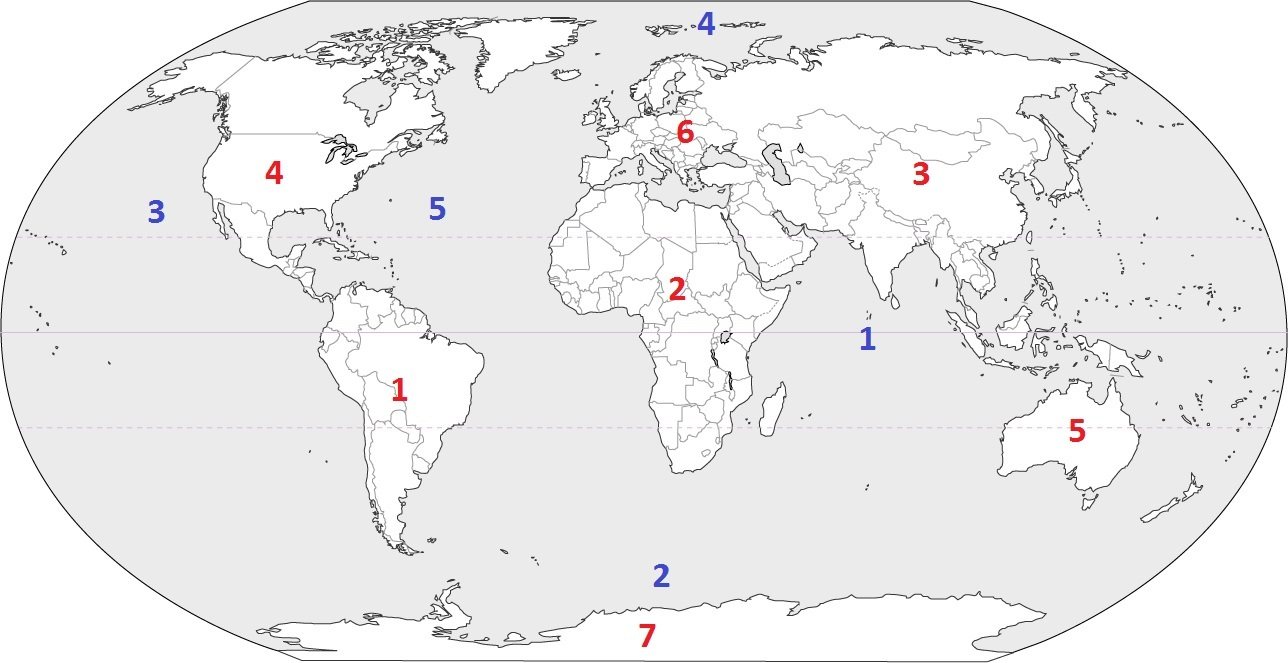
Identify the ocean at location #3
Atlantic Ocean
Arctic Ocean
Pacific Ocean
Indian Ocean
Which continent is located at #5?
South America
Asia
Australia
Antarctica
Which continent is located at #4?
South America
North America
Europe
Africa
Identify the ocean at location #3
Atlantic Ocean
Arctic Ocean
Pacific Ocean
Indian Ocean
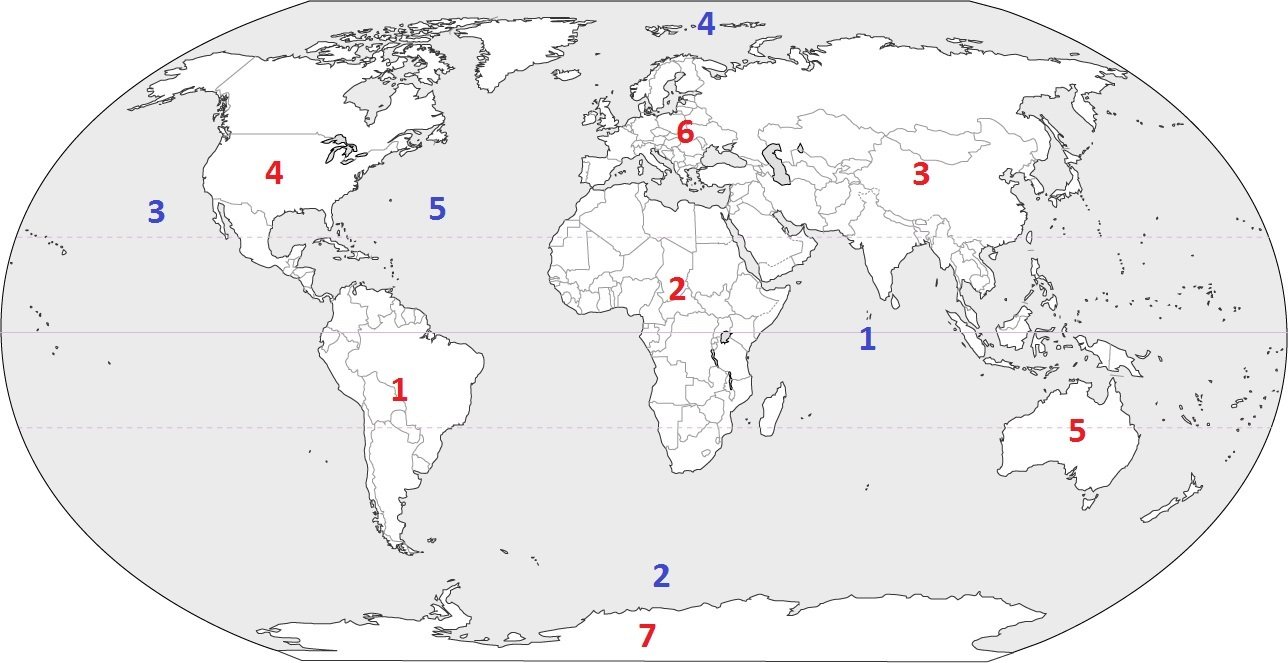
Identify the ocean at location #5
Atlantic Ocean
Southern Ocean
Pacific Ocean
Arctic Ocean
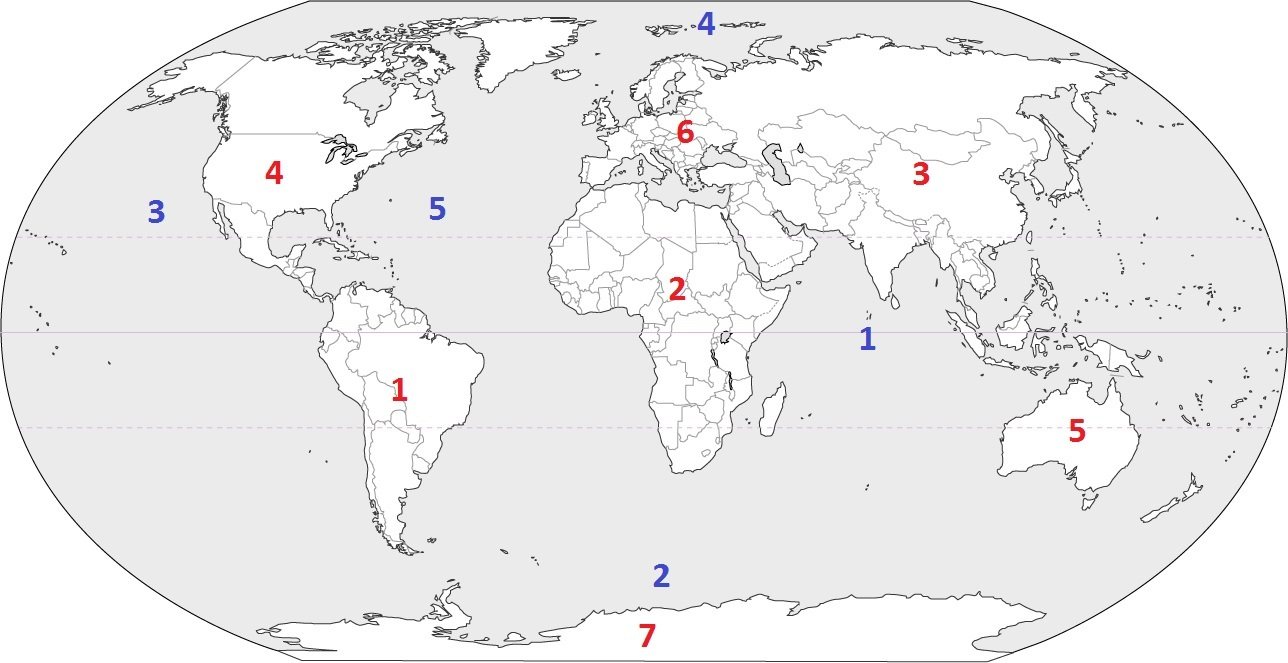
Identify the ocean at location #1
Southern Ocean
Arctic Ocean
Atlantic Ocean
Indian Ocean

Which event on this timeline happened FIRST?
Last use of hieroglyphic writing
Rosetta Stone is carved
Settlers in Nile Valley
Development of hieroglyphic writing
Timelines are read from
right to left
left to right
upside down
not read
B.C.E. stands for
Before Christ
Best Common Era
Before Common Era
Common Era
AD
Anno Domini
After Death
After Dinner
Already Done
A source created about an event or time-period by someone who was there
Primary
Secondary
An article about the Civil War written during the Civil War
Primary
Secondary
A report about the life of Abraham Lincoln written by a 5th grade student
Primary
Secondary
An audio recording of an immigrant talking about their experience of Ellis Island.
What is the audio recording in this sentence?
Primary
Secondary
Which answer below is a Secondary Source?
Autobiography
Photograph
Diary
Textbook
Which website domain should I use if I am researching a Virgina State's historical sites?
.com
.gov
.edu
.biz

What was the first river valley to appear?
China
Egypt
Indus
Mesopotamia

Name the civilization:
- Nile River
- Hieroglyphics
- Pyramids
Egypt
Mesopotamia/
Sumer
India
China

Name the civilization:
- Huang He (Yellow) River
- Calligraphy writing
- Paper and Silk
Egypt
Mesopotamia/
Sumer
India
China

What is a city state?
A city surrounded by agricultural land.
A city.
A city with a wall.
An empire.
What made Hammurabi famous?
He was a powerful king who built an empire.
He had some harsh laws.
He conquered and enslaved the Jewish people.
He created the first written laws.
The ancient civilizations of Mesopotamia and Egypt were similar in that both cultures
established trade routes to China
used the ziggurat form for their temples
developed along rivers
used a hieroglyphic writing system

What is a scribe?
Record Keeper
A god
A person
A tool
Qin Shi Huangdi, the first emperor of China is widely known for stopping the invading Barbarians of the North by building which historical monument?
The Pottala Palace
The Great Wall
The Terracota Army
The forbidden city
How did China's rulers and dynasties acquire their right to rule?
Eightfold Path
Mandate of Heaven
The People
Edict of Law
What is the belief in many gods?
Monotheistic
Polytheistic
Animism
Symbolism
How were civilizations able to sustain a growing population?
Fortified military bases
Strong rulers
Growing a surplus of food
Trading with other civilizations

What word best describes the land of the Greek peninsula?
rocky and mountainous
flat
desert
rolling plains

A city-state which favored democracy and a well-rounded education.
(Also, the largest city-state by a wide margin)
Sparta
Athens
Delphi
Corinth

What does the word "Democracy" mean?
"rule by the government"
"rule by the many"
"rule by the wealthy"
"rule by the people"
A great city in Greece, that had an Oligarchy type of Government, taught boys to be good soldiers, and took what they needed from neighbors.
Sparta
Athens
A Greek Philosopher that taught people use a question and answer way of thinking.
Socrates
Aristotle
A Government with the power in the hands of a few wealthy people.
Oligarchy
Tyranny
Monarchy
Democracy
A single ruler who passes their reign on to their son
Monarchy
Oligarchy
Tyranny
Democracy
A military leader seizing military power illegally
Tyranny
Oligarchy
Monarchy
Democracy
How does Athenian democracy differ from our democracy?
In Athens they directly voted to make decisions and we elect representatives.
Athens had less people on a jury than we have today.
Athens didn’t allow foreigners to vote or make decisions.
Women had more rights in Athenian democracy.
The three orders of Greek columns are called:
Socrates, Plato, Aristotle
Doric, Ionic, Corinthian
Dorian, Isosceles, Corinthian
Monarchy, Oligarchy, Democracy
The games held every four years at a festival to honor Zeus were called
Goodwill Games
Marathons
Olympics
Triathlons
Which structure is considered to be the finest example of Greek architecture?
The temple of Apollo
The stadium at Olympia
The Great Library at Alexandria
The Parthenon

This picture is an example of Greek architecture of which type of column?
Greek
Corinthian
Doric
Ionic

The Lincoln Memorial has ________________ columns.
Corinthian
Ionic
Doric
Which of the following is NOT a reason that led to the fall of the Roman Empire?
Empire was hard to defend because of size.
The economy was failing.
Invasions from barbarian tribes.
Science convinced people the earth was flat and they fell off the edge.
Which statement is an example of how hunter-gatherer communities adapted to their environments?
They made permanent homes out of wood and stone.
They built irrigation systems to water crops.
They domesticated animals such as cows and pigs.
They made small tools and weapons out of stones.
Why were hunter-gatherer communities nomadic?
They were looking for the best place to farm.
They were involved in wars with other groups.
They were searching for food.
They were on a religious pilgrimage.
Agriculture, complex governments, domestication of animals, and the division of labor are characteristics of which time period?
Industrial Revolution
Paleolithic Age (Old Stone Age)
Neolithic Age (New Stone Age)
Scientific Revolution
Which practice is an example of an irrigation technique?
building canals and dams
building a temple to the god of farming
performing soil preparation rituals
having a spiritual leader pray for rain
Which language thrived in Mesopotamia throughout the reign of three successive civilizations?
Akkadian
Babylonian
Persian
Sumerian
What significant invention derived from Mesopotamian astronomers?
a 12 month calendar
a 16 month calendar
an ovservatory
a telescope
In what way were hieroglyphics an advancement in written language?
Hieroglyphics used numbers to represent vowels.
Hieroglyphics used accents to represent emotion.
Hieroglyphics used pictograms to represent words.
Hieroglyphics used letters to represent sounds.
How did the invention of papyrus impact Ancient Egyptian civilization?
It allowed written ideas to be re-created easily.
It allowed military leaders to create stronger weapons.
It allowed religious leaders to create large temples.
It allowed a money-based economy to develop.
The Gobi Desert is located in which modern-day country?
China
Egypt
Greece
Iraq
Asia Minor is bordered by which body of water?
Atlantic Ocean
East China Sea
Mediterranean Sea
Pacific Ocean
What was the first monotheistic religion?
Buddhism
Confucianism
Hinduism
Judaism
Judaism was founded on the idea that God created a covenant with Abraham to do what?
provide a way for the Jewish people to be reincarnated to a higher status
establish a social hierarchy similar to the caste system
spread the Jewish religion and influence over all the globe
give the land of Canaan (now Israel) to Abraham's descendants.
What common belief do Judaism, Islam, and Christianity all share?
karma
monotheism
polytheism
reincarnation
Which religion grew out of Judaism?
Buddhism
Christianity
Hinduism
Shinto
is the set of beliefs, values, and practices that a group of people has in common.
history
Culture
geography
ethnic group


Polytheistic means...
To believe in many gods
To believe in only one god
That you do not believe in any gods
These things were left behind by humans
Fossils
Artifacts
Computers
Rulers of Ancient Egypt that had complete control.
Kings
Peasants
Pharaohs
The belief in only one god
polytheism
monotheism
parathesim
a time period of 100 years
a decade
a century
an era

A location described by where it is in relation, or compares, to somewhere else.
Longitude
Relative Location
Latitude
Specific Location
Societies adapted to their surroundings by irrigating and building dams. Why did they need to use these techniques?
to decrease the overcrowding of crops
to increase space for people to live
to increase their farmland for growing crops
to decrease the numbers of animals on the land
What was the greatest benefit when people began farming?
They had more time to relax.
They had better-tasting food.
They had a large and stable supply of food.
They had enough water for crops.
Trade
Permanent shelters
Division of labor (jobs)
Agriculture
Are characteristics of the
Neolithic Era
Paleolithic Era
Middle Ages
Iron age

This map shows which social studies concept?
Innovations
Government
Cultural Diffusion
Conflict
the study of a how a society uses limited resources to meet unlimited wants and needs is called
economics
history
geography
culture
One of the most important responsibilities we have in the US is the right to
sing
eat
dance
vote
What does the word Buddha mean?
enlightened
chosen
awakened
predicted
What is Nirvana?
a region in India
what a person desires
a band from the 90s
a state of peace and happiness
Who is the founder of Buddhism?
Guru Nanak
Siddhartha Gautama
Mahavira
No founder
Term for the effect of a person's actions in this and in previous lives.

