
 Worksheets
Final Test Outline - Fundamentals and Safety
Total questions: 98
Worksheet time: 59mins
What is the main role of Primary Health Care?
Specialized surgery
Prevention and treatment for regular and minor conditions
Emergency room visit
Cancer treatment
Which type of health care involves medical specialists who typically don’t have initial contact with patients?
Primary Health Care
Secondary/Acute Health Care
Tertiary Health Care
Home Care
Tertiary Health Care is required for patients who need a higher level of care in a hospital.
True
False
What is the purpose of OHSA?
To provide medical treatment
To facilitate a strong internal responsibility system (IRS) in the workplace
To offer health insurance
To manage patient records
Fill in the blank: OHSA gives workers the right to know about (a) in their work and get information, supervision, and instruction to protect their health and safety on the job.
WHMIS is a program legislated by both federal and provincial jurisdictions to provide information on the safe use of all hazardous materials in the workplace.
True
False
What is the minimum time to wash hands for (using soap, water, and sanitizer)?
(a)
Which of the following is NOT one of the 7 motions of hand hygiene?
Rub hands together palm to palm.
Rub palms to palm with fingers interlaced.
Rub elbows together.
Rub each thumb clasped in the opposite hand using a rotational movement.
List all 7 motions of hand hygiene.
(a)
When should a healthcare worker use hand sanitizer instead of soap and water?
(a)
Hands must look clean before using hand sanitizer.
True
False
What is the minimum time to scrub with hand sanitizer?
(a)
How should the tap be turned off after hand washing is done?
(a)
What is the recommended percentage of alcohol in hand sanitizer?
(a)
When should gloves be used? Select all that apply.
When handling hazardous materials
When cleaning
When caring for someone who is sick
All of the above
True or False: After caring for a patient, you can wear the same pair of gloves for the care of more than one patient.
True
False
What is the first item to be removed in the PPE doffing order?
(a)
What areas of your personal protective equipment (PPE) are considered contaminated?
Anatomical position (what is the positioning of the body for it to be anatomically correct?)
Use anatomical terminology correctly in a sentence (e.g., distal, lateral, superior, etc.).
What does the term 'Medial' mean?
Towards the middle
Away from the middle
Towards the top
Towards the bottom
What does the term 'Lateral' mean?
Towards the middle
Away from the middle
Towards the top
Towards the bottom
What does the term 'Superior' mean?
Towards the bottom
Towards the surface
Towards the top
Away from the surface
What does the term 'Inferior' mean?
Towards the top
Towards the bottom
Closest to the point of attachment
Farthest from the point of attachment
What does the term 'Superficial' mean?
Towards the surface
Away from the surface
Closest to the point of attachment
Farthest from the point of attachment
What does the term 'Deep' mean?
Towards the surface
Away from the surface
Towards the middle
Away from the middle
What does the term 'Proximal' mean?
A) Closest to the point of attachment
B) Farthest from the point of attachment
C) Towards the top
D) Towards the bottom
What does the term 'Distal' mean?
Closest to the point of attachment
Farthest from the point of attachment
Towards the surface
Away from the surface
Fill in the blank: A group of cells that perform the same function is called a (a) .
Fill in the blank: A group of tissues that work together is called an (a) .
Fill in the blank: A group of organs that work together is called an (a) .
Which of the following is NOT a function of the skeletal system?
Provide support and protection for the organs
Provide levers for movement
Store minerals and make red blood cells
Digest food
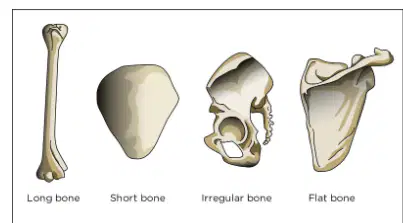
Which type of bone is longer than it is wide and acts as a rigid lever for muscles?
Short
Long
Irregular
Flat
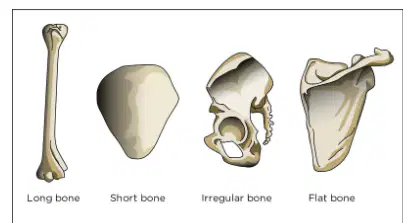
Which type of bone is equal in width and length?
Short
Long
Irregular
Flat
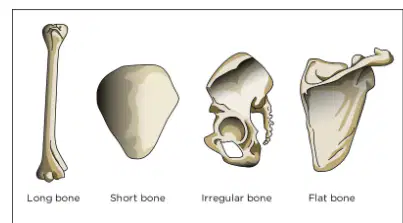
Which type of bone is typically not flat nor long?
Short
Long
Irregular
Flat
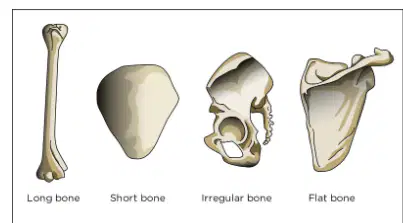
Which type of bone protects soft organs and is curved?
Short
Long
Irregular
Flat
What is the definition of a joint?
(a)
What is the definition of a dislocation?
(a)
Which type of joint is connected by dense connective tissue made mostly of collagen and is immovable?
Fibrous
Cartilaginous
Synovial
Which type of joint is connected entirely by cartilage and provides cushioning between bones?
Fibrous
Cartilaginous
Synovial
Which type of joint is freely moveable and joins bones together with fibrous joint capsules filled with synovial fluid?
Fibrous
Cartilaginous
Synovial
What does a ligament do?
(a)
What is a sprain?
(a)
What does a tendon do?
(a)
What is a strain?
(a)
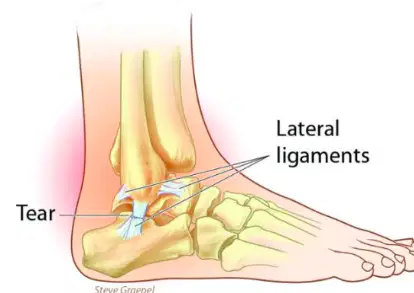
Refer to the diagram of the ankle. What injury is shown by the tear in the lateral ligaments?
(a)
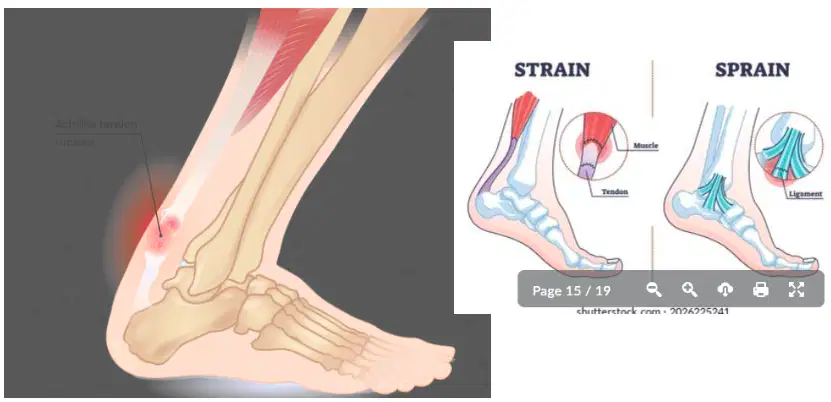
Which of the following is NOT a sign or symptom that indicates a possible injury (such as a fracture, dislocation, sprain, strain) in general?
Extreme pain
Redness and bruising
Heat
Increased appetite
Swelling
Fill in the blank: The three types of muscles are ________, ________, and ________.
(a)
Which type of muscle is attached to bones and is also known as voluntary muscle since it can be moved by conscious control?
(a)
Which type of muscle is found only in the heart and is involuntary?
(a)
Which type of muscle is involuntary, unattached to bones, acts slowly, and is also known as visceral muscle?
(a)
What is the difference between active and passive range of motion?
Strain is defined as:
Protrusion of an organ through the wall of a cavity
A tear or overstretching of muscle or tendon
Hernia is defined as:
Protrusion of an organ through the wall of a cavity
A tear or overstretching of muscle or tendon
What is Tetanus?
(a)
What is a Muscle Spasm?
(a)
What is Lateral Epicondylitis?
(a)
What are Shin Splints?
(a)
What is a Rotator Cuff Tear?
(a)
What is the main function of the heart in the circulatory system?
(a)
Which blood vessels carry blood AWAY from the heart?
(a)
Which blood vessels carry blood TOWARDS the heart?
(a)
What do capillaries connect?
(a)
How many capillaries are there in the human body?
(a)
What is the purpose of valves in the heart?
(a)
Why is the pulmonary artery considered an artery even though it carries deoxygenated blood?
(a)
Which of the following is NOT a risk factor for cardiovascular disease?
Family history
High blood pressure
Eating vegetables
Obesity
Arteries carry oxygen rich blood.
True
False
True or False: Veins carry blood away from the heart.
True
False
What is a myocardial infarction (MI)?
(a)
What are the functions of the respiratory system?
(a)
What is pulmonary ventilation?
(a)
Describe the process of inhalation (inspiration) in the respiratory system.
(a)
Describe the process of exhalation (expiration) in the respiratory system.
(a)
What does 'intercostal' mean?
(a)
What is eupnea?
(a)
What is apnea?
(a)
What is dyspnea?
(a)
What is hyperpnea?
Decrease in depth/rate of breathing
Increase in depth/rate of breathing with abnormal exaggeration of respiratory movements
Laboured breathing when in a horizontal position
Infection of the lung
What is orthopnea?
Laboured breathing when in a horizontal position
Increase in depth/rate of breathing
Infection of the lung
Inflammation of mucous membrane of respiratory system
What is a common way to relieve orthopnea?
(a)
Which virus causes the common cold?
Rhinovirus
Streptococcus
Influenza virus
Mycobacterium tuberculosis
Which of the following is NOT a symptom of the common cold?
Runny nose
Watery eyes
Painful swallowing
Coughing
What is the usual treatment for the common cold?
(a)
Pharyngitis (Strep Throat) is usually treated with (a) .
Which of the following is a symptom of pharyngitis (strep throat)?
Painful swallowing
Chest pain
Night sweats
Sneezing
What is the main symptom of influenza ("flu")?
Inflammation of mucous membrane of respiratory system
Red, inflamed throat
Alveoli filled with thick fluid
Laboured breathing when in a horizontal position
What is the recommended prevention for influenza?
(a)
Pneumonia is an infection of the (a) .
Which of the following is NOT a symptom of pneumonia?
A) Chest pain
B) Fever
C) Chills
D) Painful swallowing
Tuberculosis (TB) is primarily a disease of the (a) .
Which of the following is NOT a symptom of tuberculosis?
Weight loss
Night sweats
Painful swallowing
Coughing up blood
What is the typical duration of antibiotic treatment for tuberculosis (TB)?
(a)
What is ergonomics?
The science concerned with the 'fit' between people and their work
The study of animals
The science of weather
The study of plants
Which of the following is NOT a consideration for electrical beds?
Plugged in prior to use
Check the condition of the cord
Unplug when not in use
Use the bed without checking the cord
Fill in the blank: Bed should be raised to caregivers’ (a) level when performing a procedure on a patient.
What should you do if wheels are not locked on a hospital bed?
Move the bed
Leave the bed as it is
Lock the wheels unless the bed is being moved
Ignore it
What is the first priority in emergency scene management?
Get help
Survey the scene
Get consent
Assess responsiveness

