
 Worksheets
GROS EOPA
Total questions: 100
Worksheet time: 1hrs 4mins
Which of the following agencies is responsible for enforcing safety standards in the workplace?
OSHA
EPA
FDA
USDA
What is the purpose of safety data sheets?
To describe past accidents related to the chemical
To describe who can use the chemical
To list information such as precautions and possible hazards of a chemical
To list the ingredient concentrations in a chemical
Ebola is a highly infectious disease. This agency, along with the WHO, sets the rules and standards for how healthcare workers and other professionals respond to Ebola outbreaks?
Department of Labor
United Nations
OSHA
CDC
An autoclave is used to?
Spin samples very fast in order to separate them.
Weigh very precise amounts of a solid.
Make copies of DNA samples
Sterilize equipment using very hot steam under high pressure.
What is the definition of sterilization?
A process that eliminates some microorganisms but NOT all.
A process that eliminates ALL microorganisms including viruses and spores.
A process that eliminates 75% of microorganisms including viruses.
A process that eliminates 99% of microorganisms.
Alcohol is a .
Sterilizer
Disinfectant
Gas sterilizer
Sanitizer
What degree do you need to be a Physical Therapist?
Doctorate
Bachelors
Masters
Associates
What is the stage of Medical School where you get your training?
Undergraduate
Residency
Volunteer experience
Fellowship
What does a Otorhinolaryngologist treat?
Rhinoceros'
Diseases of the Ear, Nose, & Throat
Limb Pain
Communicable Diseases


Biohazard
Johnny Test
Toxic/Radioactive

Crying
Eye wash station
Wash your face
Fee paid when you see a doctor
copay
deductible
premium
coinsurance
Amount you pay before the insurance pays
copay
deductible
premium
coinsurance
Amount you pay each month to the insurance company
copay
deductible
premium
out of pocket maximum
What term describes the death rate?
morbidity
biohazard
HAI
mortality
What does OSHA stand for?
organization for student health and academics
ordinances for saved health accounts
occupational safety and health administration
optimal safety by hazard allocation
If you are supine, you are lying ___.
on your side
face down
face up
in a seated position
If you work with chemicals, your office must have what documents available?
CDC
FDA
MSDS
OSHA
Your new office has ergonomic desk chairs. This means the chairs are designed for ___?
easy rolling
efficient movement
effective weight distribution
encouraging productivity
Healthcare professionals must wash their hands and wear gloves to help reduce the risk of _____.
hospital acquired infections
biohazards
ergonomics
patient positioning errors
The heart is best described as a:
muscular pump
storage chamber
message center
filtration unit
What would happen if a small hole developed in the septum?
The heart would stop pumping.
Blood would move between the right and left side of the heart.
The blood from the pulmonary artery would enter the aorta.
Blood would not flow into the coronary arteries
When blood leaves the left atrium, where does it go next?
aorta
left ventricle
right atrium
pulmonary artery
After blood leaves the right atrium, what valve prevents back flow?
tricuspid
mitral
pulmonary
aortic
What follows diastole?
phagocytosis
fibrillation
hyperbole
systole
What type of blood vessel is the MOST muscular and elastic?
artery
vein
venule
capillary
Patient Self-Determination Act
Mr. Garner is a 75 year old man who has developed stage II Alzheimer's disease. He can walk and use his hands, but he is very forgetful. He has difficulty communicating verbally. He often repeats himself when talking. Sometimes he appears not to understand what has been said to him. Which of the following will MOST likely promote effective communication with Mr. GArner.
Avoid talking with him unless you need to provide physical care.
Distract him and then provide information to him quickly before he forgets.
Get his attention and provide information in much detail.
Get his attention and provide information in short concise sentences.
You work at Nightingale Nursing Home as a nursing assistant. You have been assigned to care for Mr. Rodriguez, who is a newly admitted resident. Mr. Rodriguez asks you to go to the newspaper vending machine and purchase a newspaper for him. When you return with the paper, Mr. Rodriguez states, "Thank you so much. Take this dollar and buy yourself a soft drink on your break." Which of the following actions BEST describes what you should do next?
Take the money but ask him not to tell anyone.
Take the money just this one time.
Thank him and politely refuse the money.
Thank him and take the money.
You are a nursing assistant working the 7pm - 7am shift at a hospital. As you are leaving the unit for your break, you pass a patient's room and notice that another nursing assistant is changing the patient's bed. The door to the room is wide open and the patient is exposed. The other nursing assistant state, "It doesn't matter, no one is around to see him in the middle of the night." Which of the following is the BEST response?
Agree with the nursing assistant. After all, she is right; who is going to see in the middle of the night?
Close the door, cover the patient, and remind the nursing assistant that the patient is entitled to privacy.
Go ahead and take your break, but report the incident to the Charge Nurse when you return.
Walk on by quickly and try to prevent anyone else from walking past the room.
You are the nurse assigned to care for Mrs. Galloway who has been newly diagnosed with diabetes. You have been assisting her to learn to manage her medications and diet. Which of the following statements would be BEST in promoting effective communication?
"I believe that you have come a long way in learning how to manage your care."
"It didn't look as if you were ever going to be able to get the injection technique right."
"You don't appear to take any interest in managing your dietary intake."
"You really should check your blood sugar more often or you will end up right back in the hospital."
A dentist walks into a room with a client seated in the dental chair. While looking at x-rays, the dentist states, "We are going to need to send you to an endodontist." As the dentist is walking out the door, he adds, "My receptionist will make you an appointment." What message does the dentist's body language send to the patient?
I am busy and do not really care about you.
I am recommending what is best for yo u.
You need more help than I can give you.
Your gums are in really bad condition.
HS-IHS-2.21 Mrs. Hinton is planning to donate a kidney to her sister who has renal failure. Mrs. Hinton's procedure to remove her kidney will be documented as:
A gastrectomy
A glossectomy
A nephrectomy
An angioectomy


Which area of the heart is likely damaged if the patient has a heart attack?
Endocardium
Myocardium
Pacemaker
Pericardium
What circulatory disorder could be diagnosed with an electrocardiogram?
Anemia
Embolism
Fibrillation
Hypertension
What disabling muscle disorder usually affects children?
Fibromyalgia
Muscular dystrophy
Myasthenia gravis
Strain

In the diagram, number 1 is pointing to the...
dermis
epidermis
hypodermis
sebaceous gland
The part of the skin that produces the pigment that gives the skin color.
pigment layer
melanin
carotin
epidermis
The skin is the body's largest organ.
True
False

#3
pulmonary artery
pulmonary veins
aorta
inferior vena cava

#12
tricuspid valve
mitral/bicuspid valve
aortic valve
pulmonary valve

#9
left ventricle
right ventricle
septum
apex

#15
superior vena cava
inferior vena cava
aorta
septum

#6
pulmonary valve
aortic valve
mitral/bicuspid valve
tricuspid valve
Lara is frightened and can feel her heart start to pound. What hormone is causing her reaction?
Glucagon
Progesterone
Epinephrine
Thyrotropin
A patient exhibiting symptoms of excessive thirst, polyphagia and polyuria. The patient will be evaluated for which endocrine condition?
Cushing syndrome
Diabetes Insipidus
Diabetes mellitus
Graves’ Disease
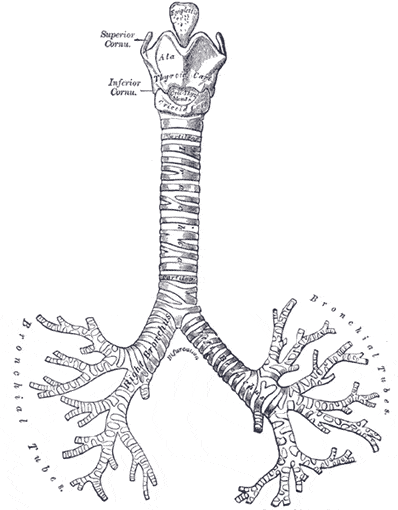

Name the structure labeled 8
lungs
trachea
diaphragm
alveoli

Which sequence correctly indicates the branching pattern of the human respiratory system?
trachea -> bronchi -> bronchioles -> alveoli
trachea -> bronchioles -> bronchi -> alveoli
alveoli -> trachea -> bronchioles -> bronchi
alveoli -> bronchioles -> trachea -> bronchi

Structure B carries
oxygenated blood
deoxygenated blood
The circuit that delivers blood to the body is called
pulmonary
systemic


Rectus Abdominus
External Oblique
Pectorals
Trapezius


What is the spine
Sacrum
Vertebra
Sternum
Scapula

What is this called
Pelvis
Femur
Clavicle
Fibula
Which of the following is NOT a life function
Digestion
High thinking skills
Metabolism
Arteries carry blood ______ from the heart.
Across
Away
To
Around
What is the smallest level of organization in the human body?
Organs
Tissues
Cells
None of the above

Which imaging plane is demonstrated by the letter A?
Sagittal
Coronal
Axial
Oblique
Superior means:
above
below
away from trunk
toward trunk
Anterior means:
Front
Behind
Above
Below
Posterior means:
Above
Below
In front
Behind
Medial means:
close to middle
away from middle
close to trunk
below
Lateral means:
Close to middle
Away from trunk
Away from middle
Close to trunk
When doing CPR, where should you place your hands on the patient?
Center of the chest
Right above the belly button
Tilt the head and lift the chin
On the left side of the chest
What is the VERY FIRST thing you should do in a CPR or Fist Aid situation?
Scream for help
Check for breathing and a pulse
Call 911
Panic
What is the acronym used to check for the possibility of a stroke?
M.O.V.E.
C.P.R.
F.A.S.T.
A.E.D.
What is considered a good blood pressure?
140/90
130/50
120/80
80/120
After an AED delivers a shock, you should:
take a 5 minute break
stop CPR
call for more help
continue CPR
Why do you use an epi pen?
To inject oxygen during CPR
To prevent an allergic reaction
To write down information for the 911 operator
To draw a picture of the accident scene

