
 Worksheets
The Endocrine System
Total questions: 101
Worksheet time: 49hrs 2mins
The endocrine system differs from the nervous system in that it:
uses hormones for slower, longer-lasting communication
uses electrical impulses for rapid, short-term responses
controls only voluntary actions
is not involved in homeostasis
Which of the following lists major endocrine organs and the hormones they release?
Pituitary gland - Growth hormone, Thyroid gland - Thyroxine, Adrenal gland - Adrenaline
Liver - Insulin, Kidney - Glucagon, Heart - Estrogen
Lungs - Testosterone, Pancreas - Melatonin, Skin - Cortisol
Stomach - Prolactin, Spleen - Oxytocin, Intestine - Thyroxine
The release of each hormone is prompted by which of the following types of stimuli or variables?
Neural, hormonal, and humoral stimuli
Only neural stimuli
Only hormonal stimuli
Only environmental changes
The function of the major hormones is to:
Regulate various physiological processes in the body
Provide structural support to cells
Store genetic information
Facilitate movement of muscles
Some conditions resulting from hypo or hypersecretion of hormones include:
Diabetes mellitus, gigantism, and acromegaly
Asthma, anemia, and arthritis
Hypertension, influenza, and eczema
Tuberculosis, malaria, and dengue
Fill in the blank: The endocrine system controls function by releasing _______ into the bloodstream.
hormones
enzymes
neurotransmitters
vitamins
Which of the following circulates throughout the body and controls function by targeting cell receptors?
Enzymes
Hormones
Neurotransmitters
Vitamins
Hormones act broadly and have longer lasting effects compared to most neurotransmitters.
True
False
Fill in the blank: In the endocrine system, ______ are released into the blood.
hormones
enzymes
neurotransmitters
antibodies
Fill in the blank: In the nervous system, ______ are released into synapses.
neurotransmitters
hormones
enzymes
antibodies
Fill in the blank: In the endocrine system, hormones remain in blood until ______ or excreted.
degraded
absorbed
filtered
diluted
Fill in the blank: In the nervous system, neurotransmitters remain in synapse until degraded, ______ or diffused.
recirculated
oxidized
phosphorylated
deactivated
Which system has broad targets?
Endocrine
Nervous
Which system has generally narrow targets?
Endocrine
Nervous
Which system has lasting effects?
Endocrine
Nervous
Which system has short lasting effects?
Endocrine
Nervous
What are hormones?
Hormones are chemicals released by glands into the bloodstream.
Hormones are a type of blood cell that fights infection.
Hormones are nutrients absorbed from food.
Hormones are electrical signals sent by nerves.
Hormones circulate and only affect cells that have the proper receptors that respond to each specific hormone.
True
False
Which of the following is NOT a main classification of hormones?
Amino acid based hormones
Steroid based hormones
Carbohydrate based hormones
Both A and B
Amino acid based hormones are ______ soluble and act on the ______ of cells.
water, outside
lipid, inside
water, inside
lipid, outside
Steroid based hormones are lipid soluble and act on the inside of cells.
True
False
The ________ gland consists of the Anterior Pituitary and Posterior Pituitary.
Pituitary
Thyroid
Adrenal
Pineal
Fill in the blank: The ________ gland is one of the major endocrine glands listed.
Thyroid
Sebaceous
Sweat
Salivary
Fill in the blank: The ________ gland is responsible for regulating calcium levels in the blood.
Parathyroid
Pituitary
Thyroid
Adrenal
Fill in the blank: The Adrenal Gland consists of the Adrenal Cortex and ________.
Adrenal Medulla
Adrenal Capsule
Renal Pelvis
Pituitary Lobe
Fill in the blank: The ________ is an endocrine gland that also functions as part of the digestive system.
Pancreas
Thyroid
Adrenal gland
Pituitary gland
Fill in the blank: The Gonads include the Ovaries and ________.
Testes
Kidneys
Liver
Pancreas
Fill in the blank: The ________ gland is involved in regulating sleep-wake cycles.
Pineal
Thyroid
Adrenal
Pituitary
What is the main function of the major endocrine glands listed?
Produce digestive enzymes
Produce hormones that regulate various bodily functions
Store vitamins
Filter blood

Identify the gland located at the base of the brain, as shown in the diagram.
Pineal gland
Pituitary gland
Adrenal gland
Pancreas

Fill in the blank: The gland labeled at the front of the neck in the diagram is the ________.
Thyroid gland
Adrenal gland
Pituitary gland
Pineal gland

Which gland is responsible for producing insulin, as shown in the diagram?
Pancreas
Thymus
Adrenal gland
Thyroid gland
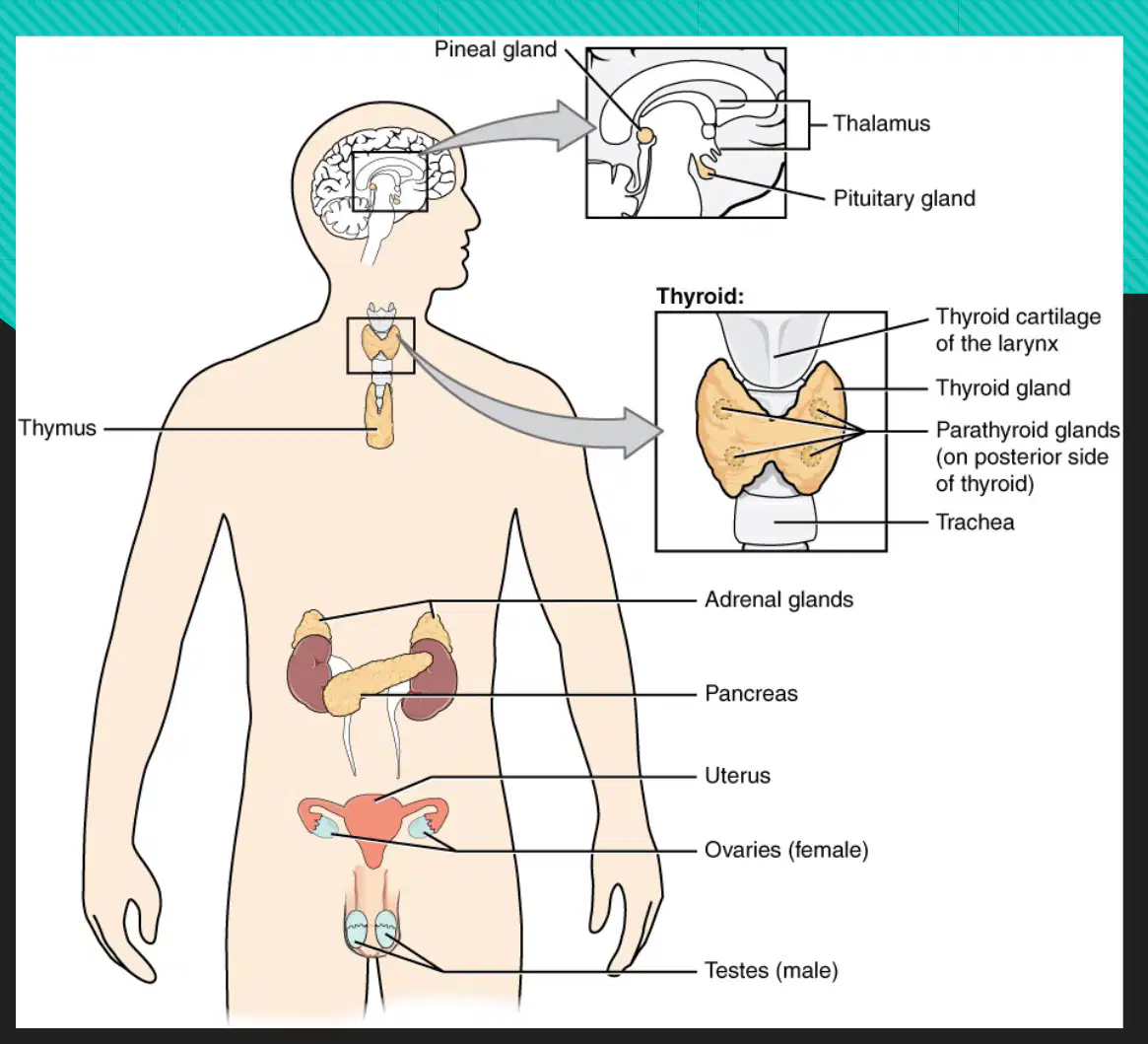
Fill in the blank: The ________ are located on the posterior side of the thyroid, as shown in the close-up diagram.
Parathyroid glands
Adrenal glands
Pituitary gland
Pineal gland

The testes are part of the endocrine system in males, as shown in the diagram.
True
False

Which gland is shown in the chest area of the diagram?
Thymus
Thyroid
Pancreas
Adrenal gland

Fill in the blank: The ________ are the female reproductive glands shown in the pelvic region of the diagram.
Ovaries
Testes
Pancreas
Adrenal glands

Which gland is located above the kidneys, as shown in the diagram?
Adrenal glands
Pineal gland
Pituitary gland
Thyroid gland

Fill in the blank: The ________ is shown in the brain and is responsible for regulating sleep-wake cycles.
Pineal gland
Cerebellum
Amygdala
Medulla oblongata
How do hormones travel from the hypothalamus to the anterior pituitary?
Hormones travel from the hypothalamus to the anterior pituitary via the Hypophyseal portal system.
Hormones travel from the hypothalamus to the anterior pituitary via the lymphatic vessels.
Hormones travel from the hypothalamus to the anterior pituitary via the cerebrospinal fluid.
Hormones travel from the hypothalamus to the anterior pituitary via direct neural connections.
How are hormones manufactured in the hypothalamus released into the bloodstream by the posterior pituitary?
Hormones manufactured in nuclei of the hypothalamus travel down axons of the hypothalamic-hypophyseal tract and are released into the bloodstream by the posterior pituitary.
Hormones manufactured in the hypothalamus are directly secreted into the anterior pituitary and then into the bloodstream.
Hormones manufactured in the hypothalamus are stored in the pineal gland before being released into the bloodstream.
Hormones manufactured in the hypothalamus are released into the bloodstream through the adrenal medulla.

What is the function of the hypothalamus in this process?
Releases hormones that stimulate the pituitary gland
Produces digestive enzymes
Pumps blood to the brain
Filters waste from the blood

Refer to the diagram of the hypothalamus and pituitary gland hormone pathway. Fill in the blank: The ________ is responsible for releasing hormones that stimulate the pituitary gland to release its own hormones.
hypothalamus
thyroid gland
adrenal gland
pancreas

Which structure connects the hypothalamus to the pituitary gland?
Infundibulum
Cerebellum
Medulla oblongata
Thalamus

Refer to the diagram of the hypothalamus and pituitary gland hormone pathway. The primary capillary plexus of the hypophyseal portal system is located in the ________.
infundibulum
anterior pituitary
posterior pituitary
optic chiasm

Refer to the diagram of the hypothalamus and pituitary gland hormone pathway. What is the final step in the process shown in the diagram?
Hypothalamus releases hormone
Hypothalamus hormone stimulates pituitary to release hormones
Anterior pituitary hormone is released
Posterior pituitary hormone is released

Refer to the diagram of the hypothalamus and pituitary gland. Which hormone is released by the neurosecretory cells of the supraoptic nucleus?
Oxytocin (OT)
Antidiuretic hormone (ADH)
Growth hormone
Prolactin
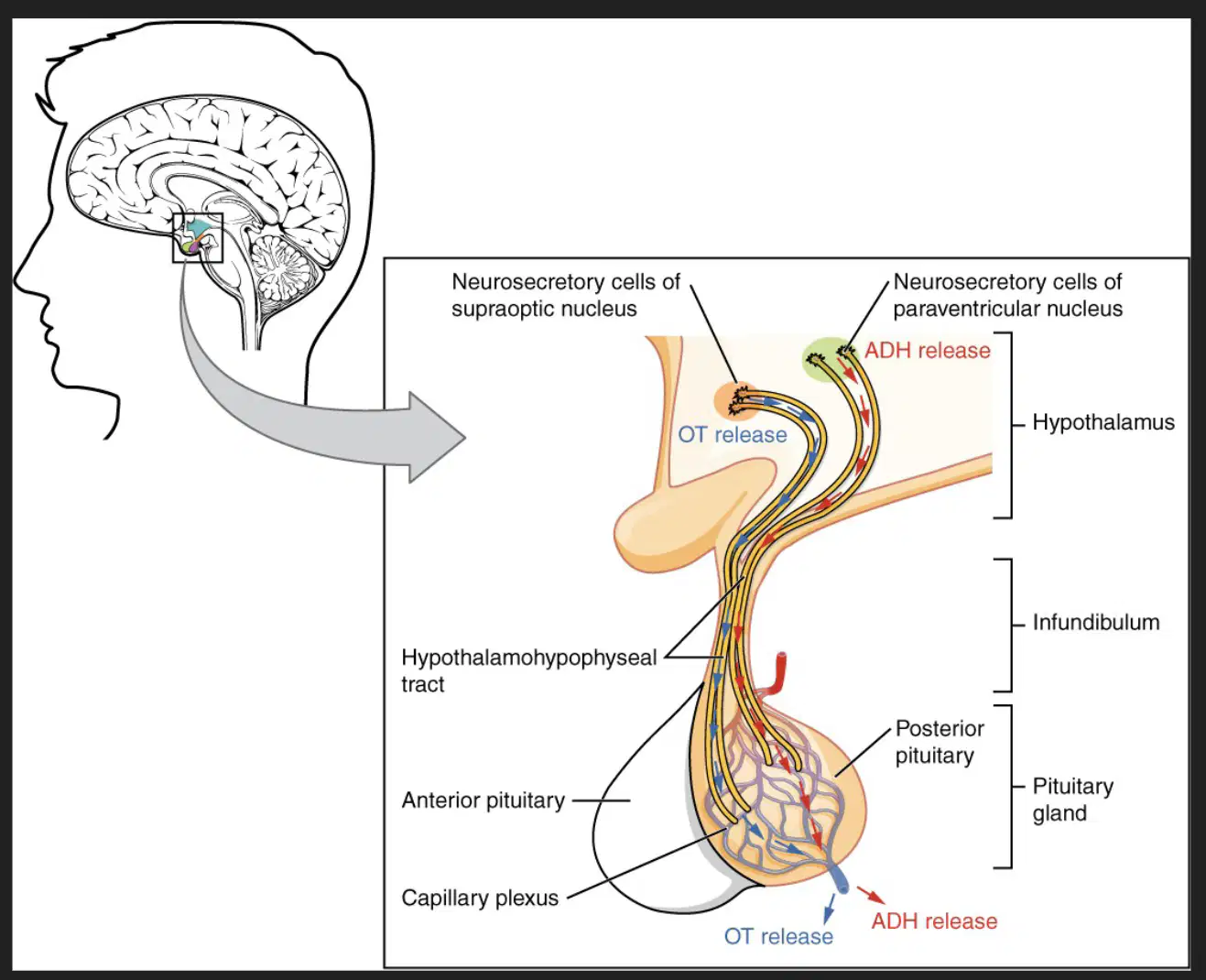
The hypothalamohypophyseal tract connects the hypothalamus to which part of the pituitary gland?
Posterior pituitary
Anterior pituitary
Pars intermedia
Infundibulum

Refer to the diagram of the hypothalamus and pituitary gland. True or False: The anterior pituitary is directly connected to the hypothalamus by the hypothalamohypophyseal tract.
True
False
Which hormone released from the adenohypophysis is also known as Thyrotropin?
Thyroid Stimulating Hormone (TSH)
Adrenocorticotropic Hormone (ACTH)
Growth Hormone (GH)
Prolactin (PRL)
Which hormone released from the adenohypophysis is also known as Corticotropin?
Adrenocorticotropic Hormone (ACTH)
Thyroid Stimulating Hormone (TSH)
Growth Hormone (GH)
Prolactin (PRL)
Which hormone released from the adenohypophysis is abbreviated as FSH?
Follicle Stimulating Hormone
Luteinizing Hormone
Adrenocorticotropic Hormone
Thyroid Stimulating Hormone
Which hormone released from the adenohypophysis is abbreviated as LH?
Luteinizing Hormone
Thyroid Stimulating Hormone
Adrenocorticotropic Hormone
Growth Hormone
Which hormone released from the adenohypophysis is abbreviated as GH?
Growth Hormone
Thyroid Stimulating Hormone
Adrenocorticotropic Hormone
Prolactin
Which hormone released from the adenohypophysis is abbreviated as PRL?
Prolactin
Adrenocorticotropic hormone
Thyroid-stimulating hormone
Growth hormone
What is the function of tropic hormones released from the adenohypophysis?
Tropic hormones cause other endocrine glands to release hormones.
Tropic hormones directly regulate blood glucose levels.
Tropic hormones are responsible for muscle contraction.
Tropic hormones function as digestive enzymes.
Fill in the blank: TSH stimulates the thyroid to release ______ and ______ (Thyroid Hormones).
T3 and T4
Insulin and Glucagon
Cortisol and Aldosterone
FSH and LH
Fill in the blank: ACTH stimulates the adrenal cortex to release ______ and ______.
cortisol and aldosterone
insulin and glucagon
thyroxine and calcitonin
adrenaline and noradrenaline
Fill in the blank: FSH stimulates the gonads to form ______.
gametes
hormones
enzymes
antibodies
Fill in the blank: LH prompts ______ synthesis and triggers ovulation.
testosterone
estrogen
progesterone
FSH
Fill in the blank: GH stimulates ______, cartilage and muscle growth.
bone
skin
blood
nerve
Fill in the blank: PRL stimulates ______ production.
breast milk
insulin
adrenaline
bile
Which hormone released by the posterior pituitary increases blood pressure by causing a reduction in urine production?
Oxytocin
Antidiuretic Hormone (ADH)
Insulin
Glucagon
Antidiuretic Hormone (ADH) increases blood pressure by causing _________.
a reduction in urine production
an increase in heart rate
a decrease in blood volume
vasodilation
ADH is released when blood pressure is low.
True
False
Which of the following triggers the release of ADH?
A) Osmoreceptors in the hypothalamus sensing high plasma osmolarity
B) High blood sugar
C) Low oxygen levels
D) Increased heart rate
Which hormone released by the posterior pituitary intensifies uterine contractions during labor?
ADH
Oxytocin
Prolactin
Estrogen
Oxytocin promotes bonding in sexual partners and offspring.
True
False
Oxytocin prompts ________ in lactating mothers.
milk ejection
ovulation
digestion
sweating
Which of the following hormones is NOT released by the thyroid gland?
T3 – Triiodothyroine
T4 – Thyroxine
Calcitonin
Insulin
Fill in the blank: T3 and T4 increase ________ , and permit normal growth, development of the nervous system, and development of the reproductive system.
basal metabolic rate
blood pressure
bone density
immune response
Which hormone reduces blood calcium levels?
T3 – Triiodothyroine
T4 – Thyroxine
Calcitonin
Insulin
T3 and T4 permit normal growth, development of the nervous system, and development of the reproductive system.
True
False
Fill in the blank: ________ is also known as Thyroxine and is released by the thyroid gland.
T4
Insulin
Cortisol
Adrenaline
Fill in the blank: The formation of thyroid hormones requires dietary ______ in order to be complete.
iodine
calcium
iron
potassium
Which form of thyroid hormone is more active?
A) T3
B) T4
Fill in the blank: 90% of thyroid hormone released from the thyroid is ______.
T4
T3
Calcitonin
TSH
Fill in the blank: T3 is enzymatically converted to ______ in tissues.
T4
T2
Reverse T3
Cortisol

What does the hypothalamus release when the metabolic rate and/or T3 and T4 concentration in blood is low?
TRH (Thyrotropin-releasing hormone)
TSH (Thyroid-stimulating hormone)
ACTH (Adrenocorticotropic hormone)
GH (Growth hormone)

What is the effect of TSH release on thyroid follicle cells?
Triggers release of T3 and T4 by thyroid follicle cells
Inhibits the production of thyroglobulin
Decreases iodine uptake by thyroid follicle cells
Suppresses the activity of thyroid peroxidase

Which of the following is an effect of T3 and T4 release?
Decreased basal metabolic rate
Increased basal metabolic rate
Decreased body temperature
No effect on body temperature

What type of feedback is involved when elevated T3 and T4 levels inhibit the release of TRH and TSH?
Negative feedback
Positive feedback
Feedforward regulation
Direct stimulation

When T3 and T4 levels in the blood are high, the hypothalamus continues to release TRH.
True
False
What is the main function of the parathyroid hormone?
Decreases blood calcium levels
Increases blood calcium levels
Stimulates insulin production
Decreases bone resorption
Parathyroid hormone stimulates osteoclasts prompting _________.
bone resorption.
bone formation.
calcium excretion.
muscle contraction.
Which of the following is a function of the parathyroid hormone?
Decreases calcium reabsorption in the kidneys
Causes an increase in calcium reabsorption in the kidneys
Prevents activation of vitamin D
Stimulates insulin secretion
Parathyroid hormone prompts activation of vitamin D. Vitamin D aids in calcium absorption by the ________.
small intestine.
lungs.
kidneys.
skin.
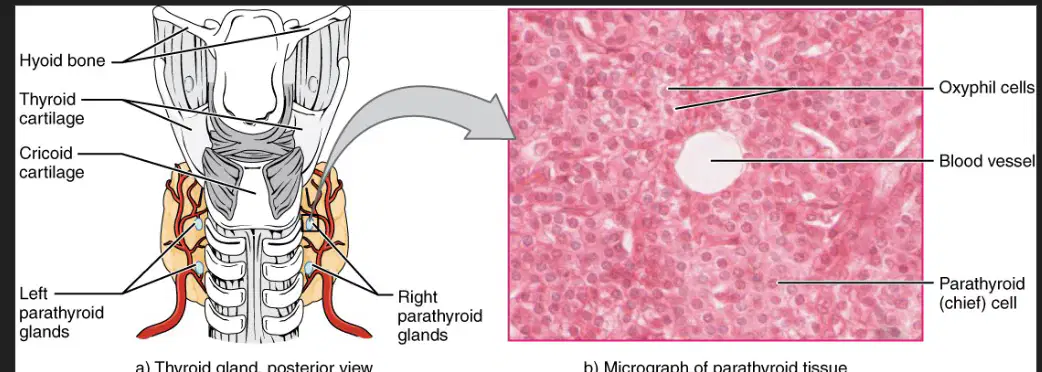
Which of the following structures is labeled as the Hyoid bone in the diagram?
Thyroid cartilage
Cricoid cartilage
Hyoid bone
Parathyroid (chief) cell
Fill in the blank: The adrenal cortex releases _________.
Aldosterone, Cortisol, Gonadocorticoids (adrenocortical sex hormones)
Insulin, Glucagon, Somatostatin
Thyroxine, Calcitonin, Triiodothyronine
Adrenaline, Noradrenaline, Dopamine
Which hormone is released by the adrenal cortex?
Epinephrine
Aldosterone
Nor-Epinephrine
Insulin
Fill in the blank: The adrenal medulla releases _________.
Epinephrine (adrenaline), Nor-Epinephrine (nor-adrenaline)
Insulin and Glucagon
Thyroxine and Calcitonin
Cortisol and Aldosterone
Which hormone is released by the adrenal medulla?
Cortisol
Gonadocorticoids
Epinephrine
Aldosterone
True or False: The adrenal cortex and adrenal medulla produce the same hormones.
True
False
What does aldosterone cause in the kidneys?
Sodium secretion and potassium reabsorption
Sodium reabsorption and potassium secretion
Sodium and potassium reabsorption
Sodium and potassium secretion
As Na+ is reabsorbed in the kidneys, it returns to the blood (not excreted). What follows sodium and increases blood volume and blood pressure?
Water
Glucose
Potassium
Urea
As K+ is secreted, it is excreted in the urine. This lowers plasma K+ concentration.
True
False
Which of the following triggers the RAAS (renin angiotensin aldosterone system) and increases aldosterone (and ADH) release?
High blood pressure
Low blood pressure
High sodium
Low potassium
Stress causes ACTH release which prompts Aldosterone release (through the hypothalamus and anterior pituitary).
True
False
What is the term for high potassium that increases aldosterone release?
Hyperkalemia
Hypokalemia
Hyponatremia
Hypercalcemia
Which gland is primarily responsible for regulating metabolism in the body?
Thyroid gland
Pineal gland
Adrenal gland
Pituitary gland
Fill in the blank: The ________ gland secretes melatonin to help control sleep cycles.
Pineal
Thyroid
Adrenal
Parathyroid
Which hormone is produced by the pancreas to lower blood glucose levels?
Insulin
Adrenaline
Glucagon
Thyroxine

