
 Worksheets
Chap 6
Total questions: 151
Worksheet time: 1hrs 21mins
Is the following statement true or false?
"Coordination and allocation of responsibility for the preparation of budgets is one of the functions of the budgets committee"
True
False
Is the following statement true or false?
"A budget covers periods longer than one year and is used for strategic planning"
True
False
Is the following statement true or false?
"A budget manual will contain instructions governing the preparation of budgets"
True
False
Cash budget is a functional budget. Is it true or false
True
False
Is the following statement true or false?
“A principal budget factor is a factor which limits an organization’s performance”(activities)
True
False
Distribution and selling resources NOT be a principal budget factor. Is it true or false?
True
False
Is the following statement true or false?
“When preparing the master budget, establishing the organization’s long-term objectives would normally be carried out first”
True
False
Is the following statement true or false
“The master budget includes the instructions for the completion of the budget and the responsibilities of the personnel involved”
True
False
Is the following statement true or false?
The master budget (Functional budgets) details the timetable for the preparation of the various budgets
True
False
Is the following statement true or false?
“Positive correlation means that low values of one variable are associated with high values of the other, and high values of one variable are associated with low values of the other”
True
False
Is the following statement true or false?
“An advantage of the high-low method of cost estimation is that it takes into account the full (relevant) range of available data”
True
False
Is it true or false?
The coefficient of determination must always fall between 0 and +1. Is it true or false?
True
False
Reducing the incidence of budgetary slack is an advantage of a ‘bottom-up’ style of budgeting. Is it true or false
True
False
Is the following statement true or false?
“A characteristic of rolling budgets is that a new accounting period, such as a month or a quarter, is added as each old one expires”
True
False
Is the following statement true or false?
“A firm that uses zero-based budgeting for its overheads has a zero variance between budgeted and actual overhead”
True
False
Which of the following is NOT considered to be an objective of budgeting?
A. Authorization
B. Activities Coordination
C. Expansion
D. Resources allocation
Which of the following is NOT one of the main purposes of a budget?
A. To compel planning
B. To communicate targets to the managers responsible for achieving the budget
C. To inform shareholders of performance in meeting targets
D. To establish a system of control by comparing budget and actual results
Which of the following is NOT one of the main purposes of a budget?
A. To compel planning
B. To inform shareholders of performance
C. To communicate ideas and plans
D. To provide a framework for responsibility accounting
Which of the following statements relating to budgets is correct?
A. A budget covers period longer than one year and is used for strategic planning
B. A budget manual will contain instructions governing the preparation of budgets
C. A budget is usually prepared by the shareholders of a company
D. The budget committee is responsible for the preparation of functional budgets
Which of the following is NOT considered to be function of the budget committee?
A. Preparing functional budgets
B. Timetabling
C. Issuing the budget manual
D. Monitoring the budgeting process
When preparing a production budget, what does the quantity to be produced equal?
A. Sale quantity + opening inventory of finished goods + closing inventory of finished goods
B. Sales quantity - opening inventory of FGs + closing inventory of FGs
C. Sale quantity - Opening inventory of FGs - closing inventory of FGs
D. Sales quantity + opening inventory of FGs - closing inventory of FGs
If a company has no production resource limitations, in which order would the
following budgets be prepared?
(i) Material usage budget
(ii) Sales budget
(iii) Material purchase budget
(iv) Finished goods inventory budget
(v) Production budget
(vi) Material inventory budget
(v),(iv),(i),(vi),(iii),(ii)
(ii),(iv),(v),(i),(vi),(iii)
(ii),(iv),(v),(i),(iii),(vi)
(ii),(v),(iv),(i),(vi),(iii)
In a situation where there are no production resource limitations, which of the
following items of information must be available for the production budget to be
completed?
(i) Sales volume form the sales budget
(ii) Material purchases form the purchases budget
(iii) Budgeted change in finished goods inventory
(iv) Standard direct labour cost per unit
(i), (ii) and (iii)
(i), (ii) and (iv)
(i) and (iii)
All of them
Which of the following is NOT a functional budget?
A. Production budget
B. Distribution cost budget
C. Selling cost budget
D. Cash budget
1 Which of the following are considered to be objectives of budgeting?
(1) Authorisation
(2) Expansion
(3) Performance evaluation
(4) Resource allocation
A (4) only
B (1), (2) and (4) only
C (1), (3) and (4) only
D (1), (2) and (3) only
Which two of the following statements relating to budgets are correct?
A A budget covers periods longer than one year and is used for strategic planning
B The budget committee coordinates the preparation and administration of budgets.
C The budget committee is responsible for the preparation of functional budgets
D A budget manual will contain instructions governing the preparation of budgets.
E A budget is usually prepared by the shareholders of a company
When preparing the master budget, which of the following tasks would normally be carried out first?
A Calculate the overhead absorption rate
B Establish the organisation's long-term objectives
C Identify the principal budget factor
D Prepare the sales budget
Which three of the following are steps in the preparation of a budget?
A Arrange overdraft facilities
B Identify the principal budget factor
C Prepare a budgeted income statement
D Budget the resources for production
E Complete the audit of the prior year's results
Which of the following is a principal budget factor?
A The highest value item of cost
B A factor which limits the activities of an undertaking
C A factor common to all budget centres
D A factor controllable by the manager of the budget centre
Which of the following could be principal budget factors?
(1) Sales demand
(2) Machine capacity
(3) Key raw materials
(4) Cash flow
A (1) and (2) only
B (1), (2), (3) and (4)
C (1), (2) and (3) only
D (1), (2) and (4) only
Which of the following is not a functional budget?
A Purchases budget
B Cash budget
C Sales budget
D Marketing cost budget
For a company that does not have any production resource limitations, which of the following sets out the correct sequence for budget preparation?
A Production budget, finished goods inventory budget, sales budget, then materials usage budget
B Sales budget, finished goods inventory budget, production budget, then materials usage budget
C Sales budget, production budget, finished goods inventory budget, then materials usage budget
D Sales budget, finished goods inventory budget, materials usage budget, then production budget
Which two of the statements below correctly complete the following sentence? The master budget
A will include a budgeted balance sheet and a budgeted income statement prepared on the accruals basis
B will include a cash budget
C is usually prepared before the functional budgets
D details the timetable for the preparation of the various budgets
E includes the instructions for the completion of the budget forms and the responsibilities of the personnel involved
Which of the following expressions is correct?
A Opening inventory + sales - closing inventory = production (in units)
B Opening inventory + sales + closing inventory = production (in units)
C Closing inventory + sales - opening inventory = production (in units)
D Closing inventory - sales - opening inventory = production (in units)
A company is preparing its production budget for product Z for the forthcoming year. Budgeted sales of product Z are 1,500 units. Opening inventory is 120 units and the company wants to reduce inventories at the end of the year by 10%. The budgeted number of units of product Z to be produced is
A 1,392
B 1,488
C 1,500
D 1,512
Research Ltd purchases a chemical and refines it before onward sale. Budgeted sales of the refined chemical are as follows. Litres January 40,000 February 50,000 March 30,000
(1) The target month-end inventory of unrefined chemical is 30% of the chemical needed for the following month's budgeted production
. (2) The targeted month-end inventory of refined chemical is 30% of next month's budgeted sales. Calculate the budgeted purchases of unrefined chemical for January.
A 56,200 litres
B 49,750 litres
C 48,250 litres
D 43,300 litres
When preparing a material purchases budget, which of the following is the quantity to be purchased?
A Materials required for production - opening inventory of materials - closing inventory of materials
B Materials required for production - opening inventory of materials + closing inventory of materials
C Opening inventory of materials + closing inventory of materials - materials required for production
D Opening inventory of materials - materials required for production - closing inventory of materials
Barlow plc manufactures two products, Vip and Bip. It intends to produce 2,000 units of each product in the next year to meet the sales budget. Each Vip requires 2 kg of material Z and 1 kg of material Y and each Bip requires 3 kg of material Z and 4 kg of material Y. At present there are 200 kg of Z and 500 kg of Y in inventory. Barlow plc intends to increase the inventory levels of these materials by the end of the year to 600 kg of Z and 800 kg of Y. Material Z costs £4 per kg and material Y costs £5 per kg. What is the total materials purchases for the next year?
A £86,900
B £90,000
C £93,100
D £96,400
A retailing company makes a gross profit of 25% on sales. The company plans to increase inventory by 10% in June. The budgeted sales revenue for June is £25,000. Opening inventory on 1 June is valued at £5,000. What are the budgeted inventory purchases for June?
A £18,250
B £19,125
C £19,250
D £25,500
Budgeted sales of X for December are 18,000 units. At the end of the production process for X, 10% of production units are scrapped as defective. Opening inventories of X for December are budgeted to be 15,000 units and closing inventories will be 11,400 units. All inventories of finished goods must have successfully passed the quality control check. The production budget for X for December, in units, is
A 12,960
B 14,400
C 15,840
D 16,000
The quantity of material in the material purchases budget is greater than the quantity of material in the material usage budget. Which of the following statements can be inferred from this situation?
A Wastage of material occurs in the production process.
B Finished goods inventories are budgeted to increase.
C Raw materials inventories are budgeted to increase.
D Raw materials inventories are budgeted to decrease.
George has been asked by his bank to produce a budgeted income statement for the six months ending on 31 March 20X4. He forecasts that monthly sales will be £3,000 for October, £4,500 for each of November and December and £5,000 per month from January 20X4 onwards. Selling price is fixed to generate a margin on sales of 33 1/3%. Overhead expenses (excluding depreciation) are estimated at £800 per month. He plans to purchase non-current assets on 1 October costing £5,000, which will be paid for at the end of December and are expected to have a five-year life, at the end of which they will possess a nil residual value. The budgeted net profit for the six months ending 31 March 20X4 is
A £3,200
B £3,700
C £3,950
D £8,200
At the beginning of March 20X2, a company has an opening balance of £60,000 on its receivables ledger. Sales of £160,000 have been budgeted for March and it is budgeted that 60% of these will be settled in March after a cash discount of 2.5%. If 23% of the opening receivables are still outstanding at the end of March, what will be the budgeted receivables figure at that date?
A £76,200
B £77,800
C £80,200
D £110,200
A retailing company budgets to maintain inventories at the end of each month which are sufficient to meet the budgeted sales requirements for the following month. Two months' credit will be received from suppliers of inventory. Budgeted sales, which earn a gross profit margin of 20% of sales value, are as follows: £ January 28,300 February 26,100 March 33,800 April 30,690
The budgeted balance sheet as at the end of March will show a payables balance of
A £47,920
B £51,592
C £59,900
D £64,490
A company's master budget contains the following budgeted income statement. £ £ Sales revenue (5,000 units) 120,000 Variable materials cost 24,000 Variable labour cost 32,500 Variable overhead 13,000 Fixed overhead 41,000 110,500 Budgeted net profit 9,500 The company's management are considering a change in the materials specification. This would reduce the materials cost per unit by 10%. The reduced product quality would necessitate a 2% reduction in the selling price and the sales volume would fall by 5%. The revised budgeted net profit for the period would be
A £3,620
B £6,975
C £9,025
D £9,375
Which two of the following statements are correct?
A A forecast and a budget are essentially the same thing.
B A budget must be quantified if it is to be useful for planning and control purposes
C A budget provides the basic unit rates to be used in the preparation of standards for control purposes.
D The sales budget must always be prepared first.
E An organisation's long term plan provides the framework within which an annual budget is set.
A company has recorded the following costs over the last six months. Month Total cost Units produced £ 1 74,000 3,000 2 72,750 1,750 3 73,250 2,000 4 75,000 2,500 5 69,500 1,500 6 72,750 2,000 Using the high-low method, which of the following represents the total cost equation?
A Total cost = 61,250 + (1.25 quantity)
B Total cost = 65,000 + (3 quantity)
C Total cost = 65,000 + (1.25 quantity)
D Total cost = 61,250 + (3 quantity)
A company has recorded the following costs over the last four months. Month Cost Production £ Units 1 21,995 1,050 2 19,540 1,090 3 19,000 750 4 17,200 700
A £17,030
B £18,700
C £20,625
D £23,343
The following estimates of possible sales revenue and cost behaviour for a one-year period relate to one of AB Company's products: Activity level 60% 100% Sales and production (units) 36,000 60,000 £ £ Sales revenue 432,000 720,000 Production costs Variable and fixed 366,000 510,000 Sales distribution and administration costs Variable and fixed 126,000 150,000 The budgeted level of activity for the current year is 60,000 units, and fixed costs are incurred evenly throughout the year. There was no inventory of the product at the start of the first quarter, in which 16,500 units were made and 13,500 units were sold. Actual fixed costs were the same as budgeted. AB Company uses absorption costing. You may assume that sales revenue and variable costs per unit are as budgeted. What is the value of the fixed production costs that were absorbed by the product in the first quarter?
A £33,750
B £37,500
C £41,250
D £66,000
The following data have been extracted from the budget working papers of BL Ltd. Production volume 1,000 2,000 £/unit £/unit Variable materials 4.00 4.00 Variable labour 3.50 3.50 Production overhead - department 1 6.00 4.20 Production overhead - department 2 4.00 2.00 The total fixed cost and variable cost per unit is
A 3,600 9.90
B 4,000 11.70
C 7,600 7.50
D 7,600 9.90
Which of the following would affect the reliability of a forecast using linear regression? (1) The amount of data on which the regression line is based (2) The assumption that the trend line applies outside the range of X values used to establish the line in the first place (3) The assumption that there is a linear relationship between the two variables (4) The coefficient of correlation
A (1) and (2) only
B (1), (2) and (3) only
C (1), (2), (3) and (4)
D (2) and (4) only
Which two of the following are underlying assumptions of forecasts made using regression analysis?
A A curvilinear relationship exists between the two variables
B The value of one variable can be predicted or estimated from the value of one other
variable
C A perfect linear relationship between the two variables
D What has happened in the past will provide a reliable guide to the future
A company's weekly costs (£C) were plotted against production level (P) for the last 50 weeks and a regression line calculated to be C = 100 + 20P. Which of the following statements about the breakdown of weekly costs is true?
A Fixed costs are £100. Variable costs per unit are £20.
B Fixed costs are £20. Variable costs per unit are £100.
C Fixed costs are £20. Variable costs per unit are £5
D Fixed costs are £100. Variable cost per unit are £4
Which two of the following statements are correct?
A Positive correlation means that low values of one variable are associated with low values of the other, and high values of one variable are associated with high values of the other
B Positive correlation means that low values of one variable are associated with high values of the other, and high values of one variable are associated with low values of the other
C Negative correlation means that low values of one variable are associated with low values of the other, and high values of one variable are associated with high values of the other.
D Negative correlation means that low values of one variable are associated with high values of the other, and high values of one variable are associated with low values of the other.
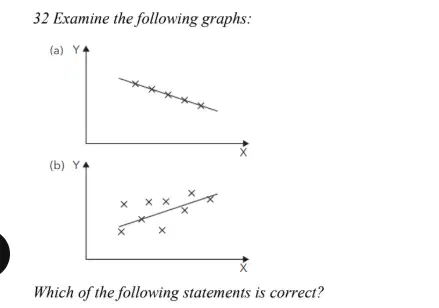
Which of the following statements is correct?
Diagram (a) represents perfect positive correlation: diagram (b) represents negative correlation
B Diagram (b) represents perfect positive correlation: diagram (a) represents negative correlation.
C Diagram (a) represents perfect negative correlation; diagram (b) represents imperfect positive correlation
D Diagram (b) represents perfect positive correlation: diagram (a) represents positive correlation.
The correlation coefficient between two variables, x and y, is +0.72. The proportion of variation in y that is explained by variation in x is (to two decimal places).
A 0.52
B 0.72
C 0.85
D 1.44
The correlation coefficient between advertising expenditure and sales revenue is calculated to be 0.85. Which of the following statements is true?
A There is a weak relationship between advertising expenditure and sales revenue.
B 85% of the variation in sales revenue can be explained by the corresponding variation in advertising expenditure.
C 72% of the variation in sales revenue can be explained by the corresponding variation in advertising expenditure.
D Sales revenue will increase by 85% more than advertising expenditure will increase.
The linear relationship between advertising in thousands of pounds (X) and sales in tens of thousands of pounds (Y) is given by Y = 5 + 2X. Which two of the following statements are correct?
A For every £1,000 spent on advertising, sales revenue increases by £50,000 on average.
B When nothing is spent on advertising the average level of sales is £50,000.
C For every £1,000 spent on advertising, sales revenue increases by £20,000 on average.
D When nothing is spent on advertising, the average level of sales is £20,000.
Which of the following is the best description of a 'top-down' budgeting process?
A The process starts with sales, then progresses to production, materials usage and other functional budgets.
B Top management prepare a budget with little or no input from operating personnel.
C A series of budgets is prepared, from the most optimistic performance down to the most pessimistic.
D The top level budget is non-financial, but more detailed budgets are progressively in more financial terms.
Which two of the following are advantages of a 'bottom-up' style of budgeting?
A Increase operational managers' commitment to organisational objectives
B Enhance the coordination between the plans and objectives of divisions
C Reduce the incidence of budgetary slack
D Based on information from employees most familiar with day to day activities
E Decrease the period of time taken to prepare the budgets
Which of the following are criticisms of incremental budgeting? (1) It is time consuming because it involves starting each budget from scratch (2) It encourages slack (3) It includes past inefficiencies as cost levels are not scrutinised (4) It encourages wasteful spending
A (1) and (2) only
B (1), (2) and (3) only
C (2), (3) and (4) only
D (3) and (4) only
Which of the following best describes incremental budgeting?
A Increments of expenditure are compared with the expected benefits to be received.
B Budgeted capacity is increased in increments until it is just sufficient to satisfy
budgeted production requirements.
C The budget for each period is based on the current year's results, modified for
changes in activity levels.
D The budget is updated in regular increments, by adding the budget for a further
accounting period when the earliest accounting period has expired.
Which two of the following are characteristics of rolling budgets?
A Each item of expenditure has to be justified in its entirety in order to be included in the
next year's budget.
B A new accounting period, such as a month or a quarter, is added as each old one
expires.
C The budget is more realistic and certain as there is a short period between the
preparation of budgets.
D Updates to the fixed annual budget are made only when they are foreseeable.
Which of the following best describes 'zero-based budgeting'?
A A budget method where an attempt is made to make expenditure under each cost
heading as close to zero as possible.
B A method of budgeting whereby all activities are re-evaluated each time a budget is
formulated.
C A method of budgeting where the sum of costs and revenues for each budget centre
equals zero.
D A method of budgeting that distinguishes fixed and variable cost behaviour with
respect to changes in output and the budget is designed to change appropriately with
such fluctuations
Three separate newly-formed companies are currently designing their budgetary planning
and control systems.
Company A will manufacture a wide range of products of varying flexibility. Some of the
products will be mass produced, others will be low volume. The degree of non-production
support required for each product differs widely.
Company B will manufacture a single product and has employed a specialist to manage
each of its production and non-production activities.
Company C will manufacture a small range of diverse products and the cost and revenue
responsibilities will differ for each product.
Indicate which budget structure would be most appropriate for each organisation.
Product based budget
A Company A
B Company B
C Company C
Three separate newly-formed companies are currently designing their budgetary planning
and control systems.
Company A will manufacture a wide range of products of varying flexibility. Some of the
products will be mass produced, others will be low volume. The degree of non-production
support required for each product differs widely.
Company B will manufacture a single product and has employed a specialist to manage
each of its production and non-production activities.
Company C will manufacture a small range of diverse products and the cost and revenue
responsibilities will differ for each product.
Indicate which budget structure would be most appropriate for each organisation.
Responsibility based budget
D Company A
E Company B
F Company C
Three separate newly-formed companies are currently designing their budgetary planning
and control systems.
Company A will manufacture a wide range of products of varying flexibility. Some of the
products will be mass produced, others will be low volume. The degree of non-production
support required for each product differs widely.
Company B will manufacture a single product and has employed a specialist to manage
each of its production and non-production activities.
Company C will manufacture a small range of diverse products and the cost and revenue
responsibilities will differ for each product.
Indicate which budget structure would be most appropriate for each organisation.
Activity based budget
G Company A
H Company B
I Company C
Which two of the following statements about budgeting are correct?
A A forecast is an attempt to predict what will happen.
B A budget is a plan of what is intended to happen.
C All budgets are prepared in financial terms.
D The master budget consists of a budgeted income statement and a budgeted balance sheet.
E A flexible budget adjusts both fixed and variable costs for the level of activity.
A firm that uses zero-based budgeting for its overheads has
A zero as the starting point for budgeting the coming year's overheads
B a zero variance between budgeted and actual overhead
C an assumed sales level of zero as the starting point for budgeting the coming year's
overheads
D an overhead budget of zero
The high-low method of cost estimation is useful for
A calculating the budgeted cost for the actual activity
B calculating the highest and lowest costs in the budget period
C measuring the actual cost for the budgeted activity
D predicting the range of costs expected in the budget period
An extract from next year's budget for a manufacturing company is shown below.
Month 3 Month 4
£ £
Closing inventory of raw materials 22,000 12,000
The manufacturing cost of production is £116,000 in both Month 3 and Month 4. Materials
costs represent 40% of manufacturing cost.
The budgeted material purchases for Month 4 are
A £36,400
B £42,400
C £46,400
D £56,400
You are given the following budgeted cost information for Verlaine plc for January.
Sales £120,000
Unit selling price £2
Gross profit 30% margin on sales
Opening inventory 6,000 units
Sales volumes are increasing at 20% per month and company policy is to maintain 10% of
next month's sales volume as closing inventory.
The budgeted cost of production for January is
A £84,000
B £85,680
C £120,000
D £122,400
Which of the following statements about big data is/are correct?
(1) Big data is often out of date before it can be used.
(2) Big data is only relevant for short term decisions.
(3) Big data can be used to predict consumer preferences.
A (1), (2) and (3)
B (1) and (2) only
C (3) only
D (2) and (3) only
Fashn Ltd runs a chain of fashion retail stores. A key element of its commercial success
comes from being able to identify customer trends, and responding to them, more quickly
than its competitors.
Which two of the following are potential sources of big data for Fashn Ltd?
A Online video clips of clothes being shared by customers
B Daily transactions records from stores
C Inventory records from the chain's central warehouse
D Keywords from conversations about fashion on social media
E The number, and level, of discounts Fashn Ltd has to offer on its products
Consider the following statements:
(1) Big data analytics enables businesses to gain a more detailed understanding of
customer behaviour.
(2) Big data requires analysis by a skilled data analyst.
Which of the following is correct with regards to the statements above?
A (1) and (2) are correct
B (1) and (2) are incorrect
C (1) is correct and (2) is incorrect
D (2) is correct and (1) is incorrect
What are the four 'V's associated with big data?
A Volume, velocity, visibility, veracity
B Variability, volume, verification, veracity
C Volume, velocity, variety, veracity
D Velocity, visibility, variety, variability
Teecee Ltd operates a chain of coffee shops. It has an interactive website where customers
can leave feedback, and has recently introduced a customer loyalty card that is swiped at
the till whenever a purchase is made. Teecee is keen to make use of this new data.
Which two of the following are suitable uses of the data that is collected from Teecee's
website and its customer loyalty cards?
A Understanding individual customer preferences
B Updating inventory records
C Analysing the take-up of targeted promotions
D Rewarding branch managers for the achievement of sales targets
The number of specialist data analytics firms has risen in recent years with the increase in
the collection of big data.
Which two of the following explain this?
A Privacy concerns mean that it is prudent to give data to analytics firms who are better
able to protect it.
B Cybersecurity risks can be avoided by the use of data specialists.
C There is a lack of employees within the organisation with appropriate data analytics
skills.
D Big data is often incorrect and data analysts are quicker to detect errors and
inaccuracies.
E Traditional data management systems cannot readily process unstructured data.
Is the following statement true and false?
“The key trade-off that lies at the heart of working capital management, is that between business stability and solvency”
True
False
Is the following statement true and false?
“Insurance cost is an inventory holding cost”
True
False
Is the following statement true and false?
“Profit and cash flows are the same.”
True
False
Is the following statement true and false?
“When using the EOQ formula to find the optimal quality to be ordered, the purchase price per unit is included in the calculation”
True
False
Is the following statement true and false?
“Just in time (JIT) manufacturing systems require a large amount of inventory to be held for production and sales”
True
False
Is the following statement true and false?
“Perpetual inventory method is a system whereby inventory levels are reviewed at fixed time intervals to fit in with production schedules, and variable quantities are ordered as appropriate.”
True
False
Is the following statement true and false?
“In the re-order level system of inventory control, a fixed quantity will be ordered whenever inventory falls to a pre-determined level”
True
False
Is the following statement true and false?
“In the ABC system of inventory control, inventory is categorized into classes A, B or C according to annual cost of the usage of that inventory item, or the difficulty of replacements, or the importance to the production process.”
True
False
Is the following statement true and false?
“In the periodic review system of inventory control, the inventory records are updated for each receipt and issue of inventory as it occurs.”
True
False
Is the following statement true and false regarding the Economic order quantity system?
“One of EOQ’s limitations is that it ignores the potential benefit of taking advantage of bulk discounts because it does not consider whether the best price is being obtained.”
True
False
Is the following statement about manager's reaction in control system true or false? “By comparing actual results and plans, depending on how managers see the situation, they can revise the plans.”
True
False
“Decentralization makes performance evaluation of managers and their area of responsibility easier”
True
False
“Within a system of responsibility accounting there are four main types of responsibility center: cost center, revenue center, profit center and investment center”
True
False
“Managers of cost centers can take control action on controllable costs and investment in non-current assets of those centers”
True
False
“Investment centers have the highest degree of autonomy.”
True
False
“Shared service center can reduce overhead costs”
True
False
Is the following statement true or false? "Material total variance measures the difference between the standard material cost of the actual output units and the actual material cost incurred"
True
False
Is the following statement true or false? "The material total variance can be divided into the material price variance and the material efficiency variance"
True
False
Is the following statement true or false? "The material price variance is the difference between the standard cost and the actual cost for the actual quantity of material used or purchased"
True
False
Is the following statement true or false? "The material usage variance is the difference between the standard quantity of materials that should have been used for the number of units actually produced, and the actual quantity of materials used, valued at the actual price per unit of material"
True
False
Is the following statement true or false? "The material usage variance is the difference between the standard quantity of materials that should have been used for the number of units actually produced, and the actual quantity of materials used, valued at the standard price per unit of material"
True
False
Is the following statement true or false? "Labour total variance measures the difference between the standard labour cost of the actual output units and the actual labour cost incurred."
True
False
Is the following statement true or false? "The labour rate variance is the difference between the standard cost and the actual cost for the expected hours paid at actual output units."
True
False
Is the following statement true or false? "The labour efficiency variance is the difference between the hours that should have been worked for the number of units actually produced, and the actual number of hours worked, valued at the standard rate per hour.”
True
False
Is the following statement true or false? "The variable overhead total variance: can be subdivided into the variable overhead expenditure variance and the variable overhead usage variance"
True
False
Is the following statement true or false? "The fixed overhead expenditure variance is the difference between the budgeted and actual fixed overhead expenditure in the period"
True
False
Is the following statement true or false? "The sales price variance is a measure of the effect on expected contribution of charging a different selling price from the standard selling price"
True
False
Is the following statement true or false? "The sales volume variance is the difference between the actual units sold and the budgeted quantity, valued at the expected sales price per unit"
True
False
Is the following statement true or false? "Unforeseen discounts received" is one of the reasons for a favourable material price variance"
True
False
Is the following statement true or false? "Material price increase' is one of the reasons for a favourable material price variance"
True
False
Is the following statement true or false? "More effective use of material' is one of the reasons for an adverse material variance"
True
False
Is the following statement true or false? "Theft is one of the reasons for an adverse material usage variance"
True
False
Is the following statement true or false? "Use of workers at a lower rate of pay than standard' is a reason of a favourable labour rate variance"
True
False
Is the following statement true or false? "Use of workers at a lower rate of pay than standard' is a reason of an adverse labour rate variance"
True
False
Is the following statement true or false? "Better quality of equipment or materials' may be a reason for a favourable labour efficiency variance"
True
False
Is the following statement about contribution true or false? "Contribution per unit is the difference between the selling price per unit and the variable costs per unit"
True
False
Is the following formula to calculate profit true or false? Profit = (sales volume x contribution per unit) – fixed cost per unit
True
False
Is the following formula to calculate breakeven point true or false? Breakeven point in units= Total fixed costs/ contribution per unit
True
False
Is the following statement about breakeven point true or false? "Breakeven point is the activity level at which there is neither a profit nor a loss."
True
False
Is the following statement about traditional breakeven chart true or false? "The breakeven point where the sales revenue line crosses the fixed cost line".
True
False
Is the following statement about traditional breakeven chart true or false? "The breakeven point is at the intersection of the sales line and the total cost line"
True
False
Is the following statement about margin of safety true or false? "The margin of safety is the difference in units between the budgeted sales volume and the actual sales volume"
True
False
Is the following statement true or false? "If margin of safe for product Z is 2000 unit then actual sales can fall short of budget by 2000 units before the breakeven point is reached and no profit is made"
True
False
Is the following statement about CVP analysis true or false? "CVP analysis is the study of the interrelationships between contribution, volume and profit at various levels of activity"
True
False
Is the following statement about the variable cost line on a contribution breakeven chart true or false? "The variable cost line on a contribution breakeven chart starts at origin."
True
False
Is the following statement about limiting factor true or false? "A limiting factor is anything which limits the managers to make decisions in operating a business"
True
False
Is the following statement about limiting factor analysis in order to calculate maximum profit. It is assumed that total fixed costs are not changed by increase or decreases in production volume.
True
False
Is the following statement about limiting factor analysis true or false? "When there’s insufficient resource to meet the potential sales demand for 2 products, in order to maximize contribution, company should give production priority for product which has the higher contribution per unit of limiting factor than the other."
True
False
Is the following statement about limiting factor analysis true or false? "If a specific resource is a limiting factor, contribution will be maximized by earning the lowest possible contribution per unit of limiting factor."
True
False
Is this true or false if material is identified as a limiting factor in cases as follows? It needs 3 Kg of material X and 2 machine hours to produce one unit of product A and those of 2 Kg and 1.5 hours for product B. It was expected that 6000 machine hours and 10000 kg of X being available for production. Sale demand was 2000 units for each production
True
False
Which of the following is NOT considered to be an objective of budgeting?
Authorization
Activities Coordination
Expansion
Resources allocation
Which of the following is NOT one of the main purposes of a budget?
To compel planning
To inform shareholders of performance
To communicate ideas and plans
To provide a framework for responsibility accounting
Which of the following statements relating to budgets is correct?
A budget covers period longer than one year and is used for strategic planning
A budget manual will contain instructions governing the preparation of budgets
A budget is usually prepared by the shareholders of a company
The budget committee is responsible for the preparation of functional budgets
Which of the following is NOT considered to be a function of the budget committee?
Preparing functional budgets
Timetabling
Issuing the budget manual
Monitoring the budgeting process
When preparing a production budget, what does the quantity to be produced equal?
Sale quantity + opening inventory of finished goods + closing inventory of finished goods
Sales quantity - opening inventory of FGs + closing inventory of FGs
Sale quantity - Opening inventory of FGs - closing inventory of FGs
Sales quantity + opening inventory of FGs - closing inventory of FGs
If a company has no production resource limitations, in which order would the following budgets be prepared?
In a situation where there are no production resource limitations, which of the following items of information must be available for the production budget to be completed?
(i) Sales volume from the sales budget
(iii) Budgeted change in finished goods inventory
Which of the following is NOT a functional budget?
Production budget
Distribution cost budget
Selling cost budget
Cash budget
Which of the following is a principal budget factor?
The highest value item of cost
A factor which limits an organization’s performance
A factor common to all budget centers
A factor controllable by the manager of the budget center
What is the amount budgeted to be received from credit sales in November?
46,260
49,480
50,200
50,530
For suppliers paid in the month of purchase, a settlement discount of 5% is received. What is the amount budgeted to be paid to suppliers in November?
$278,500
$280,000
$289,000
$292,500
What does a master budget comprise?
The budgeted statement of profit or loss
The budgeted cash flow, budgeted statement of profit or loss and budgeted statement of financial position
The budgeted cash flow
The entire set of budgets prepared
The budgeted net profit for the six month ending 31 December 20X2 is
$2,700
$3,300
$3,600
$7,700
The revised budgeted net profit for the period would be
$8,530
$12,155
$14,155
$14,625
The proportion of variation in y that is explained by variation in x is (to two decimal places)
0.72
0.85
0.92
1.57
Which of the following statements is correct?
The coefficient of determination must always fall between -1 and + 1
The correlation coefficient must always fall between 0 and +1
A disadvantage of the high-low method of cost estimation is that it does not take into account the full range of available data
A cost estimate produced using the high-low method can be used to reliably predict the cost for any level of activity
Using the high-low method which of the following is the correct equation for linking advertising and sales from the above date?
Sales revenue = 62,500 + (25 x advertising expenditure)
Advertising expenditure = -2,500 + (0.04 x sales revenue)
Sales revenue = 95,000 + (20 x advertising expenditure)
Advertising expenditure = -4,750 + (0,05 x sales revenue)
What is the best estimate of the company’s fixed costs per period?
$13,500
$13,200
$5,100
$4,800
What would be the variable overhead cost per unit (to the nearest $0,01) using the high - low method?
$1,67 per unit
$1,83 per unit
$2,75 per unit
$3,00 per unit
Which of the following are the disadvantages of a bottom-up style of budgeting?
(i) Consume more time
(ii) May cause managers to introduce budget slack
(iii) Morale and motivation is improved
(iv) Changes implemented by senior managers may cause dissatisfaction
Which of the following best describes ‘zero-based budgeting’?
A method of budgeting whereby all activities are re-evaluated each time a budget is formulated
The budget for each period is based on the current year’s results, modified for changes in activity levels
The budget is updated in regular increments, by adding the budget for a further accounting period when the earliest accounting period has expired
A budget method where an attempt is made to make expenditure under each cost heading as close to zero as possible.
Which of the following best describes a “top-down” budget?
A series of budgets is prepared, from the most optimistic performance down to the most pessimistic
Top management prepares a budget with little or no input from operating personnel
A budget which is set by delegating authority from top management, allowing budget holders to participate in setting their own budgets
A budget which has been set be scaling down individual expenditure items until the total budgeted expenditure can be met from available resources
Which of the following is the correct formula to calculate working capital?
Inventory - Cash - Receivables + Payables
Inventory + Cash + Receivables - Payables
Receivables + Payables- Inventory - Cash
Inventory + Cash + Payables - Receivables

