
NEW
Font size
 Worksheets
Medical Quiz
Total questions: 40
Worksheet time: 39mins
Identify the most appropriate feature in a lateral chest x-ray that suggest COPD.
Retrocardiac shadow
Retrosternal opacification
Consolidation
Lobar collapse
Increased anteroposterior (AP) diameter
The most important purpose served by inter-professional communication is
personal identity
effective team building
self-understanding
a sense of security
collaboration
The management for ST segment elevation myocardial infarction includes the following except:
Administration of antiplatelet
Activation of percutaneous coronary intervention (PCI) team
Administration of anticoagulant before PCI procedure
Initiate intensive lipid lowering therapy with statin
Stat ECG & cardiac enzymes
Which of the following condition is least likely to be diagnosed with a chest x-ray?
Pulmonary embolism
Pneumothorax
Atelectasis
Pleural effusion
Pneumonia
The following conditions result in the trachea being 'pulled' toward pathological site except______.
Lobectomy
Consolidation
Pneumothorax
Pneonectomy
Lung lesion
The followings are the common causes of macrocytic anaemia EXCEPT:
Iron deficiency
B12 deficiency
Folate deficiency
chronic excessive alcohol intake
Liver cirrhosis
A 60-year-old male presented to the emergency department for sudden onset of chest pain. His blood pressure was 80/60 mmHg, respiratory rate 22 bpm, heart rate 110 bpm, ECG showed sinus tachycardia, SPO2 95% on room air. What will be your approach for this patient?
Establish airway, breathing and circulation
Take a focused history and physical examination
Establish intravenous access
Check for life-threatening conditions
All the above
Which of the following is a cause of pyuria?
Urinary tract infection
Nephrotic syndrome
Renal tubular disease
Minimal change disease
Kidney stones
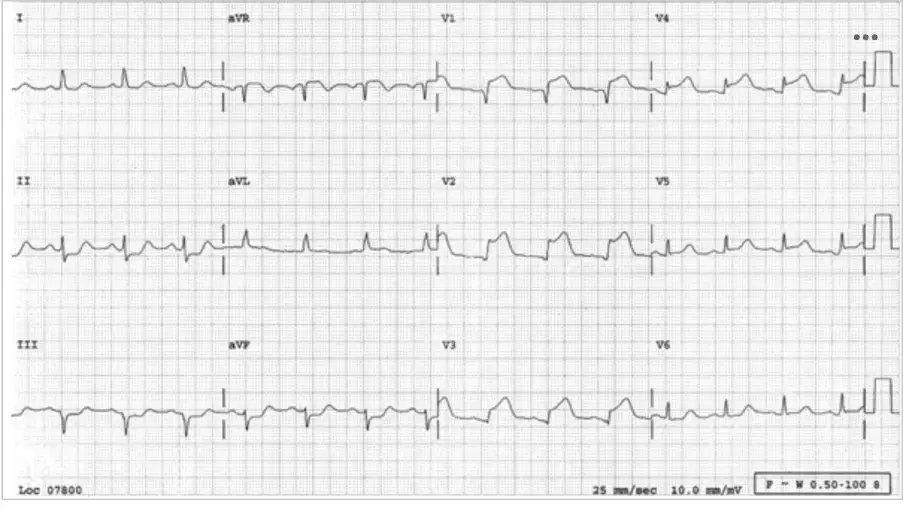
What is the culprit artery involved?
Inferior myocardial infarction - Right coronary artery occlusion
Lateral wall myocardial infarction - Right coronary artery occlusion
Anterolateral myocardial infarction - Left circumflex artery occlusion
Anterior myocardial infarction - Left anterior descending artery occlusion
Anterior septal myocardial infraction - Left anterior descending artery
Which of the following lesions will produce upper motor neuron features?
Nerve root
Brachial plexus
Muscle
Spinal cord
Neuromuscular junction
Bilateral affection of spinal cord at the cervical level may produce the following syndrome
Hemiplegia
Paraplegia
Tetraplegia
Monoplegia
Parasthesia
One of the most common drugs associated with bilateral lower limb swelling is
Hydrochlorothiazide (Diuretic)
Losartan (ARB)
Amlodipine
Enalapril (ACE-i)
The abdomen can be divided into four quadrants and __regions?
3
5
7
9
2
A 30-year-old female came to the multidisciplinary clinic complaining of palpitations and unable to sleep well. She has intentional weight loss of 6kg over the past 2 months. On examination, her pulse rate is approximately 120/min and irregularly irregular. Her blood pressure is 140/90. There are no murmurs heard upon auscultation. The ECG confirms the diagnosis of atrial fibrillation. What would you suggest as the most useful next investigation?
Echocardiography
Chest x-ray
Fasting blood glucose
Thyroid function tests
Sleep study
Which of the following statement is false?
Osmotic diarrhea is caused excessive glucose in the gut
A diagnosis of osmotic diarrhoea is made if serum osmotic gap is 80mOsm
A diagnosis of Secretory diarrhea is made if osmotic gap <50mOsm
Stool osmolality gap formula =290 - ( Stool sodium + stool potassium).
A normal osmotic gap is above 100 mOsm
Which of following is not the unique working diagnosis of bilateral lower limb swelling for females of reproductive age:
Pregnancy
Pre-eclampsia
Premenstrual edema
Deep vein thrombosis
Which of the following blood tests is most indicative of cardiac damage?
Lactate dehydrogenase
Aspartate aminotransferase
Troponin T
Creatine kinase
D-dimer test
48 years Chinese Lady came with progressive and intermittent giddiness since yesterday. Each attack lasted less than 5 seconds. She felt her giddiness was spinning type and made her feel nausea, but no vomiting, It was worse on turning her head. She had similar episodes of giddiness last year. She had no hearing loss, no discharge from ears. HINS test revealed impaired vestibular-ocular reflex, unidirectional horizontal nystagmus was noted and it was fatigable. Her vitals: T:36.6 degree celsius. BP: Sitting: 130/ 70 mmhg, Standing 127/68 mmhg. HR: 76 beat/ mins , 70 beats/ mins. SPO2: 99% on room air. What is the possible diagnosis?
Posterior circulation stroke
Meniere's syndrome
Benign Paroxysmal Positional Vertigo (BPPV)
Orthostatic hypotension
Alcohol induce
What is the ratio of the normal heart side in a posterior-anterior CXR?
< 0.5 of the cardiothoracic ratio
¾ of cardiothoracic ratio
> 0.5 of the cardiothoracic ratio
1/4 of cardiothoracic ratio
0.5 of the cardiothoracic ratio
Which of these is NOT to the benefit of inter-professional collaboration?
Increase in positive outcomes and decrease risk of negative outcomes
Increase HCP retention and job satisfaction
Promote safe quality care, decrease errors
Increase fragmentation and duplication of care
Improve patient outcomes
Mr A, 75-year-old male walks into the emergency department for worsening of breathlessness for 4 days. He also has a productive cough with chest tightness and fever. His past medical history includes hypertension, hyperlipidaemia, diabetes and ischemic heart disease. What is your next immediate action for Mr A?
Obtain his vital signs
Obtain a thorough history from patient
Isolate patient and put on personal protective equipment
Provide oxygen supplement
Isolate patient
Which of the following best defines sarcopenia?
↓muscle mass, ↔ muscle strength, ↓physical performance
↓muscle mass, ↑muscle strength, ↑physical performance
↓muscle mass, ↓muscle strength, ↑physical performance
↔muscle mass, ↔muscle strength, ↓physical performance
↓muscle mass, ↓muscle strength, ↔physical performance
What is the normal upper limit of the mediastinum width?
< 8cm
< 9cm
< 10 cm
< 11cm
< 12cm
A patient complaint of bilateral lower limb swelling for more than a year. It was noted the patient is a poorly controlled diabetes with worsening proteinuria. The most likely cause of lower limb swelling for this patient is
Heart failure
Renal disease
Liver disease
Thyroid disease
Which statement is least appropriate in explaining medication-induced weight loss?
Anticholinergics causes dry mouth
Metformin cases nausea and/or vomiting
Alendronate causes esophagitis
Steroids causes anorexia
Chemotherapy agents causes dysgeusia
What is the most likely cause of acute weakness?
B12 deficiency
Diabetic neuropathy
Brain tumor
Stroke
Spinal cord disease
The following conditions are associated with a widened mediastinum except _______.
Aortic dissection
Mediastinal lymphadenopathy
Pleural effusion
Ruptured aorta
Cardiomegaly
The following conditions result in the trachea being 'pushed' to the non pathological site except______.
Tension pneumothorax
Aortic aneurysm
Pleural effusion
Pulmonary fibrosis
Mediastinal mass

Interpret the following rhythm strip:
First degree heart block
Second degree atrioventricular block (Mobitz type I)
Second degree atrioventricular block (Mobitz type II)
Third degree atrioventricular block
Wolff -Parkinson-White Syndrome
Which patient with asymptomatic bacteriuria no need treatment?
50 years old male with presence of struvite stones
60 years old MALE, prior to genitourinary tract procedures: TURP, cystoscopy
20 years old female prior to renal biopsy
30 years old female trying to conceive
Neonates and preschool children
Which is the first step when interpreting a chest x-ray?
Exposure
Projection
Rotation
Patient identification
Trachea position
Chest x-ray shows a large opacification in the left lung with obscured heart margins. There are also air bronchograms within the opacification. The trachea appears to be in the midline. What is the most likely diagnosis?
Malignancy
Tuberculosis
Pneumonia
Massive pleural effusion
Atelectasis
Kris your colleague had severe diarrhoea since yesterday. Today he is complaining feeling light headed. His eyes look sunken and sallow. Upon checking his blood pressure is 80/60 mmHg with heart rate 120/min. He says he has seen a doctor yesterday. Today his diarrhea is better as he has been fasting but feels sleepy. He has blamed it on the 'antibiotics'. He also tells you he has lost 5kgs overnight . He asks for time off to sleep and recover. Which of the following is the most appropriate action you would take?
Send him home to rest
Order to drink 1 liter of water with oral Rehydraton salts
Prepare to set IV line and hydrate him first while waiting for Dr to review and prepare him for admission.
Book a Grab taxi to send him home.
Arrange for him to sleep in the office so staff can monitor him
The followings are the common symptoms of anaemia EXCEPT:
Chest pain
Right side of body weakness
Postural giddiness
Exertional shortness of breath
Palpitation
History of alcohol consumption is the important history to obtain to rule out the possibility of liver disease and pancreatitis.
True
False
Which of the following statements is CORRECT about the medications for the treatment of hyperkalaemia with potassium level of 5.6mmol/L?
IV Calcium gluconate can be used to reduce the total body potassium level
IV Insulin is administered to reduce the total body potassium level
IV insulin can shift the potassium from the cell to the blood stream
Sodium polystyrene sulfonate (Resonium) can be used to reduce the total body potassium level
IV Calcium gluconate, IV insulin and Resonium should be administered to all patients with hyperkalaemia
Which of the following is NOT a cause of glucose in urine?
Diabetes mellitus
Fanconi syndrome
Empagliflozin
Nephrotic syndrome
Renal calculus
Where does the heart's electrical stimulus originate from?
Right bundle branch
Purkinje fibres
Sino-atrial node
Bundle of His
Mr Tan H. L, an 85-year-old man, who was found sitting on the fl oor during night shift. He was admitted 4 days ago with fever and agitation, who was diagnosed as community acquired pneumonia. The team has started on antibiotic, his fever subsided, and he was calm. Mr Tan has known dementia with behavioural and psychological symptoms of dementia (BPSD), atrial fi brillation on warfarin and poorly controlled diabetes. Family requested no retainer on admission. After fall, patient vitals are stable except having fever again, no obvious injury observed. Medical team reviewed him and physical examination is normal. But patient is confused and was placed on hourly conscious level monitoring while waiting for CT scan head to be done. Night shift nurses attempted to call patient’s son, but unable get through. You are the morning nurse in charge, you are required to call and inform patient’s son Alfred about last night incident. During the conversation, the son requested for the name of the staff who was involved in the incident, you should:
Acknowledge and agree with the son that the staff who was involved in the incident has work performance issue.
Use phrases such as ‘I’m so sorry that this incident had happened’ and reassure that the team is investigating the incident. More update will be given later.
Reveal the name of the staff to the son.
Discuss his request with your supervisor.
Argue with the son and refuse to reveal the name of the staff.
Inter-professional teams that establish collaborative relationships among Doctors, nurses and pharmacists focus on which one of the following?
Family-centred care
Cost-effective care
Professional-organized care
Patient-Centred care
Decentralised care

