
NEW
Font size
 Worksheets
Root Modifications and Examples
Total questions: 15
Worksheet time: 8mins
Adventitious root modifications can be explained as?
Root tubers
Support
Capable of Photosynthesis
Absorption of Food
What is a tuberous root?
Clusters of adventitious roots growing from stem nodes, swollen with indefinite shape. Example: Sweet potato (Ipomoea batatus).
A type of root that stores nutrients and has a defined shape, such as carrots.
Roots that grow deep into the soil to access water and nutrients, like taproots.
A type of root that primarily serves for anchoring the plant, without nutrient storage.
Significance of adventitious roots:
They primarily absorb water and minerals from the soil.
They can provide support, store nutrients, and sometimes perform photosynthesis.
They are responsible for the plant's reproductive processes.
They mainly serve as a means of vegetative propagation.
Type of root modification found in sweet potatoes:
Tuberous root
Fibrous root
Tap root
Adventitious root
Example of contractile root
Crocus sativus (Saffron)
Zea mays (Corn)
Solanum tuberosum (Potato)
Beta vulgaris (Beetroot)
Breathing roots
Another term for floating roots.
Roots that absorb water from the air.
Roots that grow above the ground.
Roots that store nutrients.
Examples of root buttresses
Terminalia arjuna and Bombax malabarica
Quercus robur and Pinus sylvestris
Ficus elastica and Acer saccharum
Carya ovata and Betula alleghaniensis
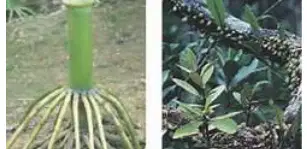
Stilt root
Adventitious roots arise from the lower nodes of the plant, penetrating the soil to provide additional support.
Roots that grow above the ground to absorb moisture from the air.
Roots that store nutrients and energy for the plant.
Roots that grow horizontally to spread out and stabilize the plant.
Example of a plant with nodulose roots:
Mango ginger (Curcuma)
Bamboo
Cactus
Oak tree
Examples of climbing roots
Piper nigrum (Pepper)
Rosa rubiginosa (Sweet Briar)
Cucumis sativus (Cucumber)
Zea mays (Corn)
Velamen tissue
Special spongy tissue in epiphytic roots.
A type of vascular tissue found in ferns.
A protective layer in seed coats.
A type of connective tissue in animals.
Parasitic root function
Penetrates host's cortex to reach vascular bundle, absorbing water, minerals, and food.
Provides structural support to the plant.
Stores energy in the form of carbohydrates.
Facilitates photosynthesis by capturing sunlight.
Support function of stilt roots
Stilt roots provide support against wind forces in plants like sugarcane.
Stilt roots help in nutrient absorption from the soil.
Stilt roots store water for the plant during droughts.
Stilt roots assist in photosynthesis by increasing surface area.
Photosynthetic root / Assimilatory root
Green chlorophyll-containing roots capable of carbon assimilation (photosynthesis) that hang freely like ribbons.
Roots that primarily absorb water and nutrients from the soil.
Roots that store energy in the form of starch.
Roots that anchor the plant and prevent soil erosion.
Contractile root function
Shrinks to maintain underground stem level.
Absorbs water and nutrients from the soil.
Stores energy for the plant.
Supports the plant above ground.

