
Font size
 Worksheets
1 Particles MCQ
Total questions: 74
Worksheet time: 40mins
A sequence of radioactive decays starts with nuclide P and ends with an isotope of P. Which is a possible sequence for these decays?
one alpha decay followed by four β⁻ decays
one alpha decay followed by two β⁻ decays
two alpha decays followed by two β⁻ decays
two alpha decays followed by one β⁻ decay
The alpha particle, positron and proton have different charge-to-mass ratios. Which row shows the particles that have the greatest and the smallest value of this ratio?
Greatest charge-to-mass ratio | Smallest charge-to-mass ratio
A. positron | alpha particle
B. positron | proton
C. alpha particle | proton
D. alpha particle | positron
Monochromatic radiation from light source P is incident on a metal surface and photoelectrons are emitted. When monochromatic radiation from light source Q is used, no photoelectrons are emitted. Which property of the radiation from P must be greater than that from Q?
frequency
intensity
speed
wavelength
The quark structure of the antiparticle of the K+ meson is
u̅s
u̅d
u̅s̅
d̅s
What is the de Broglie wavelength of a positron travelling at 5% of the speed of light?
2.7 × 10⁻¹⁶ m
2.7 × 10⁻¹⁴ m
4.9 × 10⁻¹³ m
4.9 × 10⁻¹¹ m
Which nuclear change results in the nucleus with the greatest specific charge?
the alpha decay of a ²⁰⁹₈₂Po nucleus
the beta-minus decay of a ²⁸₁₂Mg nucleus
the beta-plus decay of a ³⁹₂₀Ca nucleus
electron capture by a ¹⁰⁵₄₇Ag nucleus
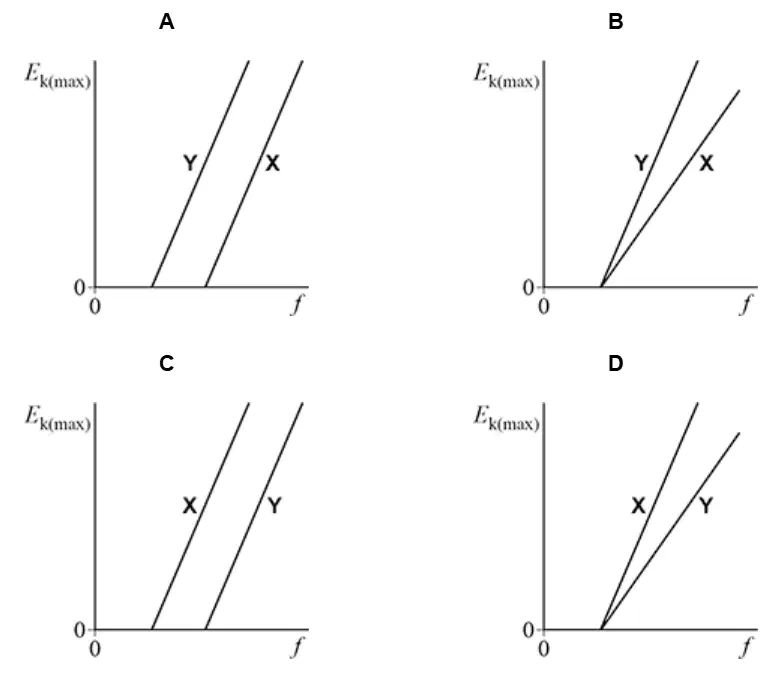
In two separate experiments, electromagnetic radiation of variable frequency f is incident on the surfaces of plates made from metals X and Y. The work function of X is greater than the work function of Y. Which graph shows how the maximum kinetic energy E_k(max) of photoelectrons emitted from the surfaces of the plates varies with f?
A
B
C
D
Monochromatic light is incident on a metal surface in a vacuum and photoelectrons are emitted from the surface. The photoelectric current I is the rate of flow of charge from the surface. The maximum kinetic energy of the photoelectrons is E_k(max). E_k(max) and I are measured. The frequency of the light is then increased. There is no change to the rate at which energy is incident on the surface. What happens to E_k(max) and I when the frequency is increased?
A. increases, decreases
B. increases, no change
C. no change, no change
D. no change, decreases
An electron and a proton move with the same speed. What is de Broglie wavelength of electron / de Broglie wavelength of proton?
5.5×10⁻⁴
2.3×10⁻²
42
1800
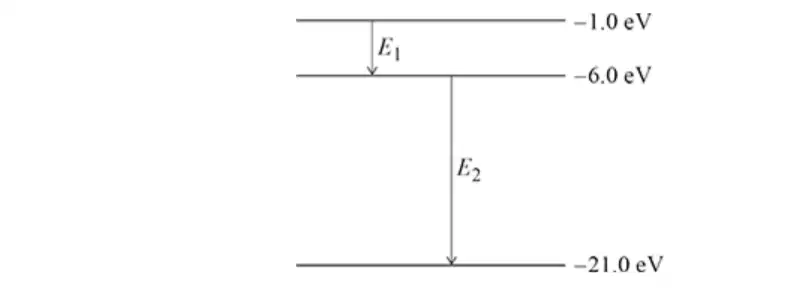
Three energy levels for an atom are shown. Energy change E1 leads to the emission of a photon of wavelength λ1. Energy change E2 leads to the emission of a photon of wavelength λ2. What is λ1/λ2?
1/4
1/3
3
4
An ion has a specific charge of -7.1 × 10^7 C kg^−1. It is held stationary in a vertical electric field on the surface of the Earth. What are the magnitude and direction of the electric field?
1.38 × 10^−7 V m^−1 upwards
1.38 × 10^−7 V m^−1 downwards
7.24 × 10^6 V m^{−1} upwards
7.24 × 10⁶ V m^−1 downwards
Which particle pair has the largest magnitude of electrostatic force when separated by the same distance?
an electron and a positive pion
a helium nucleus and a proton
a proton and a positive pion
a proton and an electron
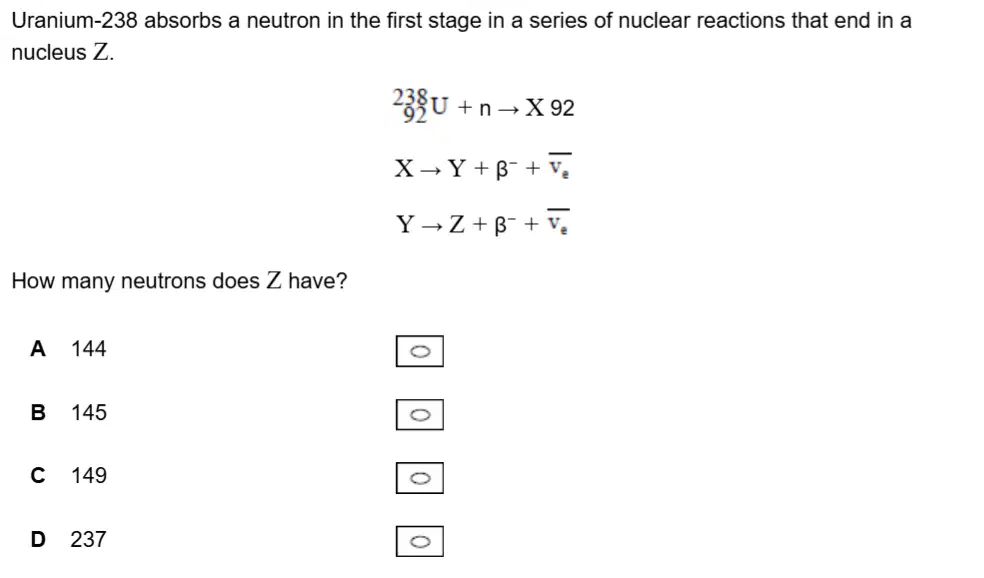
Uranium-238 absorbs a neutron in the first stage in a series of nuclear reactions that end in a nucleus Z. 238/92 U + n → X 92 X → Y + β⁻ + ν̅ₑ Y → Z + β⁻ + ν̅ₑ How many neutrons does Z have?
144
145
149
237
The four lowest energy levels of an atom are shown.
n = 1, n = 2, n = 3, n = 4 (from lowest to highest energy level)
n = 4, n = 3, n = 2, n = 1 (from lowest to highest energy level)
n = 2, n = 3, n = 4, n = 1 (from lowest to highest energy level)
n = 3, n = 1, n = 2, n = 4 (from lowest to highest energy level)
A gas contains atoms in the n = 4 level. The atoms de-excite to the n = 1 level. How many photon frequencies are observed?
3
4
5
6
Monochromatic light of frequency f is incident on a metal surface in a vacuum. Photoelectrons are emitted from the surface. The photoelectric current I is measured. The magnitude of the stopping potential Vs is then measured. f is increased without changing the rate at which photons arrive at the metal surface. What are the new measurements of the photoelectric current and the magnitude of the stopping potential?
Photoelectric current: I, Magnitude of the stopping potential: Vs
Photoelectric current: I, Magnitude of the stopping potential: > Vs
Photoelectric current: > I, Magnitude of the stopping potential: Vs
Photoelectric current: > I, Magnitude of the stopping potential: > Vs
An electron and a positron annihilate each other. Which quantity is not conserved in the annihilation?
A. electric charge
B. kinetic energy
C. lepton number
D. momentum
Which exchange particle transfers charge during electron capture?
meson
pion
virtual photon
W boson
A free neutron decays to produce a proton and
an electron and an antineutrino.
an electron and a neutrino.
a positron and an antineutrino.
a positron and a neutrino.
A nucleus of bismuth-209 (209/83 Bi) absorbs a neutron. The newly formed nucleus subsequently decays in two stages to form a nucleus of nuclide X. One beta-minus particle and one alpha particle are emitted during these two decays. What are the nucleon number and the proton number of X?
205 | 82
205 | 83
206 | 82
206 | 83
The concept of exchange particles was introduced to explain forces between elementary particles. This concept requires that exchange particles have
charge.
momentum.
phase.
rest mass.
A nucleus contains N neutrons and Z protons. Which combination of N and Z gives a nucleus with the greatest specific charge?
N = 6, Z = 5
N = 8, Z = 7
N = 16, Z = 13
N = 20, Z = 17
Which statement about muons is correct?
They consist of a quark and an antiquark.
They include pions and kaons.
They are subject to the strong interaction.
They decay into electrons.
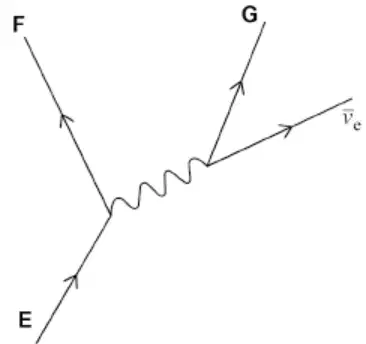
The particles labeled E, F, and G in the diagram are:
Electron, Proton, Neutron
Proton, Neutron, Electron
Neutron, Electron, Proton
Electron, Neutron, Proton
What are E, F and G?
up quark, down quark, β⁻
down quark, up quark, β⁻
up quark, down quark, β⁺
down quark, up quark, β⁺
Photoelectrons are released when monochromatic light with a photon energy of 4.2 × 10⁻¹⁹ J is incident on a metal surface. The work function of the surface is 2.4 eV. What is the maximum speed of the photoelectrons as they leave the surface?
1.3 × 10⁶ m s⁻¹
6.3 × 10⁵ m s⁻¹
2.8 × 10⁵ m s⁻¹
2.0 × 10⁵ m s⁻¹

The diffraction pattern observed when electrons with a certain kinetic energy pass through a powdered crystalline sample and are incident on a fluorescent screen indicates which property of electrons?
Electrons exhibit wave-like behavior, confirming their wave-particle duality.
Electrons are unaffected by crystalline structures.
Electrons only behave as particles and do not show diffraction.
Electrons lose all their energy when passing through crystals.

A change is made and this second pattern is produced. Which change could produce the second pattern?
decreasing the kinetic energy of the electrons
replacing the electrons with protons with the same kinetic energy
using a crystalline sample with a wider spacing between its atoms
moving the screen closer to the crystalline sample
Which row has the largest value for specific charge of the particle in column X? specific charge of the particle in column Y?
A. X: electron, Y: alpha particle
B. X: alpha particle, Y: electron
C. X: electron, Y: proton
D. X: proton, Y: alpha particle
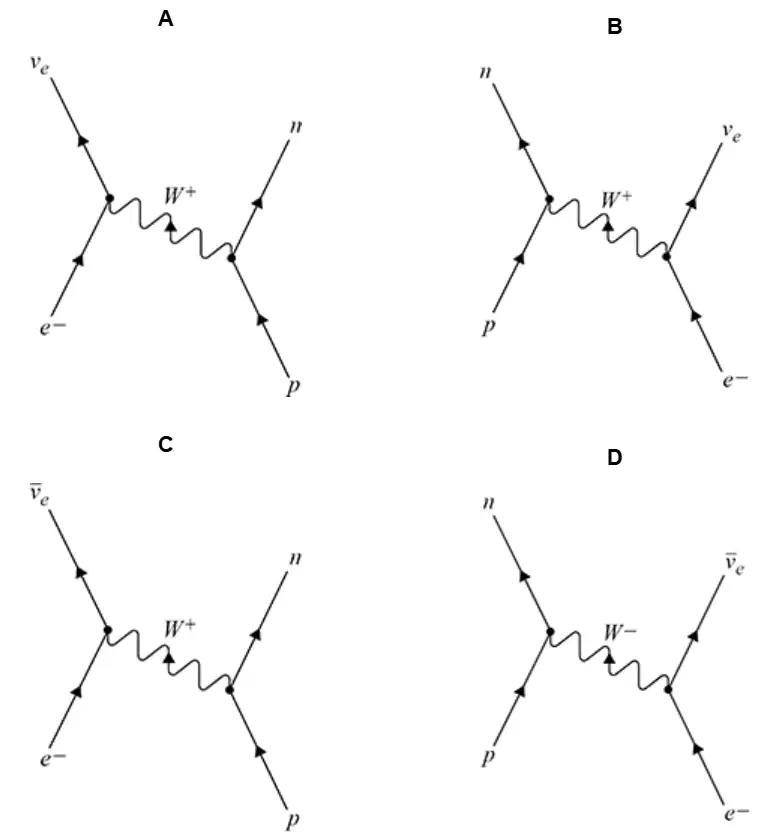
Which diagram represents the process of electron capture?
Diagram A: Shows e⁻ and p combining to form νₑ and n via W⁺
Diagram B: Shows n and p combining to form νₑ and e⁻ via W⁺
Diagram C: Shows e⁻ and p combining to form ν̅ₑ and n via W⁺
Diagram D: Shows n and p combining to form ν̅ₑ and e⁻ via W⁻
Which row is correct?
A antineutron | meson | ūū d̄
B positive kaon | baryon | ū s
C antiproton | baryon | ūū d̄
D positive pion | meson | ū d̄
An alpha particle and a nucleus of boron 10/5 B interact to form an unstable nucleus and a free neutron. The unstable nucleus decays by positron emission to form a nucleus of nuclide X. What is X?
13/5 B
13/6 C
13/7 N
13/8 O
30. The diagram shows the ground state and two higher-energy states X and Y of an atom. A transition from X to the ground state produces a photon of wavelength 147 nm. A transition from Y to the ground state produces a photon of wavelength 160 nm. What is the wavelength of the photon produced when a transition occurs from state X to state Y?
857 nm
94 nm
313 nm
307 nm
What is the energy difference between X and Y?
1.5 × 10⁻¹⁷ J
1.4 × 10⁻¹⁸ J
1.2 × 10⁻¹⁸ J
1.1 × 10⁻¹⁹ J
Which provides evidence for discrete atomic energy levels?
β⁺ decay
electron diffraction
line spectra
the photoelectric effect
What is the specific charge of a ¹³₆C nucleus?
4.4 × 10⁷ C kg⁻¹
5.2 × 10⁷ C kg⁻¹
8.3 × 10⁷ C kg⁻¹
2.1 × 10⁸ C kg⁻¹
Which row describes the variation with distance of the strong nuclear force?
A
B
C
D
Which statement is correct?
All strange particles are mesons.
Strange particles are always created in pairs.
Strangeness can only change in strong interactions.
Strangeness can only have a value of 0 or -1.
Which combination of quarks is possible?
sd
sū
sūd
ud
In photoelectricity, Vs is the stopping potential. What quantity is eVs?
energy of an incident photon
maximum kinetic energy of a photoelectron
threshold frequency × the Planck constant
work function
A fluorescent tube contains a gas. The coating of the tube
becomes ionised by the gas and emits photons of ultraviolet light.
absorbs photons of ultraviolet light from the gas and emits visible light.
absorbs photons of ultraviolet light from the gas and emits photoelectrons.
absorbs several photons of visible light from the gas and then emits one photon of ultraviolet light.
Which row gives evidence for the wave nature of electrons and evidence for the particulate nature of light?
A. electron diffraction | photoelectric effect
B. electron diffraction | single-slit diffraction
C. photoelectric effect | single-slit diffraction
D. photoelectric effect | electron diffraction
Which particle has the smallest de Broglie wavelength?
an electron moving at 4×10³ms−1
a proton moving at 4 × 10^3 m s^−1
an electron moving at 8 × 10^5 m s^−1
a proton moving at 8 × 10^5 m s^−1
An atom of oxygen-15 (15/8 O) gains two electrons to form an ion. What is the specific charge of the ion?
−1.3 × 10^7 C kg^−1
−2.4 × 10^7 C kg^−1
−5.1 × 10^7 C kg^{−1}
−6.4 × 10^7 C kg^−1
Which is an exchange particle for the weak interaction?
lepton
photon
pion
W+
A particular baryon has a quark structure dss and decays by the weak interaction. What are possible decay products of this baryon? The quark structure of Λ⁰ is uds.
Λ⁰ + π⁻
n + π⁻
Λ⁰ + e⁻
K⁺ + K⁰
A muon and an antimuon annihilate to produce the minimum number of photons. What is the maximum wavelength of the photons?
5.9 × 10⁻¹⁵ m
1.2 × 10⁻¹⁴ m
5.9 × 10⁻⁹ m
1.2 × 10⁻⁸ m
Which row describes the nature of the strong nuclear force between two nucleons at separations of 0.25 fm, 2.0 fm and 8.0 fm?
At a separation of 0.25 fm: attractive, At a separation of 2.0 fm: repulsive, At a separation of 8.0 fm: negligible
At a separation of 0.25 fm: repulsive, At a separation of 2.0 fm: attractive, At a separation of 8.0 fm: attractive
At a separation of 0.25 fm: negligible, At a separation of 2.0 fm: repulsive, At a separation of 8.0 fm: attractive
At a separation of 0.25 fm: repulsive, At a separation of 2.0 fm: attractive, At a separation of 8.0 fm: negligible
Some energy levels of a lithium atom are shown below. A free electron with kinetic energy 6.0 × 10⁻¹⁹ J collides with a stationary lithium atom in its n = 1 energy level. The lithium atom is excited to the n = 2 energy level. What is the kinetic energy of the free electron after the collision?
0.3 × 10⁻¹⁹ J
2.6 × 10⁻¹⁹ J
3.1 × 10⁻¹⁹ J
5.7 × 10⁻¹⁹ J
What are the products when a free neutron decays?
p + e⁻ + νₑ
p + e⁺ + ν̅ₑ
p + e⁻ + ν̅ₑ
p + e⁺ + νₑ
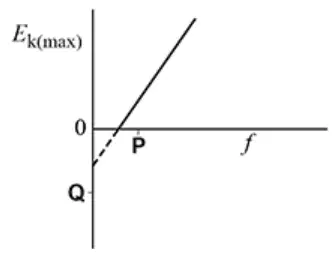
The graph shows how the maximum kinetic energy E_k(max) of photoelectrons emitted from a metal surface varies with the frequency f of the incident radiation. P is the intercept on the f axis. Q is the intercept on the E_k(max) axis. Which graph shows the variation of E_k(max) with f for a metal with a greater work function?
Graph A
Graph B
Graph C
Graph D
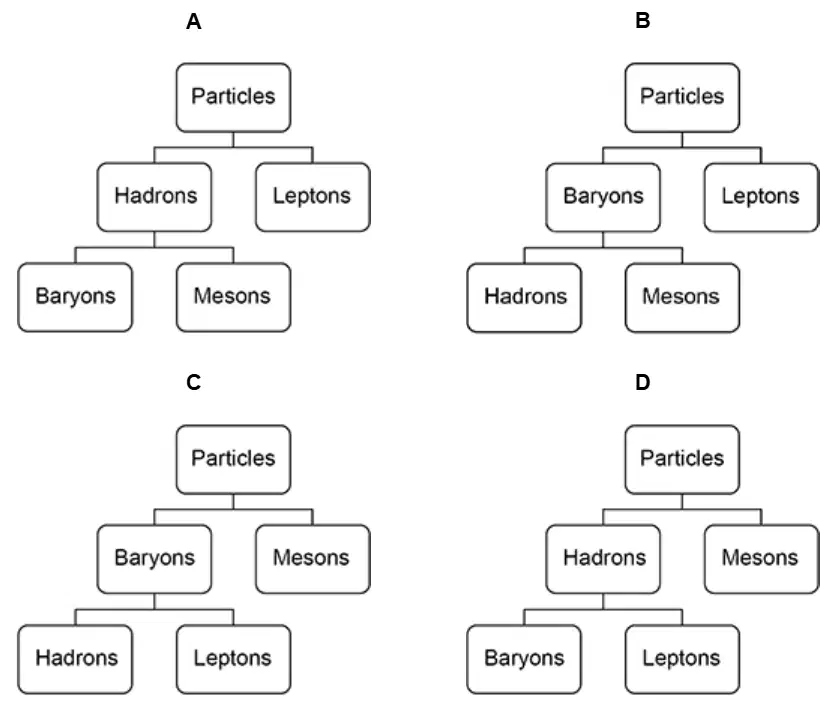
Which shows the classification of particles?
Particles → Hadrons, Leptons → Hadrons → Baryons, Mesons
Particles → Baryons, Leptons → Baryons → Hadrons, Mesons
Particles → Baryons, Mesons → Baryons → Hadrons, Leptons
Particles → Hadrons, Mesons → Hadrons → Baryons, Leptons
The gravitational force is one of the four fundamental forces. The ticks in the table match particles with the other fundamental forces. In which row is the particle matched to the only other fundamental forces it experiences?
A
B
C
D
The proton number of uranium is 92 and the proton number of radon is 88. Which series of decays turns a uranium nucleus into a radon nucleus?
α + β⁻ + β⁻ + α + α
β⁻ + β⁻ + α + β⁻ + α
α + α + α + α + β⁻
β⁻ + β⁻ + β⁻ + β⁻ + α
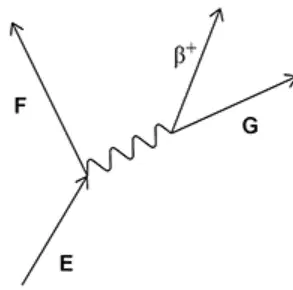
51. The diagram represents a particle interaction. Which particle is labeled as β⁺ in the interaction?
Positron
Electron
Proton
Neutron
Which row identifies particles E, F and G?
A up quark down quark neutrino
B down quark up quark neutrino
C up quark down quark antineutrino
D down quark up quark antineutrino
The quark combination of a particle is sū. Which is true for this particle?
It has a baryon number of 1
It has a charge of −1.6 × 10⁻¹⁹ C.
It is a pion.
It has a strangeness of −1/3
Monochromatic light with a photon energy of 4.1 × 10⁻¹⁹ J is incident on a metal surface. The maximum speed of the photoelectrons released is 4.2 × 10⁵ m s⁻¹. What is the work function of the metal?
A 2.5 × 10⁻¹⁹ J
B 3.3 × 10⁻¹⁹ J
C 4.1 × 10⁻¹⁹ J
D 4.9 × 10⁻¹⁹ J
What is the role of the mercury vapour in a fluorescent tube?
It absorbs photons of UV light and emits visible light.
It absorbs photons of visible light and emits UV light.
It emits photons of visible light following ionisation or excitation.
It emits photons of UV light following ionisation or excitation.
What is the difference in energy between the ground state and energy level 1?
0.3 × 10⁻¹⁸ J
1.3 × 10^{-18} J
1.6 × 10^{-18} J
1.9 × 10^-18 J
A muon and an electron are travelling at the same speed. Which row gives the particle with the greater kinetic energy and the particle with the longer de Broglie wavelength?
A. muon | muon
B. muon | electron
C. electron | muon
D. electron | electron
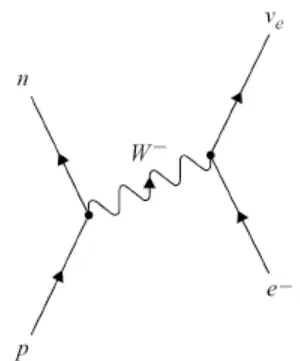
Which diagram represents electron capture?
Diagram A: n, p, W+, ve, e-
Diagram B: n, p, W-, ve, e-
Diagram C: n, p, W+, ve-bar, e-
Diagram D: n, p, W-, ve-bar, e-
81Tl decays to 206Pb by a series of four radioactive decays. Each decay involves the emission of either a single α particle or a single β⁻ particle. What is x?
207
209
210
212
What is the number of up quarks and down quarks in a 9Be nucleus?
Number of up quarks: 11, Number of down quarks: 16
Number of up quarks: 13, Number of down quarks: 14
Number of up quarks: 14, Number of down quarks: 13
Number of up quarks: 16, Number of down quarks: 11
Which decay of a positive kaon (K⁺) particle is possible?
K⁺ → π⁰ + e⁺ + ν̅ₑ
K⁺ → p + νμ
K⁺ → π⁺ + π⁺ + π⁰
K⁺ → μ⁺ + νμ
one alpha decay followed by two β- decays.
A
B
C
D
Choose the correct answer:
positron
alpha particle
Choose the correct answer: frequency.
(a)
Choose the correct answer: μs.
A
B
C
D
Choose the correct answer: 4.9×10⁻¹¹m.
A
B
C
D
the beta-plus decay of a 39/20 Ca nucleus.
A
B
C
D
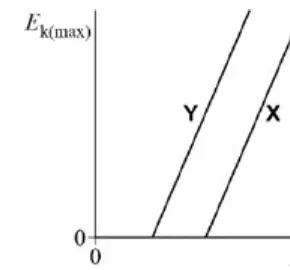
Choose the correct answer: (Diagram of E_k(max) vs f with lines Y and X)
(a)
Choose the correct answer: increases, decreases.
increases
decreases
Choose the correct answer:

