
NEW
Font size
 Worksheets
Paschal Mystery Quiz
Total questions: 58
Worksheet time: 29mins
What is the primary focus of eschatology in Catholic teachings?
The creation of the universe
Life after death
The history of the Church
The role of saints

Why is belief in life after death important for Catholics today?
It provides a historical context
It offers a sense of purpose and hope
It explains the creation of the world
It focuses on the role of angels
What is eschatology concerned with?
The study of ancient civilizations
The final destiny of the soul and humankind
The development of languages
The history of art
Which of the following questions is related to eschatology?
How do plants grow?
What is the speed of light?
Where do we go when we die?
How is electricity generated?
Eschatology is a part of which field of study?
Biology
Theology
Chemistry
Physics
What is one reason why people find it difficult to talk about death?
People enjoy discussing it.
It is a common topic in all cultures.
People fear what happens after death.
It is a joyful subject.
Which of the following is a cultural reason why death is difficult to discuss?
It is celebrated in all cultures.
Some cultures think death is a taboo subject.
It is always discussed openly.
It is considered a minor topic.

How does talking about death affect people emotionally?
It makes them feel happy.
It makes them feel indifferent.
It can make them feel sad.
It makes them feel excited.
What is the concept of spending eternity in a state that is beautiful beyond our ability to conceive?
Hell
Annihilation
Heaven
Reincarnation
According to the Catholic Catechism, what is defined as an 'eternal separation from God'?
Heaven
Hell
Annihilation
Reincarnation
Which view on life after death involves the soul and spirit being reborn into another living entity?
Annihilation
Reincarnation
Heaven
Hell
What happens to one's soul, spirit, memory, personality, and mind in the concept of Annihilation?
They are reborn
They spend eternity in paradise
They disappear and are no more
They are eternally separated from God
Hell means being separated from God forever.
True
False
Reincarnation means your soul disappears after death.
True
False
In Annihilation, your soul and mind no longer exist.
True
False
Heaven is a beautiful place where you live with God forever.
True
False
All beliefs about the afterlife agree that the soul continues to exist in some form after death.
True
False
What is Particular Judgement according to Catholic belief?
It occurs at the end of the world.
It happens immediately after an individual's death.
It is when souls are cleansed in purgatory.
It is the final judgment of all humanity.
What is the purpose of purgatory in Catholic teaching?
It is a place where souls are punished forever.
It is where souls are cleansed before entering heaven.
It is where souls are judged for the first time.
It is a place where only saints go.
What does General Judgment involve according to Catholic teaching?
Only the judgment of saints.
The resurrection and public judgment of all the dead.
The immediate judgment after death.
The cleansing of souls in purgatory.
How can people on earth help souls in purgatory according to Catholic belief?
By ignoring them.
By praying for them.
By judging them.
By sending them to heaven directly.
What is the state of eternal communion with God, the angels, and the saints known as?
Purgatory
Heaven
Hell
Limbo
Which state is characterized by eternal separation from God and suffering?
Heaven
Purgatory
Hell
Limbo
What is the Beatific Vision?
Seeing God face to face
A vision of angels
A dream of paradise
A vision of the saints
Who is Hell reserved for according to Catholic teaching?
Those who have committed venial sins
Those who die in a state of mortal sin
Those who have not been baptized
Those who have not attended church
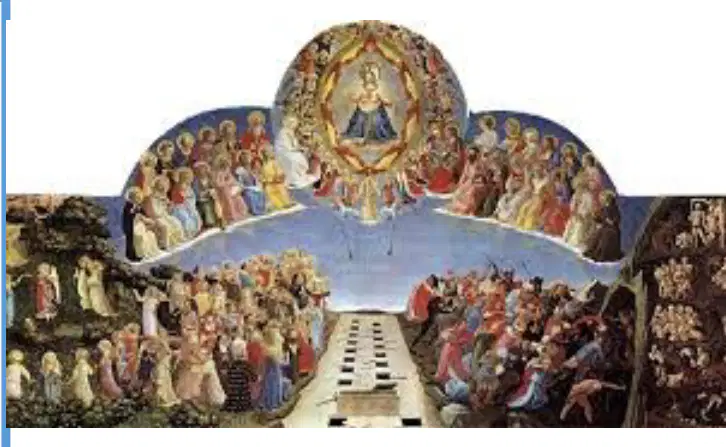
Outline three Catholic beliefs about judgement.
Judgement is immediate after death, involves a life review, and determines eternal destiny.
Judgement is delayed, involves reincarnation, and is based on karma.
Judgement is symbolic, involves a council of elders, and is temporary.
Judgement is a myth, involves no consequences, and is irrelevant.
Outline three Catholic beliefs about purgatory.
Purgatory is a place of eternal punishment, involves no hope, and is for the damned.
Purgatory is a temporary state, involves purification, and leads to heaven.
Purgatory is a myth, involves no suffering, and is irrelevant.
Purgatory is a reward, involves celebration, and is for the righteous.
Outline three Catholic beliefs about heaven.
Heaven is a state of eternal happiness, involves union with God, and is for the righteous.
Heaven is temporary, involves reincarnation, and is based on karma.
Heaven is a myth, involves no joy, and is irrelevant.
Heaven is a place of eternal punishment, involves suffering, and is for the damned.
Outline three Catholic beliefs about hell.
Hell is a state of eternal separation from God, involves suffering, and is for the unrepentant.
Hell is temporary, involves purification, and leads to heaven.
Hell is a myth, involves no consequences, and is irrelevant.
Hell is a reward, involves celebration, and is for the righteous.
What do Catholics believe happens during Judgement?
God judges everyone after they die
People are immediately sent to Heaven
Souls are reincarnated
Everyone goes to Hell
What is the purpose of Purgatory according to Catholic belief?
It is a place of eternal punishment
It helps clean the soul to be ready for God
It is where souls are forgotten
It is a place of endless joy
What do Catholics believe about Heaven?
It is a temporary resting place
It is being with God forever
It is a place of suffering
It is a place of uncertainty
According to Catholic belief, what characterizes Hell?
It is a place of perfect peace
It is being separated from God forever
It is a place of learning
It is a temporary state
Which biblical quote suggests that belief in Jesus leads to eternal life?
John 11:25
Luke 23:43
Matthew 10:28
John 16:22
According to Luke 23:43, where does Jesus say you will be with him?
In Heaven
In Paradise
In the Kingdom
In the Temple
What is the key message of John 3:16?
Fear those who can destroy the soul
Belief in Jesus leads to eternal life
Sorrow will turn to joy
Resurrection is promised
Which quote advises not to fear those who can kill the body but not the soul?
John 11:25
Luke 23:43
Matthew 10:28
John 16:22
What does John 16:22 promise about sorrow and joy?
Sorrow will be everlasting
Joy will be taken away
Sorrow will turn to joy
Joy is temporary
What is required when explaining two Catholic teachings about life after death in the given task?
Only one point with a personal opinion
Two well-developed points, one with a Biblical quote
Three points with no references
A single point with a historical reference
What does the Catholic Church teach about the judgment after death?
It is a process that takes several years.
It is an immediate and personal event.
It happens only after the resurrection.
It is decided by the community.
According to Catholic teachings, what happens to the soul at the end of time?
It remains in purgatory forever.
It is reincarnated into a new body.
It is reunited with a glorified body.
It ceases to exist.
What is the significance of the belief in the resurrection of the body in Catholic teachings?
It emphasizes the importance of earthly possessions.
It provides hope for a new, transformed life with God.
It suggests that life on earth is the ultimate goal.
It indicates that judgment is not necessary.
What are the "Last Things" in Catholic belief?
Birth, life, death, and resurrection
Death, judgment, Heaven, Hell, and Purgatory
Creation, sin, redemption, and salvation
Faith, hope, charity, and love
Why are the Last Things important for Catholics?
They provide historical context
They help understand scientific phenomena
They guide how Catholics live and understand life after death
They are part of a cultural tradition
How do the Last Things offer hope to Catholics?
By promising wealth and prosperity
By ensuring a long life on Earth
By offering comfort through the promise of Heaven and purification in Purgatory
By guaranteeing immediate entry to Heaven
What is the role of Purgatory in Catholic belief according to the text?
It is a place of eternal punishment
It shows God's mercy by allowing souls to be purified before entering Heaven
It is a temporary state of happiness
It is a myth with no real significance
Why do Catholics try to live good lives according to the text?
Because they want to be famous
Because they know God will judge them
Because they want to be rich
Because they want to travel the world
What does believing in heaven provide to Catholics?
Wealth and prosperity
Hope and comfort
Fame and recognition
Power and control
What do Catholics remember about God according to the text?
God is strict and unforgiving
God is both kind and fair
God is distant and unknown
God is only fair
What actions do Catholics take to grow closer to God?
They ignore others
They pray and do good things
They focus on material wealth
They isolate themselves
Describe the character of Bart whilst he still has his soul intact. Use at least 3 adjectives.
Kind, generous, and shy
Mischievous, rebellious, and clever
Quiet, timid, and reserved
Serious, focused, and diligent
Who does he sell his soul to and for how much?
Lisa for $10
Milhouse for $5
Nelson for $15
Martin for $20
What are the implications of this that can be seen in this clip?
Bart becomes invisible
Bart loses his sense of humor
Bart experiences a loss of identity and connection
Bart gains superpowers
What then can we infer about the significance/importance of the soul for Christians?
It is a symbol of wealth
It is a source of entertainment
It represents one's true self and spiritual connection
It is a physical object
According to Catholic belief, what happens to the soul after death?
The soul ceases to exist
The soul lives on after death
The soul is reincarnated
The soul is immediately judged
What is purgatory according to Catholic teachings?
A place of eternal punishment
A temporary place of purification before entering heaven
A place where souls are reincarnated
A place where souls are given a second chance to choose God
What does the Catholic Church teach about the final judgment?
It happens immediately after death
There will be a final judgment at the end of time
It occurs only for those who have sinned
It is a metaphorical concept
What is the Catholic belief about hell?
It is a place where souls are given a second chance to choose God
It is a place of eternal happiness
It is a temporary place of purification
It is a place of eternal separation from God

