
 Worksheets
Вопросы по очистке воды
Total questions: 172
Worksheet time: 1hrs 26mins
What is the purpose of flocculation in the mechanical process of water purification?
To remove large particles from water
To help small particles clump together
To disinfect the water
To adjust the pH of the water
There is no correct answer
Which of the following methods is commonly used in the sedimentation stage of water purification?
Filtration
Chlorination
Aeration
Allowing particles to settle
No correct answer
What is the main purpose of coagulation in water treatment?
Kill bacteria
Remove dissolved minerals
Neutralize the charge of particles
Add color to the water
No correct answer
How does the filtration stage contribute to the production of clean water?
By exposing water to UV light
By trapping small particles in the medium
By evaporating water
By adding minerals for taste
No correct answer
In the context of water purification, what does the abbreviation "TDS" stand for?
Toxin Detection System
Treatment and Disinfection Strategy
Turbidity Measurement
Total Dissolved Solids
No correct answer
What step usually follows the filtration stage in the mechanical water purification process?
Settling
Aeration
Disinfection
Softening
No correct answer
What is the purpose of the disinfection stage in water purification processes?
Remove odors
Regulate the water temperature
Kill harmful microorganisms
Improve the taste of water
No correct answer
What does the term "backwashing" mean in water filtration systems?
Water flow in the reverse direction to clean the filter
Adding chemicals to the water
Measuring the turbidity of the water
The final stage before distributing the water
No correct answer
How does aeration contribute to the water purification process?
By adding oxygen to the water to remove impurities
By lowering the water temperature
By increasing the concentration of minerals
By accelerating the sedimentation process
There is no correct answer
What is the main goal of the biological water purification process?
Remove heavy metals from water
Decompose organic substances into simpler substances
Increase the temperature of the water
Add more chemicals to the water
No correct answer
Which of the following microorganisms are commonly used in biological water treatment?
Insects
Algae
Mammals
Bacteria
No correct answer
What role do aerobic bacteria play in the biological treatment of water?
They survive only in the absence of oxygen
They break down pollutants in water using oxygen
They increase the acidity of water
They remove suspended solids from water
There is no correct answer
What is the function of activated sludge in the biological water treatment process?
To act as a barrier to prevent the flow of water
To provide nutrients for aquatic plants
To settle at the bottom of the water body
To decompose organic matter through microbial activity
There is no correct answer
Which of the following is a product of the biological water purification process?
Toxic gases
Recycled plastics
Clean water
Radioactive waste
No correct answer
In biological water treatment, what does the term "nitrification" mean?
Removal of nitrogen compounds from water
Adding nitrates to water
Growth of algae in water
Filtration process
No correct answer
What equipment is commonly used for aeration in biological water treatment systems?
Pumps
Water heaters
Vacuum cleaners
Filters
Batch aeration systems
Which of the following statements is true about biofilters in water treatment?
They are mainly used to improve color
They work by physically removing impurities
Biofilms on the filtering material help in removing pollutants
They are ineffective in breaking down organic matter
There is no correct answer
What is the purpose of the final sedimentation tank in the process of biological water treatment?
To release treated water back into the environment
To provide a habitat for aquatic animals
To collect remaining suspended solids
To increase the temperature of the water
No correct answer
What is the importance of monitoring and controlling the pH level in biological water treatment?
Accelerate the growth of pathogens
Create an environment suitable for microorganisms
Increase water turbidity
Reduce dissolved oxygen content
No correct answer
What is the significance of bioaugmentation in biological water treatment?
Introduction of genetically modified organisms for water purification
Reduction of beneficial bacteria growth in the system
Artificially increasing the pH level of water
Increasing the turbidity of water
Decomposition of heavy metals in water
What is the purpose of the secondary treatment stage in biological water purification?
Remove physical residues from the water
Continue the decomposition of organic substances after primary treatment
Adjust the color of the water
Add disinfectants to the water
No correct answer
Which of the following is a common chemical substance used in water purification processes?
Vinegar
Chlorine
Baking soda
Lemon juice
No correct answer
Which of the following is a common chemical substance used in water purification processes?
Vinegar
Chlorine
Baking soda
Lemon juice
What is the purpose of adding chlorine in the water purification process?
To improve the taste of the water
To remove harmful bacteria and pathogens
To color the water blue
To raise the temperature of the water
How does the coagulation process help in water purification?
By adding color to the water
By removing dissolved particles from the water
By making the water acidic
By increasing the salinity of the water
What is the purpose of the sedimentation process in water purification?
To mix chemicals in the water
To kill bacteria in the water
To settle solid particles out of the water
To change the pH of the water
What is the main purpose of adding fluoride to drinking water?
To provide color
To improve dental health
To remove odor
To increase acidity
What role do coagulants play in the water purification process?
To accelerate the evaporation process
To remove solid particles from water during sedimentation
For water aeration
To lower the water temperature
How does the pH level of water affect the effectiveness of chemicals for water treatment?
It doesn't matter
A high pH level increases effectiveness
A low pH level decreases effectiveness
It neutralizes the chemicals
What process involves the removal of pathogens and microorganisms from water?
Filtration
Softening
Aeration
Fluoridation
What is the purpose of adding aluminum in the water purification process?
To demineralize the water
To neutralize pH
To aid in coagulation
To add color
What chemical is commonly used to regulate low pH levels in water during the purification process?
Ammonia
Vinegar
Hydrogen peroxide
Sodium hydroxide
What chemical is commonly used to regulate high pH levels in water during the purification process?
Ammonia
Sulfuric acid
Hydrogen peroxide
Sodium hydroxide
How does the process of flocculation help in water purification?
Increasing water hardness
Neutralizing pH
Removing colloidal particles
Lowering water temperature
Which of the following methods is NOT a common method of water purification?
Reverse osmosis
UV disinfection
Deep frying
Activated carbon filtration
What is the purpose of the backwashing process in water purification?
To remove accumulated residues from filters
To add chemicals to the water
To introduce air into the water
To change the color of the water
What method is used to remove excess minerals, such as calcium and magnesium, from water?
Distillation
Ionic exchange
Flocculation
Filtration
What is the characteristic of drinking water?
It is safe to drink
It has an unpleasant smell
It is heavily colored
It contains visible particles
How does the ozonation process benefit water purification?
Removing dissolved iron
Neutralizing alkalinity
Disinfecting water
Increasing turbidity
What step in the water purification process involves the removal of suspended particles through a filtration medium?
Disinfection
Aeration
Filtration
Settling
What state standard is used in several countries from the list below?
GOST
Technical requirements
Company rules
Official duties
Which document is not related to global significance?
Company Rules
GOST Standard
ISO Document
ASTM Standard
Which standard is American?
ASTM Standard
GOST Standard
UOP Standard
Technical Requirements
What standards provide recommendations for testing and analysis of oil and petroleum products?
UOP Standard
MSDS Requirement
ASTM Standard
GOST Standard
What standards have been approved by the State Council for Standardization, Metrology, and Certification?
State standards
Industry standards
Enterprise standards
Technical requirements
What standards are approved by the relevant ministries, agencies, and other central executive authorities?
State standards
Industry standards
Enterprise standards
Technical requirements
What standards are approved by companies?
Industry standards
State standards
Enterprise standards
Technical requirements
Main equipment is:
equipment in which the main chemical and technological processes of product production are carried out
equipment whose failure leads to the shutdown of the technological line
the main part of the equipment on which other components are assembled and installed
equipment of the plant’s repair workshops
equipment used for transportation of raw materials
Friction occurring on frictional surfaces in the complete absence of impurities is called:
Rolling friction
Sliding friction
Pure friction
Coriolis friction
Cam friction
At what imbalance is the center of gravity of a part or assembly located outside the axis of rotation?
During rotation
Static support
Static moment
Static imbalance
Friction observed between solid surfaces with insufficient lubrication (film thickness not more than 0.5 μm):
Semi-dry friction
Pure fluid friction
Semi-fluid friction
Pure complete friction
Pure incomplete friction
Friction occurring with abundant lubrication:
Semi-dry friction
Fluid friction
Semi-fluid friction
Pure friction
Friction
Friction that occurs with proper geometric shapes of bodies:
Boundary friction
Pure fluid friction
Semi-fluid friction
Pure semi-fluid friction
Organic-fluid friction
Electrodes used for welding non-ferrous metals:
Steel
Copper
Carbon
Thin
Non-ferrous
Electrodes used for resurfacing worn-out parts:
<a>Electrodes used for resurfacing worn-out parts:
ENR
ED
E
EM
To obtain a hard, wear-resistant layer, the following is used:
Alloy of cobalt, chromium, and iron
Alloy of chromium and vanadium
Alloy of chromium and nickel
Alloy of chromium and titanium
Chromium cast iron
Cause of failure of punching dies:
Dulling of cutting edges
Soft material
Saw dulling
Material wear
Edge sticking
Cause of failure of punching dies:
Dulling of cutting edges
Soft material
Saw dulling
Material wear
For sealing small cracks in equipment parts, the following is used:
Straightening
Pinning
>Adhesive
Welding
To obtain a permanent (non-detachable) connection:
Screw
Bolt
Welding
Nut
Purpose of spring stops:
To transfer load in one direction
To transmit rotary motion
To engage gears
To return the mechanism
Current used for arc welding:
Direct current
Alternating current
Both direct and alternating
Solar energy
How do working surfaces of machine parts wear?
Evenly
Unevenly
Quickly
Slowly
How do working surfaces of machine parts wear?
Evenly
Unevenly
Quickly
Slowly
Change in reaction rate under the influence of special accelerators is called:
isomerization
dehydrogenation
catalysis
cracking
Process where dissolved gases are released from water into the air and removed:
aeration
coagulation
ion exchange
flotation
Reactions where the initial substance forms an intermediate, which then forms the final product are:
consecutive
parallel
catalytic
endothermic
A wastewater treatment method used for removing acids and alkalis:
coagulation
neutralization
rectification
regeneration
Additives used to increase catalyst activity are:
promoters
packings
antioxidants
carriers
Reactions classified by heat effect include:
catalytic
endothermic
homogeneous
multistage
The biochemical water treatment process occurring with a constant oxygen supply is:
aerobic
anaerobic
reductive
oxidative
The process of separating the useful part of raw material from the non-useful one is called:
neutralization
degassing
enrichment
complex utilization
Raw materials are classified by origin into:
mineral raw materials
gaseous raw materials
inorganic raw materials
The process in which a catalyst is used to speed up a reaction is called:
homogeneous catalysis
heterogeneous catalysis
negative catalysis
positive catalysis
Equipment used for high-temperature processes:
rectification column
conveyor
feeder
furnace
Suspension of fine solid particles in a liquid is called:
emulsion
polymer
catalyst
suspension
A substance that changes the reaction rate is:
activator
intermediate
catalyst
regulator
Separation into solid and liquid phases is:
catalysis
coagulation
rectification
absorption
A value that characterizes a device or its operating mode is:
concentration
technological parameter
technological mode
technological regulation
Reactions occurring in different phases are:
homogeneous
heterogeneous
high-temperature
The process of separating the useful part of raw material from the non-useful one is called:
regeneration
degassing
enrichment
A set of operations performed in sequence to obtain a finished product from raw materials is:
chemical-technological process
technological mode
technological parameter
technological regulation
Target product separation is achieved by:
enrichment
rectification
neutralization
A substance that changes the rate of a reaction is:
activator
catalyst
intermediate
By-products not used in the current production but can be raw materials elsewhere are:
intermediates
waste
raw materials
Particle agglomeration in a colloidal system is called:
catalysis
coagulation
rectification
absorption
During major overhaul, the following is performed:
modernization
restoration of equipment resource
replacement of any parts
repair of only some parts, excluding base parts
To restore the equipment’s resource, the following is performed:
routine repair
major overhaul
shift maintenance
periodic maintenance
Preparatory work for major overhaul is performed by:
operational personnel
maintenance personnel
either operational or maintenance personnel
no correct answer
During the preparatory phase of major overhaul, the following tasks are performed:
hydraulic testing
depressurizing to atmospheric pressure
pneumatic testing
removal of product from equipment
Maintenance is divided into shift and periodic depending on:
the availability of labor
the nature of the work performed
the time of day
the scope of work
Periodic maintenance is carried out:
on standby equipment
every shift
on operating equipment
during equipment downtime
Maintenance and repair in the Maintenance and Repair System can be performed according to one of the methods depending on:
the technical condition of the equipment
the structure of the repair cycle
the significance of the equipment in the technological process
whether the equipment is primary or auxiliary
Number of operating hours during which all repairs are performed:
<a>Shift duration
<a>Inspection duration
<+a>Repair cycle duration
Repair cycle duration
Shift duration
Inspection duration
Accident report is filled out when machine downtime exceeds:
60 minutes
50 minutes
40 minutes
30 minutes
Process of gradual damage accumulation under repeated stresses, leading to reduced durability:
Long-term failure
Fast failure
Fatigue failure
Accepted failure
Purpose of cam stops:
To transfer load in one direction
To transmit rotary motion
To engage gears
To return the mechanism
For sealing small cracks in metallurgical equipment parts:
Welding
Adhesive
Pinning
Straightening
One of the main methods of restoring machine parts:
Fatigue failure
With changing material properties
With changing original dimensions
With changing location
The process of changes over time in deformation and stresses in parts under external loads:
Flexibility
Hardness
Viscosity
Creep
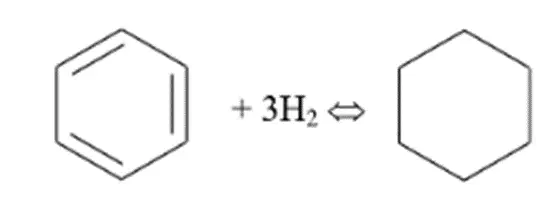
Name the following reaction:
Hydrogenation of benzene
Dehydrogenation of cyclohexane
Hydrocracking of benzene
Hydrogenolysis of hexane
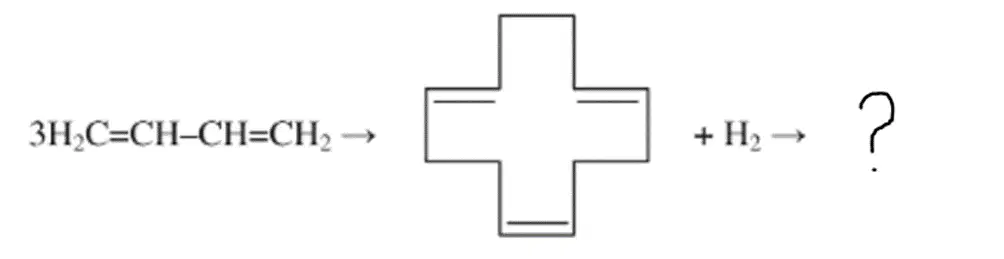
What product is obtained in the industry by cyclotrimerization of butadiene-1,3 in the presence of a complex catalyst Al(C2H5)2Cl-TiCl4 in cyclododecanthrene-1,5,9 followed by its hydrogenation?
Cyclododecane
Cyclotrimer
Cyclooctane
Cyclohexane

Name the following chemical reaction:
Esterification
Formation of acetals
Aldol condensation
Hydrogenation of aldehydes in alcohols
What product is obtained after non-destructive oxidation of propane?
Propanoic acid
Hexanol
Methyl ethyl ether
Dimethyl ether
What product is obtained after destructive oxidation of butane?
Valeric acid
Maleic acid
Vinegar acid
Acrylic acid
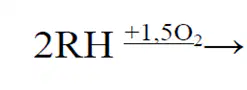
What product is obtained after oxidative condensation by following form of reaction?
Glycol
Hydroperoxide
Anhydride
Epoxide
What secondary alcohol is oxidized to butanone-2?
Butanol-3
Butanol-2
Butanol-1
Butanol-4

Who developed a method for directed liquid-phase oxidation of liquid saturated hydrocarbons C10-C20 with the formation of alcohols in following reaction?
Kucherov M.G.
Konovalov M.I.
Bashkirov A.N.
Zaycev A.M.
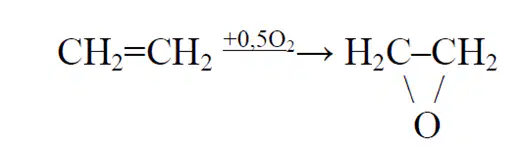
Name the reagent and product in following reaction:
Ethyne, oxygen, ethylene peroxide
Ethylene, oxygen, ethylene peroxide
Ethyne, oxygen, ethylene oxide
Ethylene, oxygen, ethylene oxide
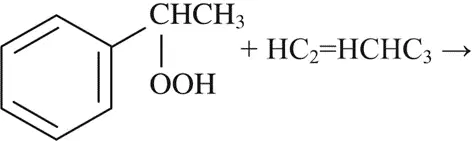
What products are obtained by following reaction:
propylene oxide and acetophenone
styrene and methylphenylcarbonyl
acetophenone and methylphenylcarbonyl
propylene oxide and methylphenylcarbonyl
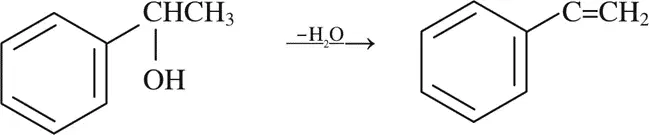
Name the following reaction:
Preparation of styrene by dehydration of methyl phenyl carbonyl
Epoxidation of propylene with hydroperoxide
Decomposition of ethylbenzene hydroperoxide
Oxidation of ethyl benzene

Name the organic product in following reaction:
Acetaldehyde
Formaldehyde
Ethylene oxide
Formic acid
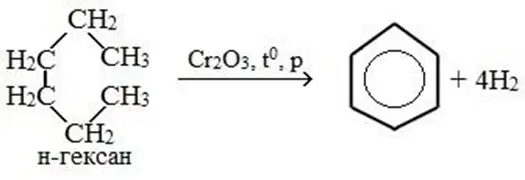
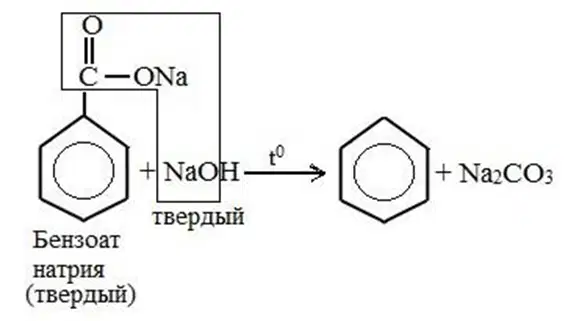
Name the following reaction:
Decarboxylation of benzoic acid
Dehydrocyclization of alkanes
Dehydrogenation of cycloalkanes
Trimerization of acetylene
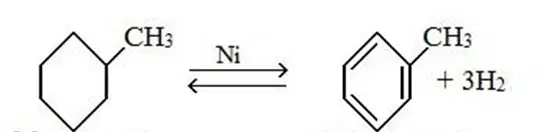
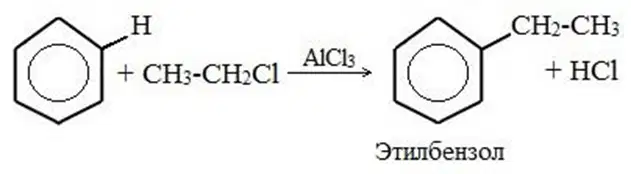
Name the following reaction:
Alkylation of benzene
Dehydrogenation of cycloalkanes
Trimerization of acetylene
Decarboxylation of benzoic acid
Name the following reaction:
Dehydrogenation of cycloalkanes
Dehydrocyclization of alkanes
Decarboxylation of benzoic acid
Alkylation of benzene
Name the following reaction:
Trimerization of acetylene
Dehydrogenation of cycloalkanes
Dehydrocyclization of alkanes
Alkylation of benzene
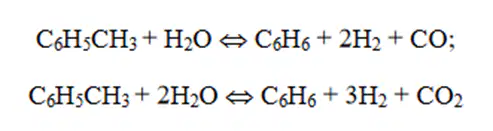
What metal catalyst is used in following dealkylation reaction:What metal catalyst is used in following dealkylation reaction:Ni
Pd
Rh
Mo
Ni
> What is another name of disproportionation reaction?
Transalkylation
Cracking
Isomerization
Hydrogenation
How to produce acetylene from ethane (name the reaction)?
By alkylation reaction
By halogenation reaction
By hydrogenation reaction
By dehydrogenation reaction
How o-xylene is obtained from benzene (name the reaction)?
By hydrogenation reaction
By dehydrogenation reaction
By oxidation reaction
By alkylation reaction
How benzene is obtained from cyclohexane (name the reaction)?
By alkylation reaction
By halogenation reaction
By trimerization reaction
By dehydrogenation reaction

Name the following compound:
Benzoquinone
Benzene
Cyclohexane
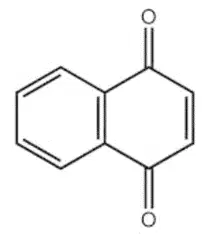
Name the following compound:
Toluene
Naphthaquinone
Benzene
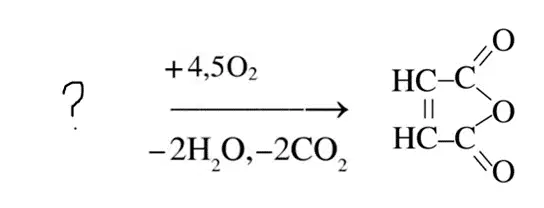
What is initial reagent in following reaction?
Naphthalene
Toluene
Benzene
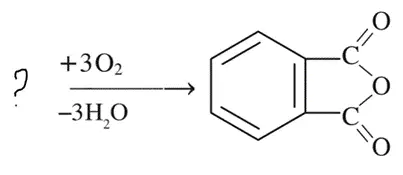
сWhat is the initial reagent in the following reaction?
O-xylene
P-xylene
Benzene
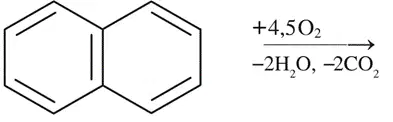
What is produced by following reaction?
Phthalic anhydride
Maleic anhydride
romellitic dianhydride
Acetophenone
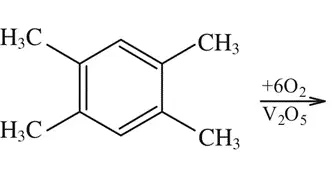
What products are obtained by following reaction?
Phthalic anhydride and water
Methyl phenyl carbonyl and water
Acetophenone and water
Pyromellitic dianhydride and water
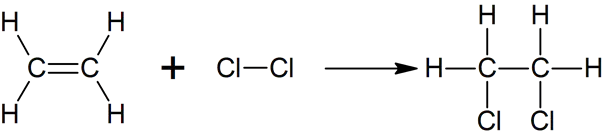
Name the following reaction
хз какой праавильный
Halogenation
Alkylation
Isomerization
Hydrohalogenation
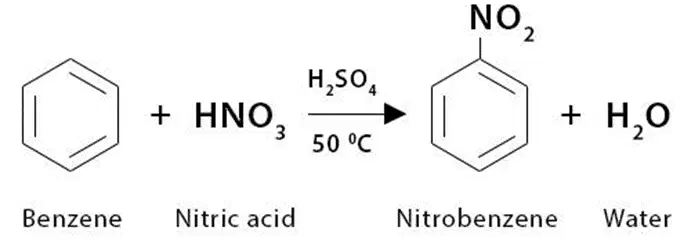
дячвмь
Nitration
Alkylation
Isomerization
Hydrohalogenation
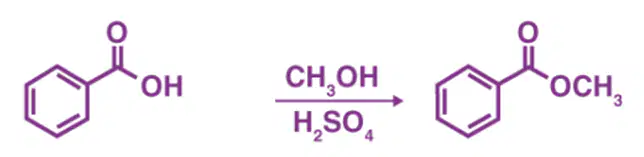
Isomerization
Esterification
Nitration
Alkylation

Cumene process
<a> Fischer-Tropch process
<a> Friedel-Craft’s process
<a> Alkylation process
Cumene proces
ischer-Tropch process
iedel-Craft’s process
lkylation process
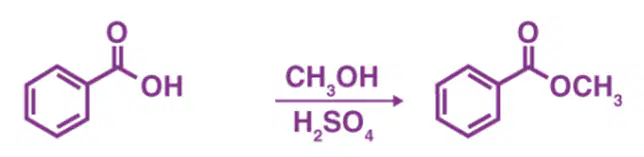
Isomerization
Alkylation
Esterification
Nitration
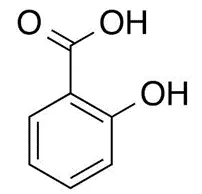
Hydroxiphenone
Phenol
Benzoic acid
Salicylic acid
When was the reaction of hydroformylation (oxosynthesis) discovered?
1938
1945
1952
1960
What is false from the following states?
he reaction rate is proportional to the olefin concentration
The hydroformylation reaction releases the energy
The hydroformylation reaction is endothermic

<a> Carbon monoxide
Sulfur
Ammonia
In reactors with internal heat removal, how are the reaction components introduced into the reaction zone?
AllAll reaction components are introduced from below.
Only reaction products are introduced from below.
Only cold feedstock is introduced from below.
What is a disadvantage of reactors with internal heat removal?
They are complex to design and manufacture
They increase yield of by-products.
They cannot be used for exothermic reactions.
What type of coolant is typically used in reactors with external heat exchangers for hydroformylation?
Reaction product
Mineral oil
Air
Demineralized water
What ordinary material is used for reactors made in hydroformylation?
carbon steel
nickel steel
zinc alloy
It is obtained by polymerizing ethylene at high temperatures (up to 300°C) and pressures up to 250 MPa in the presence of radical initiators
low-pressure polyethylene
high-pressure polyethylene
low-pressure polypropylene
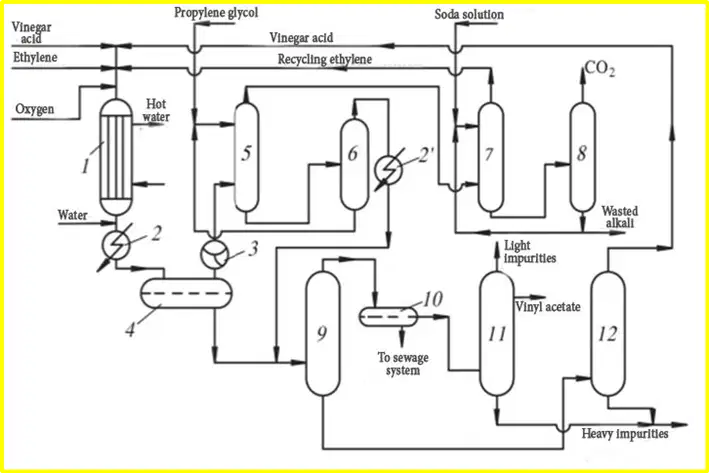
Name the equipment 6 in following scheme
Desorber
Absorber
Settler
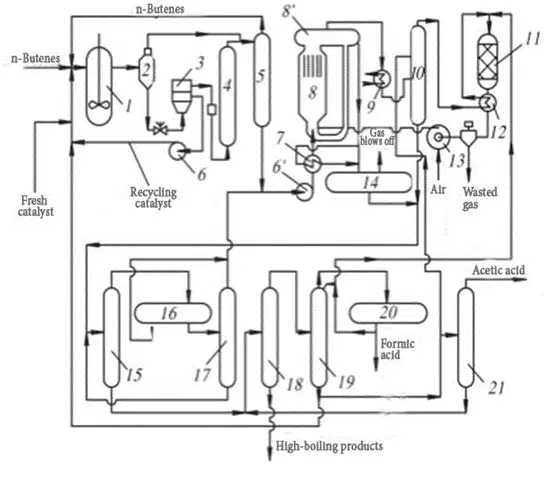
How is the heat of the oxidative cracking reactor supplied in the following scheme?
By gas from the gas separator 14
By recycling compounds from separator 8’
> By air which is pumped by the compressor 13 through the nozzles to the lower part of the reactor
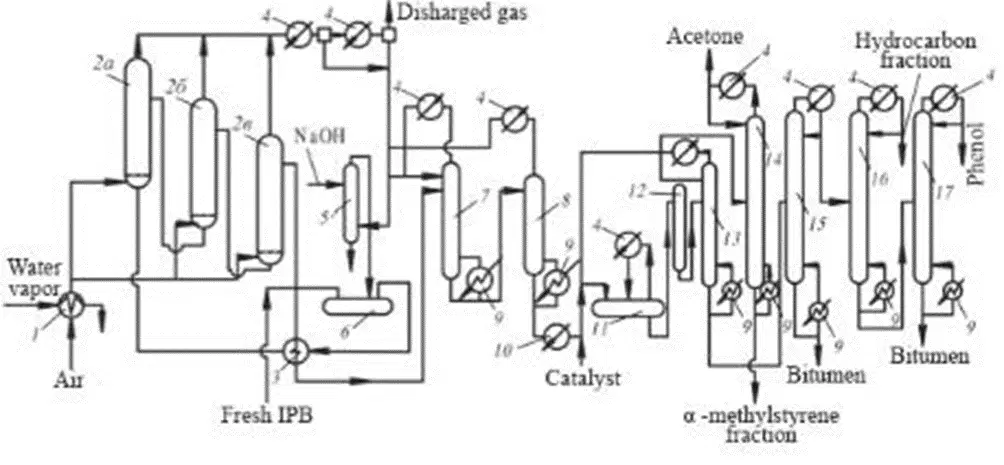
какой катализатор используется в данном процессе
50% solution of sulfuric acid in acetone
50% solution of boric acid in acetone
60% solution of sulfuric acid in acetone
50% solution of sulfuric acid in butanone
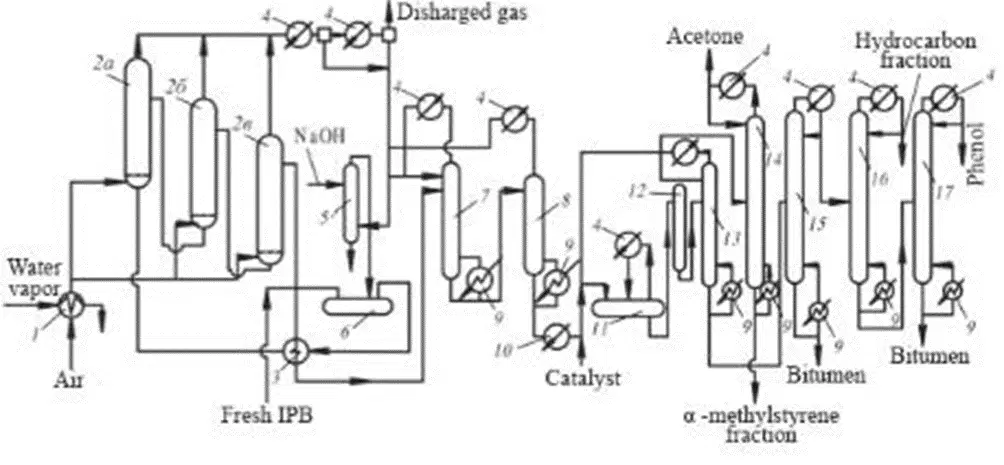
Name the equipment 7 in following scheme
decomposition reactor
concentration column
fortification column
alkali washing column
At what temperature range the oxidation of the isopropylbenzene is carried out in the liquid phase in the presence of the initiator - hydroperoxide isopropylbenzene (HPIPB)?
at a temperature of 120-135°C
at a temperature of 115-135°C
at a temperature of 110-130°C
at a temperature of 115-135°C
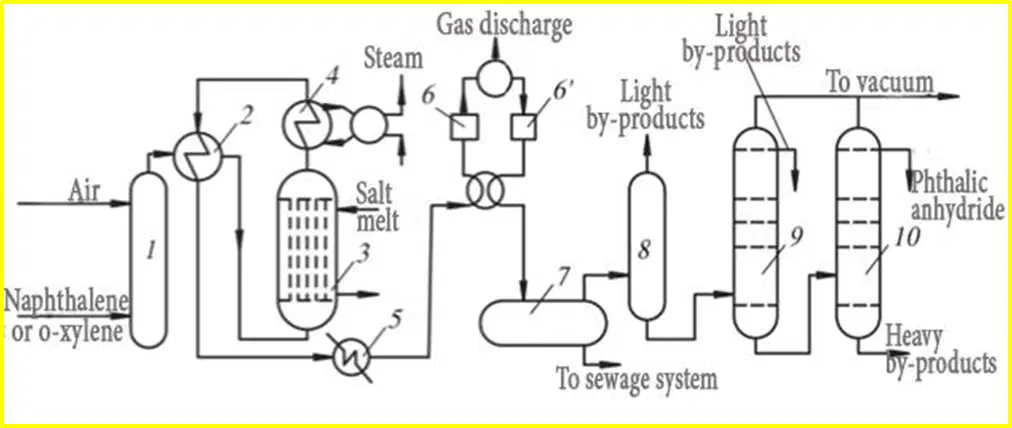
Name the equipment 8 in following scheme
receiving tank
rectification column for commercial phthalic anhydride isolation
rectification column for light by-products isolation
phthalic anhydride preliminary purification column
What type of oxidation process is the liquid-phase oxidation of hydroperoxide production?
rectification
destructive oxidation
оxidative condensation
non-destructive oxidation
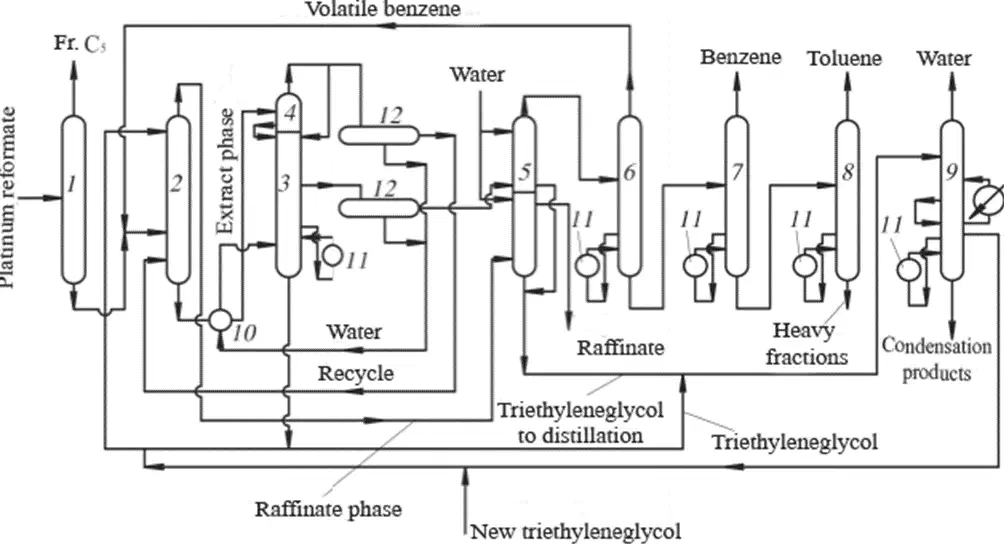
Name the equipment 9 in following scheme
Washing column of extract and raffinate
<a> Extractive rectification column
TEG purification column
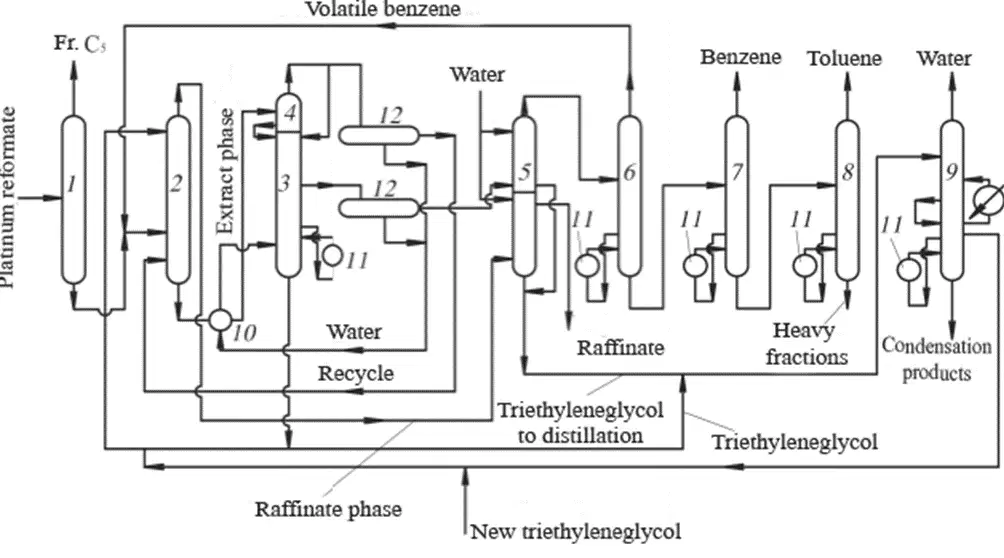
Name the equipment 5 in following scheme
Washing column of extract and raffinate
Extractive rectification column
Single-entry evaporation section
This process is based on the selective dissolution of components of the mixture (aromatic) in a solvent with limited solubility or absence of it
Primary dehydration
Azeotropic rectification
Selective extraction
Extractive rectification
12. What temperature is required to complete the reaction: CH3OH + 0.5O2 → HCHO + H2O?
600°C
500°C
400°C
700°C
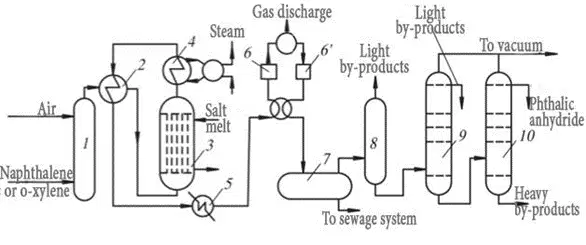
Name the equipment 8 in following scheme
phthalic anhydride preliminary purification column
rectification column for light by-products isolation
rectification column for commercial phthalic anhydride isolation
What particularly often used catalyst in gas-phase oxidation which produces anhydrides?
vanadium-potassium sulfate-silica gel catalyst
cobalt-nickel silicate catalys
cobalt ctarbonyl catalyst
palladium chloride catalyst
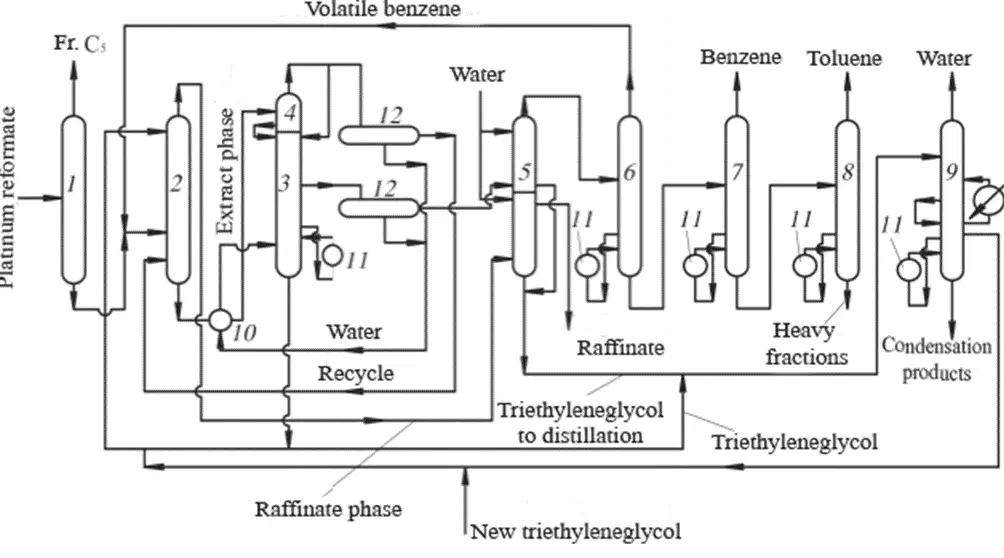
Name the equipment 5 in following scheme
ne
Washing column of extract and raffinate
Extractive rectification column
Single-entry evaporation section
Transmitting column of volatile benzene
Process of separation of components with close boiling points using the third component, which dissolves one of the components well
Primary dehydration
Selective extraction
Extractive rectification
Azeotropic rectification
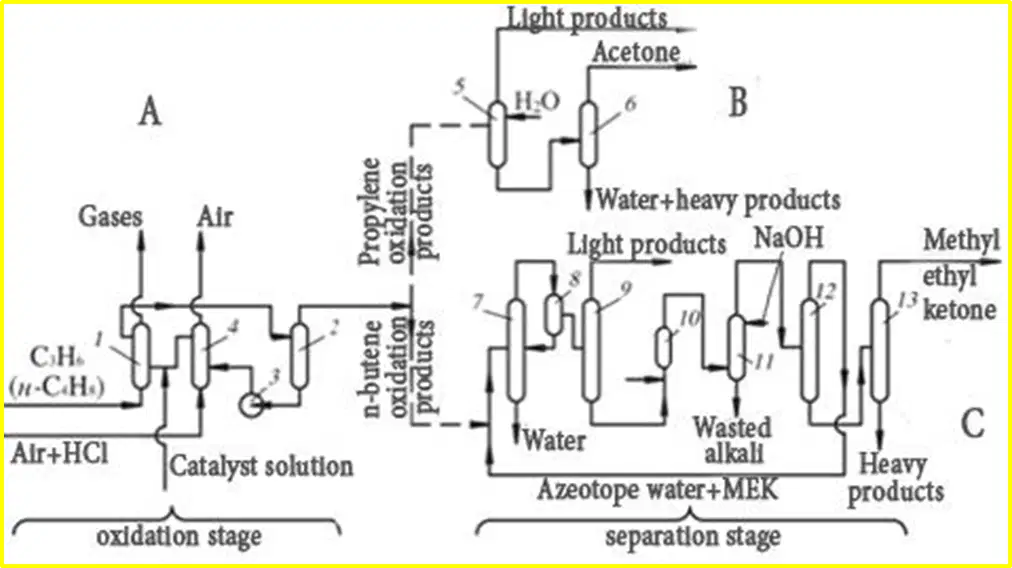
Name the equipment 10 in following scheme:
contact apparatus of selective hydrogenation
low-boiling products distillation column
primary rectification column
acetone extraction column
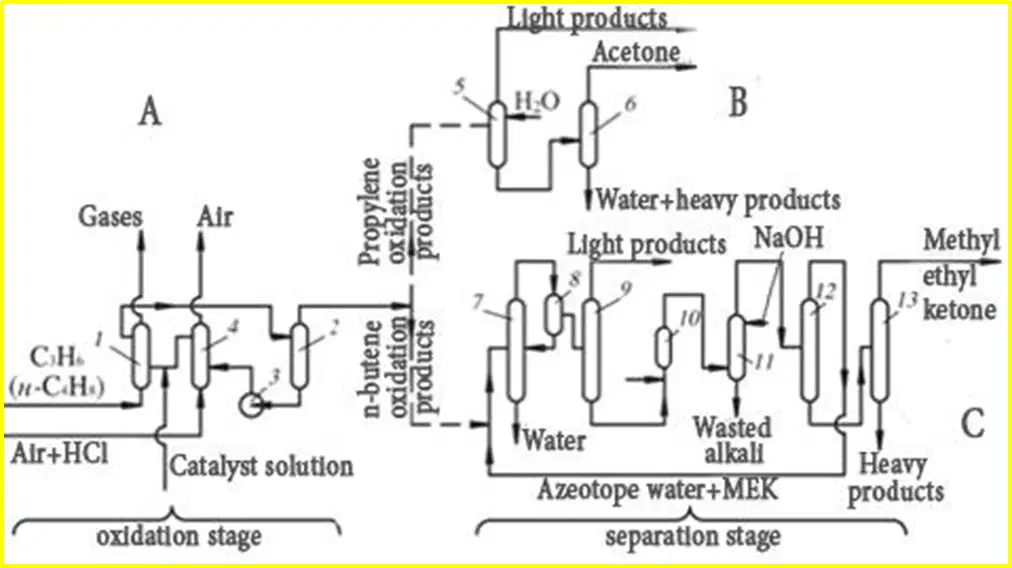
Name the equipment 10 in following scheme:
contact apparatus of selective hydrogenation
low-boiling products distillation column
primary rectification column

<q> Name the equipment 2 in following scheme:
stripping column
regenerator
alkali scrubber
reactor
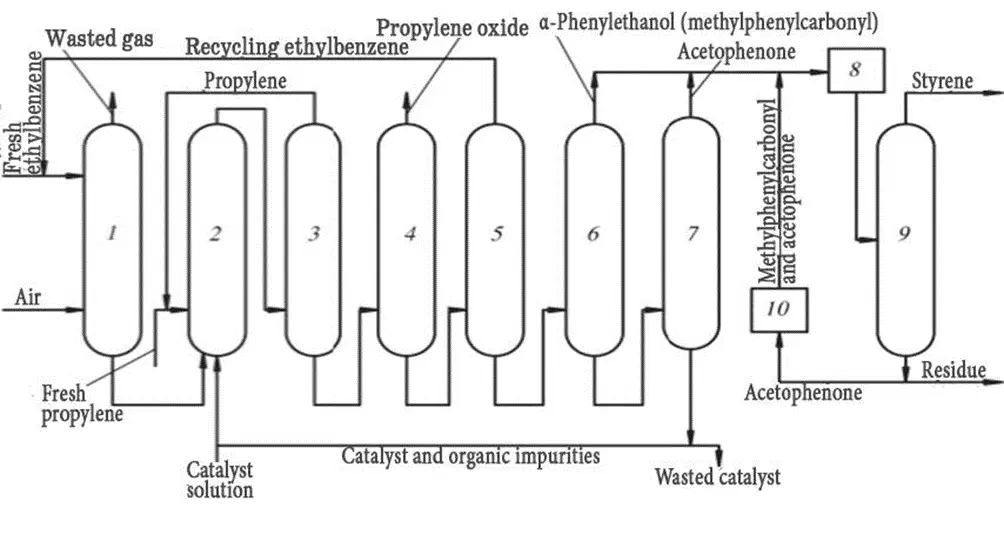
rName the equipment 5 in following scheme:
rectification column
hydrogenation block
dehydrator
oxidation reactor
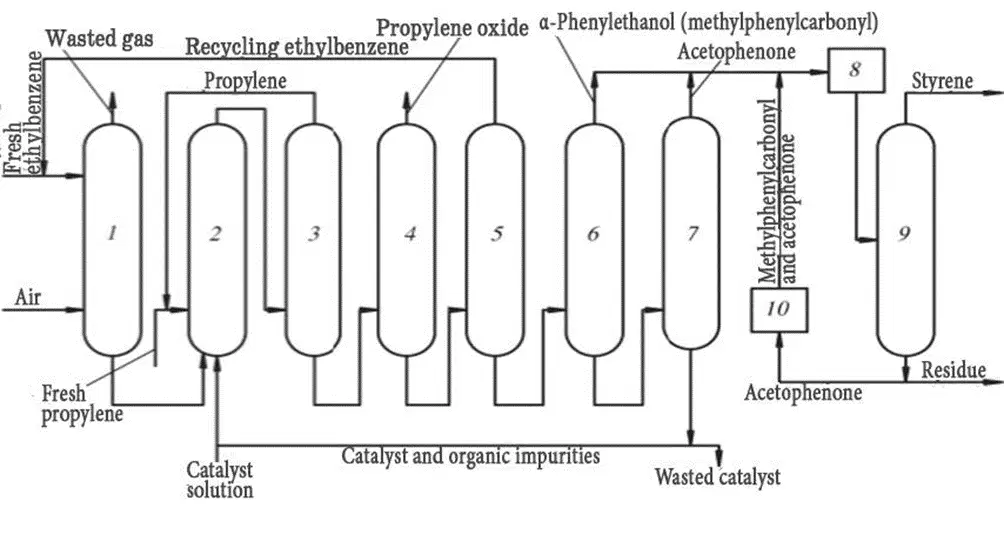
Name the equipment 8 in following scheme
rectification column
dehydrator
oxidation reactor
epoxidation reactor
What by-products are formed in propylene oxide production?
propylene oxide and methyl ethyl carbonyl
ethylbenzene hydroperoxide
ethylbenzene and styrene
acetophenone and methyl phenyl carbonyl
What methods from the list below are not related to propylene oxide production?
the epoxidation method of propylene over acids or H2O2
electrochemical method
hydrofluoride method
oxidation of propylene with molecular oxygen
Name the equipment 7 in following scheme:
condenser
rectification column
main contact reactor
main contact absorber
How ethylene is purified from the acetylene in ethylene oxide production?
by selective hydrogenation or by copper oxide with precipitation of copper acetylides
it is saponified in saponifiers
it is hydrolysed with water by decomposition reaction
it is washed with alkali, water, passed through an adsorber with activated carbon
What is mostly used as the oxidizing agent in oxidation process?
oxygen and air
nitrogen and air
hydrogen and air
sulfur and air
What is the optimal range of temperature for ethylene oxide production process?
200-300°C
100-200°C
300-400°C
250-350°C
What catalyst is used in the process of oxidation of ethylene to ethylene oxide?
silver
cobalt
palladium
arsenium
What process is carried out in the equipment 16?
regeneration of boric acid
hydrolysis of borate esters
oxidation of liquid paraffins in the presence of H3BO3
saponification and distillation of secondary alcohols
Name the stage where borate ester is formed in following technological scheme:<+a> oxidation of liquid
paraffins in the presence of H3BO3
hydrolysis of borate esters
saponification and distillation of secondary alcohols
regeneration of bc acidori
What method from below is not used for production of gigher fatty alcohols?
separation from the second unsaponifiable production of SFA;
hydrogenation of SFA and their methyl and butyl ethers;
hydrogenation of whale oil;
direct oxidation of saturated hydrocarbons C1-C2 with molecular oxygen
What methods are used to produce a lot of low-molecular acids?
liquid-phase oxidation of acetaldehyde;
liquid-phase oxidation of n-butane and n-paraffins C5-C8;
all answers are correct
liquid-phase carbonylation of methanol

