
 Worksheets
CPS SS2 Final Exam Review
Total questions: 77
Worksheet time: 1hrs 12mins
(a) is defined as the product of an object’s (b) and its (c) .
The __________________________________________ states that the total momentum of a system remains constant unless acted upon by an external force.
law of conservation of momentum
law of universal gravitation
law of inertia
law of acceleration
______________________________________________________________ is a fundamental concept in physics that describes the motion of objects. Momentum is conserved in a closed system, meaning it remains constant unless acted upon by an external force. It plays a crucial role in collisions and is a key concept in understanding the behavior of moving objects.
Momentum
Friction
Energy
Gravity
Impulse: The __________________________ of an object or the force times the time
change in momentum
velocity
mass
acceleration
Collisions: ______________ between objects resulting in a change in momentum.
interactions
separations
vibrations
reflections
Conservation of Momentum: Total momentum, (a)
a collision is the same as (b) a collision.
Conservation of Momentum is a fundamental principle in physics. It states that the total momentum of a system remains constant before and after a collision. This concept is crucial in understanding the behavior of objects during collisions. ____________ and ____________ are related concepts, but Momentum is not the correct answer. What is the correct pair?
Mass
Energy
Impulse
Force
Momentum is a _________________ that depends on an object's mass and velocity.
vector quantity
scalar quantity
chemical property
wave property
Conservation of momentum states that the ________ momentum of a system remains __________ before and after a collision.
total, constant
net, increasing
kinetic, decreasing
angular, variable
In an isolated system, the ______________________________ is equal to the ________ momentum.
total momentum after collision, initial
total energy after collision, final
kinetic energy after collision, initial
total momentum before collision, final
Elastic Collisions: Collisions where _________________ is conserved.
kinetic energy
momentum only
mass only
velocity
Inelastic Collisions: Collisions where _________________ is not conserved.
kinetic energy
momentum
mass
velocity
Impulse: Change in momentum caused by a _______.
force
distance
temperature
speed

What is the formula for momentum?
p=mv
F=ma
KE=21mv2
W=Fd
Which law is represented by the equation F=ma ?
Newton's First Law
Newton's Second Law
Newton's Third Law
Law of Universal Gravitation
Which of the following is NOT a part of a wave?
Crest
Trough
Nucleus
Wavelength
Which of the following is evidence that the universe is expanding?
Blue shift of galaxies
Red shift of galaxies
Increase in Earth's gravity
Decrease in star temperature
Which type of electromagnetic wave has the shortest wavelength?
Radio waves
Gamma rays
Infrared waves
Microwaves
What does the HR diagram primarily classify?
Planets by size
Stars by luminosity and temperature
Galaxies by shape
Moons by orbit
If a 2 kg object moves at 3 m/s, what is its momentum?
5 kg·m/s
6 kg·m/s
1.5 kg·m/s
9 kg·m/s
A force of 10 N is applied to a 2 kg object. What is its acceleration?
5 m/s 2
20 m/s 2
0.2 m/s 2
12 m/s 2
Which part of a wave is the highest point?
Trough
Crest
Wavelength
Amplitude
If the energy in a system decreases, what could be a possible reason?
Work is done on the system
Energy is lost as heat
The system gains mass
The system moves faster
Which of the following best describes how gravity affects space?
It causes objects to lose mass
It bends or curves space
It increases the speed of light
It changes the color of stars
A wave has a frequency of 10 Hz and a wavelength of 2 m. What is its speed?
5 m/s
10 m/s
20 m/s
0.2 m/s
A star is plotted on the HR diagram as being very hot and very luminous. What type of star is it most likely to be?
White dwarf
Main sequence
Red giant
Blue supergiant
A scientist observes that light from distant galaxies is shifted toward the red end of the spectrum. What does this observation suggest about the motion of these galaxies and the universe as a whole?
The galaxies are moving toward us; the universe is contracting.
The galaxies are stationary; the universe is static.
The galaxies are moving away from us; the universe is expanding.
The galaxies are moving in random directions; the universe is chaotic.
Two students are each holding a negatively charged balloon. The students firmly hold the balloons so that the balloons are close to each other but not touching. The students then release the balloons at the same time. Which statement BEST predicts how the balloons would move once they are released?
The electrical force on the balloons will cause them to accelerate away from each other, increasing the distance between the balloons.
The electrical force on the balloons will cause them to accelerate toward each other, increasing the distance between the balloons.
The electrical force on the balloons will cause them to accelerate away from each other, decreasing the distance between the balloons.
The electrical force on the balloons will cause them to accelerate toward each other, decreasing the distance between the balloons.
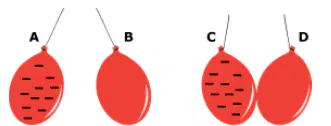
A student makes a model to show how charges react to each other using two balloons. Balloon A and Balloon C have a negative charge. Describe the charge on Balloons B and D.
Balloons B and D both have a positive charge.
Balloons B and D both have a negative charge.
Balloon B has a negative charge and Balloon D has a positive charge.
Balloon B has a positive charge and Balloon D has a negative charge.
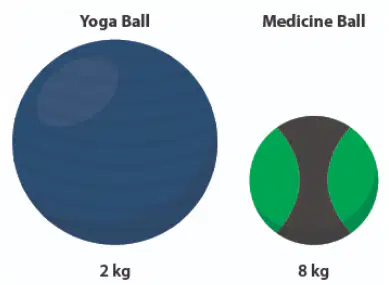
An athlete lifts two different exercise balls, a yoga ball and a medicine ball. The picture shows the yoga ball and the medicine ball. The medicine ball requires more force for the athlete to lift. Which claim is BEST supported by this data?
The ball with the smaller volume has the weakest gravitational attraction with Earth.
The ball with the larger volume has the strongest gravitational attraction with Earth.
The ball with the larger mass has the greatest gravitational attraction with Earth.
The ball with the smaller mass has the greatest gravitational attraction with Earth.
Which statement BEST describes this difference in weight on Earth and the Moon?
The Moon has a greater mass than Earth.
The Moon is larger than Earth.
Earth is larger than the Moon.
Earth has a greater mass than the Moon.
What is the difference between mass and weight?
Mass refers to the amount of matter in an object, while weight is a measure of how much gravity is pulling on an object.
Mass and weight are the same and can be used interchangeably.
Weight is the amount of matter in an object, while mass is the force of gravity on it.
Mass changes depending on location, but weight always stays the same.
On Earth, a bowling ball with a mass of 5 kilograms is dropped from a height of 10 meters. The ball hits the ground in 1.43 seconds. Which statement BEST describes the gravitational force between the ground and the ball?
The ball exerts a force on the ground.
The ground exerts a force on the ball.
The ground and the ball repel each other with equal force.
The ball and the ground attract each other with equal force.
When an object on Earth is thrown high into the air, it always returns to Earth's surface. Which statement is BEST supported by this phenomenon?
The gravitational force depends on the direction in which the object is thrown.
The gravitational force depends on the force with which the object is thrown.
Gravitational interactions between two objects are attractive.
Gravitational interactions between two objects are repulsive.
When an object on Earth is thrown high into the air, it always returns to Earth's surface. Which statement is BEST supported by this phenomenon?
The gravitational force depends on the direction in which the object is thrown.
The gravitational force depends on the force with which the object is thrown.
Gravitational interactions between two objects are attractive.
Gravitational interactions between two objects are repulsive.
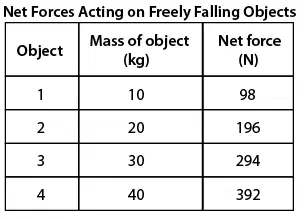
The data shown in the table represent net forces acting on four freely falling objects. Nash makes a claim that is supported by the data.
Use the drop-down menus to complete the claim.
The force of gravity causes freely falling objects to experience (a) acceleration. The data in the table support this claim because the ratio of (b) to (c) is (d) 9.8 m/s².
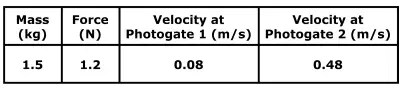
Nash adds mass to the cart so that it has a total mass of 1.5 kg. He pulls the cart along the track with a constant force of 1.2 N. He records this information along with the average velocity of the cart as it passes each of the photogates.
Use the data table to determine the BEST explanation of why the average velocity of the cart increases from the first photogate to the second photogate?
A. The mass of the cart causes it to accelerate.
B. The net force on the cart causes it to accelerate.
C. The mass of the cart causes it to keep a constant speed.
D. The net force on the cart causes it to keep a constant speed.
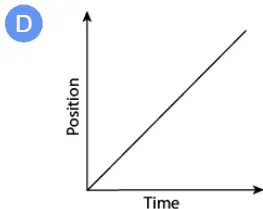
Nash pulls the cart along the track with a near constant force. Which graph BEST represents the change in position over time?
Graph A: Position vs. Time, curved up then down
Graph B: Position vs. Time, horizontal line
Graph C: Position vs. Time, upward curve
Graph D: Position vs. Time, straight diagonal line
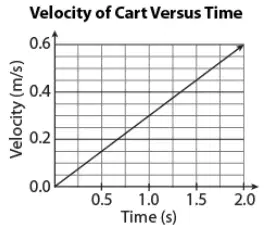
Which TWO statements are supported by the velocity versus time graph?
The acceleration of the cart is 0.3 m/s².
The velocity of the cart is constant over time.
The cart moves 0.3 meter in 2 seconds.
The velocity of the cart is increasing over time.
The cart moves in different directions over time.
A sound wave leaves the loudspeaker. As it travels, it experiences a temporary increase in wavelength and then returns to its original wavelength. Which of the following scenarios could explain this change in wavelength? Select ALL that apply.
The sound wave traveled through a helium balloon (helium is less dense than air).
The sound wave traveled into the rocky ground.
The sound wave traveled through a glass of water.
The sound wave reflected off of a rock wall nearby.
The sound wave traveled through a person walking along the shore.
A single sound wave travels from the loudspeaker through three different media: Medium A, Medium B, and Medium C. The table below contains both given and missing values for the wave’s speed, frequency, and wavelength in each medium. Fill in the missing values in the data table.
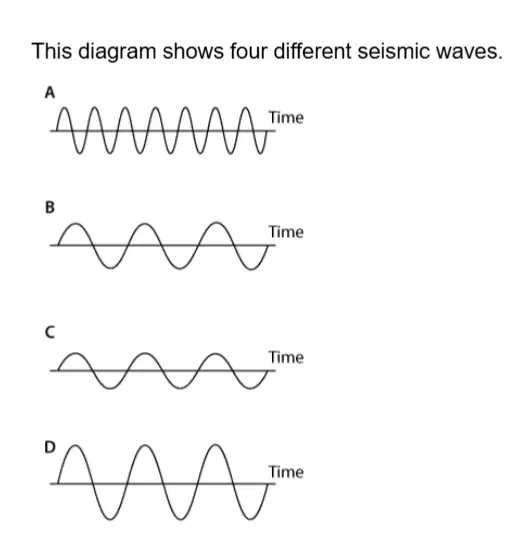
These waves in the diagram are seismic S-waves. In an earthquake, waves like (a) would likely cause the most damage. The (b) of the waves is the best measure of the strength of an earthquake.
Frequency
Impact of Gravitational Forces
Earth's solar system was formed 4.5 billion years ago from a dense cloud of interstellar gas and dust known as a solar nebula. At the center, gravity pulled more and more matter in. It is gravity that continued to collapse the matter and is responsible for the formation of the Sun, moons, planets, their orbits, and other objects in the solar system. The most widely accepted theory of the origin of the Moon proposes that a Mars-sized body collided with Earth, ejecting large volumes of debris into Earth’s orbit. The debris then collected together to form the Moon. Which statement BEST explains how gravitational force could have caused the debris to form the Moon?
The debris was pulled together by the attractive gravitational force of the debris itself.
The debris was pulled together by the attractive gravitational force of the closest planet, Earth.
The debris was pulled away from Earth by Mars, causing the debris to collect between Earth and Mars.
The debris was pulled away from Earth by the Sun, causing the debris to collect between Earth and the Sun.
Earth's solar system was formed 4.5 billion years ago from a dense cloud of interstellar gas and dust known as a solar nebula. What force was responsible for the formation of the Sun, moons, planets, their orbits, and other objects in the solar system?
Gravity
Magnetism
Friction
Electricity
Which of the following statements describe the effects of gravity on the atmosphere? Select ALL that apply.
Gas particles with more mass have a weaker gravitational attraction to Earth.
Gas particles that have less mass are pulled closer to Earth.
Gas particles with less mass have a weaker gravitational attraction to Earth.
Gas particles that have more mass are pulled closer to Earth.
Gas particles that are closer to Earth are most likely to escape the atmosphere.
Choose the correct statement that describes how the distances between particles and their orbiting planet affect whether planetary moons or rings form.
If the particles are close to the planet, they are more likely to form rings. If the particles are farther from the planet, they are more likely to form moons.
If the particles are close to the planet, they are more likely to form moons. If the particles are farther from the planet, they are more likely to form rings.
The distance between particles and the planet does not affect whether rings or moons form.
Particles always form moons regardless of their distance from the planet.
When particles are closer to a planet, the gravitational force between the small particles and the planet is strongest. Because of this, the particles do not pull themselves together. When the particles are farther away from a planet, the gravitational force between the small particles is strongest. Because of this, the particles can pull themselves together.
True
False
Match the causes to their correct effects.
Gravitational attraction between individual particles - (a)
Gravitational attraction between the Sun and the planets in our solar system- (b)
Gravitational attraction between Moon and Earth- (c)
The Big Bang Theory is a scientific explanation for the origin of what?
The universe
The solar system
The Milky Way galaxy
The sun
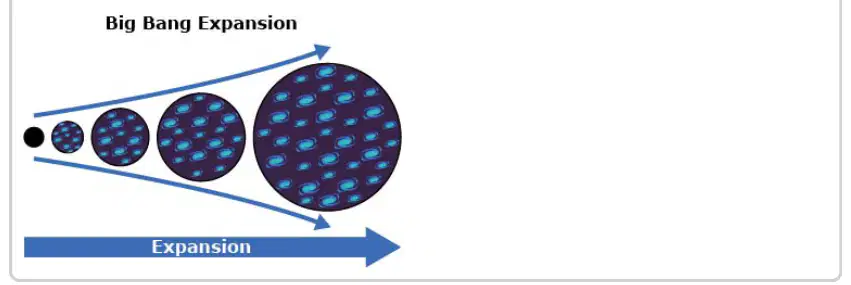
According to the Big Bang theory, which element(s) were formed when the Big Bang occurred?
only carbon
only hydrogen and helium
all elements lighter than iron
all elements lighter than carbon
Ben learns that a type of radiation called cosmic microwave background (CMB) provides evidence that supports the Big Bang theory. Which statement BEST explains why CMB is evidence that supports the Big Bang theory?
The temperature of CMB is slowly increasing over time.
CMB fills the universe and can be detected in every direction.
The frequency of CMB is slowly increasing over time.
CMB is constantly being emitted by stars throughout the universe.
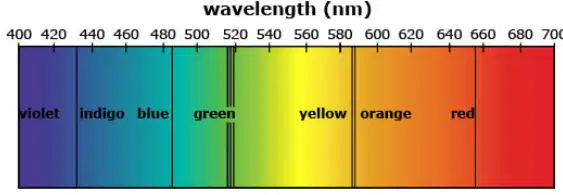
Ben learns that scientists use a visible light spectrum to determine the composition of the Sun and distant stars. The diagram shown below represents a visible light spectrum from the Sun. Which statement BEST explains why scientists can use a visible light spectrum from the Sun and other stars to identify composition?
The atomic absorption lines undergo red or blue shift depending on the composition of the star.
The atoms of elements in a star's atmosphere absorb specific wavelengths of light that appear as dark lines.
The atoms of elements in a star's atmosphere emit light at specific wavelengths that appear as dark lines.
The atomic emission lines undergo red or blue shift depending on the composition of the star.
Match the term with an example:
45 m/s
15 km/h South
7.5 m/s2
Displacement
-10 meters
Distance
25 miles
An mariachi band is playing on a float in a parade. When the float is moving away from you, the (a) of the music sounds (b) because of the (c)
Match the Newton's Law to the correct definition or example
Newton's 1st Law
The law of inertia
Newton's 2nd Law
The law of mass and acceleration
Newton's 3rd Law
The law of action reaction
Click the dot that has the greatest kinetic energy.
The amount of matter of an object is it's (a) , while (b) is the force of gravity acting on that mass. An astronaut will have (c) Mass on Jupiter, and experience (d) Weight
What law states that for every action, there is an equal and opposite reaction?
Newton's First Law of Motion
Newton's Second Law of Motion
Newton's Third Law of Motion
All of the above
The amount of matter in an object
mass
atom
proton
weight
The amount of space an object takes up.
weight
volume
color
location
Which term describes the composition of the outer planets?
rocky
solid
water
gaseous
Why do the outer planets have longer years than the inner planets?
The outer planets rotate faster than the inner planets.
The outer planets are farther from the sun.
The inner planets are denser and rotate slower.
Outer planets are made of gas.
As galaxies move away from our galaxy
a shift on the electromagnetic spectrum
(EMS) is noticed. This phenomena is
called _____________.
redshift
blueshift
unshift
blackshift
The universe's first visible light can now be observed as ___.
starlight
CMB (Cosmic Microwave Background)
the doppler effect
long as you have a telescope

Galaxies that are REDSHIFTED are:
actually BLUE
really NEAR earth
invisible or not visible
moving AWAY from us.
The process of fusion happens in a star's
Corona
Convection Zone
Radiative Zone
Core
What force creates the environment needed for nuclear fusion reactions to happen in stars?
Star Wars Force
Gravity
Friction
Normal Force

Each element on the periodic table can be identified by its
classification as a solid, liquid or gas.
location on the table.
ability to react to form compounds.
unique spectral "fingerprint."

The mass and speed of three vehicles are shown below. Rank the vehicles by momentum from greatest to least.
A > B > C
B > A > C
B > C > A
C > B > A

