
 Worksheets
Physical and Chemical changes
Total questions: 102
Worksheet time: 53mins
Snow melts and becomes liquid which on evaporation turns into _____.
solid
gas
water
solid ice
Which property is related to physical change?
Temporary
Irreversible
Permanent
New substance is formed
Which of the following is a physical change?
Unflatten the balloon
Changing shapes of clay
Cutting tree into blocks
All of these
Burning of fireworks is a change which is
reversible
irreversible
both (1) & (2)
natural change
What is a reversible change?
Something you can change back
Something you cannot change back
Something will be constant
All of these
Rotting of fruit is _____.
physical change
reversible change
chemical change
both (1) and (2)
Curdling of milk is an example of____.
physical change
reversible change
chemical change
none of these
Which of the following is an example of chemical change?
Glowing of an electric bulb
Magnetisation of a bar of steel
Grinding a fruit to pulp
Respiration in living beings
Which of the following may accompany a chemical change?
Sound may be produced
A new smell may be given off
A colour change may take place
All of these
Animal dung is digested to produce biogas (process A). The biogas is used in stove as a fuel (process B), which of the following is correct?
Process 'A' is a chemical change
Process 'B' is a chemical change
Both 'A' and 'B' are chemical changes
None of these
On combining of methane and oxygen _____ are formed.
Carbon dioxide and hydrogen
Carbon dioxide and water
Carbon monoxide and water
Carbon monoxide and hydrogen
A chemical reaction is not signified by
change of colour
change in temperature
evolution of a gas
change from crystalline to powdered state
New substance formed in a chemical reaction is called
Reactant
Chemical
Product
Atom
Magnesium burns in air to combine with oxygen to form magnesium oxide. This change can be represented as-
Magnesium ⎯→ Magnesium oxide + oxygen
Magnesium ⎯→ Magnesium oxide
Magnesium + oxygen ⎯→ Magnesium oxide
Magnesium oxide ⎯→ Magnesium + oxygen
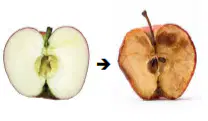
Identify the change/changes
Chemical change
Physical change
Reversible change
Both (2) and (3)
In galvanization, metal is electroplated with
Tin
Iron
Chromium
Zinc
Promoting factors of rusting is/are
Presence of water
Presence of salt
Presence of gases like CO2 or SO2
All of these
Rusting can be prevented by
oiling
painting
placing article in water
Both (1) & (2)
Mother liquor is
liquid obtained after evaporation
liquid obtained after rusting
liquid obtained after crystallisation
liquid obtained after melting
Which of the following is use of crystallization
obtaining pure CuSO4
obtaining salt from sea water
obtaining pure sample of phitkari
All of these
Burning of wood produces ashes and smoke.
True
False
Freezing of water involves change in matter.
True
False
Cooking of eggs do not involve changes in matter.
True
False
Curdling of milk gives foul smell.
True
False
The identity of original substance is completely lost in chemical change.
True
False
When Kaththa is applied on lime while making a pan a chemical change takes place.
True
False
Chemical change cannot be observed by colour change.
True
False
Cooking of an egg is a physical change.
True
False
Chemical change are generally irreversible.
True
False
Solid decomposes or gets charred on heating to dryness during crystallization.
True
False
The soluble impurities do not get removed in the process of evaporation. But such impurities get removed in crystallization.
True
False
Evaporation is better technique than crystallization.
True
False
Conversion of water in three states is a type of (a) change.
Melting of butter is a (a) change.
Frying an egg to make an omelette is a (a) change.
(a) is a better technique than evaporation to dryness.
If the surface of metal is electroplated by zinc it is known as (a) .
(a) is used for the process of tinning.
Which of the following is not a chemical change?
Digestion of food
Conversion of liquified petroleum gas into gas on opening the cylinder
Photosynthesis
Production of biogas from animal waste
Assertion (A): Some changes which result in formation of new substances are called chemical changes. Reason (R): Chemical changes are irreversible.
Both A and R are true and R is the correct explanation of A
Both A and R are true but R is not the correct explanation of A
A is true but R is false
A is false but R is true
_____ is a chemical change
Mixing of paint colours
Cleaning rust of a bridge
Spinning of fibres
Baking a cake
Choose the correct option on the basis of two statements (i) and (ii) (i) Hydrogen gas reacts with oxygen gas to form water (ii) Liquid water on evaporation changes to water vapour
(i) is a chemical change, (ii) is a physical change
(i) is a physical change, (ii) is a chemical change
Both (i) and (ii) are physical changes
Both (i) and (ii) are chemical changes
Which of the following is a physical change?
Ink being absorbed by a chalk
Blackening of potato
Stretching of a rubber band
Both (1) and (3)
Which one of the following is not a characteristic of chemical change?
Change in chemical composition
Evolution of gas
Change in colour
Change in physical state
When baking soda is added into vinegar, _____ gas is released.
Oxygen
Hydrogen
Carbon dioxide
Nitrogen
Galvanisation is a method of protecting iron from rusting by coating with a thin layer
Galium
Aluminium
Zinc
Silver
Which of the following cannot be separated by crystallization?
Separation of crystal of alum from impure sample
Purification of salt from sea water
Sugar from sugar solution
Sand and water
Which of the following is a reversible change?
Ripening of fruits
Freezing of water
Burning of paper
Converting wood into saw dust
Which of the following is a physical but irreversible change?
Lighting of an electric bulb
Switching on a fan
Crushing of a glass
Melting of an ice cream
Shredding of paper is
Reversible chemical change
Irreversible chemical change
Reversible physical change
Irreversible physical change
Which of the following is a physical change?
Sublimation of camphor
Digestion of food
Respiration
Photosynthesis
Which of the following statement is correct?
Generally chemical changes are reversible
Generally physical changes are reversible
New compounds are formed during physical change
Chemical changes are temporary in nature
_____ is a process that separates a pure solid in the form of its crystal from a solution.
Galvanization
Evaporation
Crystallisation
Condensation
Which one of the following processes involve chemical reactions?
Storing of oxygen gas under pressure in a gas cylinder
Liquefaction of air
Keeping petrol in a China dish in the open
Heating copper wire in presence of air at high temperature
When iron nail is immersed in the copper sulphate solution, it turns the blue colour of copper sulphate solution to _____ colour.
Red
Brown
Light green
Colourless
When we add sugar to water, it becomes sweet. Which of the following statement is TRUE regarding this change?
It is a chemical change because a new substance is formed
It is a physical change because the original substance can be recovered
o _____ colour.
Red
Brown
Light green
Colourless
When we add sugar to water, it becomes sweet. Which of the following statement is TRUE regarding this change?
It is a chemical change because a new substance is formed
It is a chemical change because there is exchange of heat
It is a physical change because the original substance can be recovered
It is a chemical change because there is only change in colour
Which of the following method is not used for prevention of iron from rusting?
Galvanization
Electroplating
Crystallization
Tinning
Identify the product in the given reaction Iron + Copper sulphate → Iron sulphate + Copper
Iron and copper
Iron sulphate and copper
Iron sulphate and copper sulphate
Copper sulphate and iron
Which among the following is not a physical change?
Melting of solids to liquids
Vaporisation of liquids to gases
Liquefaction of gases to liquids
Decay of matter
An example of a chemical change is _____.
Formation of clouds
Glowing of an electric light
Dropping sodium into water
Dissolving of salt in water
Which among the following is not a chemical change?
Melting of ice
Carbon cycle
Dehydration of substances
Fermentation of substances
Which of these will cause a chemical change to occur?
Grinding of wheat into flour
Lighting of a gas stove
Evaporation of water from a lake
Ringing of an electric bell
Chemical changes are __________.
Temporary, reversible and a new substance is produced
Always accompanied by exchange of light
Permanent, irreversible and a new substance is produced
Never accompanied by exchange of light and heat energy
Which of the following is a physical change?
Solubility in water
Combustibility
Aerial oxidation
Reaction with water
Physical changes are _______.
Temporary
Permanent
Irreversible
Endothermic
Which of the following is a physical change?
Rusting of iron
Combustion of magnesium ribbon
Burning of candle
Melting of wax
A chemical change may involve
Change in colour only
Change in temperature only
Evolution of gas only
Any or all of the above
Which of the following are true when milk changes into curd?
(i) Its state is changed from liquid to semi solid
(ii) It changes colour
(iii) It changes taste
(iv) The change cannot be reversed
What does a chemical change involve?
Formation of substance with different states
Formation of substance with different chemical properties
Formation of substance with different size
Formation of substance with different shapes
Which of the following is an irreversible physical change?
Freezing of water
Melting of ice
Burning paper
Cutting of wood in small pieces
Rusting of iron is
An irreversible chemical change
A reversible chemical change
An irreversible physical change
A reversible physical change
The change of state of a substance from solid to liquid and liquid to gas is
A physical change
A chemical change
Combination of a physical and chemical change
Sometimes physical change and sometimes chemical changes
Galvanisation is a process in which
Iron is coated on zinc metal
Zinc and iron are mixed in molten state
Zinc is coated as a layer on iron
Carbon is mixed with iron and heated
Dissolve some common salt in water and leave the solution in an open and sunny place for a day. What do you observe?
The whole of the solution evaporates
Water evaporates leaving behind salt
Salt evaporates leaving behind water
No change of any form in the salt solution
What kind of change is involved when a sheet of paper is shredded?
An irreversible chemical change
A reversible chemical change
An irreversible physical change
A reversible physical change
Which of the following is not a physical change?
Breaking of a glass tumbler
Melting of butter
Dissolving of sugar in water
Ripening of a fruit
When an iron spade is left lying in a moist atmosphere it
Develops brown powdery layer of iron oxide
Develops green layer of iron oxide
Develops brown layer of oxygen
Does not undergo any change
Which of the following is a chemical change?
Cutting of a cloth
Ironing of a cloth
Drying of a cloth
Burning of a cloth
Heat or light is generally given out during a chemical change.
True
False
During a physical change, only the physical properties of the substance undergo a change.
True
False
Chemical changes are usually irreversible.
True
False
Making cloth from yarn is a chemical change.
True
False
Making ice from water is a chemical change.
True
False
Rusting of iron is a physical change.
True
False
Cutting a log of wood into pieces is a chemical change.
True
False
Burning of a candle involves both a physical as well as a chemical change.
True
False
Condensation of steam is not a chemical change.
True
False
When carbon dioxide is passed through lime water, it turns milky due to the formation of (a) .
The chemical name of baking soda is (a) .
Two methods by which rusting of iron can be prevented are __________ and __________.
(a)
Changes in which only (a) properties of a substance change are called physical changes.
Changes in which new substances are formed are called (a) changes.
Cutting a log of wood into pieces is a chemical change.
True
False
Formation of manure from leaves is a physical change.
True
False
Iron pipes coated with zinc do not get rusted easily.
True
False
Iron and rust are the same substances.
True
False
Condensation of steam is not a chemical change.
True
False
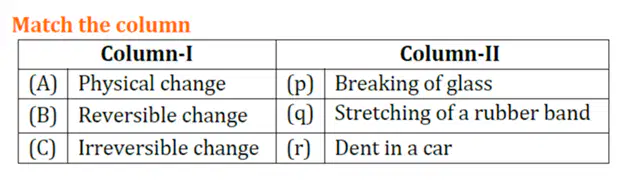
Match the column
A-r, B-q, C-p
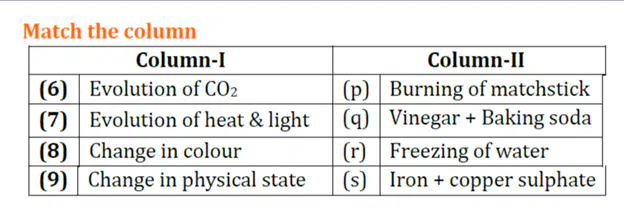
Match
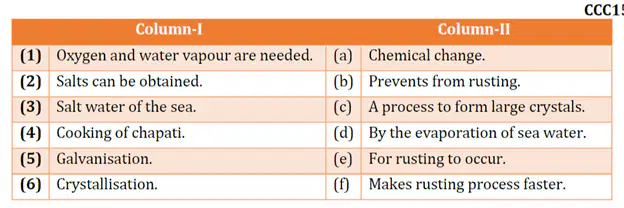
Match the column
1(e), 2(d), 3(f), 4(a), 5(b), 6(c)

