
 Worksheets
Electricity and Circuits Worksheet
Total questions: 100
Worksheet time: 50mins
What is the SI unit for electric current?
Volt
Ohm
Ampere
Watt
Which formula correctly describes the relationship between current (I), potential difference (V), and resistance (R)?
V = IR
V = I + R
V = I/R
V = R/I
Which of the following is NOT an effect of an electric current?
Chemical effect
Heating effect
Magnetic effect
Gravitational effect
Why is it important to state the SI unit when describing power in an electrical system?
It helps to compare different systems easily.
It makes the answer longer.
It is required only in some countries.
It is not important at all.
Which of the following is a precautionary measure to ensure the safe use of electricity in the home?
Overloading sockets
Using wet hands to touch switches
Keeping electrical appliances away from water
Ignoring damaged wires
How can changes made to an electrical system cause hazards?
By making the system more efficient
By increasing the risk of electric shock or fire
By reducing the current
By lowering the voltage
What is the purpose of drawing and interpreting circuit diagrams?
To make the circuit look more complicated
To help set up and understand electrical circuits
To decorate the classroom
To avoid using real components
If you want to reduce the consumption of electrical energy in your household, which of the following actions would be most effective?
Leaving lights on all night
Using energy-efficient appliances
Using more electrical devices
Ignoring energy bills
A student investigates how the arrangement of fixed resistors in series or parallel affects the current in a circuit. What type of task is this?
Recall
Drawing
Investigation
Guessing
Why is it important to calculate the cost of using electrical appliances in kilowatt-hours?
To know how much energy is consumed and manage expenses
To make the calculation more difficult
To confuse the user
To increase the cost
What is the rate of flow of electric charge called?
Electric current
Voltage
Resistance
Power
What is the S.I. unit of electric current?
Volt
Ohm
Ampere
Watt
One ampere of current means that:
One unit charge flows in one second
One unit charge flows in one minute
One unit charge flows in one hour
One unit charge flows in one millisecond
In conventional current flow, current flows from:
Negative terminal to positive terminal
Positive terminal to negative terminal
Both terminals at the same time
The ground to the battery
After the discovery of electrons, it was found that electron flow occurs from:
Positive terminal to negative terminal
Negative terminal to positive terminal
Both terminals at the same time
The ground to the battery
The direction of conventional current flow is ______ to the direction of electron flow.
The same as
Opposite
Perpendicular
Unrelated
What is required for an electric current to flow in a circuit?
A complete path set up by an electric circuit
Only a battery
Only a bulb
Only a switch
What is the function of a switch in an electric circuit?
It provides energy for the circuit
It turns the current on or off
It converts electrical energy into light
It connects wires together
Why must all components of an electric circuit be connected correctly?
To make the circuit look neat
For the circuit to work
To save energy
To increase resistance
How does a circuit diagram help us?
It shows the color of wires
It helps us see if the electrical components are connected correctly
It measures the current
It provides energy to the circuit
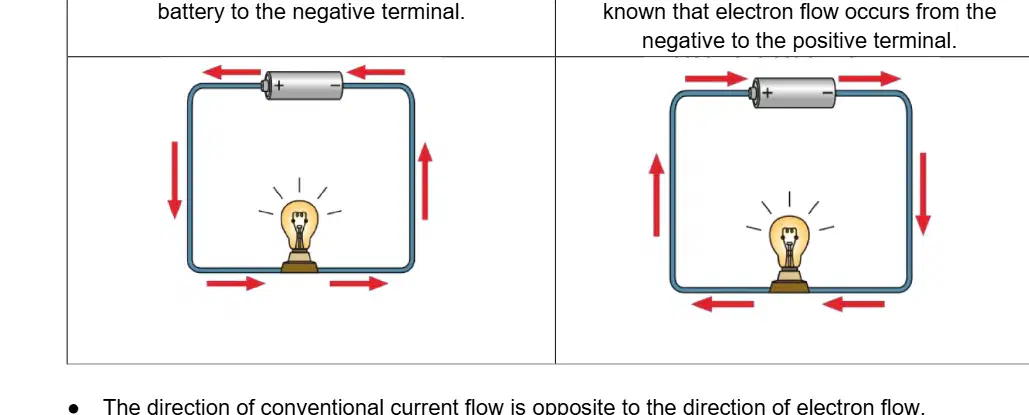
Based on the diagram, which statement is correct?
Conventional current and electron flow are in the same direction
Conventional current flows from positive to negative terminal
Electron flow moves from positive to negative terminal
Both flows start at the bulb
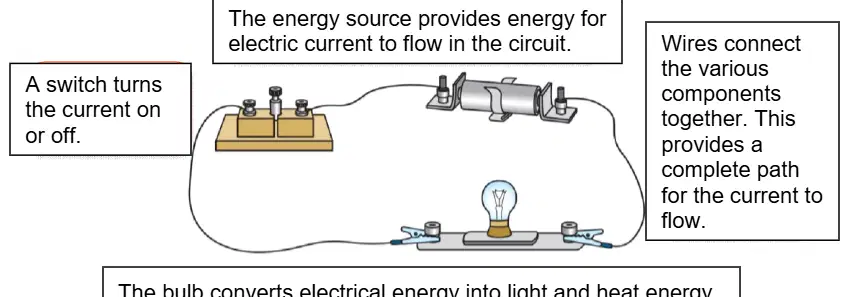
What happens when the switch in the circuit is turned off?
The bulb lights up
The current stops flowing
The energy source increases
The wires disconnect
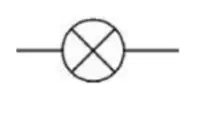
What is the symbol represents in a circuit diagram?
Light bulb symbol
Connecting wire symbol
Ammeter symbol
Fixed resistor symbol
What is the main difference between a series circuit and a parallel circuit?
Series circuits have more branches than parallel circuits.
Electric current passes through a single path in a series circuit, but through all branches in a parallel circuit.
Parallel circuits do not use batteries.
Series circuits do not use switches.
Which component is used to measure electric current in a circuit?
Voltmeter
Light bulb
Ammeter
Switch
If one bulb in a series circuit burns out, what happens to the other bulbs?
The other bulbs will stay lit.
The other bulbs will also go out.
The other bulbs will get brighter.
The other bulbs will flicker.
Which of the following best describes a parallel circuit?
All components are connected in a single loop.
The electric current passes through only one path.
The electric current is divided into branches, with components in each branch.
Only one bulb can be used in the circuit.

What is the symbol in a circuit diagram?
Open switch symbol
Closed switch symbol
Voltmeter symbol
Fixed resistor symbol
Why might an engineer choose to use a parallel circuit instead of a series circuit for household lighting?
Because parallel circuits are easier to draw.
Because if one bulb goes out, the others will still work.
Because series circuits use less wire.
Because parallel circuits cannot use switches.
Which instrument is used to measure electric current in a circuit?
Voltmeter
Thermometer
Ammeter
Barometer
How should an ammeter be connected in a circuit to measure current?
In parallel
In series
Across the battery only
Not connected at all
What do the + and – signs on the terminals of an ammeter indicate?
The direction of the current
The voltage of the battery
The positive and negative terminals
The resistance of the circuit
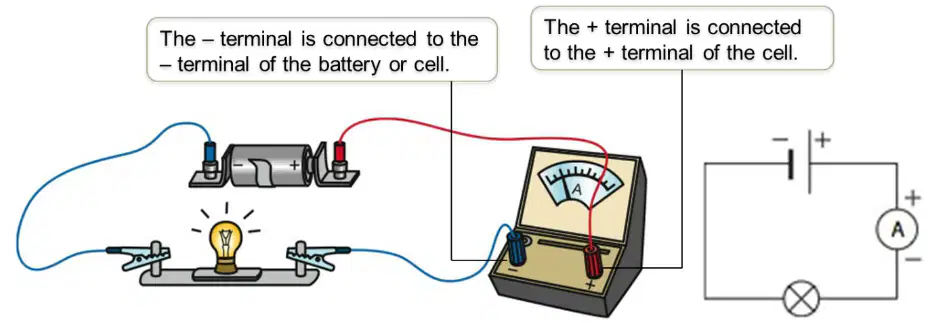
If the + terminal of the ammeter is connected to the + terminal of the cell, where should the – terminal of the ammeter be connected?
To the + terminal of the cell
To the – terminal of the cell
To the bulb only
To the ground
What is the potential difference (p.d.) between two points in a circuit?
The amount of energy needed to move one unit of electric charge from one point to another
The total resistance in the circuit
The speed of the current
The number of bulbs in the circuit
Which unit is used to measure potential difference?
Ampere
Ohm
Volt
Watt
Why can an electric current flow only when there is a potential difference?
Because the circuit is open
Because energy is needed to move charges
Because the wires are too long
Because the battery is off
How is a voltmeter connected in a circuit to measure potential difference?
In series with the circuit
In parallel to the circuit component
Only to the battery
Not connected at all
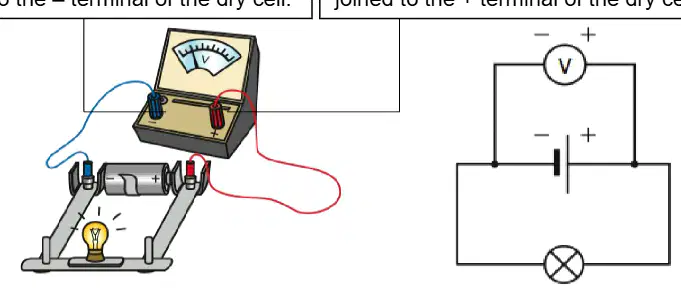
If the – terminal of the voltmeter is joined to the – terminal of the dry cell, where should the + terminal of the voltmeter be joined?
To the – terminal of the dry cell
To the + terminal of the dry cell
To the bulb only
To the ground
A student wants to measure the potential difference across a bulb in a circuit. Which instrument should they use and how should it be connected?
Ammeter, in series with the bulb
Voltmeter, in parallel with the bulb
Voltmeter, in series with the bulb
Ammeter, in parallel with the bulb
What does electrical resistance do in a circuit?
It increases the flow of electric charges.
It resists or hinders the flow of electric charges.
It creates electric charges.
It changes electric charges into light.
What is the SI unit of resistance?
Volt (V)
Ampere (A)
Ohm (Ω)
Watt (W)
Which formula is used to calculate the resistance of a component?
R = V × I
R = V / I
R = I / V
R = V + I
If a component has a potential difference of 12 V and a current of 2 A, what is its resistance?
24 Ω
10 Ω
6 Ω
4 Ω
Which of the following factors does NOT affect the resistance of an object?
Cross-sectional area
Length
Type of material
Color of the object
Why are copper wires commonly used to carry current in households?
They have high resistance.
They are electrical insulators.
They have very low resistance.
They are flexible plastics.

What does the diagram of a narrow channel and electric charges represent in the context of resistance?
How resistance increases the flow of electric charges.
How resistance hinders the flow of electric charges, similar to how a narrow channel resists water flow.
How resistance creates electric charges.
How resistance changes electric charges into water.
What happens to the potential difference needed to move electric charge through a component as resistance increases?
It decreases.
It stays the same.
It increases.
It disappears.
Why are electrical wires often enclosed in materials with high electrical resistance?
To increase the current flow.
To prevent the wires from conducting electricity.
To insulate and protect the wires.
To make the wires heavier.
What is the amount of current flowing through a lamp of 80 Ω when it is connected across a potential difference of 240 V?
3 A
0.33 A
240 A
80 A
A current of 2.5 A flows through a component with a resistance of 40 Ω. What is the potential difference across the component?
100 V
42.5 V
16 V
10 V
Which of the following statements about fixed resistors is correct?
The resistance of fixed resistors cannot be changed.
Fixed resistors are used to adjust the brightness of light bulbs.
Fixed resistors allow us to adjust the resistance in a circuit.
Fixed resistors are only used in radios.
What is the main function of a variable resistor (rheostat) in a circuit?
To adjust the resistance in a circuit
To store electrical energy
To increase the voltage
To decrease the current to zero
How can the resistance of a circuit be adjusted if it contains only fixed resistors?
By connecting fixed resistors in different arrangements (series or parallel)
By increasing the voltage
By using a rheostat
By removing all resistors
Rheostats are commonly used to:
Adjust the sound volume of radios and the brightness of light bulbs
Store electrical charge
Measure temperature
Convert AC to DC

What type of resistor is shown in the image above?
Fixed resistor
Variable resistor
Capacitor
Inductor

What does the slider in the variable resistor (rheostat) diagram do?
Adjusts the resistance by changing the length of wire the current flows through
Stores electrical energy
Converts current to voltage
Measures the temperature of the circuit
What happens to the brightness of a light bulb when another resistor is added in parallel to the circuit?
The bulb becomes dimmer.
The bulb goes out completely.
The bulb becomes brighter.
The bulb stays the same brightness.
What effect does adding another resistor in series have on the resistance and current in a circuit?
Resistance decreases, current increases.
Resistance increases, current decreases.
Resistance stays the same, current increases.
Resistance decreases, current stays the same.
If a circuit contains a variable resistor (rheostat), how can we adjust the resistance of the circuit?
By changing the battery.
By moving the slider.
By adding more bulbs.
By using a thicker wire.

When the slider is on the left, what happens to the resistance and the brightness of the bulb?
Resistance is high, bulb is dim.
Resistance is low, bulb is bright.
Resistance is high, bulb is bright.
Resistance is low, bulb is dim.

When the slider is on the right, what happens to the resistance and the brightness of the bulb?
Resistance is low, bulb is bright.
Resistance is high, bulb is dim.
Resistance is low, bulb is dim.
Resistance is high, bulb is bright.
Why does the current flowing through a bulb increase when another resistor is added in parallel?
Because the total resistance increases.
Because the total resistance decreases.
Because the battery voltage increases.
Because the wires become shorter.
Explain how moving the slider on a variable resistor affects the brightness of a bulb in a circuit.
Moving the slider does not affect the brightness.
Moving the slider to the left increases brightness; to the right decreases brightness.
Moving the slider to the right increases brightness; to the left decreases brightness.
The brightness only changes if the battery is changed.
What is the process called when electricity is used to break down compounds into their elements?
Electrolysis
Magnetism
Electroplating
Solenoid
Which raw material is used to extract aluminium by passing electricity through its molten form?
Bauxite
Iron ore
Copper ore
Silver
What is the purpose of electroplating?
To coat objects with a metal
To break down compounds
To create a magnetic field
To generate electricity
What is a solenoid?
A coil of wire that increases the magnetic effect of electric current
A type of battery
A chemical used in electrolysis
A metal used for electroplating
What happens when an iron rod is placed inside a solenoid and current flows through it?
The iron rod becomes a magnet
The iron rod melts
The iron rod dissolves
The iron rod changes color
What is the setup called when an iron rod inside a solenoid loses its magnetism after the current is switched off?
Electromagnet
Permanent magnet
Electrolyte
Anode
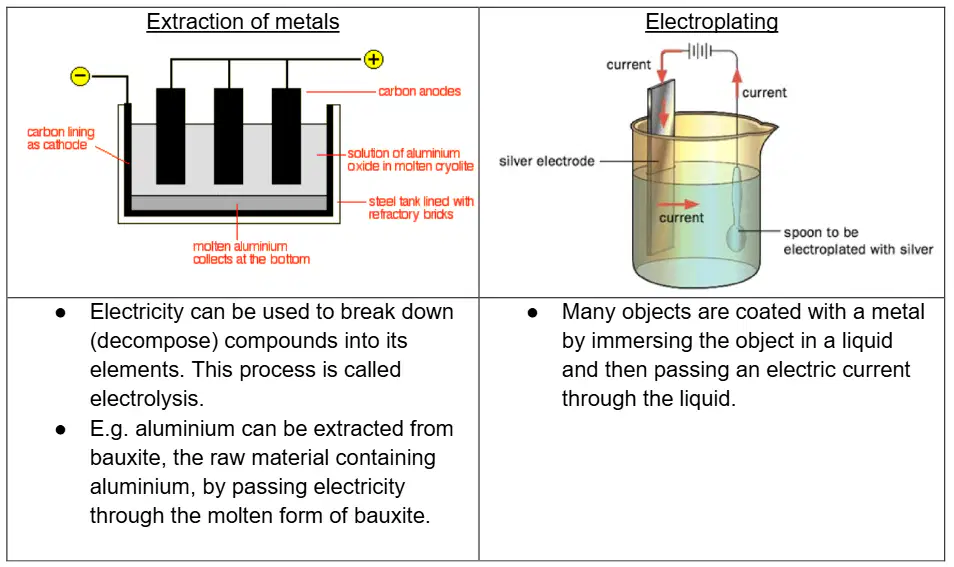
Which part of the electrolysis setup collects the aluminium after the process?
The bottom of the container
The carbon anodes
The top of the solution
The steel tank lining
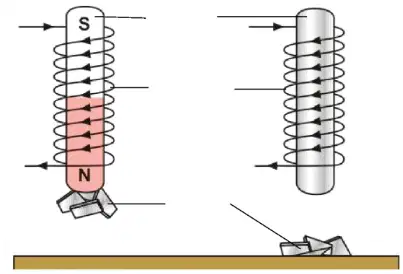
Why does the iron rod lose its magnetism when the current is switched off in a solenoid?
Because it is a temporary magnet
Because it is a permanent magnet
Because it is made of copper
Because it is coated with silver
Which of the following is NOT an application of electromagnets?
Motor of electric fans
DVD drives
Lifting heavy loads in scrapyards
Cooking food in a microwave oven
What causes the diaphragm in a telephone ear piece (speaker) to vibrate and produce sound?
A constant electric current
A changing magnetic effect
Heat from the wire
Light from a bulb
What is the diaphragm in a telephone ear piece made of?
Plastic
Thin piece of metal
Glass
Rubber
When an electric current passes through a wire, what is the electrical energy converted to?
Light
Sound
Heat
Magnetism
Why is nichrome used as the heating element in appliances like electric kettles?
It is a good conductor of electricity
It has a high melting point
It is very cheap
It is transparent

What is the purpose of the insulation layer around the heating element in an electric kettle?
To make the kettle look attractive
To prevent heat loss and protect users from electric shock
To increase the weight of the kettle
To allow more current to flow
The heating effect of a current can lead to which of the following effects?
Lighting effect
Magnetic effect only
Sound effect only
Cooling effect
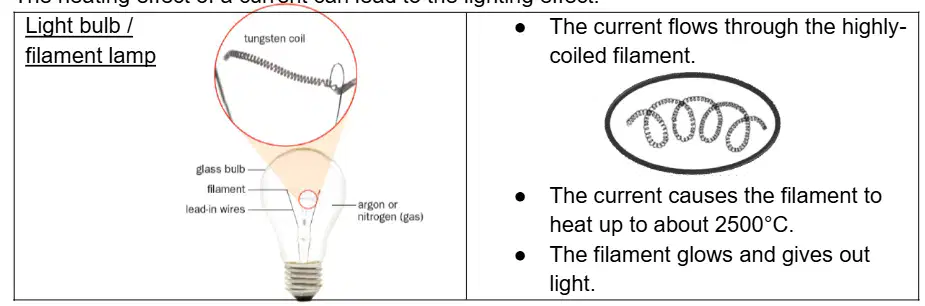
What happens to the filament in a light bulb when current flows through it?
It cools down and stops glowing
It heats up and glows, giving out light
It melts immediately
It produces sound
At approximately what temperature does the filament in a light bulb heat up to when current flows through it?
100°C
500°C
2500°C
10,000°C
Which statement is TRUE about the light produced in mobile phones, televisions, and computers?
It is caused by the heating effect
It is not caused by the heating effect
It is caused by a magnetic effect
It is caused by sound waves
What is the SI unit of power?
Joule
Watt
Kilogram
Volt
Which of the following best describes the power rating of an appliance?
The amount of energy stored in the appliance
How quickly an appliance converts electrical energy into other forms of energy
The size of the appliance
The voltage required by the appliance
How many watts are there in 1 kilowatt (kW)?
10
100
1000
10000
Which formula is used to calculate electrical energy usage in a home?
E=m×c2
E = P × t
E = V × I
E = F × d
A 3 kW water heater is used for 2 hours. How much electrical energy is used?
1 kWh
3 kWh
5 kWh
6 kWh
If the cost of electricity is 26 cents per kWh, what is the cost of using 6 kWh of energy?
$1.56
$2.60
$0.26
$6.00
Why is electrical power for most household appliances measured in kilowatts (kW) instead of watts?
Because kilowatts are easier to calculate
Because household appliances have high power ratings
Because watts are not a standard unit
Because kilowatts are smaller units
Which unit is most commonly used to calculate the cost of using electrical energy at home?
Joule
Watt
Kilowatt-hour (kWh)
Ampere
What does the formula Cost = E × rate calculate?
The total power used by an appliance
The cost of using electrical energy
The voltage required by an appliance
The time an appliance is used

What information can you typically find on an appliance label?
The color of the appliance
The power rating and voltage
The price of the appliance
The manufacturer’s address
What is the cost of using an electric oven with a power rating of 1200 W for 90 minutes if electricity costs 30 cents per kWh?
$0.54
$0.36
$0.72
$0.90
If an air conditioner has a power rating of 2160 W and the total cost of using it for a month (30 days) is $24.30, with electricity costing 25 cents per kWh, what is the average number of hours it was used each day?
1.5 hours
2.0 hours
3.0 hours
0.5 hours
Which of the following can cause an electrical fire?
Damaged or misused electrical circuits
Using a single plug in a socket
Turning off all appliances
Using plastic casings for all appliances
What is a possible consequence of inserting too many plugs into the same power socket?
A large current may be drawn, generating heat and possibly causing a fire.
The appliances will work more efficiently.
The electricity bill will decrease.
The socket will automatically shut off.
What usually happens when large currents pass through a person’s body?
They may experience an electric shock or electrocution, which can lead to serious injuries or death.
They will feel a mild tingling sensation.
They will not be affected at all.
They will become immune to electricity.
Why is it dangerous to clean electrical appliances without switching them off?
You may accidentally touch exposed wires connected to high potential, leading to electric shock.
The appliance will not be cleaned properly.
The appliance may overheat.
The appliance will use more electricity.
Which type of appliances can increase the risk of electric shock if not handled properly?
Appliances with metal casing or metallic parts on the outside
Appliances made entirely of plastic
Battery-operated toys
Wooden furniture

What does the warning sign in the image most likely indicate?
Danger of electric shock or electrocution
Danger of falling objects
Danger of slippery floor
Danger of fire only
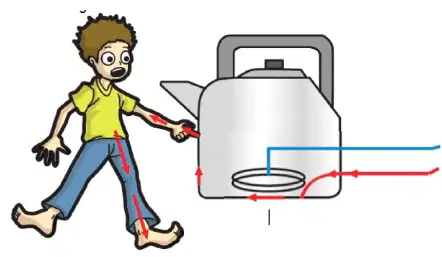
What happens if a person touches the metal casing of a damaged kettle where the wire at high potential has touched the casing?
The person will receive an electric shock as current flows through their body into the ground.
The kettle will stop working but the person will be safe.
The kettle will automatically repair itself.
The person will not feel anything.

