wayground logo

Free Printable Worksheets

Font size

S
M
L
XL
Worksheets

3D printing Quiz 1

Total questions: 36

Worksheet time: 36mins

Name
Class
Date
1.
How can you prevent print failures when using 3D printers?
a)
Properly calibrating the printer and checking material compatibility
b)
Printing without any support structures
c)
Using larger layer sizes
d)
Printing without adjusting settings
2.
What material is best for producing highly durable parts that require impact resistance?
a)
Nylon
b)
PLA (Polylactic Acid)
c)
Glass
d)
ABS (Acrylonitrile Butadiene Styrene)
3.
What type of file is needed for a 3D printer to read and print a model?
a)
STL or OBJ
b)
JPG or PNG
c)
DOC or PDF
d)
TXT or CSV
4.
What is the benefit of using Nylon in 3D printing?
a)
It offers mechanical strength and durability
b)
It is biodegradable
c)
It is lightweight
d)
It is highly flexible
5.
Which printing technology uses a high-powered laser to melt and fuse metal powder?
a)

Selective Laser Melting (SLM) OR Selective Laser Sintering (SLS)
b)
Fused Deposition Modeling (FDM)
c)
PolyJet
d)
Electronic Beam Melting (EBM)
6.
What is a disadvantage of using ABS for 3D printing?
a)
It emits strong fumes during printing
b)
It is too brittle for most applications
c)
It is not compatible with FDM
d)
It cannot be used for prototypes
7.
Which material is best for flexible parts in 3D printing?
a)
TPU (Thermoplastic polyurethane)
b)
ABS (Acrylonitrile Butadiene Styrene)
c)
PLA (Polylactic Acid)
d)
Nylon
8.
What factor is most important when adjusting 3D printing settings?
a)
Layer thickness and printing temperature
b)
Print color
c)
Print speed only
d)
Printer brand
9.
What is one common cause of print failures related to filament?
a)
Clogs or incorrect filament type
b)
Low print speed
c)
Overheating of the printer
d)
Excessive material use
10.
Which of the following 3D printing processes uses a laser to cure liquid resin into solid objects?
a)
Stereolithography (SLA)
b)
Selective Laser Sintering (SLS)
c)
Direct Energy Deposition (DED)
d)
Fused Deposition Modeling (FDM)
11.
What material is primarily used in the Fused Deposition Modeling (FDM) process?
a)
Thermoplastic filaments
b)
Metal powders
c)
Ceramic
d)
Liquid resin
12.
Which 3D printing process is most suitable for creating metal parts?
a)
Direct Metal Laser Sintering (DMLS)
b)
Binder Jetting
c)
Selective Laser Sintering (SLS)
d)
Stereolithography (SLA)
13.
Which 3D printing process is known for producing parts with the highest level of detail and smoothest surface finish?
a)
Stereolithography (SLA)
b)
Fused Deposition Modeling (FDM)
c)
Selective Laser Sintering (SLS)
d)
Direct Metal Laser Sintering (DMLS)
14.
Which of the following 3D printing processes does NOT require support structures during printing?
a)
Selective Laser Sintering (SLS)
b)
Stereolithography (SLA)
c)
Fused Deposition Modeling (FDM)
d)
Digital Light Processing (DLP)
15.
What is the primary difference between Digital Light Processing (DLP) and Stereolithography (SLA)?
a)
DLP uses a digital light projector while SLA uses a UV laser
b)
DLP uses powder while SLA uses liquid resin
c)
DLP is only for metals while SLA is for plastics
d)
DLP requires support structures while SLA doesn't
16.
Which 3D printing process is most suitable for functional testing of parts that will eventually be injection molded?
a)
Selective Laser Sintering (SLS)
b)
PolyJet
c)
Stereolithography (SLA)
d)
Laminated Object Manufacturing (LOM)
17.
What type of materials can Multi Jet Fusion (MJF) primarily work with?
a)
Nylon powder
b)
Liquid photopolymer resins
c)
Metal powders only
d)
Ceramic slurries
18.
Which 3D printing process category does Electron Beam Melting (EBM) belong to?
a)
Powder bed fusion
b)
Material extrusion
c)
Vat photopolymerization
d)
Directed energy deposition
19.
What is the main advantage of PolyJet technology compared to other plastic 3D printing processes?
a)
Ability to print multiple materials and colors simultaneously
b)
Fastest printing speed
c)
Lowest cost per part
d)
Strongest mechanical properties
20.
Which statement best describes the difference between Selective Laser Sintering (SLS) and Direct Metal Laser Sintering (DMLS)?
a)
SLS works with plastic powders while DMLS works with metal powders
b)
SLS uses electron beam while DMLS uses laser
c)
SLS requires support structures while DMLS doesn't
d)
SLS is faster while DMLS is more accurate
21.
For which application would Fused Deposition Modeling (FDM) be the LEAST suitable choice?
a)
High-precision medical devices requiring smooth surfaces
b)
Rapid prototyping of concept models
c)
Educational demonstrations
d)
Low-cost desktop manufacturing
22.
Which 3D printing process requires a powder bed and a heat source?
a)
Selective Laser Sintering (SLS)
b)
Stereolithography (SLA)
c)
Direct Metal Laser Sintering (DMLS)
d)
Binder Jetting
23.

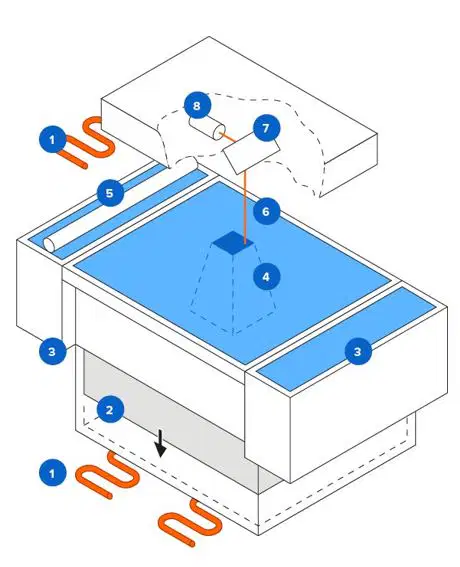
What is the 3D printer part marked with No 1 in the following picture?
a)
Heater
b)
Build Chamber
c)
Recoater
d)
laser beam
24.

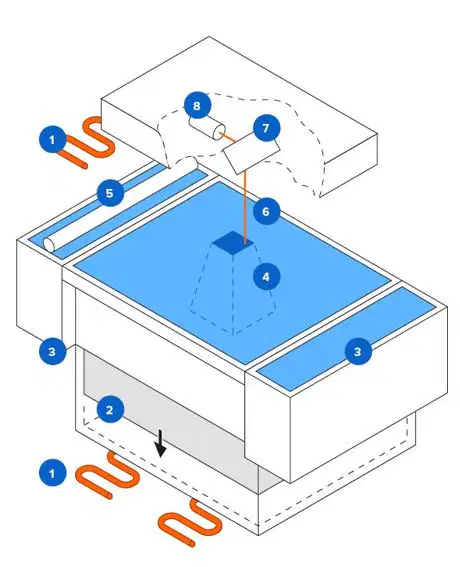
What is the 3D printer part marked with No 2 in the following picture?
a)
Build Chamber
b)
Printed part
c)
Recoater
d)
Scanning mirror
25.

What is the 3D printer part marked with No 3 in the following picture?
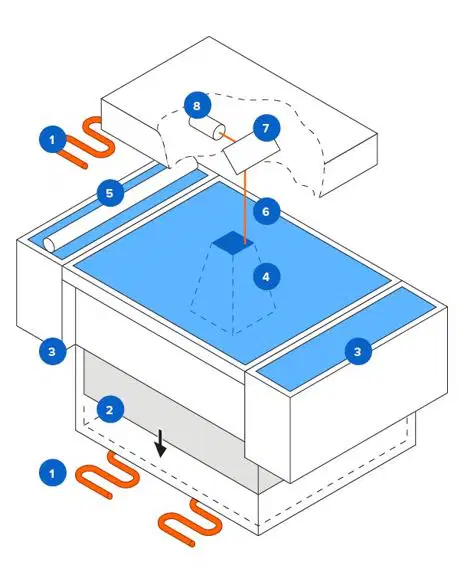
a)
Powder Delivery system
b)
Build Chamber
c)
Recoater
d)
laser beam
26.

What is the 3D printer part marked with No 4 in the following picture?
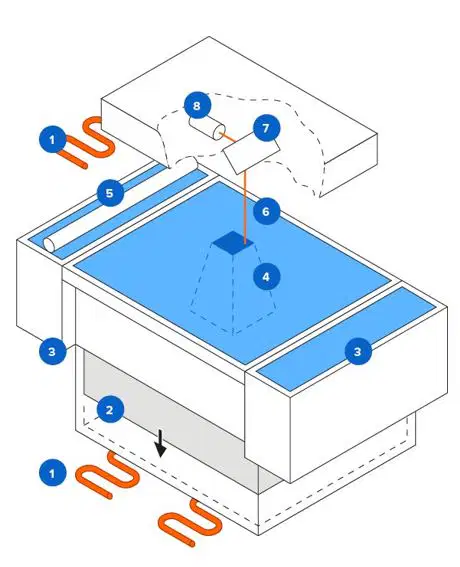
a)
Printed part
b)
Build Chamber
c)
Laser
d)
laser beam
27.

What is the 3D printer part marked with No 5 in the following picture?
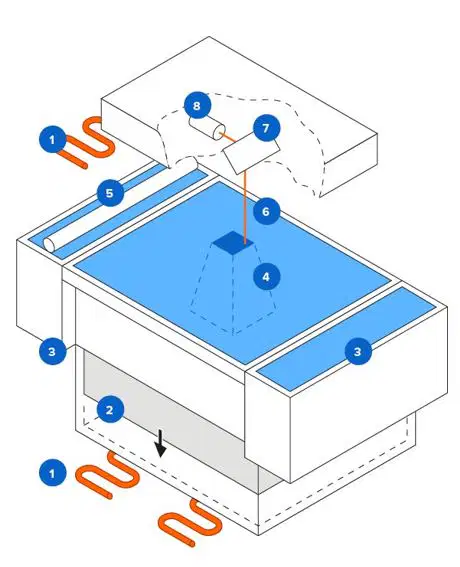
a)
Recoater
b)
Build Chamber
c)
Printed part
d)
laser beam
28.

What is the 3D printer part marked with No 6 in the following picture?
a)
laser beam
b)
Build Chamber
c)
Recoater
d)
Printed part
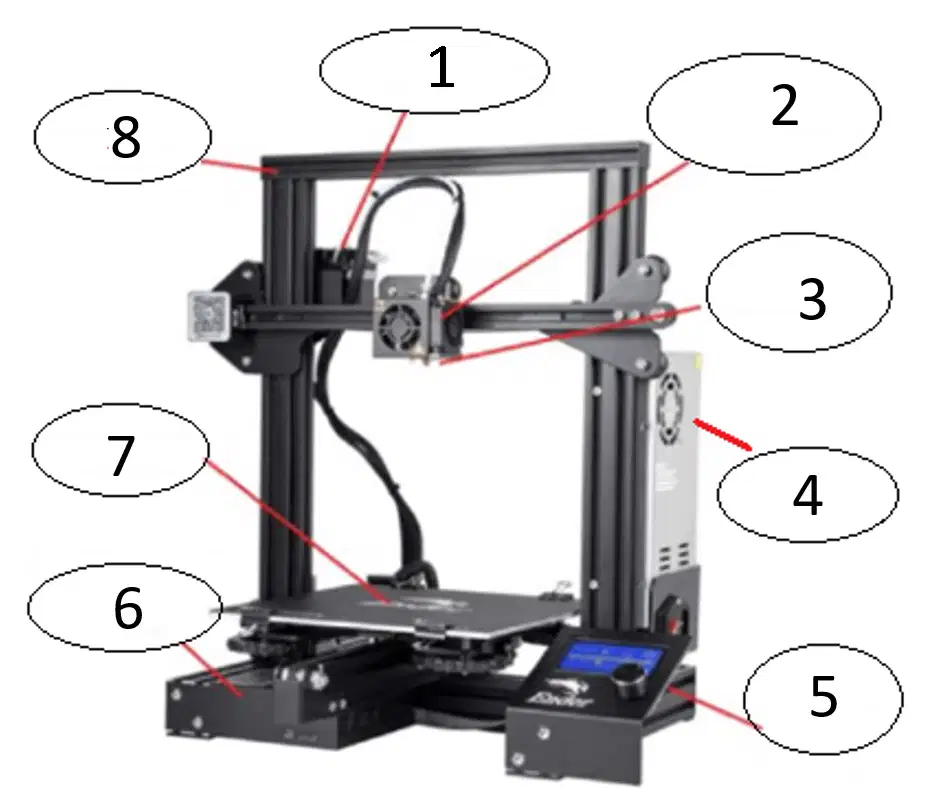
29.

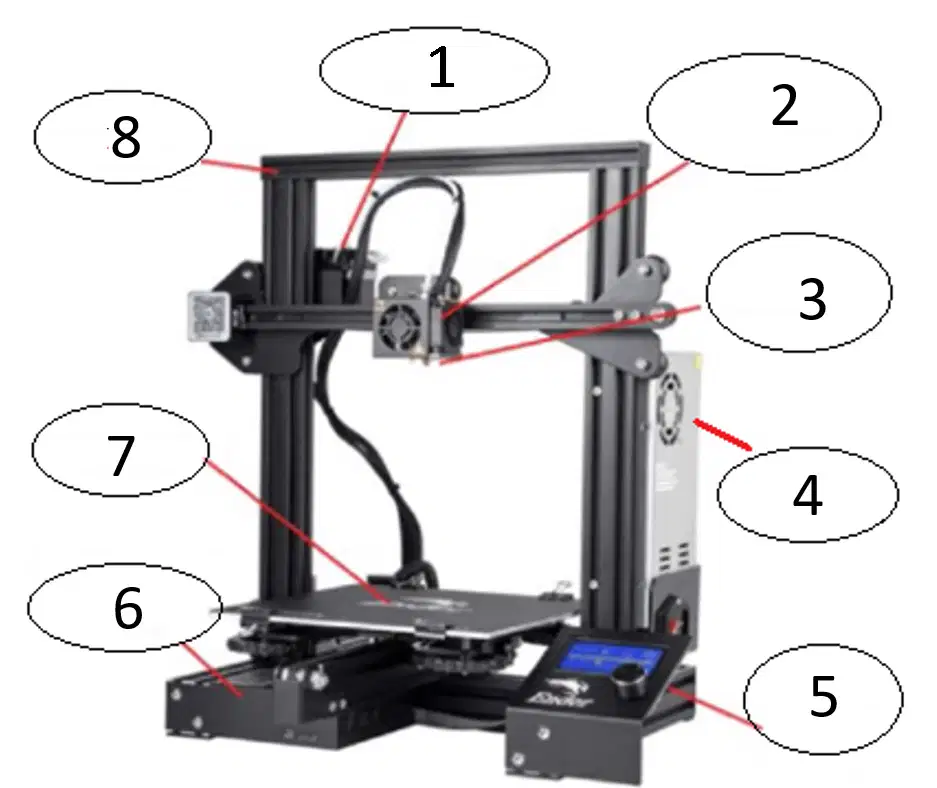
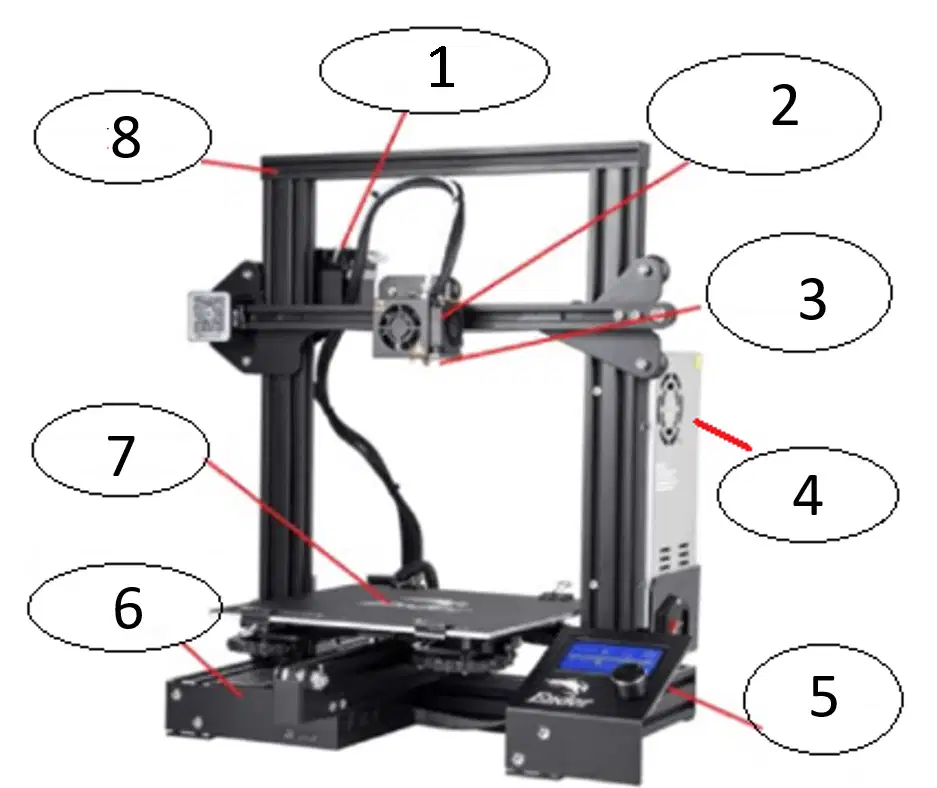
What is the 3D printer part marked with No 1 in the following picture?
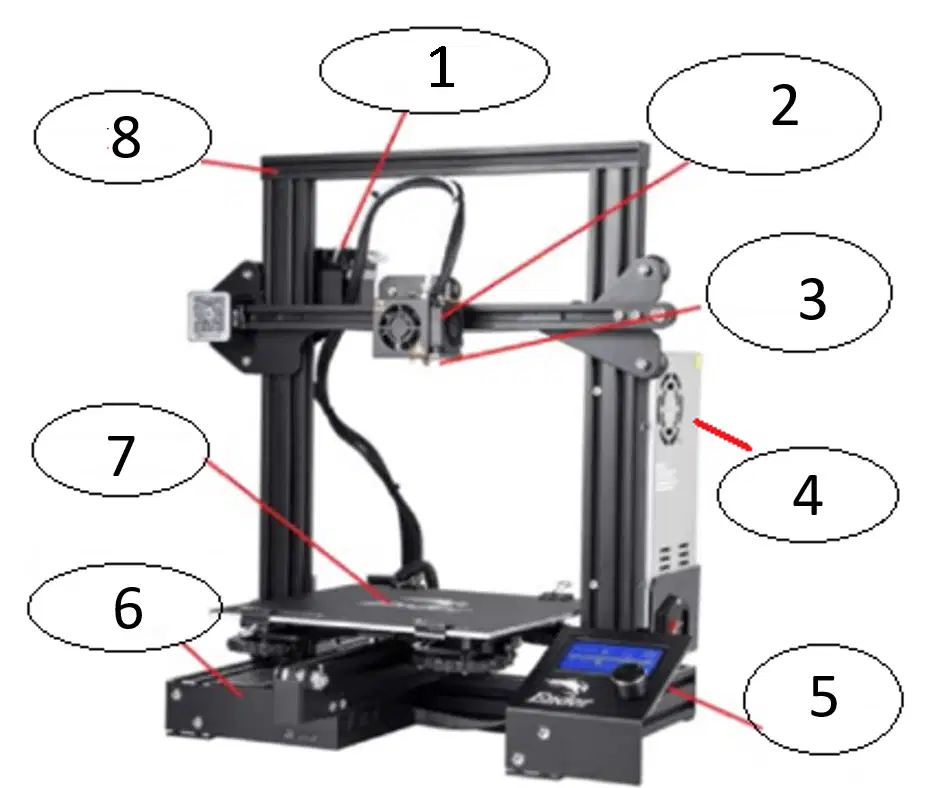
a)
Extruder
b)
Cooling Fan
c)
Nozzle
d)
Power supply
30.

What is the 3D printer part marked with No 2 in the following picture?
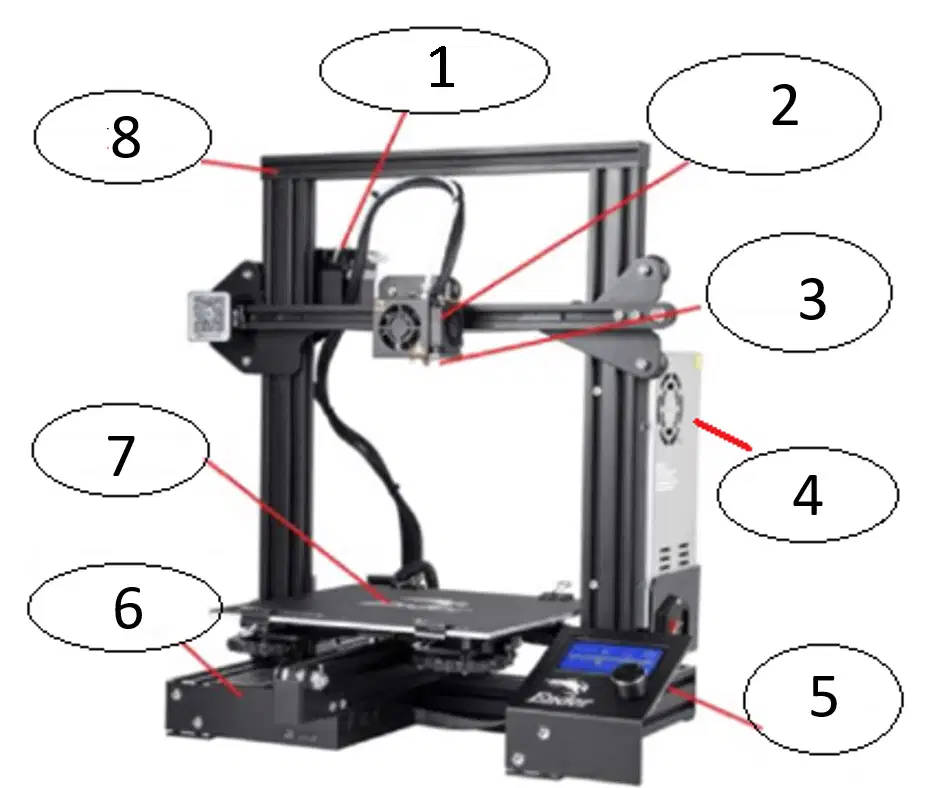
a)
Cooling Fan
b)
Extruder
c)
Nozzle
d)
Power supply
31.

What is the 3D printer part marked with No 3 in the following picture?

a)
Nozzle
b)
Cooling Fan
c)

Stepper motor

d)
Power supply
32.

What is the 3D printer part marked with No 4 in the following picture?
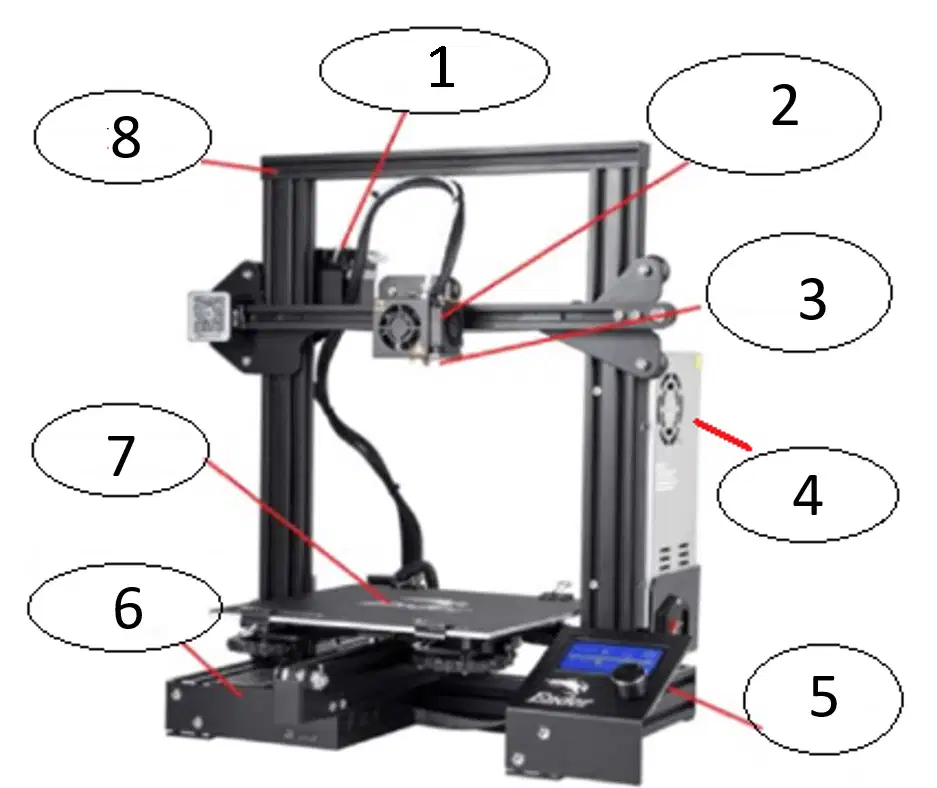
a)
Power Supply
b)
Display Screen
c)
Cooling Fan
d)
Power supply
33.

What is the 3D printer part marked with No 5 in the following picture?
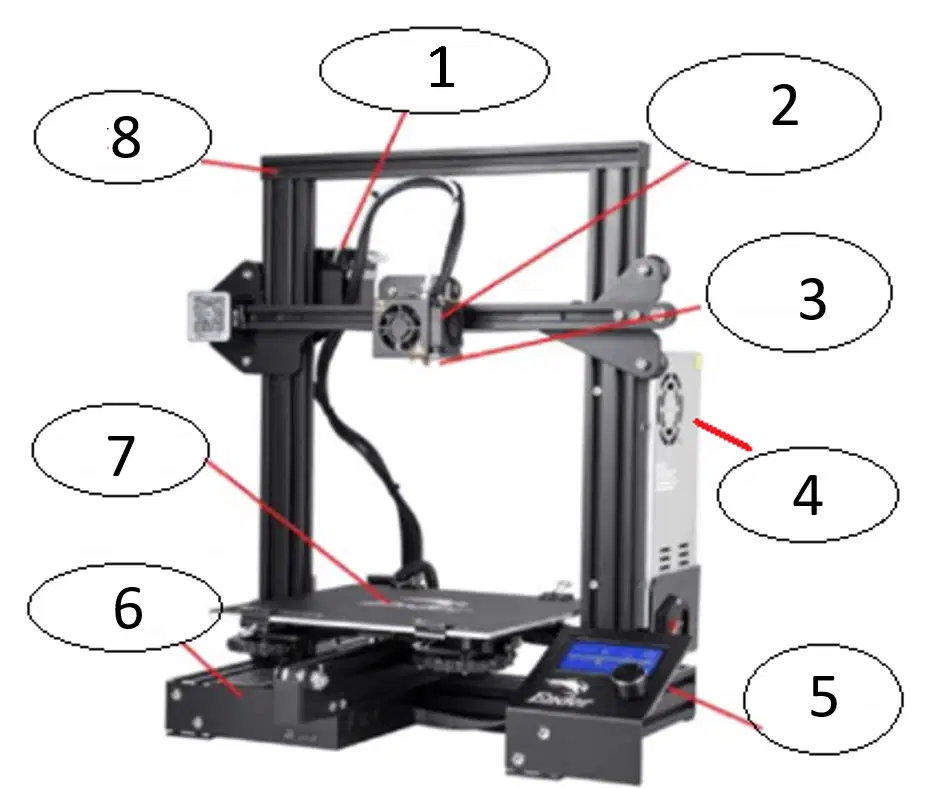
a)
Display Screen
b)
Nozzle
c)
Recoater
d)
Power supply
34.

What is the 3D printer part marked with No 6 in the following picture?
a)
Motherboard
b)
Recoater
c)
Cooling Fan
d)
Power supply
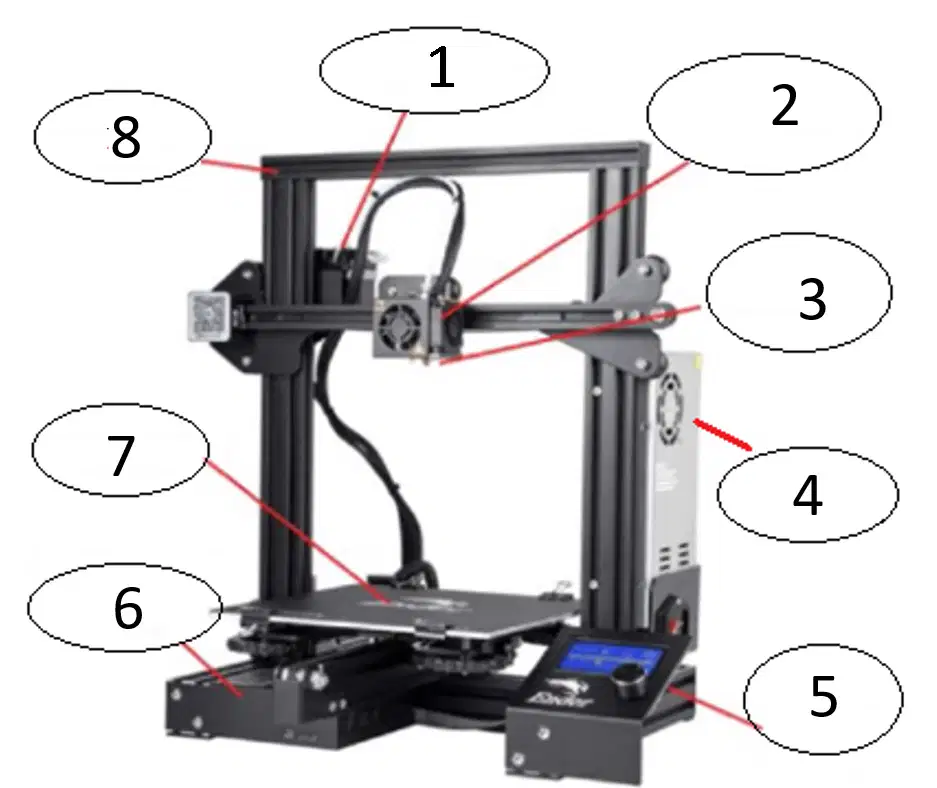
35.

What is the 3D printer part marked with No 7 in the following picture?
a)
Printer Bed
b)
Display Screen
c)
Build Chamber
d)
Power supply
36.

What is the 3D printer part marked with No 8 in the following picture?

a)
Frame
b)
Laser
c)
Cooling Fan
d)
Power supply