
 Worksheets
DSL 109 HHP SYSTEM & PUMPS
Total questions: 34
Worksheet time: 17mins
An open-center hydraulic system’s flow and pressures when the DCVs are in a neutral position are best described as:
Pump flow returns to the reservoir at low pressure.
Pump flow is blocked and pressure builds up.
All actuators operate simultaneously.
System pressure is at maximum at all times.
Methods used for varying actuator speeds in open-center systems include:
Changing the size of the orifice, using flow control valves, and adjusting pump speed.
Increasing the reservoir size and using larger actuators.
Only using pressure relief valves.
Switching to a closed-center system.
The system operation of a two-stage open-center log splitter hydraulic system involves:
Using a two-stage pump to provide high flow at low pressure and low flow at high pressure for efficient log splitting.
Using a single-stage pump to maintain constant pressure throughout the operation.
Utilizing a closed-center hydraulic system for continuous flow.
Operating only at high pressure for all stages of log splitting.
In an open-loop hydraulic system, the pump receives ____ assistance.
no
full
partial
external
Oil flow through a six-way open-center DCV is determined by the position of the spool valve. Which of the following best explains this process?
The spool position directs oil to different ports, allowing or blocking flow paths as needed.
Oil always flows to all ports regardless of spool position.
The spool valve only controls the pressure, not the flow direction.
Oil flow is stopped completely in all spool positions.
Which statement correctly describes the differences between parallel, serial, and tandem open-center circuits?
Parallel circuits allow multiple paths for flow, serial circuits have components arranged in a single path, and tandem circuits combine features of both.
Parallel circuits have only one path for flow, serial circuits allow multiple paths, and tandem circuits are not used in hydraulics.
Serial circuits are used for high pressure only, parallel circuits for low pressure, and tandem circuits for alternating current.
Tandem circuits are the same as parallel circuits, while serial circuits are not used in open-center systems.
Types of variable-displacement pumps that can be used with traditional open-center DCVs include:
Axial piston pumps
Gear pumps
Vane pumps
Peristaltic pumps
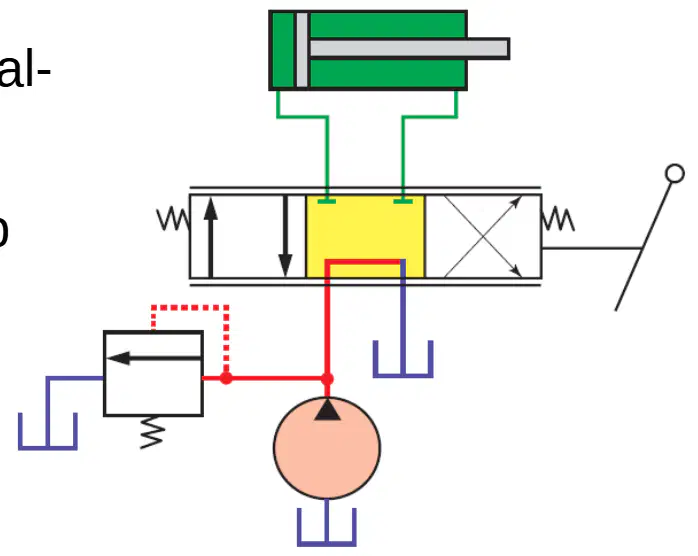
What happens to the oil in an open-center hydraulic system when the directional-control valve is in the neutral position?
It is routed to the actuator
It is routed back to the reservoir
It is stored in the pump
It is vented to the atmosphere
Open-center hydraulic systems traditionally use which type of pump?
Variable-displacement pump
Fixed-displacement pump
Centrifugal pump
Peristaltic pump
Which of the following is an example of a pump used in open-center hydraulic systems?
Piston pump
Gear pump
Diaphragm pump
Screw pump
Which of the following statements is true about hydraulic pumps?
All hydraulic pumps can only be driven by gasoline engines.
Some hydraulic pumps can be driven by an electric motor as well.
Hydraulic pumps cannot be driven by electric motors.
Hydraulic pumps are only used in cars.
When the DCV valve is in neutral, the system has ______ system pressure and ______ system flow.
low system pressure and high system flow
high system pressure and low system flow
high system pressure and high system flow
low system pressure and low system flow
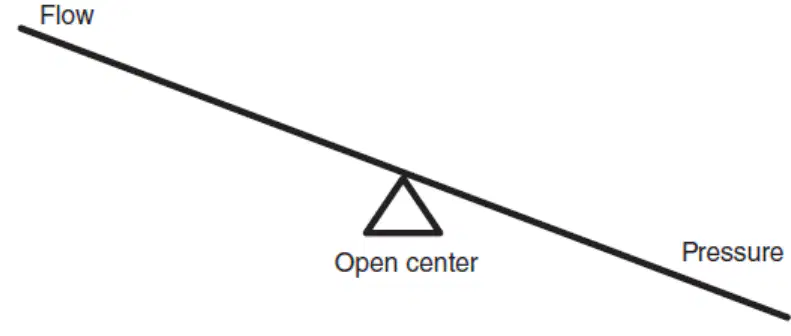
According to the diagram, in an open-center system, when flow is high, what happens to the pressure?
Pressure is high
Pressure is low
Pressure is unchanged
Pressure fluctuates
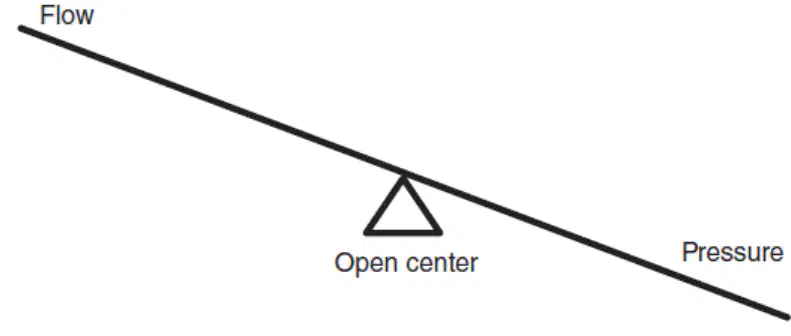
The relationship between flow and pressure in an open-center system when the DCV valve is in neutral is:
Flow returns to the tank at low pressure
Flow is blocked and pressure builds up
Pressure is constant and flow is zero
Both flow and pressure are at maximum
In open-center systems, although open-center DCVs are often depicted as four-way valves, in practice many are actually ______ valves.
six-way
three-way
five-way
two-way
How many ports form the neutral bypass passageway in open-center systems?
Two
Three
Four
One
What does the port labeled 'T' represent in open-center systems?
return to reservoir
tank pressure
test port
transmission line
What is the function of the port labeled 'P' in open-center systems?
pressure supply port with lift check valve
return port for hydraulic fluid
drain port for excess oil
connection for auxiliary equipment
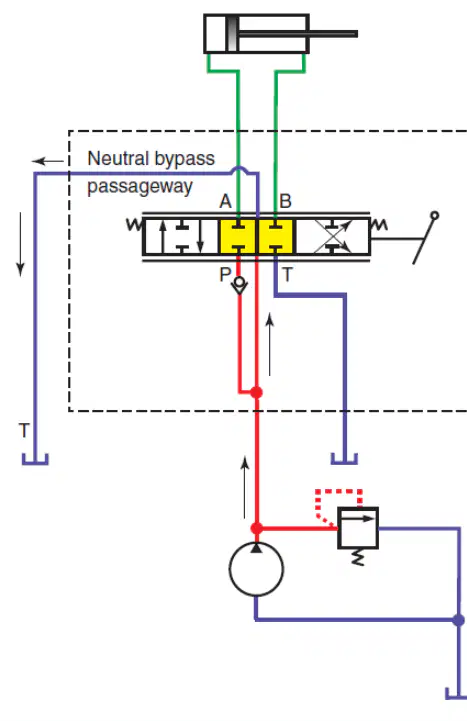
Refer to the diagram of the Six-Way Open-Center DCV. What is the primary function of the directional control valve (DCV) in this hydraulic circuit?
To store hydraulic fluid
To control the direction of fluid flow
To generate hydraulic pressure
To filter hydraulic fluid
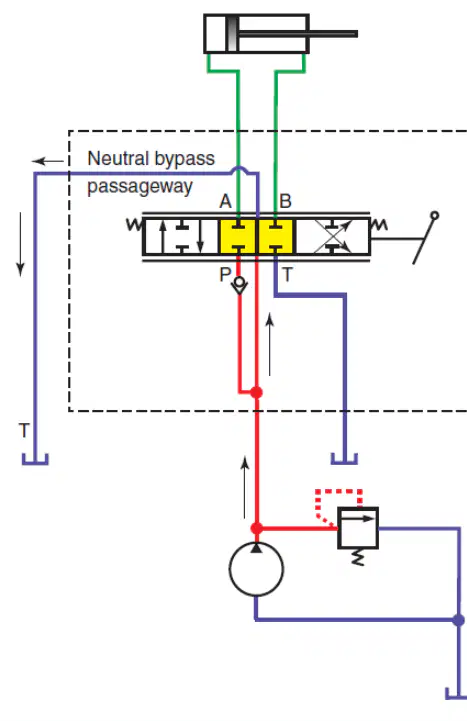
Refer to the diagram of the Six-Way Open-Center DCV. The passage labeled 'Neutral bypass passageway' allows fluid to:
Return to the tank without passing through the actuator
Increase system pressure
Filter contaminants
Power the actuator directly
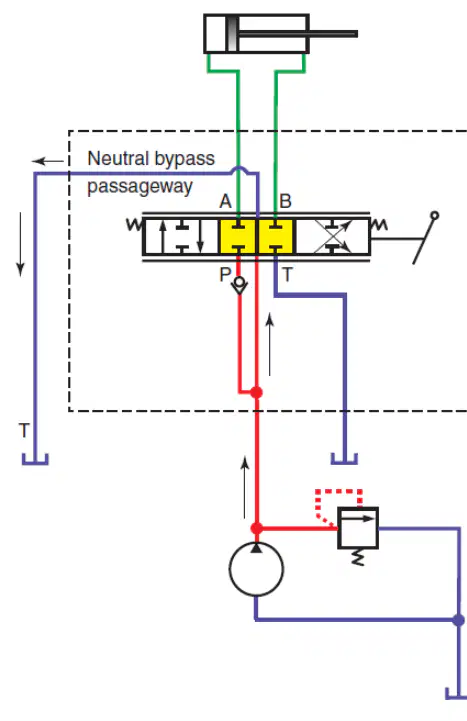
Refer to the diagram of the Six-Way Open-Center DCV. The port labeled 'P' in the diagram stands for _________?
Pressure (or Pump)
Pilot
Port Return
Piston
According to the note on terminology, what might the neutral bypass passageway in a DCV spool valve be called?
Power core
Pressure core
Open-center core
Supply core
Feeder passageway delivers oil to _________?
lift check valve
oil filter
fuel injector
pressure gauge
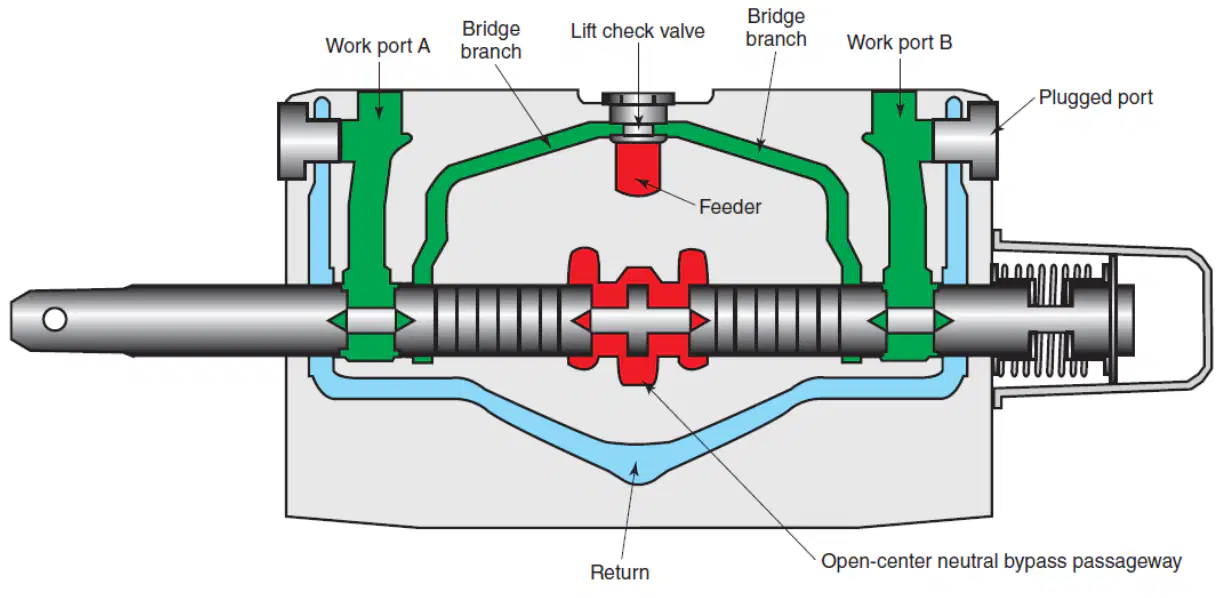
Refer to the diagram of the Parallel Six-Way Open-Center DCV Operation. The passage labeled as 'Return' is responsible for which function?
Returning fluid to the reservoir or system.
Supplying fluid to the actuator.
Controlling the speed of the pump.
Filtering contaminants from the fluid.
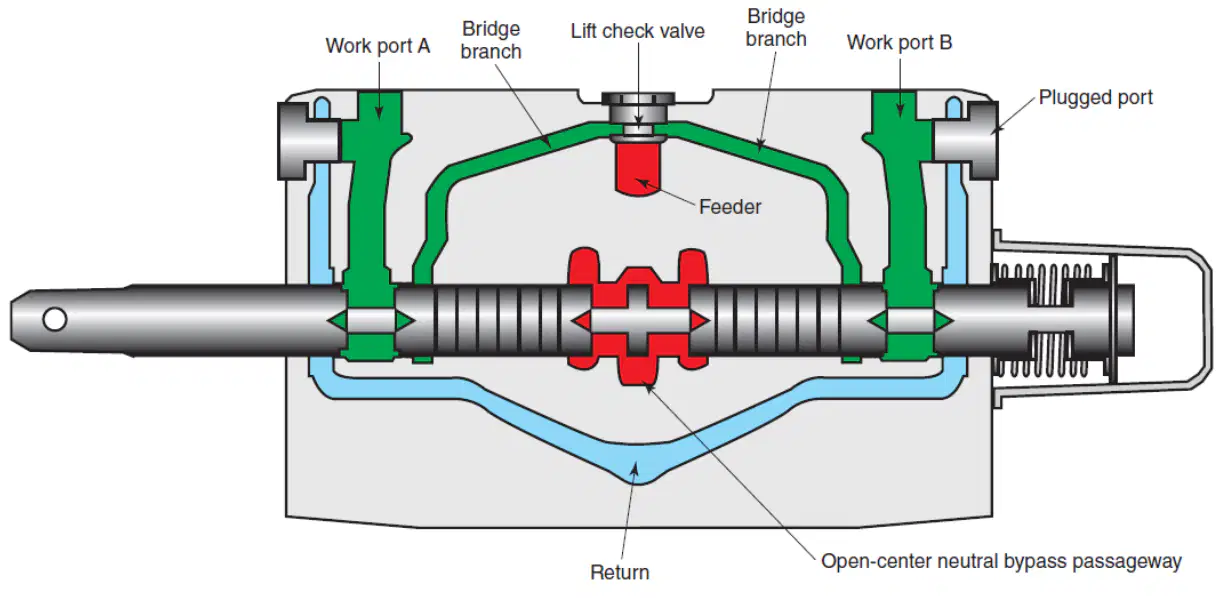
What is the function of the 'Open-center neutral bypass passageway'?
It allows fluid to bypass the valve when in the neutral position.
It increases the pressure in the hydraulic system.
It prevents the valve from returning to the neutral position.
It directs fluid to the actuator at all times.
Orifices in a Parallel Six-Way Open-Center DCV are variable.
True
False
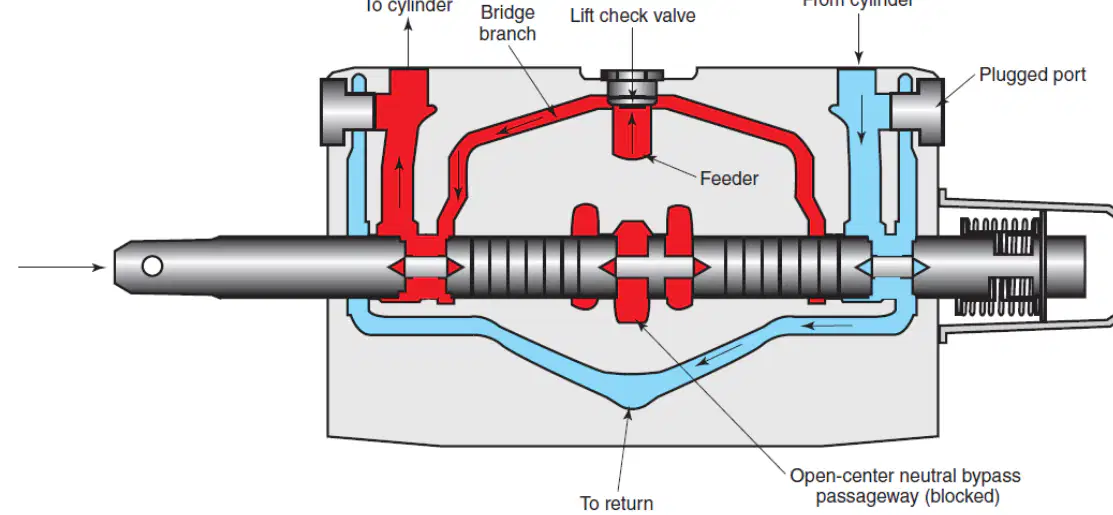
In the Parallel Six-Way Open-Center DCV Operation (4 of 4), what is the position of the spool?
The spool is shifted fully to the right.
The spool is centered in the neutral position.
The spool is shifted fully to the left.
The spool is partially shifted to the right.
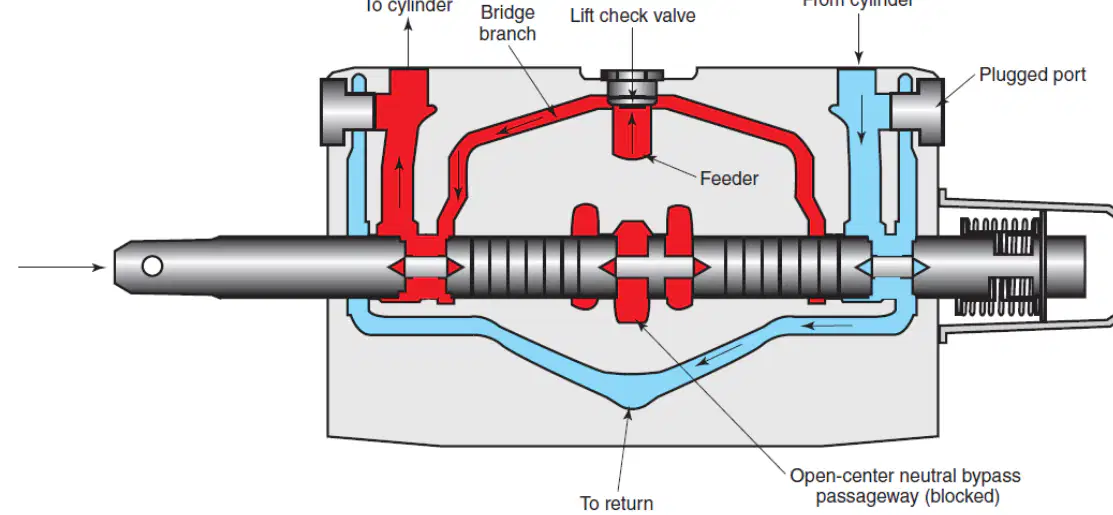
In the diagram of the Parallel Six-Way Open-Center DCV Operation (4 of 4), which component is responsible for allowing flow from the feeder to the cylinder?
Lift check valve
Pressure relief valve
Directional control spool
Return line filter
Which of the following is a disadvantage of open-center systems?
Hydraulic horsepower is maximized when actuator quits moving
Hydraulic horsepower is wasted when actuator quits moving or DCVs are in neutral
Hydraulic horsepower is always conserved
There is no inefficiency due to flow
Open-center systems provide good ________-control metering.
fine
rough
slow
random
Open-center systems are less sensitive to ________.
contamination
pressure changes
temperature
vibration
Open-center systems simplify oil ________ and filtration.
cooling
heating
pressurization
distribution
One advantage of open-center systems is that there is no ________ signal network.
complex
simple
hydraulic
electrical
Open-center systems result in less ________ generation.
heat
pressure
noise
vibration

